South Cambridgeshire District Emergency Centre is located in a converted basement at the Council Offices at the junction of Hills Road and Harvey Road, Cambridge.
The bunker was completed in 1986 with the help of a substantial Government grant which paid for the conversion of the semi sunken basement of Cambridgeshire House, a converted early 20th Century town house. The basement was completely stripped out with a new concrete roof being installed capable of withstanding the building above collapsing on top of it. Entrance is through a nondescript door at the rear of the building which gives access to a short flight of steps down to the main blast door made of steel and concrete. Once inside there is a small lobby area, a second blast door straight ahead leads into the bunker proper with a third blast door on the left which gives access to the standby generator (a Petter) and the boiler.
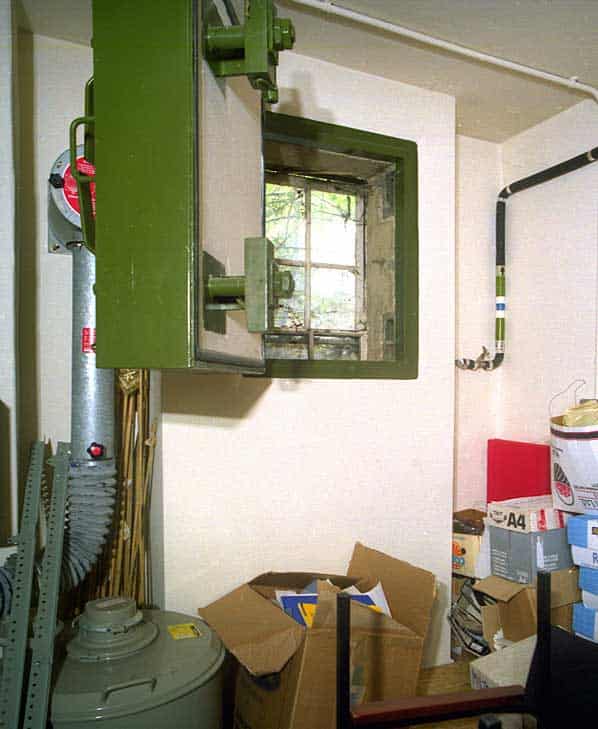
Passing through the second blast door leads straight into the kitchen which still retains it’s work surface, sink and pumped water supply. Left out of the kitchen leads past two empty toilet cubicles (the two chemical toilets are stored in another room) into the District Controllers Room. The room contains half the filtration plant) It is unclear why this has been split between two rooms), a wash basin with a pumped water supply and three feet up the far wall a small blast door which is the emergency exit.
The emergency exit has been constructed by casting a thick concrete pillar in front of the original basement window. The blast door is set into the pillar and immediately beyond the pillar the original wooden window frame and glass is still in place - a most unusual arrangement.
Opposite the kitchen is a small tank and ventilation plant room and to the right is the Operations Room which contains nothing original apart from the other piece of filtration plant and three maps on three walls. These show emergency feeding centres, power distribution lines and parish and district boundaries. Two further rooms are accessed from the control room. The Scientific Advisors Room is to one side, this still has a long 1" Ordnance Survey map of South Cambridgeshire; marked with parish contacts and UKWMO (ROC) observation posts.
The final room, on the opposite side of the control room, is the Communications Room which contains an SX50 ECN unit, a number of radio transceivers that belong to Raynet and the councils own communications system.
Although the bunker still contains much of it’s communications equipment it has not been used operationally since 1996 and is now used purely for storage leaving little room to move about. The site is due to be sold for redevelopment later this year when the Council move to new premises so the future for the bunker looks bleak.
Thanks to Keith Ward for arranging the visit and South Cambridgeshire EPO Tony Lendley for taking the time to show us round. Those present were Nick Catford, Keith Ward, Richard Challis and Wayne Cocroft.