The Cambridge war room was rebuilt in 1963 and the extension was to form one of 3 purpose built central command Armed Forces HQ’s (AFHQ). The plan was later dropped (1965). Cambridge was undergoing a refit in late 1990/1 as it was planned to use it as a sub control for Bawburgh which was the main RGHQ. It had previously been used as a COMCEN during the Gulf War.
SITE VISIT
On Thursday 15th March five members of Subterranea Britannica visited the Cambridge Regional War Room / RSG 4.
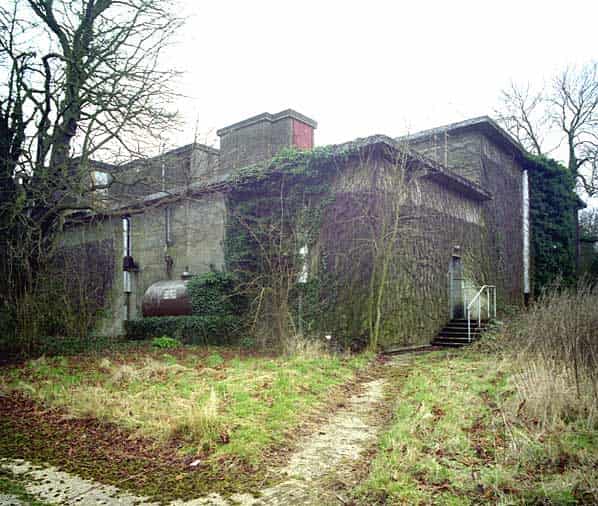
The two storey blockhouse is located in its own very secure compound at the rear of the Government offices site in Brooklands Avenue on the outskirts of Cambridge. It is surrounded by a 10ft high fence topped with barbed wire. This bunker was originally built as a regional war room identical to the one at Shirley in Birmingham but had an extension added to it later when it became RSG4.
The compound is 100yds by 40yds in size and is in one corner of the Government (MAFF) site. The building is currently the subject of an attempt to have it listed as it has a number of unique features and was 1 of only 2 purpose built RSG’s. (That at Nottingham differs as the extension was built on top of the existing war room) The site is to be sold for housing and MAFF have left it up to the developers to negotiate with English Heritage. If the listing application fails, the building will be demolished.
The outside of the building has some unique pebble dash panels which were put on to the structure in an attempt to make it blend in with the surrounds.
Entering the compound via the double gates we turn right and approach the blast door and enter the bunker. On the left inside the dog leg entrance are the showers, toilets and decontamination area complete with all their original 1950’s fittings (hot water tank, shower curtains and curtains on the toilet cubicles instead of doors). Moving straight ahead you enter one of the 2 plant rooms from the corridor that circles the lower level. This is still in perfect order with all items intact including an electrical control cabinet and a battery rack for starting the standby generator which is housed in a separate small room. Beyond the generator along a short corridor within the plant room, the ventilatiuon and filtration plant is also in good order.
The first half of the bunker is identical to other regional war rooms but is totally empty apart from a few filing cabinets (empty) and a large number of chairs. It is set out on 2 floors, both above ground and internally it is in excellent condition with no vandalism or evidence of water problems. The balcony around the well has been floored over but on the lower floor the original curved perspex windows remain intact while on the upper floor new opening windows have been installed looking onto what would have been the balcony.
The newer section of the bunker is accessed by walking along one side of the corridor past a second toilet area (one male, one female) and down a couple of steps through what was the original emergency exit to the war room. This brings you out at the end of a long corridor in the later extension. At the very far end is one of two emergency escape doors protected by a dog leg entrance lobby.
Along this corridor there are a number of rooms on each side but mid way down on the left is a very extensive, plant room containing a large standby generator (with only a few hours use on the clock) and a substantial amount of air filtration equipment. Also in this room is the boiler for heating and hot water. This room is in excellent condition and in the middle of the plant is the power distribution board. The next room on the left houses the battery starter for the generator and the emergency battery back up for powering the bunker which was almost identical to the ones installed at the bunker beneath Eton College and the Southern Water bunker at Brede in Sussex. A corridor runs round three sides of the lower level with the second emergency exit on the far side of the building where one of two stairways leads to the upper floor.
Almost opposite the plant room is a corridor and a flight of steps going up and down. Going down leads you to the oil tanks whilst going up leads to further rooms including several male and female dormitories, and a combined canteen and kitchen. Some of the kitchen appliances remain together with a long serving counter. Again all rooms in this section of the bunker are empty although there are signs on the doors as to the function of each room. The rooms themselves still have the partitioning in them that would have divided up the working area into many small rooms for the various agencies. There are extensive asbestos warning signs in the new section of the bunker as there are a large number of asbestos panels on the room walls.
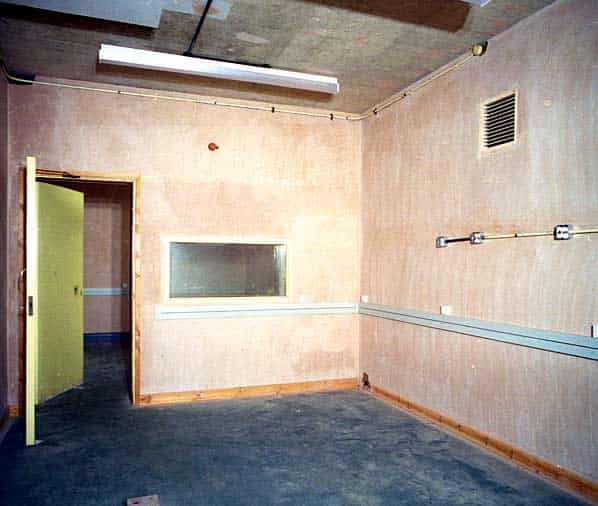
The bunker itself was part way through a re-wire when instructions were given to stop (1991) and there are a number of cables etc. dangling from wall junction boxes and light fittings in one of the lower corridors giving the place a semi finished feel.
The BBC studio and office, at the end of this corridor appears freshly plastered and the power sockets were never fitted into the wall trunking but acoustic panels were fitted to the walls. It was very much the case of a half finished Marie Celeste! In the centre of the lower floor is a large ‘L’ shaped room with four small offices along one side and a large number of chairs.
The upper floor of the bunker shows some signs of water ingress in a couple of the rooms. Outside the compound is overgrown and has a number of trees in it.
The Govt buildings complex that the bunker is sited on has 24hr security and the compound which the bunker sits in is securely locked. The whole site is not open to the general public, only to those with official business with the Government departments based there. Unauthorised visitors are not welcome. It can however be viewed through bushes from a public footpath on the far side of a small river that runs along one side of the compound.