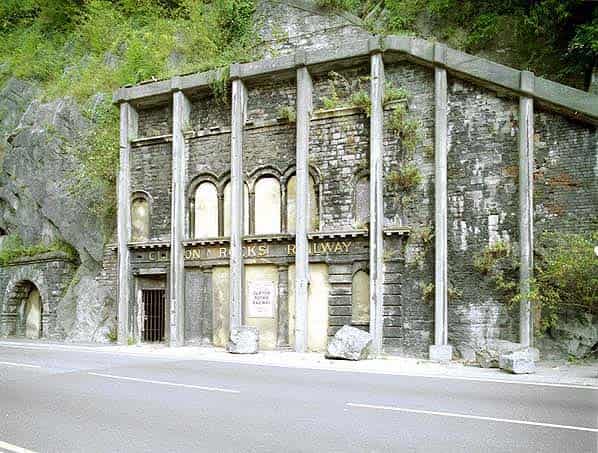
Most of us pass by the Clifton Rocks Railway without even knowing it is there. Constructed with great difficulty inside the cliffs of the Avon Gorge in order to reduce its visual impact on the picturesque surroundings, this funicular railway operated for 40 years against diminishing trade. Its closure before WWII did not mark the end of its useful life as it became a secret transmission base for the BBC. Now a disused shell, with access so difficult that any potential scheme to revitalise it would be so expensive as to be unprofitable, this wonderful relic of a bygone era will probably remain undeveloped. Many people remark upon the strange ‘house - like’ facade set into the cliff which can be seen from a motor car as one travels from the Cumberland Basin area towards Bridge Valley Road on the right hand side before passing below the Suspension Bridge. This facade is the lower station entrance of the Clifton Rocks Railway.
Behind the entrance is a tunnel cut through the rock which extends at a steep angle to emerge in the now derelict small triangle of ground between the junction of Princes Lane and Sion Hill, adjacent to the Avon Gorge Hotel. Within this triangle of ground is the upper Station which has long since fallen into a state of disrepair. The tunnel itself forms a straight and direct connection between the upper and lower stations. A Description Of The Original Railway. The tunnel is 500 feet long, semi elliptical in cross section with a roof height of 18 feet and a width of 27 feet 6 inches it climbs a vertical distance of 240 feet on a rising gradient of about 1:2.2, that is a vertical rise of 1 foot for every 2.2 feet of forward travel. The tunnel was blasted and cut through badly faulted limestone and was brick lined in almost its entirety with a wall thickness of 2 feet.
Although the tunnel was lit by daylight at both top and bottom, this was supplemented by gas lamps installed down the tunnel length. From the surface, the upper station appears to be a small single storey building, triangular in plan, with a facade of ashlar bath stone faced masonry construction facing Princes Lane and the Avon Gorge. The Sion Hill elevation consisted of iron railings between masonry piers: the railings are now covered with sheets of boarding. There are two entrances to the upper station, one at the junction of Princes Lane and Sion Hill, the other onto Sion Hill itself. The Sion Hill entrance had an ornamental iron arch over. A visitor would descend down steps from either entrance to the top station into a small platform which was below upper street level. In fact the platform extends under the pavement in Sion Hill, and a series of small arched roof vaults between the rock face and a substantial steel beam, itself supported on cast iron columns, support the pavement of the street above. The remainder of the 15 feet wide platform which is not recessed under the pavement was covered with an awning of small glass panels set in iron frames (pavement lights) forming a floor on which sightseers could stand and take in the view, or watch the cars ascending and descending the tunnel. Most of these glass panels are still in place, but the grid of supporting steelwork in which they are mounted is in poor condition. At the head of the tunnel was a timber screen, pay box and turnstiles, together with the two large pulley wheels described later.
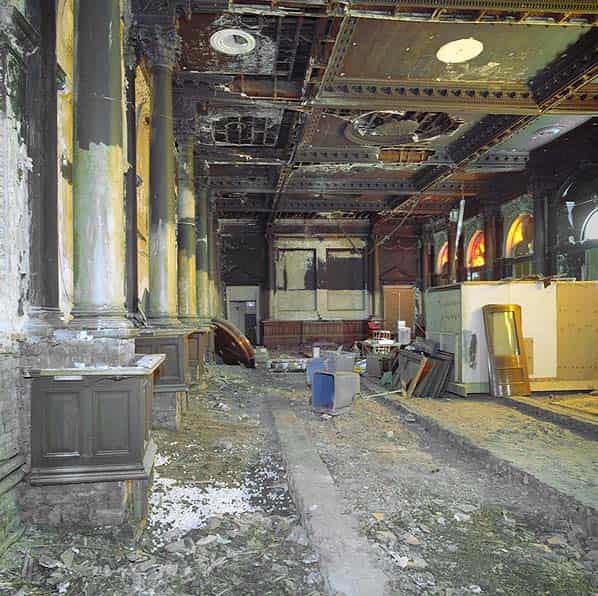
The lower station itself is constructed inside the rock, and was finished with the facade erected flush with the rock face. This facade was of rubble construction using grey pennant stone, locally mined and used extensively in the less expensive houses being built in Bristol in the 1800’s. Quoins and architraves were of bath stone with three decorative gargoyles above the three entrance arches, the two windows, one on either side remaining undecorated. A verandah was originally incorporated but was later removed, the six smaller arches of the upper floor being retained as picture windows giving a superb view across the river, with a tiled timber canopy above to provide shade. The building behind this facade was of two storeys and the ground floor consisted of two rooms. One contained the turnstiles and pay box (now removed) set in a floor of red 6 inch tiles. The walls of this room were lined from floor to ceiling with vertical pine matchboarding. The other room was undecorated and contained the pumping machinery. On the second floor was situated a small toilet installed in September, 1894 and some staff facilities. A later addition above the entrance portals were three bath stone lintels with the legend ‘Clifton Rocks Railway’ carved in stone.
From the day that it opened the line was operated by four cars. Each car consisted of an upper passenger section, with a triangular chassis angled to suit the gradient of the tunnel. The upper passenger section resembled in appearence the horse-drawn tramcars to be found operating during the 1890s on the City tramway, and are believed to have been constructed in Birmingham by Starbruck who built tramcars for the City. Each car could accommodate 18 seated passengers and had sliding doors at either end, the door at the end facing the river opening onto a small platform on which the ‘brakesman’ or attendant rode alongside the brake control. Cars were painted light blue and white with gold lining when new, but were later re-painted in colours similar to the Bristol Tramway Company. The cars were mounted by four leaf springs onto the chassis which were built by Messrs Gimsons of Leicester. These four chassis were part of a batch of six ordered on 7 March 1892 and delivered in December, 1892. The balance of the order was for the Bridgenorth/Castle-Hill Railway, those for the Clifton Rocks being designated by a C prefix on the detail drawing. The Bridgenorth equipment had a wider guage at 3 ft 8 ins. The chassis were constructed of 8 in by 3 in steel channel section 14 ft 6 in long, carried on four wheels. The only item not manufactured at Leicester within the chassis were the axles which were supplied by J.H. Lloyd and Co. The axles ran in brass bearings fitted onto cast iron housings bolted onto the top side of the bottom chassis member. The cars were handed left and right.
Cars ran in pairs on adjacent tracks of 75-80 lbs/yd flat bottom rail. These rails were bolted directly onto concrete cross sleepers the width of the tunnel at 5 feet spacing firmly bedded in the rock bed of the tunnel, The gauge of the railway was 3 feet and each pair of tracks either side of the tunnel were at 5 feet 6 inch centres.
Each pair of carriages was connected together via two steel wire cables ‘being 30 times stronger than the load that has to be put upon them’ which turned around large pulley wheels at the top of the tunnel. The principle behind the operation of the cars is known as ‘water balance’. As one car ran down its rail its companion car would be pulled up, the weight of the water plus passengers in the descending car overbalancing the weight of the passengers in the ascending car. Mounted in the frames beneath each passenger section was a tank of 12 gauge steel bolted on 3 inch x 1.5 inch rolled steel joists and fitted with a lid of 18 gauge steel. At the beginning of a journey, releasing the brakes on both cars allowed the top car to descend, pulling the bottom car up in doing so. Equipped with all “mod cons”, an electric telegraph manufactured by King, Mendham & Co. of Bristol, permitted the brakesman of the car at the bottom to inform his opposite number in the car at the top of the number of passengers to be raised. By this means, the correct weight of water required to balance the load could be added to the top car. If the ascending car was empty, then the weight of passengers in the descending car (if full) was sufficient to activate the system without the water tank being filled. Upon completion of the journey and whilst the passengers disembarked, water in the tank of the car at the base of the incline was automatically emptied into a sump before being pumped back up to a reservoir at the head of the incline by duplicate sets of pumps powered by self starting “Otto cycle” gas engines manufactured by Crossley of Manchester. The water which was employed to operate the line was therefore used over and over again, the cost of the motive power for working that required to drive the gas engines for pumping the water.
The design of the system showed a great concern for safety: some might describe the design as ‘belt, braces, piece of string and the Royal Air Force’. This is amply demonstrated in the superb braking systems which were arranged ‘such as to satisfy the requirements of the most nervous of passengers’. Duplicate brakes were incorporated, operated by hydraulic pressure and acting on both sides of the rails of the line. Another set of duplicate brakes were incorporated for arresting the speed should the cars for any undue cause exceed their proper pace and a third set of duplicate brakes were also incorporated for automatically stopping the cars should either of the other two systems fail, or should the two steel ropes break at the same time.
The hydraulic brakes acting upon the rails were the ones controlled by the brakesmen. They were designed such that the brakesmen had to give their attention to prevent the car from stopping, rather than trying to make the car stop. Thus, should one brakesman become careless or lose his hold of the brake windlass handle, both of the cars would immediately stop, even though the brakesman upon one of them might be unaware of the problems which had befallen his companion, The hydraulic brake mechanism consisted of hydraulic rams acting into cast iron blocks which gripped the rails in a ‘calliper’ action. The rams were connected by copper tubes to much larger master cylinders, the hydraulic fluid being water. Pressure on the system was applied by heavy weights acting on the top of pistons in the master cylinders. The weights were directly connected to the conductor’s windlass hand wheel. The act of turning the windlass hand wheel would raise the weight from the top of the master cylinder reducing the pressure in the system and hence the grip of the cast iron blocks on the rails. Should either conductor release his hold on the handle for any reason, the weights would automatically drop back under gravity, increasing the pressure in the system, applying the brakes and bringing both cars to a halt.
The speed-governing brake acted independently of the controlling brake to cause the hydraulic pressure to be increased and the rails to be gripped should the recommended speed be exceeded. How it worked is not clear, but from the general specification it appears to have been operated by means of an eccentric on the lower axle. The third system of brakes which would operate in the event of a cable failure was completely automatic. It consisted of two large cast iron wedges with serrated faces mounted inside either rail, both of which were pivoted on a heavy steel cross member. Both ends of the cross member enclosed the rails. The free ends of the arms were attached to the two cables, and a large coil spring was incorporated held under compression by the tension in the ropes. In the event of a cable failure, the load on the spring would be released and the spring would pivot the arm jamming the wedge between rail and cross member. Deflection of the rail was prevented by the outer ends of the cross member. Thus the design incorporated fail-safe systems which were made simple and which were also duplicated throughout the assembly: a very reliable design concept.
At the time of construction, the tunnel was the widest of its kind in the World. Being brick lined, the timbering necessary to provide temporary support during construction was built in above the bricks, which incidentally were set in cement. Construction of the tunnel started from both ends and from intermediate shafts down its length. Steam power was used to provide compressed air for the rock drills for hauling away excavated rock, and was the power for the pumps used in draining the workings from the ever present seepage of surface water. Considerable difficulties were encountered with the tunnelling due to the faulting in the limestone, and rock falls (both inside and outside of the tunnel) were a constant source of worry and delay. Even as late as six weeks before the opening, a rock fall of some 20 tons down the outside of the rock face on the 31st of January, 1893 demolished a portion of the miniature wooden verandah which formed part of the design for the bottom entrance to the railway, just missing a City bound horse-tram that was passing. Apart from the looseness of the rock causing problems in the construction, the limestone in some cases was found to be so conglomerated with other metalliferous rock ‘as to break the drills and turn the edges of the tools that were used for boring’.
The scaffolding of the tunnel was a matter of great difficulty to the contractor, and the greatest caution was necessary when erecting the complicated centre pieces and when placing in position the immense amount of timber required as struts for the roof and sides of the cutting. On account of the steep incline, it was impossible to arrange gangs of men to work one above the other simultaneously, and it was very difficult to provide for the dislodging of the material above without choking the entrance below. Intermediate shafts were used to remove dislodged rock via winding engines and machinery erected above the ground. Men were brought from Canada to operate the pneumatic machines as suitably skilled labour was not available in Britain. There was considerable difficulty in keeping the men at work for more than a few weeks at a time, various accidents causing them to become nervous. The work originally scheduled to be completed in 12 months, actually took two years to finish, but great celebration occurred when H. C. Hayes, the Contractor’s 10 year old son, squeezed through the hole when the two headings joined and found the shafts lined up perfectly. Construction costs had been anticipated at £10,000, but in fact with all the problems, costs rose to over £30,000.
Timetable of Operation
The following is a timetable of operations dated January, 1922, which was almost identical with that of the first week of operations:
1 June - 30 Sept Weekdays 8.30 am - 10.00 pm & Sundays 2.30 pm-10.00pm 1 October - 31 May Weekdays 8.30 am - 9.00 pm & Sundays 2.30 pm- 9.00 pm
By September, 1928 the timetable had become:
All year round Weekdays 8.45 am - 9.15 pm & Sundays 2.30pm- 9.l5pm
In the mid to late 19th Century, Clifton, Bristol and Hotwells, were considered as separate. Clifton was a posh area. Hotwells, no longer a spa attraction was very down market, the River Avon a stinking open sewer, and the inhabitants including a substantial number of lower class drunken mariners due to the abundance of ships in the harbour. The residents of Clifton really did not particularly want ready access to their domain made available to the surrounding population. For some time they even resisted having trams use their streets. This then was the back drop to the conception of the Clifton Rocks Railway. The only way to get from Hotwells to Clifton was via a variety of steep hills, such as the zig zag path which remains with us today, or Granby Hill. Thus the Clifton Rocks Railway owed its existence to the self imposed isolation of the elegant and fashionable residential area of Clifton from the developing public transport system of the City of Bristol.
Historical Diary
23rd July 1880. Mr George White, founder of the Bristol Tramway Company and later founder of the Bristol Aeroplane Company made an alternative proposal for an inclined railway fom the north end of the Suspension Bridge down the face of the Avon Gorge to Hotwells. Here a connection would be made with the City Tramway, with the Hotwells terminus of the Bristol Port & Pier Railway and its services to Beach and other suburbs of Bristol, and with the Hotwells landing stage from which P & A Campbells and others operated their pleasure steamers to the exotic charms of Ilfracombe and the South Wales ports. Such a project was rejected by the Society of Merchant Venturers, owners of the cliffs, probably because they thought it would be such an eyesore.
27 September, 1889. A similar application from a Mr Kincaid was also rejected by the Society of Merchant Venturers.
26 September, 1890. A proposal was placed before the Society from Mr George Newnes MP for an inclined lift from Hotwells Road to the garden of no. 14 Princes Buildings. Princes Buildings is the row of houses which now incorporates the Avon Gorge Hotel. This time the proposal was for a railway running not up the cliff face, but through the rock in a tunnel. The Society of Merchant Venturers, being prepared to consider this scheme, resolved to confer with Engineers.
The promoter, George Newnes, was a Member of Parliament for Newmarket. Cambridgeshire, from 1891 to 1895, founder of the Newnes Publishing Company and was created a Baronet in 1895. His country residence at Hollerday Hill, Lynton, Devon, brought him into contact with the Lynton/Lynmouth Cliff Railway, and a business association began between Mr Newnes and the eminent Engineer who was responsible for the Lynton/Lynmouth Cliff Railway and similar projects elsewhere, namely Mr G Croydon Marks AMICE, MIME. The Architects appointed for the project were Philip Monroe & Sons of Baldwin Street, Bristol and the Civil Engineering Contractor Messrs C A Hayes of Thomas Street, Bristol were employed to carry out the construction of the tunnel.
The Society of Merchant Venturers evidently were only prepared to consider the construction of the tunnel and railway, providing that Mr Newnes also tried to resurrect Clifton as a spa town by constructing a Hydropathic Institute (The Spa) adjacent to the proposed upper station. The total cost of the railway was estimated at £10,000 and Mr. Newnes was the sole financier for the venture.
31 October 1890. The Society of Merchant Venturers resolved to consent to the project on the following terms: (a)That rents would be raised. (b) That the works should be finished by January, 1893. (c) That no alteration should be made to the exterior elevations of the buildings to be constructed, and that they should be used for no other purposes than permitted at the Bath Pump Room. (d) No licence for liquor (e) That the road adjacent to Princes Buildings should not be obstructed (Princes Lane). (1) That no blasting should take place between 7.00 pm and 7.00 am.
7 March, 1891 Lady Wathen, Wife of the Lord Mayor, Sir Charles Wathen, fired the first shot for the tunnel excavation, an event that was accompanied by the usual luncheon and speeches. After a difficult and expensive construction operation which had not been anticipated, the railway was ready for opening considerably later than had at first been planned.
Early Operations
11 March, 1893 was the date of the official opening of the Clifton Rocks Railway. 6,220 people made the return journey and the promoters of the project must have felt greatly heartened by the way in which the public took to their development. In the opening period around 11,000 passengers per week were carried, 427,492 passengers in the first 12 months of operation. Unfortunately this was really the peak of operations for the railway and numbers subsequently declined steadily.
The ticket for the first travellers opening day was a commemorative gilded metal medallion in the shape of a Maltese cross having on one side a representation of one of the cars together with the initials of the promoter, engineer and architect. On the reverse was a commemorative inscription.
27 October, 1893 The Society of Merchant Venturers, being notified that the railway had been operating for six months, resolve that the Deeds be executed in favour of Mr Newnes for a period of 999 years, with a Covenant under which the lessee must maintain the tunnel in proper repair.
Spring 1894. Mr Newnes formed the Clifton Rocks Railway Co. Ltd to operate the line. Chairman of the Board was Mr Newnes himself with Mr Croydon Marks a Co-Director along with P. Fussell and A Yeatman (Company Secretary). Solicitors for the company were Osborne, Ward, Vassall & Co Bristol. To this company was leased the tunnel for an annual rental of £50 subject to covenants requiring the company to maintain the tunnel with the lines, stations, etc., fit for use as a railway tunnel.
1903 A dispute arose between the City of Bristol (Plaintiffs) and the Clifton Rocks Railway Co Ltd (Defendants). The City claimed that the Clifton Rocks Railway occupied land which was owned by the City. This was a small triangle of land which included The Hot Well pump within the same parcel and was situated at the lower station, on the side most remote from Cumberland Basin. The infringement of the tunnel on this piece of land was no more than 10 feet at the absolute maximum. The Clifton Rocks Railway Co. replied that they thought they owned the land, but the lost their case and had to pay a small sum to the City in compensation.
The Decline
1908 The steady decline of passengers took their toll and a receiver was appointed.
29 November, 1912. The railway’s assets were bought outright by the Bristol Tramway and Carriage Co, for the sum of £1,500.
5 July, 1913. The Royal Show was held on Durdham Downs and during a ‘flash in the pan’ surge of use, 14,500 people used the railway during the week prior to this date.
1922 The Portway road was widened. This involved the closure and demolition of the Bristol Port & Pier Railway from Sneyd Park junction up to and including the Hotwells terminus, which must have been a good connection for the Rocks Railway, being situated just a few hundred yards away, in the Avonmouth direction. A major road was now placed only inches from the bottom station which made access most difficult.
1 October, 1934. After continued deficits, the Clifton Rocks Railway finally closed, the four cars being lowered to the bottom station. 1937. Bristol Corporation received an interest in the tunnel via the Bristol Transport Act 1937.
Use of the Tunnel During the Second World War
At the outbreak of the Second World War the Ministry of Works and Buildings took a tenancy of the tunnel from the Tramways Company at a rent of £100 per annum subject to conditions which required the Office of Works to indemnify the Tramways Company against any breach of the covenants in the lease under which the Tramways Company held the property.
25 March, 1940. British Overseas Airways constructed an office suite and used part of the upper section of the tunnel for storage. Control of the tunnel came under the ARP (Air Raid Precaution) Committee which later became the Civil Defence Committee during the War, where they established shelter number 1898.
The BBC needed to keep broadcasting through the Second World War to try to distract an estimated audience of up to six million people away from the blatant propaganda of William Joyce, an American born, English educated fascist whose exaggerated upper class accent soon earned him the nickname ‘Lord Haw Haw.’ The Nazis had craftily set up what they called a ‘British Forces Service’ which had dance music interspersed with news. Military Chiefs who, prior to the War were demanding that the BBC be closed down if and when War broke out were beginning to see the sense in keeping the BBC on the air, and some sophisticated technical changes were made to prevent BBC transmitters becoming beacons which would guide enemy aircraft to their targets. The BBC had to face up to the fact that Broadcasting House might be badly damaged by bombs or even taken over by invading Nazis. They decided to set up an emergency headquarters in Bristol, capable of handling programme production if the need arose. Since however, this station too could have come under attack, the search began for bomb proof premises. The disused railway tunnel of the Bristol Port & Pier Railway was ear marked. Despite the emergency situation, in a true blue act of eccentricity, the BBC, incredibly, sent its symphony orchestra consisting of nearly 100 members, to play in the proposed tunnel under the baton of the famous Sir Adrian Boult, with a view to checking the acoustics. One can only presume that the BBC wanted to ensure that even if Britain was about to be completely and utterly destroyed, radio listeners should not be denied broadcasted symphony concerts of the highest quality whilst the bombs dropped around them. The maestro reported favourably. Unfortunately the delay incurred in adopting these procedures had upset the BBC’s plans. The Director General went in person to inspect the tunnel, but the Nazi Air Force beat him to it and after a series of heavy raids, local people were occupying the tunnel for shelter. The Director General took a typically British view and at once decided that it would be impossible now to occupy the tunnel. The BBC had already considered the use of the Rocks Railway Tunnel but had rejected it due to the anticipated difficulties of coping with the steep incline. Circumstances now dictated that they should construct their alternative base here.
July 1941. The BBC intended erecting structures in the tunnel which would constitute a breach of covenant. A Clerk to Bristol City Council opened negotiations with all interested parties with a view to vesting in the Bristol Corporation 999 leasehold title free from all covenants which would prevent the use of a tunnel for other purposes. At this stage the structures which had already been erected in the tunnel by the Ministry of Works constituted a breach of covenant.
The result of negotiations was that the Tramway Co assigned their leasehold interest to the Bristol Corporation free of charge. The Society of Merchant Venturers released their right to enforce the covenants as to keeping the tunnel for railway purposes also free of charge. However, the Society still required that the entrances to the upper and lower stations should be kept in good repair, the Ministry having sole use of the upper entrance for which they were solely liable for keeping in repair. The BBC and Bristol Corporation were jointly liable for the bottom entrance. The Grand Hotel Company who by then held the original lease to Mr Newnes, and who were entitled to the rent of £50 per annum payable by the Tramway Company, were only prepared to sell their interest and release the covenants. Their asking price of £1,500 was met by contributions from the Ministry of Works and Buildings of £800, the BBC £400, and the balance of £300 coming from the City Corporation. The Grand Hotel Company continued to impose covenants covering nuisance, interference or damage to the amenities of the Hotel, and their title to the land at either station. Upon completion of the transfers to the Bristol Corporation, a lease was granted to the BBC for a period of 21 years at a nominal rent of 1 shilling for the bottom portion of the tunnel, and part of the bottom station, free from any liability to reinstate the tunnel at the end of the tenancy.
24 February 1941 Work proceeded on the BBC installation alongside the negotiations.
28 February 1941 The four carriages were removed from the tunnel, this part of the conversion being subcontracted to the Bristol Tramway Co. Within three months there had been constructed within the tunnel four large chambers, one above the other, with three smaller chambers being provided at ground level. The total cost of the conversion was about £10,000, of which £6,000 could be attributed to construction work.
Description of the BBC Installation
Top Room: Transmitters Various transmitters were incorporated in this room. One served Bristol with programmes whilst two others were set up to keep the station in touch with the outside World in an extreme emergency. The largest transmitter was an American RCA ‘H’ group transmitter operating on 203.5 m and broadcasting the home service. This had been brought over from America on lend lease in the early days of the War. The other two consisted of a Harvey McNamara shortwave set, and an ex RAF medium wave transmitter for restoring communication between the other main provincial and metropolitan broadcasting stations should the Post Office telephone lines be damaged by enemy action.
Second Chamber Down: Studio This was equipped with piano, gramophone and other facilities for musical, dramatic or school’s programmes and could take a cast of 10-15 actors. Poor acoustics were accommodated by installing heavy carpets and providing strategically placed quilting on the walls. Small scale musical, dramatic or feature programmes could be produced in this room
The Third Chamber Down: Recording Room This room contained a Philips-Miller record and replay machine which used gelatine coated celluloid film 7mm wide, onto which recordings were cut with a sapphire stylus. Also within this room were sufficient programmes for many weeks of broadcasting.
Fourth Chamber Down: Control Room Here the BBC Engineers surpassed themselves in compressing an enormous amount of equipment into a very small space. The room incorporated switching gear for no fewer than 80 land lines leading to outside stations. The Post Office routed these in various formations to minimise the risk of a single bomb damaging all in one go.
The Three Smaller Rooms at Lower Ground Floor Level: These rooms held emergency diesel generators, a special forced ventilation plant in which full precautions were taken against gas attacks, and a canteen containing sufficient food and water for several weeks.
Exterior: An aerial was strung from the tunnel head to the Grand Spa Hotel. At the lower level station the main entrances and windows were blocked, and ventilation ducts were installed externally.
Throughout the war the Control Room was manned day and night, transferring countless thousands of programmes in many different languages to various transmitters. However, the emergency studio never had to be used. Just in case, whenever the bombs began to fall on Bristol during the War, key programme staff used to pile into an armoured Dodge Shooting Break car and make a dash to the tunnel where they would stand by to go on the air if required. Thankfully, the main studios at BBC Bristol were never silenced, but the usefulness of the Control Room alone fully justified the work which had gone into the conversion of the railway tunnel.
After the War
30 July, 1946. The War was over and the BBC had reviewed its transmitter and studio capacity, and was ready to terminate its tenancy and remove all of it’s equipment, except for the heating lighting and ventilation plant. The ventilation plant had cost £1,600 to install and would cost £104 to remove. The Bristol Corporation were prepared to purchase all this plant for the sum of £5 in exchange for no claim being made for reinstatement in respect of the premises. Ideas had been mooted to retain the station as a museum piece.
28 August 1946. International trouble arose over the use of the 514 m waveband, and to comply meant reducing power on all main transmitters, and boosting the signal using local transmitters. Thus the Bristol transmitter was retained as a local booster station.
October 1946. The Ministry of Works' lease was surrendered.
1955 The tunnel was becoming a drain on the BBC’s operating costs, the annual rates alone being £549. A new lease was therefore negotiated by the BBC for accommodation in the upper part of the tunnel, incorporating the landing or upper platform at the head of the tunnel, together with a right of access through the entrance on Sion Hill, adjoining the Hotel, and together with the right to place and maintain a 40 foot aerial mast and hut above the premises, the mast to be stayed at three points. The BBC took on this lease for ten years at a rental of £10 per annum exclusive of rates, whilst the original lease for the bottom section was surrendered at the same time. This turned out to be a timely withdrawal from the bottom section as defects were about to be found at the base of the construction.
1956 Cracks were noticed between the masonry of the lower station facade and the face of the limestone cliffs. Further inspection showed that a crack some 4 inches wide had also opened up in the brick lining to the tunnel immediately behind the facade. Tubular steel scaffolding was used to shore up the facade and the slope behind the facade was cleared of loose rock and earth and a total of some 1,000 cubic yards of material was removed. The dense growth of vegetation on the cliff path steps behind the portal was also cleared. The facade of the railway changed in appearance at this stage, with a considerable quantity of the high level side masonry being removed.
August 1957. A W Skempton DSC MICE, and D I Henkel PhD AIvIICE, eminent Engineers specialising in soil mechanics were employed by the Bristol City Engineer to give advice on the measures that should be taken to ensure the stability of the tunnel facade and the cliffs at this point in the Avon Gorge.
Many of the walls built to retain the earth of the terraces over the Rocks Railway tunnel showed signs of movement These walls had been constructed before the tunnel had been built and cracks now were particularly marked where walls crossed the line of the tunnel. To obtain information about the site, boreholes were sunk. The boreholes confirmed that a layer of clay about 5 feet thick was sandwiched between layers of limestone rock, the strata dipping steeply downwards towards the Cumberland Basin. The boreholes would not hold water and it was concluded that the tunnel was acting as a drain removing water which was collecting above the clay layer. A considerable area of the tunnel was very wet.
January 1958. It was recommended that a series of tied buttresses be constructed along the face of the tunnel in Hotwell Road. These buttresses were constructed from rolled steel sections encased in concrete and the whole assembly was anchored to the cliff using rock inclined anchors connecting the top of the assembly down into the rock behind. Additionally, a series of drainage boreholes were specified through the clay layer above the tunnel, to be backfilled with gravel to ensure drainage of the upper limestone rock in the area of potential instability.
24 March 1960. With changes brought about by advances in technology, the radio station became redundant and the BBC’s lease determined.
Since 1960. The Pump Room was used from time to time as a store, but except for the passage of telephone cables, no permanent use has yet been found for the tunnel and stations.
Present Status
The top station is in poor condition with the original station layout disturbed by the subsequent modifications which have been introduced. A false roof of fibreboard covered with asphalt has collapsed into the station leaving a skeletal timber framework.
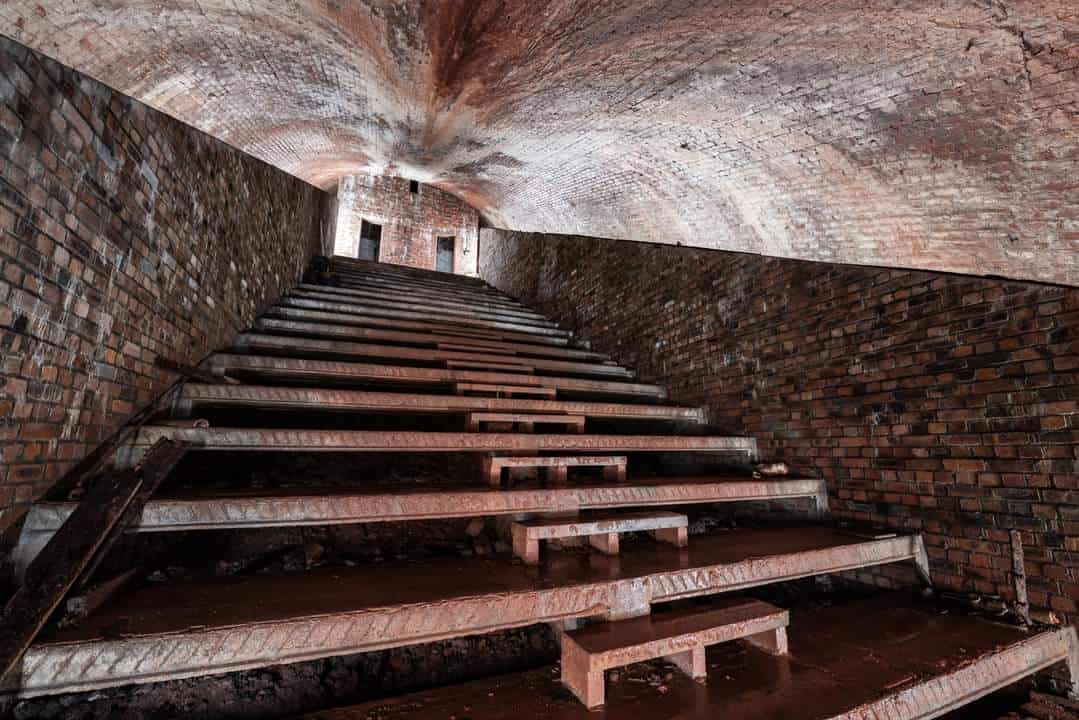
The tunnel itself is wet in places due to seepage, but the majority of the brick lining is in good condition considering its age. The track bed has been almost entirely built over. Two staircases 4 feet 6 inches wide have been constructed against either side rail of the tunnel from top to bottom. Both staircases have treads constructed from precast concrete units. The centre channel between the two staircases is separated from them by solid brick walls. There are also a number of cross walls dividing up the centre channel into compartments. In the upper parts of the tunnel these areas give the impression of steep narrow cinemas with tiered platforms rising up the slope of the tunnel between the two walls dividing the centre section from the staircases on either side. Further down, the BBC modifications are in poor condition, with most of the timber floors having disintegrated. It is estimated that in excess of 27,000 cubic feet of brick and concrete are now resident inside the tunnel.
The bottom station still contains the BBC’s ventilation plant and the configuration of the rooms is virtually as original. However, the arches that once led to the verandah have been bricked up save only for small openings at the top of each arch into which the open ends of the BBC air ducts once fitted. Unfortunately, the stabilisation work necessary to prevent further leaning of the facade towards the Portway has severely disfigured its elegant architecture.
Future Use
Many ideas have been forthcoming on the utilisation of this fascinating relic of yesteryear. In all cases, the costs of providing the necessary conversion work far outweigh the returns. There is perhaps something to commend the idea of leaving it alone so that it can remain virtually unnoticed except by the few who have discovered its charms. It seems that the tunnel is almost certain to remain, in economic terms, what it has always been: an eccentric, exciting white elephant