In the early 1950s, the government planned to protect essential communications by building a series of hardened underground telephone exchanges. These were designed to protect the chain of communications even if a Hiroshima sized atomic bomb destroyed the city above. Due to advances in weapons they were obsolete by the time they were complete, however they still played an important part in national communications. There are three known exchanges, London (Kingsway), Manchester (Guardian) and Birmingham (Anchor). There is rumour of a similar centre in Glasgow although there is no hard evidence to confirm this exists.
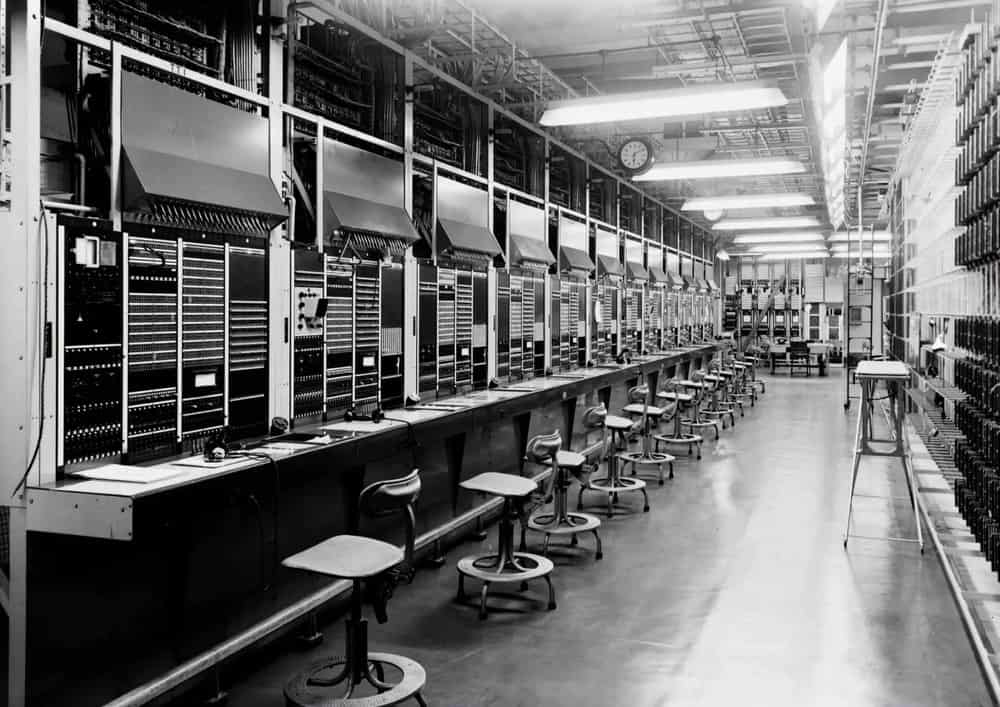
Anchor takes its name from the Birmingham assay office which is above the exchange, the mark for Birmingham being an anchor. It was the largest of the three underground exchanges packed with equipment handling 250,000 automatic calls a day.
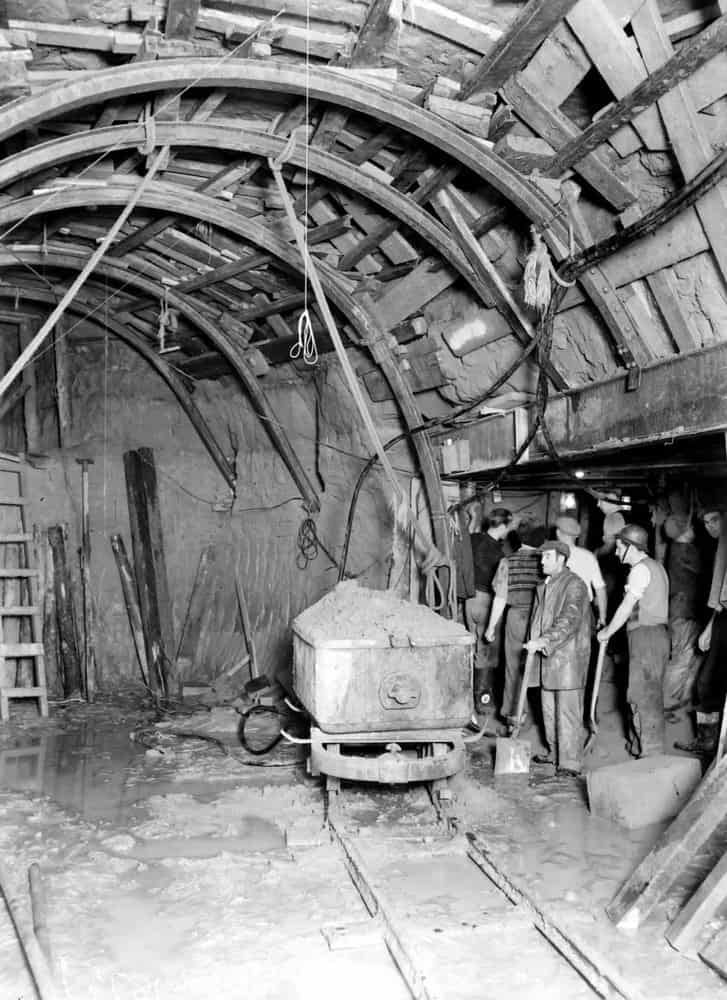
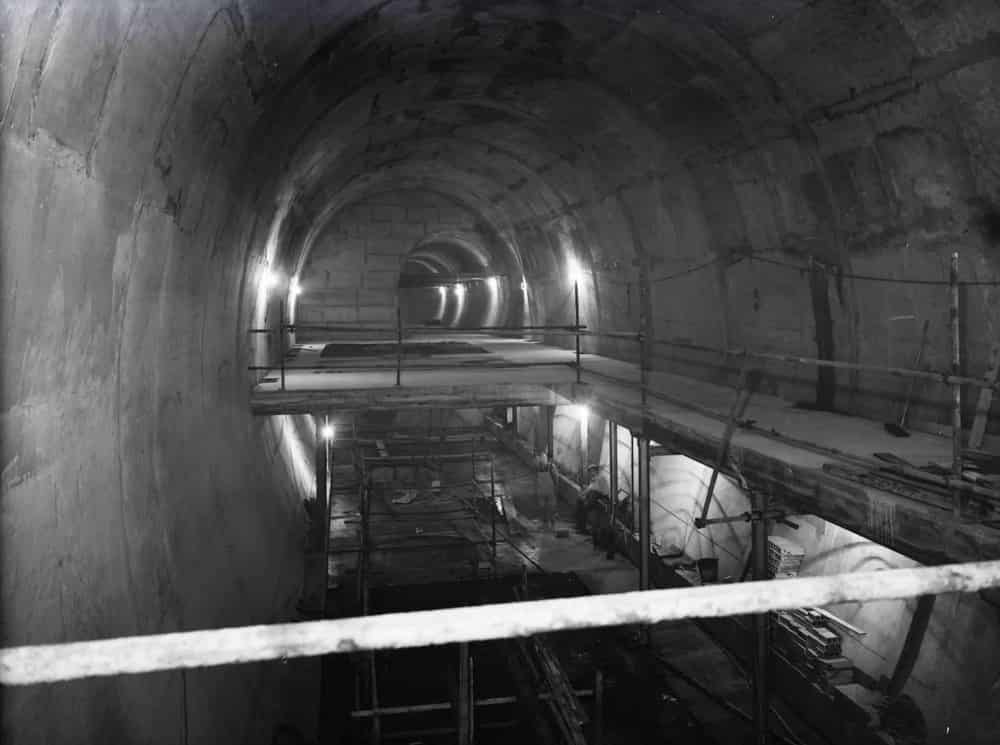
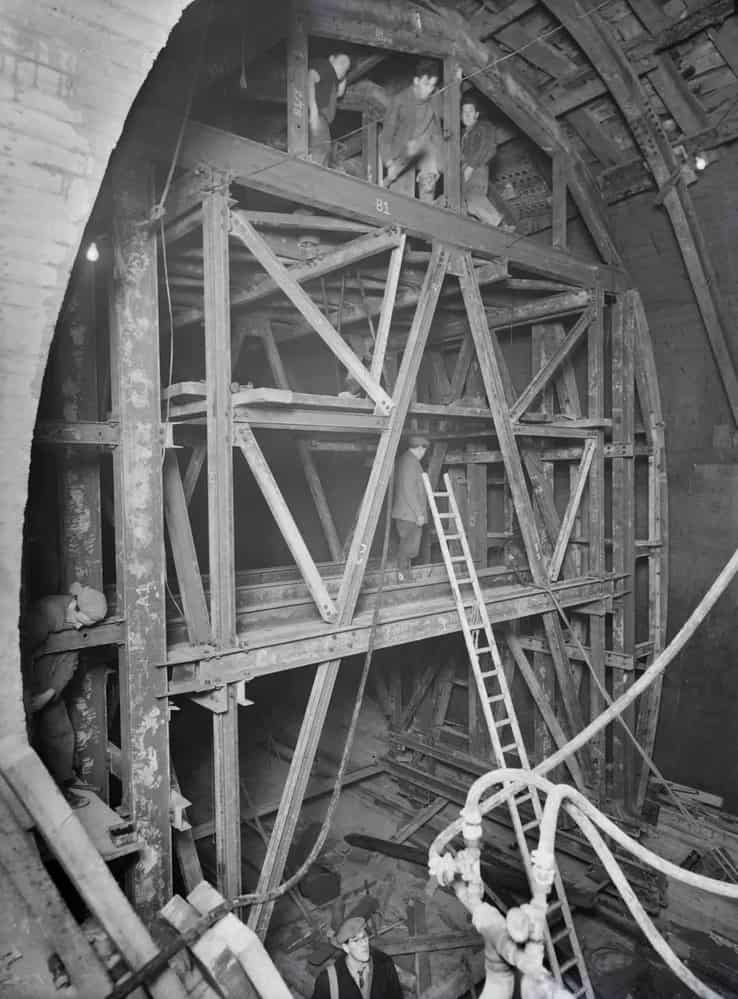
Construction of the new exchange started in 1953 with a cover story was that a new underground rail network was being built. Work progressed until 1956 when the public were told the project was no longer economic; instead Birmingham got its underpasses through the city to help relieve congestion. Nobody had realised that an underground exchange and tunnel system 100ft below Newhall Street had been completed at a cost £4m. Birmingham’s civil defence meeting records do not mention the exchange but that’s not surprising as local government wouldn’t have had a say in the matter.
The construction entrance was near Moor Street Station, where a slip road in the middle of the dual carriageway took a road down into the tunnel complex to get large construction equipment into the site. Once work had finished this entrance was sealed off and the public were able to use the slip road to reach Moor Street station on the other side of the dual carriageway. This former entrance no longer exists following the re-development in Digbeth. At the time a student working part time on the construction site told his story to a student union magazine but to this day the author of the article has protected his source.
Anchor Trunk Non-director Exchange officially opened on the 9th November 1957, opening in three stages. Stage one consisted of the outgoing circuits from Birmingham; this was complete by the 20th November. Stage two was present incoming routes including the zone centres; this was completed by the 30th. The final stage transferred all remaining incoming routes to the new exchange. Although Anchor was officially opened at this time engineers had been busy preparing for this moment for over a year installing £2m worth of equipment.
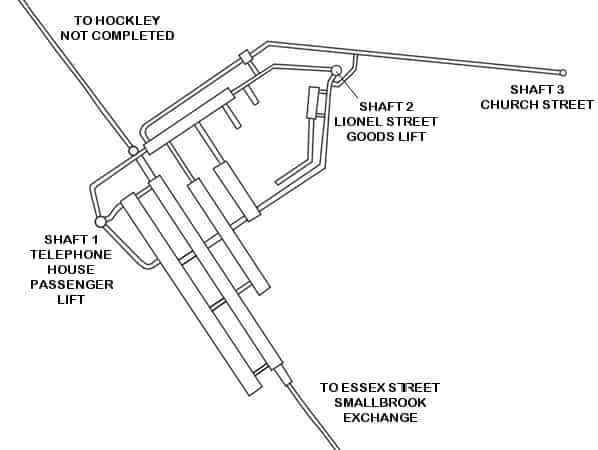
The main way into Bm/An (Anchor) was by lift at the rear of Telephone House. This was situated between Lionel Street and Fleet Street; there was a strict security check before entering the exchange. Another entrance was by a staircase across the road in Newhall Street. At the bottom of the lift there was a heavy blast door weighing about two tonnes, which could seal the entrance to the exchange if required. There was also a large concrete block that could be used to seal the ventilation shaft. Some of the tunnels also had airtight doors for added protection.
In 1956 there were about 100 engineers working in the tunnel complex and this didn’t include private contractors who were responsible for some jobs. Everyone was issued with small pencil torches as the power would regularly fail. The engineers worked in teams of two on a 24 hour shift system operating in the exchange, this consisted of Auto Maintenance, Carrier Maintenance, Trunk Test and Power Maintenance. There was strict no smoking rules with staff only being allowed to smoke in the mess room. The fire officer is reported to have said that if a serious fire were to break out in the exchange the people down there would only have about 30 seconds to live.
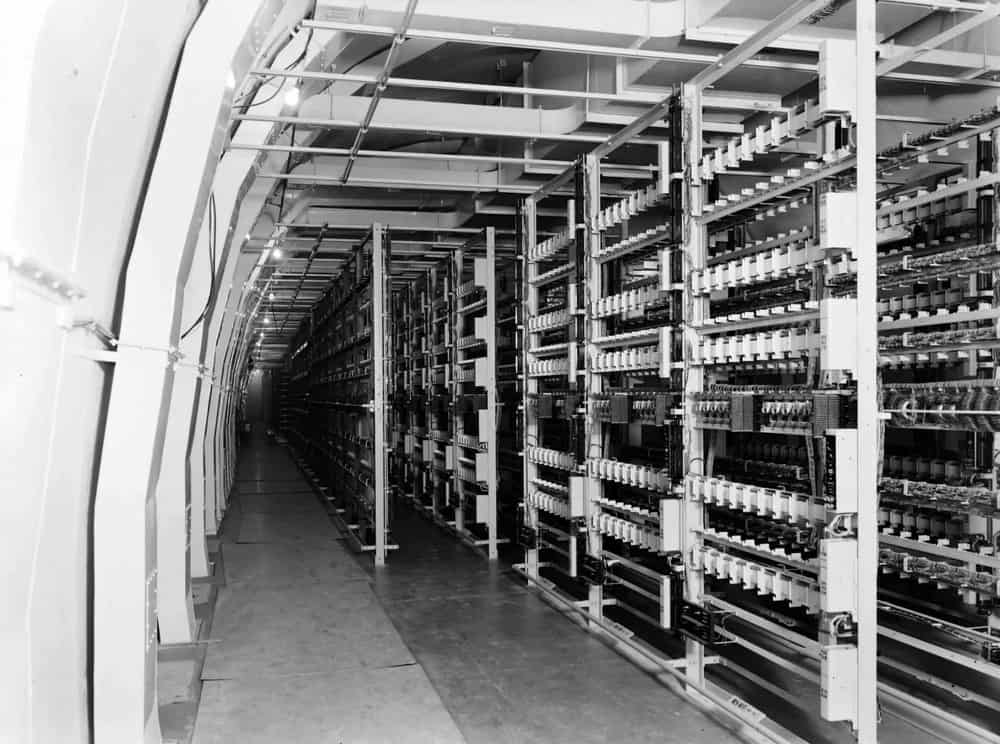
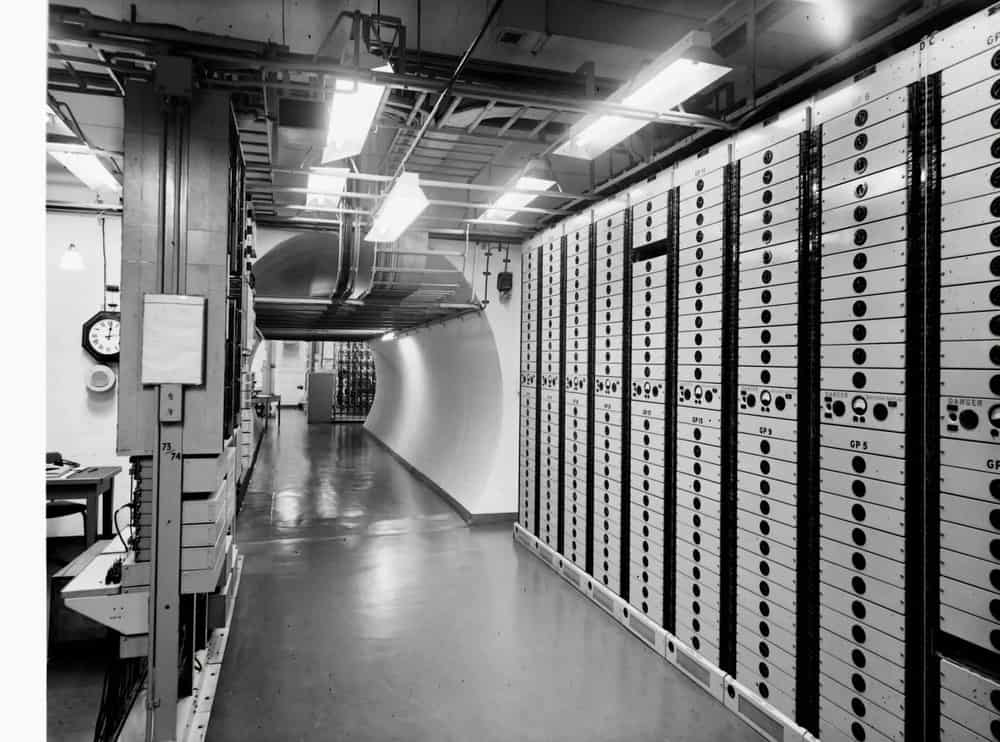
Engineers worked for 15 months preparing the MRDF (Main Repeater Distribution Frame) All the repeater station equipment on the speech band (50hz - 3400hz) terminated on this frame where the jumpering took place. There were also various copper cables (max 1000 pairs) going out to the repeater stations. These cables going out to Bm/C (Selly Oak), Bm/D (Lyndon Green), Bm/H (Queslett) repeaters with loaded cables designed to reduce the attenuation loss over long distances. They only had a speech band of 300hz - 3400hz but the signal to noise ratio was better. Because the distance from the frame to Telephone House above was only about 150ft unloaded cables were installed, there were about sixteen 1000 pair cables with a capability of 8000 speech circuits just between Anchor and Telephone House alone.
The repeaters were connected together by a “ring main” cable which carried mainly private wires and MOD circuits. These CCTS (circuits) were audio frequency but there were also carrier tie cables linking Anchor with these stations which were then relayed all over the country. The Lyndon and Queslett repeaters were hardened semi sunk bunkers with heavy blast doors. The frames and repeater equipment was housed on the upper level above ground. The lower level underground housed the standby generators and sub station.
The main exchange at Anchor was one upper level with another set of stairs going down further to the deeper level cable tunnels which lead off, unlit, into the distance. At the bottom of the lift shaft tunnels lead off in several directions to different parts of the exchange, a left turn to the repeaters and right the auto.
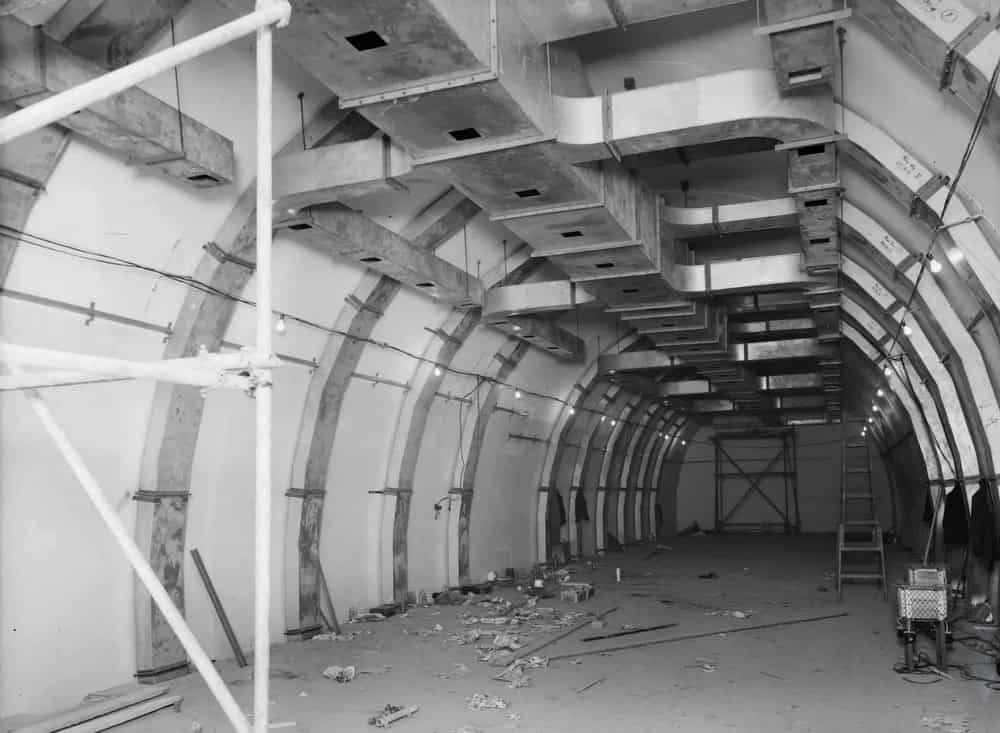
The main tunnel that was used is about the same dimensions as the London underground, running from Anchor to Midland ATE in Hill Street, from there the tunnel continued under New Street Station and on to the exchange in Essex Street. The tunnels carried many cables supported on metal racks set into the walls. The main part of Anchor housed the generator hall, the exchange being DC powered, for safety reasons; the mains transformers and high voltage switch gear were air cooled instead of the normal oil cooling. Anchor was the first exchange in the UK to get fluorescent lighting. Electricity was supplied from its own sub station keeping the three generators for standby in case the main power was to fail. Also in the exchange was the domestic accommodation including kitchens, sleeping quarters, canteen, mess room and offices along many corridors.
Water for the complex and cooling system came from a 300 foot deep artesian well, the air conditioning and cooling system was considered very important in case the tunnels were blocked so that the air cooled equipment could remain running for long periods of time without overheating. It was the first post office installation to be fitted with air conditioning controlling temperature and humidity.
Waste water and sewage was pumped up to the street sewers above. The tunnel walls were constructed of thick concrete blast proof sections with an anti spall mesh this was not completely waterproof and allowed some water into the complex. At the time the main exchange was above the water table although some of the cable tunnels needed continuous pumping to keep them dry. Today the exchange is below the water table which has now raised 50 feet following the demise of local heavy industry and breweries that once used large quantities of water. Continuous pumping is now needed for the whole exchange and tunnel system with thousands of gallons a day being pumped out.
In the 1950’s television was gaining in popularity every year. When only BBC was available their Birmingham studio was situated in Broad Street, all transmissions from there to London went through TV control in Telephone House. The picture signal and sound were sent separately, the sound being sent via copper cable. When Pebble Mill studios came online special copper cables were terminated in both Telephone House and Anchor to carry the speech paths. In the early 1970’s local radio stations really began to flourish. BBC Radio Birmingham and BRMB started expanding rapidly and to relay them out to the national network they had to be transmitted via Anchor because it was from here the circuits could be cross patched on to an OP (occasional program circuit also called Permanent CCTS).
Up to the late 1980’s Anchor had the main switching circuits and controlled all radio sound circuits in the Birmingham area. Music quality broadcast CCTS (50hz - 20,000hz) were installed all over the Midlands mostly terminating at Anchor. These were used for example if a football match at Aston Villa was being broadcast nationally. The signal would be transmitted on a local cable to the serving exchange, equalised and amplified then passed through the cable network to Anchor control. It could then be patched through to a London OP where it would go on to the BBC to be transmitted nationally.
Bm/C (Selly Oak) was the main serving station for all the CEGB (Central Electricity Generating Board) circuits. This was situated in Redhill Road just outside Kings Norton connecting their emergency control centre and their bunker. The bunker is situated amongst residential houses and appears to be a semi sunken structure, the ventilation and ducting can be seen but because of the large control centre all around it is hard to tell where the bunker ends. The repeater Bm/C Selly Oak is not hardened and is more like a satellite repeater attached to the side of the exchange. This repeater was also part of the “ring main” and had special quality cables to Anchor, Lyndon Green and Gloucester, the cable pairs were used to carry radio quality broadcasts.
Anchor was only once put on standby during its lifetime; this was during the Cuba crisis in 1962. All ordinary engineers were replaced with chosen managers and no women were allowed.
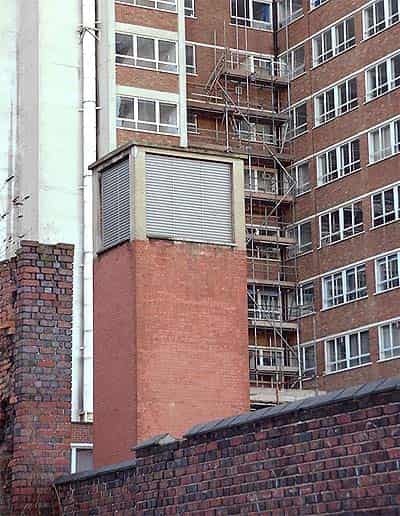
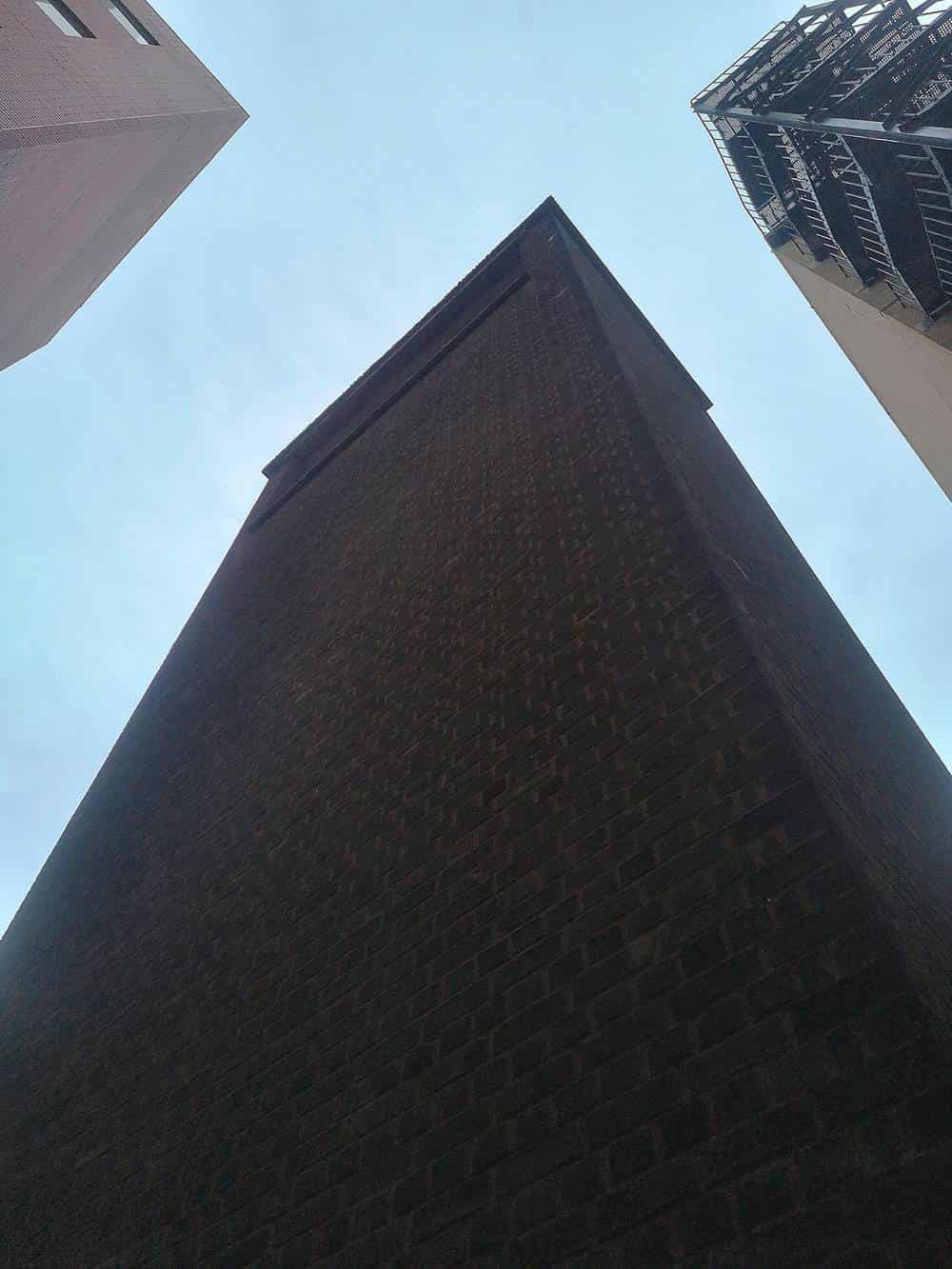
There are several surface structures connected to the exchange still in existence, there is a goods lift in Lional street; this is similar in construction to the one at Guardian (George Street) and is probably the exhaust for the complex being the tallest of the vents. Behind Telephone House is the intake for fresh air consisting of a large ventilation tower, there has been construction work next to this recently and a new office block built but the vent remains intact. Anchor would have had a positive pressure ventilation system to prevent outside contamination. There are various other vents that can be seen including St Chads where a small building is more than likely taking the mains electricity supply into the complex.
Anchor is now merely a relic of the cold war, it was maintained through to the 1980’s when is became the terminal for a new fibre optic link from London. It has recently become out of bounds to even BT staff due to serious safety concerns and is no longer on care and maintenance. The water is still pumped out continuously because the exchange and tunnel complex still serve as cable runs to save digging up the city streets.
Subject to a government D notice for 15 years Anchor came off the secret list and press were allowed down there for the first time in the late 1960’s. Two newspaper articles appeared telling of Birmingham’s best kept secret, many GPO workers at the time didn’t realise the importance of the exchange as it was referred to only by the name Anchor and kept strictly secret. These two articles mention a fourth exchange in Glasgow but as already stated there is no evidence that this exists.
An uncompleted tunnel heads off towards Hockley and from Hockley back towards Anchor but they don’t join and there is a large gap where this tunnel wasn’t finished. There are seven shafts to the surface with diameters ranging from 22 feet down to 6 feet and there are chambers roughly every 500-600ft along the tunnels.
The tunnels run on a decline away from the exchange in line with the surface contour of the land but at Essex Street the depth of the tunnel is only 60ft so even though the tunnels are on the decline the land drops away at a faster rate making the tunnel quite shallow by the time it reaches Essex Street.
The exchange was built at a deep level but the connecting tunnels were much shallower than this covering 1000’s of feet. Even post office and BT workers interviewed that have worked at the exchange do not know the full extent of the warren of tunnels under Birmingham but if it was completed a tunnel would run beneath the jewellery quarter to meet the tunnel coming the other direction from Hockley. As completed it stops just short of the jewellery quarter.
In the opposite direction the same tunnel reaches Essex Street making it around 4000ft in length. If the tunnel to Hockley had of been completed joining the section coming in the other direction it would have had a total length of 7500ft, the gap is 1500 feet.
Sources:
- Birmingham Evening Mail 11th October 1968
- Birmingham Post 12th October 1968
- BT Staff newspaper ‘Telecom Today’ March 1983
- War Plan UK by Duncan Campbell
- Communication Workers Union
- Retired Anchor personnel
- Sandy Ness' article in magazine of the Institution of British Telecommunications Engineers, #45 June 2001