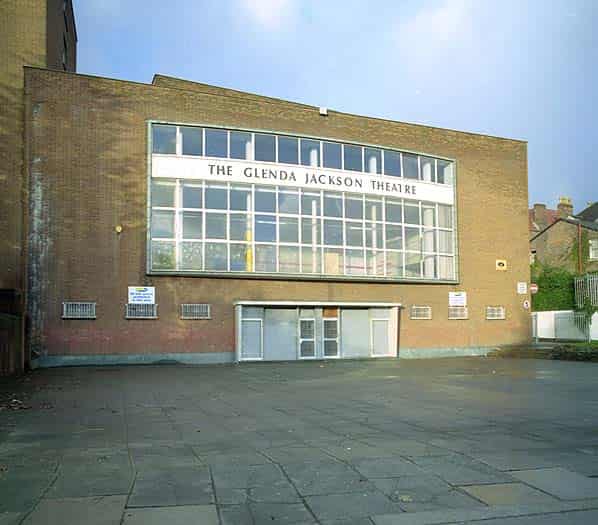
Birkenhead Corporation Control was located in a purpose built Civil Defence Corps Control Centre beneath the Technical College Theatre (later re-named the Glenda Jackson Theatre in honour of one of the Wirral’s most famous daughters), in Borough Road, Birkenhead.
It was opened in 1952 and used until 1968. It was later reactivated in the 1980’s as the Wirral Metropolitan Borough Council Emergency Centre and refurbished in 1988 with a standby generator, forced air ventilation, blast valves and two water tank. (Two sets of blast doors were fitted during construction in 1952, these were not upgraded) Following the refurbishment Merseyside County Standby was co-located at the site. At this time the centre was also fitted with an Autex 1600, 100 CMX and a TXS 50 ECN unit.
In 1990 The Wirral Emergency Centre was moved to Westminster House, Birkenhead and the bunker under the Glenda Jackson Theatre was closed; at that time Merseyside lost it’s standby centre. The Glenda Jackson Theatre itself is now also closed and the Wirral Metropolitan College is due to close in the near future. It is likely that the site will be demolished. The bunker is currently used by the college as a recording studio and rehearsal room with several structural changes being made since the closure of the emergency centre.
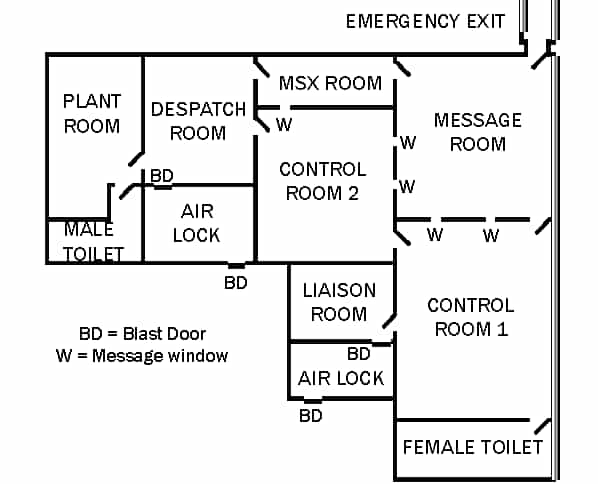
Entrance to the bunker was from the main corridor linking the college with the theatre, the blast doors have now been removed and replaced with ordinary wooden doors. These entrances were in the form of airlocks opening into a small room with a second door diagonally opposite into the bunker. The first air lock opened into the ‘Dispatch Room’ where the PABX was located. From the despatch room the ventilation plant room was on the left and the male toilets were accessed through the plant room. The internal solid walls forming these three rooms have now been removed and four smaller rooms have been created in the space. These are used as rehearsal rooms, one is empty, one contains a double bass and two contain drum kits.
On the right hand side of the former dispatch room was a door into one of two Control Rooms (Control Room 2) but the doorway has now been walled up. The narrow MSX Room was also accessed from the right hand side of the Dispatch Room, this now acts as a corridor into the other rooms. A message hatch into Control Room 2 has been filled in. A door at the far end of the MSX room opens into the ‘Message Room’ which is now empty apart from a piano. The emergency exit in the far corner of the room has been bricked up and the two message hatches into Control Room 2 have been enlarged to form a wide open doorway between the two rooms. Control Room 2 contains various items of audio equipment. A doorway linking Control Room 2 with Control Room 1 has been blocked up and access to the Control Room 1 can now only be made through the Message Room.
Control Room 1 has been converted into a recording studio with audio mixers and tape decks. Two message hatches between the Message Room and Control Room 1 have been replaced with a large glass window. From control room 1 there is also a door into the ‘Liaison Room’ and through the second air lock back into the basement corridor. These rooms are used for storage as are the former women’s toilets which were accessed from Control Room 1. The standby generator was located in a room outside the bunker and has now been removed.
While most sirens were removed in the 1990’s that at this site along with the control cabinet still survive in the college lift room. Inside the cabinet there is a WB1400 carrier receiver that was used to operate the siren remotely. The siren can be key operated and we were able to test it briefly, any longer and the college would have been evacuated. According to the log this was the first siren test since 1992. The siren is located on the roof of the lift room in a metal cage. The control cabinet and the siren have now been donated to the Hack Green museum where it was installed in full working order in 2002.
The Glenda Jackson theatre closed in 2003, and was demolished by Wirral Council, to make way for a new housing estate, in 2004. It is believed that the former emergency centre was backfilled during the new development.
Those taking part in the visit were Nick Catford , Keith Ward , Rod Siebert, John Fogg and Robin Ware.