Today saw Dan Mckenzie, Nick Catford and Myself visit the former RAF Bentwaters site in Suffolk. This site is now part used as an industrial park and the rest lies unused, but fully secure. The future of the site is unknown as the owners wanted to open it as a commercial airport for East Anglia but local council objections have put paid to that idea. The runway is still used by occasional light aircraft but that is all.
Having arrived we were given the keys (!) to enter the secure area. This comprises the main runway (1.5 miles long), hard-standing, control tower, bomb stores, protected hangers and other buildings. We made our way to the first bomb storage area which was located on the other side of the billiard table smooth main runway.
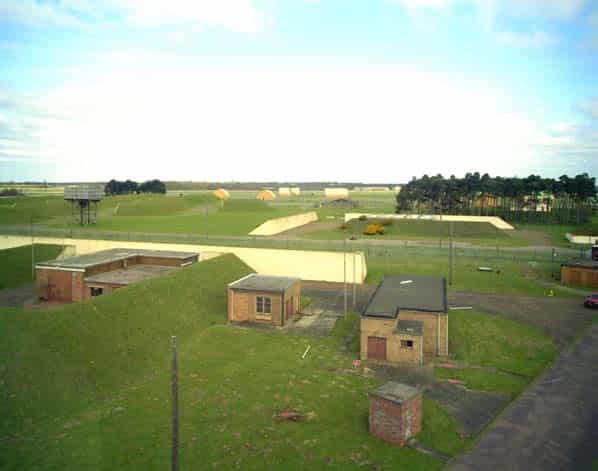
This bomb store was set within its own fenced area but fortunately the gate was open so we were able to drive in up to the individual stores. These were of the standard ‘mounded earth’ design and were quite large. Two large sliding doors were at one end to facilitate access into the store. Many of these stores were open and we entered one of them. All were identical in this area. There is an air vent with a fire shutter which was connected to a quick melt piece of wire that would shut the vent if fire broke out. Inside the light fittings were still in place although there was no power connected. There were yellow marks on the floor for vehicle positioning. Having photographed these stores we continued around to a large green building that had a loading platform on each side. Entry to the building is obtained via 3 pairs of large green sliding doors on each loading bay platform. We were unable to gain access to this heavily fortified building but looking through a gap in the doors it appeared to be divided into sections internally. We continued to walk in this area and came to plant areas that had blast shielding around them. One of the smaller buildings contained the remains of a generator and a 240v to 110v converter. Continuing on in this area we approached the rear fence which backed onto a second much more substantial and secure bomb storage area. It was interesting to note that all bomb stores had lightening conductor wires suspended approx. 20 feet above the roof of the building which were earthed by metal poles on each side.
At the back of this bomb store was a water tower (not climbed) and 2 buildings that had integral garages. These buildings had fortified sections within them although their purpose is unclear - possibly additional security for the bomb store area.
Having completed this area we moved on to the high security bomb store. We were joined by our guide at this point who had the keys to the gates!
Approaching the guardhouse along a straight piece of road it was easy to picture the base when it had been in use. Lying alongside the roadway were huge steel poles with 6" spikes sticking out of them. These were obviously used to provide additional protection against vehicles ramming the very heavy duty gates. They would have been deployed in front of the gates to deflate the tyres of any bandit vehicle approaching the bomb store.
Entry to this storage area was through a twin gate system cutting across all 4 fences including an electrified fence. These fences were in addition to the fences to enter the airfield proper once past security. The vehicles would drive into the area alongside the guardhouse and the outer gate would close behind them. This area was fully floodlit and had additional lighting at ground level for vehicle inspection. Once papers were checked and the visitors approved the inner gate would be opened to allow access to the compound. The guardhouse itself was intact and had its own generators (missing), BT comms room and a control area with a commanding view of the gates. Upstairs was a fortified area with gun holes overlooking the approach road and gate area.
Once inside there is a building to the left that was locked and its purpose was unknown but it was not fortified in any way. Directly ahead was one of the observation towers for the site which we climbed using the staircase that spiraled its way around the outside of the legs. This is a substantial tower and had a fully air conditioned (locked) room at the top which had commanding views over the high security area and some of the rest of the site. Much of the bullet proof glass had crazed but we could still see inside and the room was empty. The base of the tower had substantial concrete shielding against conventional attack and ramming by vehicles.
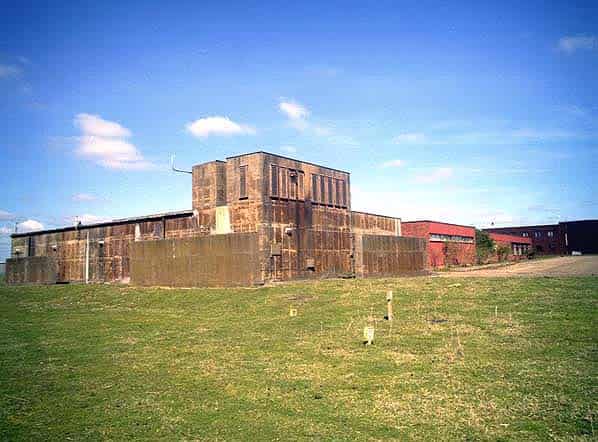
We returned to terra firma and walked along a long line of bomb stores. Most of these were locked but we found one that was open. These were similar to the stores in the other compound but had additional blast walls directly opposite the entry door and the doors themselves were much more substantial. At the end of this line of stores was a larger store and then the communications bunker. This is a surface blockhouse with gun points on all sides and was heavily fortified. We entered and it comprised a main office/work area, integral garage for a vehicle, kitchen area, BT room, toilet (only the one) and the comms room itself. This was stripped of all equipment but had the desks etc. still in place so we were able to get a very good idea of what it looked like when operational. Alongside this blockhouse was a comms tower that had a single aerial on it but did not appear to serve any current purpose for the nearby RAF Woodbridge.
We headed back to the gatehouse via the second row of bomb stores. These were of a different design and there were only 3 of them. They had integral garages and there were still cranes inside the buildings in the vehicle areas. This might have been where the weapons were loaded onto lorries for transportation. Heading back to the gate the final building had a large steel shipping container built in to it in the vehicle area. This was an integral part of the building and why it was there we didn’t know and neither did our guide. The same building also had an extremely secure cage in one of the rooms for housing something that they didn’t want anyone to get hold of. What that was we don’t know but was too small for an armoury but too big for anything nuclear. A small building just to the right of the gate house had what was left of a generator.
We then went to the control tower. This involved driving across the airfield past a number of hardened and conventional hangers and a wide variety of buildings. We managed a short drive along the runway which was in perfect condition and as smooth as a billiard table.
Our guide duly unlocked the control tower which was on 3 floors and still had the power connected. On the ground floor was a small entrance area with a reception room, a larger area led through to a corridor off which was the BT equipment room which still had quite a lot of racks and some RF transmission gear. Going upstairs took us to the intact flight-briefing area complete with NOTAM board and the insignia of 2 USAF Squadrons that must have been stationed there at some point.
The top floor comprised the aircraft control room and whilst all of the equipment was missing it was still in reasonable condition and had the points of the compass painted on the ceiling tiles. This gave an excellent view of the airfield operational areas.
With these additional security areas duly photographed our guide left us and we had the total freedom of the airfield and buildings for the rest of the day. We headed back to one of the fortified buildings we had passed and entered via a blast door. This was one of the Squadron buildings and was equipped with a full decontamination unit, plant room, blast doors etc. and according to the signs could be fully sealed in the event of attack by NBC agents.
We then moved on to photograph some of the fortified and conventional hangers/aircraft shelters and the remaining buildings including a standby control tower which still had a lot of equipment present in it.
After this we headed over to the old command bunker which is now in commercial use so we were unable to gain internal access. However, we did find hidden in the trees nearby a very well concealed bunker which we were able to access but it was just a series of empty rooms.
Most of the site is used for sheep grazing and it is totally secure with 24hr security on the entrance gate (no entry except on business) and regular patrols plus the additional fencing to get through to reach the main airfield area.