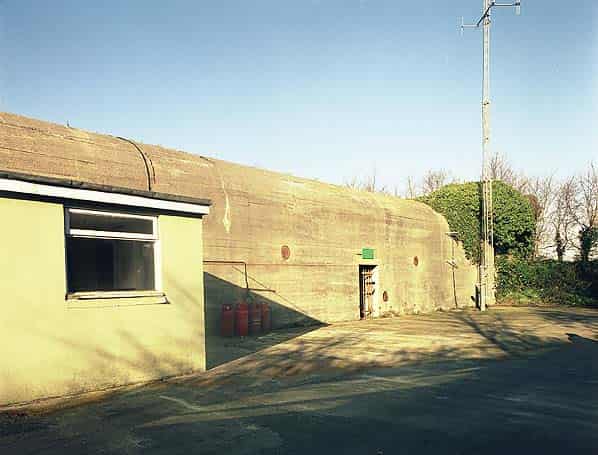
During the war plans were drawn up to excavate an underground military hospital as on Jersey and Guernsey. Construction never started and a former munitions bunker in a small quarry on the south side of Longis Road was utilised as the central surgical unit with two area first aid bunkers at either end of the island, one on Rose Farm on the north side of the airport at the other just east of Whitegates. All three bunkers still exist.
After the war the surgical bunker was adapted to house the island’s Civil Defence Unit. Unlike the mainland where the Civil Defence Corps was disbanded in 1968, in the Channel Islands it was retained through the cold war and is still functioning today. In the 1980’s the Royal Alderney Militia was reactivated by a retired SAS officer, Col. Peter Walter and this is now co-located in the former German bunker.
Although internally all parts of the bunker are linked together, Civil Defence and the Militia have their own entrance complete with a name plaque above over each door. The entrance to the Civil Defence side of the bunker is through a metal grille and two gas tight steel doors. Once inside, the first room on the right is the militia armoury which we were unable to see.
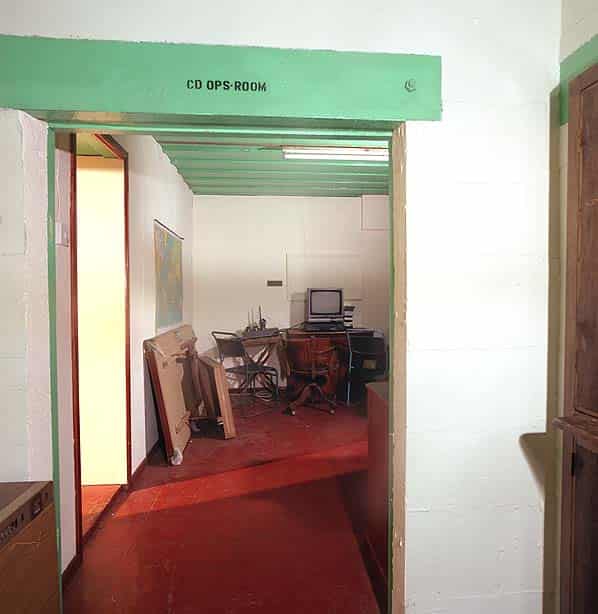
Next to it is the radio room and straight ahead through an archway, the Civil Defence operations room with ‘CD Ops. Room’ above the door. The ‘ops.’ room is approx 15 ft by 10 ft and contains a television, video recorder map of the world, tables, chairs, and a rack of transceivers, plus various military posters one showing how to identify Russian Hind helicopters.
Passing out of the ‘ops.’ room to the left there is a short corridor, the first room on the right is the CD storeroom, and the next room and beside it the small kitchen and bar. The corridor enters the main Militia training room, and from this a short corridor leads to the Militia entrance consisting of two further gas tight doors and the Militia storeroom full of uniforms.
Access to the flooded lower floor is from this corridor consisting of a ladder and an ammunition chute. In the event of nuclear or chemical attack the bunker is fully self sufficient with ventilation plant and standby generator. Outside the bunker there is a communications mast and an office in a small portacabin. Alderney Civil Defence comes under the jurisdiction of Guernsey with joint monthly exercises. They also take part in a yearly international exercise (INTEX) and are connected to the emergency communications network by radio. Colonel Walter’s Militia cadet force trains weekly often utilising disused Victorian and German fortifications.
The bunker also house the Alderney monitoring post, this is in the radio room and serves a similar function to the Royal Observer Corps posts on the mainland. The post is still fully operational although in peace time is unmanned. The monitoring instrument is a Mini Instruments 7-40, measuring temperature, wind speed, wind direction and radiation levels from sensors and detectors mounted on the roof. This data is then relayed to CD HQ at La Corbinerie on Guernsey. These days the nuclear threat is more likely to come from an accident at the nuclear waste reprocessing plant at Valognes near Cherbourg than from nuclear weapons.
Those taking part in the visit were Nick Catford, Dan McKenzie, Keith Ward, Robin Ware, Paul Sowan, John Burgess, Mike Clarkson, Bob Clary, Tony Page, Jason Green and Pete Walker.