Since this report was written, this site has been restored and opened by English Heritage.
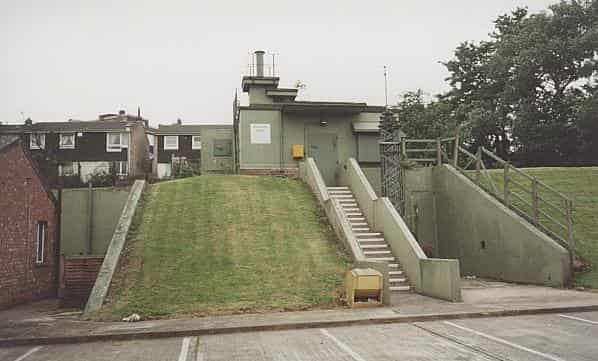
EXTANT. The York group HQ is located at the rear of Shelley House on the north side of Acomb Road on the B1224 running west out of York. It is of the semi sunken variety and is accessed up a flight of steps up a steep mound at the rear of the car park. There is a single storey brick built administration block alongside. On top of the mound at the eastern end is the original emergency exit hatch, which is a standard ROC post hatch. Later a door was added a few feet to the east at the end of the mound. The usual instrument mountings are to be found with BPI and FSM pipes on the mound itself and a GZI mounting on the roof of the small surface building. The ladder up to the roof has been removed. There is a pump up aerial mast beside the entrance door.
Internally the bunker is on three levels. On the right through the entrance door is the filter room with all the filters still in-situ and on the left is the decontamination room beyond these rooms, steps lead down and round a corner to the main east - west spine corridor which, due to the height of the mound is actually at surface level, but covered over with soil. The first room on the right is the plant room with the ventilation plant and compressors still in place with a door at the rear leading to a smaller room containing the diesel generator. The next room on the right is the canteen/kitchen. A short corridor leads from the main corridor with a doorway into the kitchen on the right. The corridor then opens into the canteen with a connecting serving hatch between them. On the rear wall of the canteen is a cupboard containing various electrical boxes. All of the kitchen equipment is still in place. Next is the BT room, which still contains a lot of wiring and two wall-mounted cabinets containing switching equipment on the rear wall.
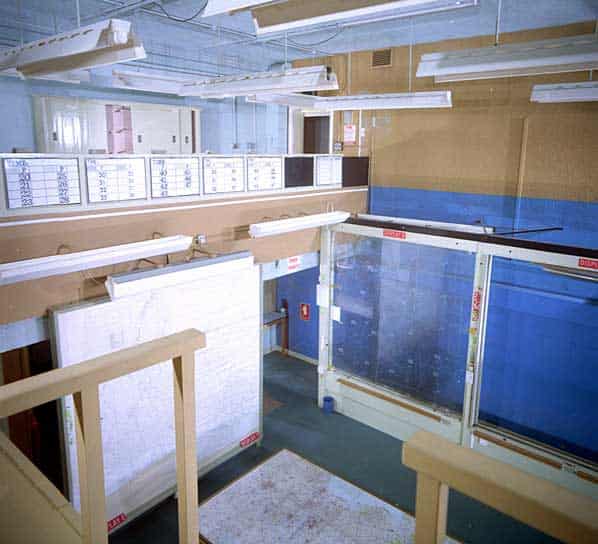
After a stairway down to the third level there is a door opening onto the balcony around the well of the control room. All the revolving tote boards remain in place around the balcony with a small open-ended room at the far end with a cluster map on the wall and a large floor mounted light box. Going round the gallery there is a second door out into the spine corridor. Turning right leads round a corner and through two doors is the emergency exit. Between the two doors there is a ladder up to the original emergency exit hatch. Returning to the bottom of the steps down from the surface there is a small room on the left opposite the plant room containing all the sewage pumping equipment. Rooms on the left hand side of the spine corridor are the male and female toilets which are all intact although not working, the male and female dormitories (female bigger) which have been stripped of all fittings, and the officers room.
Going down into the well of the control room the wooden mountings for the Perspex map screens are still in place. The B display is still in its mounting but the A display has been removed and is on display at the Imperial War Museum in London. The folding command table is still in place with maps on it and on one wall there is a large map of the UK (Display T) with the country divided into the various groups and sectors. There is also a display board on one wall labelled ‘Communications Tote’ and a ladder up to the balcony. There is a long window through into the communications centre which contains a number of tables, a rack of files and notices on the walls. The radio room is also on this level; this still contains wiring, telephones and a large floor standing cabinet.
At present the power is still on although restricted to the spine corridor and control room as the centre is suffering very badly from damp with water on the floor in places. The future of the bunker was secured in 2000 when it was granted Scheduled Ancient Monument status. The rest of the site, including Shelley House will be sold for redevelopment but the bunker cannot be altered either externally or internally and English Heritage are in discussions with a number of parties interested in taking it with a long term view to restoring it to its original internal condition.
The WW2 ROC Group HQ at Knavesmire, which was in use until Acomb opened in 1961, is still extant and used by a local rugby club.