
Struggle for Survival
Governing Britain after the Bomb
The 1955 Defence White Paper said that a future war would result in a “struggle for survival of the grimmest kind”. This book examines the way in which the government in Britain prepared for that struggle during the Cold War and the work done, often in complete secrecy by the civil and home defence planners at all levels.
Contents
- File 1: The Death of Bristol The effects of nuclear war - the civil defence response
- File 2: Any Measure Not Amounting to Actual Combat What is Civil and Home Defence? - lessons from World War II - The Civil Defence Corps - Central Government and Regional War Rooms
- File 3: A Difference in Kind - The Megaton Weapon Central Government in War - the Strath Report - response to the H bomb
- File 4: The Central Government Nucleus SUBTERFUGE, BURLINGTON, TURNSTILE, etc - Protecting the Queen
- File 5: The Regional Seats of Government The what’s, where’s and how’s of the RSGs
- File 6: Regional Government Sub Regional Controls - the end of the RSGs and the Corps
- File 7: From Civil Defence to Emergency Planning New strategies for the 1970s and 1980s - Protect and Survive - Exercise Hard Rock - new roles for local authorities
- File 8: Rethinking Regional Government Changes at regional level - Exercise Regenerate
- File 9: Central Government in War in the 1980s Conventional war - COBRA and PINDAR
- File 10: Emergency Laws New laws for wartime
- File 11: The Regional Government Headquarters RGHQs - history - sites and organisation - Chilmark in detail
- File 12: The Role of Local Authorities in War Controllers - Regulations - plans - emergency centres
- File 13: The Ministries Prepare for War Departmental plans - the War Book - health - transport - energy
- File 14: Feeding the Survivors Rationing - stockpiles - emergency cooking
- File 15: The Uniformed Services Armed forces - fire service - police
- File 16: Civil Defence Communications and Warning Wartime broadcasting - emergency communications - attack warning - Royal Observer Corps
- File 17: The Road to War Countdown to the attack - the aftermath
- Appendices
File 1: The Death of Bristol
The effects of nuclear war - the civil defence response
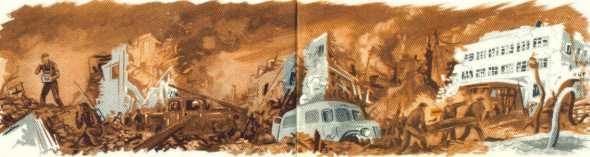
The morning of 8 March 1966 dawned clear and bright. The few high clouds promised a sunny day, perhaps the start of an early spring. As the people of the small Gloucestershire village of Almondsbury started on their daily tasks many worried about the worsening political situation in Europe. But even while armies prepared for war village life had to go on - children went to school, groceries were delivered, cattle were milked. No one noticed the small dark speck high above them in the morning sky.
The Tu-95 bomber of the Soviet Air Force had taken off from its base in northern Russia 10 hours before. It crew were tired and frightened as the bomb aimer counted down the seconds to release. Suddenly, the huge aircraft jumped upwards now freed of the massive weight of its single hydrogen bomb. A short 45 seconds later the radio altimeter triggered the fusing mechanism and the bomb exploded with the force of 2 million tons of high explosive 5000 feet above the village church of St Mary’s. Almondsbury ceased to exist.
The village and its people were instantly vaporised leaving a crater 2000 feet across and 150 feet deep. People 5 miles away in Bristol, the bomber’s intended target, seeing the flash from the bomb hundreds of times brighter than the sun were blinded before they were struck by waves of searing heat and deafening noise from the blast. A minute later the blast wave arrived smashing buildings, throwing vehicles into the air and turning windows into blizzards of deadly glass that ripped though anything and anyone in its path. Even at this distance over 6000 fires were started in north Bristol. Fed by broken gas mains, the fires overwhelmed the fire services and merged into a conflagration that turned into a firestorm. In a matter of hours most buildings were destroyed and 80000 people were dead. Thousands of others were severely injured by burns, blast and flying glass or paralysed by shock.
But Bristol was not alone. Over the next two days hundreds of cities throughout Britain, Europe, North America and the Soviet Union shared its fate as World War 3 began and ended in a deluge of hydrogen bombs. Six more bombs hit Southwest England with a total explosive power of 13 million tons of high explosive. Over 450000 died. Thousands more would die over the coming weeks from the effects of radioactive fall out, untreated injuries, disease, riots and starvation.
The attack of course never happened. It was part of the background scenario for Exercise Grass Seed prepared by civil defence planners in 1966 to examine the problems of survival in Southwest England after a major nuclear attack. The scenario revealed the horrors and scale of the nuclear war the planners expected and tried to prepare for.
Although the planned official evacuation scheme had not started, over 100000 people had left Bristol before the attack. They joined over 3 million refugees from the Midlands and Southeast fleeing to the perceived safety of the Southwest. Every hotel and guesthouse had quickly filled and thousands were living in temporary accommodation in schools and factories. But many others were living rough in the open where they were caught by blast and fall out.
The desperate position of many refugees added to a rapid break down in law and order even before the attack. By D+7, 7 days after the attack the situation had reached crisis point as desperate people with little hope and faced with a total collapse of society behaved like savages. Householders were increasingly reluctant to take in refugees. Small towns and villages were particularly badly pressed and many formed armed vigilante squads refusing to allow anyone in or any supplies out. In the face of widespread looting and attacks on food supplies the Regional Commissioner exercised his unfettered legal authority and ordered drastic measures including public floggings and executions. The overstretched police and armed forces had to be withdrawn from many areas and were formed into a “striking force” which took on the worst areas of anarchy, using tanks to break down barricades. By D+20 law and order had been re-established in most areas but it existence was fragile.
Bristol was largely unaffected by radioactive fall-out thanks to favourable winds but elsewhere it proved deadly. Drifting on the wind, it silently and slowly killed thousands. There was no cure and the over-stretched medical workers were ordered not to waste their efforts on its doomed victims. The worst affected areas were called Z-Zones where the survivors had to stay under cover until rescued but many Civil Defence volunteers quickly exceeded their War Emergency Dose of radiation and soon all rescue efforts were withdrawn from the Z-Zones. In the region an estimated 85000 people were abandoned to die.
The Regional Commissioner ordered Bristol north of the River Avon and anyone still alive there to be abandoned. To the south of the river most of the injured found some form of medical facility although this was often primitive and with supplies and staff exhausted by D+20 treatment was virtually non-existent. People died in their hundreds. Mass graves were dug in hospital grounds and parks where the bodies of humans and animals were dumped without ceremony. There was no prospect of burying the tens of thousands trapped in smashed houses and in many places the dead rotted where they had fallen. The risk of disease was a major concern for the authorities but they were powerless to prevent it.
All roads to the north of the river were blocked by debris and wrecked vehicles. By D+20, the main roads were open from Bristol to the south and west but further road clearance work was stopped to preserve fuel and equipment. The public utilities were virtually wiped out by the attack. South Bristol had some supply of gas coming from Bath but its own gas production facilities were smashed. The entire region was without electricity and no generating stations were expected to be operating for at least 2 months. Supplies of petrol and diesel were short. There was no refining and many underground storage tanks were effectively sealed by the lack of electricity for pumping. As with all other supplies there would be no prospect of obtaining anything from outside the region for months, if not years. The police and armed forces were given priority with fuel for law and order work, followed by medical, welfare, public utilities and food distribution but some fuel had to be preserved for agricultural use in the future. Bristol still had some piped water supply although the quality was low and the sewage system was inoperative and likely to remain so for months. This would only add to health problems in the coming weeks and months.
The public telephone and telegraph service was non-existent and only civil defence controls had some very limited communications. Radio broadcasting was limited to a daily 5 minute bulletin from the Regional Commissioner giving news and encouragement but few people had battery-powered radios so most did not hear him. Attempts were made to set up local newssheets but there were no printing facilities in Bristol. In the absence of news rumours fed people’s fears.
Food was not an immediate problem. By D+20, most survivors in Bristol were being fed at outdoor emergency feeding centres. There were ample supplies of meat but a shortage of vegetables. Flour would last a few more days but bakeries and flourmills were unable to operate because of shortages of fuel and water. Salt supplies were exhausted and stocks held at council road depots to de-ice roads were being used. Consideration was being given to using pet food for human consumption. The feeding centres were however running short of fuel and with the poor weather, some were becoming unusable. Food poisoning was common in the unhygienic conditions.
Few people went to their peacetime jobs. There were attempts to enrol all able bodied survivors to do manual labour, help in food preparation, hospitals, etc but many were reluctant to move from their homes. The Regional Commissioner tried to keep the economy going by insisting that people paid for food but this proved unworkable and had to be abandoned.
Overall, although the survivors in Bristol were in a better condition than many others in the region their position was precarious. Theirs was a battle for simple survival from day to day. The old, the sick, the injured and the very young were doomed. There was little thought for the future. Many would not live to see it.
This was the horror of a full-scale nuclear attack in the age of what the strategists called Mutually Assured Destruction or MAD when they assumed that the next world war would start and end with an immediate all-out exchange of city-killing hydrogen bombs. The immediate effects were on a scale never before imagined but the long-term effects of radioactive fallout made matters worse. The combined effects would virtually destroy all vestiges of civilised life even in areas not directly affected by the explosions.
These are the events that civil defence planners prepared for during the Cold War. This book describes those plans.
File 2: Any Measure Not Amounting to Actual Combat
What is Civil and Home Defence? - lessons from World War II - The Civil Defence Corps - Central Government and Regional War Rooms
Home and Civil Defence
Films of the London Blitz show fire crews in action, rescue parties digging for survivors, ambulances taking the injured to hospital and smiling ladies dispensing tea and sympathy. This is most people’s idea of civil defence. But the civil defence plans that evolved before and during World War 2 went beyond this to cover all aspects of what is called passive defence. This included pre-attack preparations such as evacuation, black out and shelters, then the wider activities of the emergency and rescue services and later the longer term response with emergency feeding, billeting and rebuilding.
The Civil Defence Act passed in 1948 defined civil defence in these wider terms as “including any measure not amounting to actual combat for affording defence against any form of hostile attack by a foreign power or for depriving any form of attack by a foreign power of the whole or part of its effect, whether the measures are taken before, at or after the time of the attack”. Some 10 years later Civil Defence Corps training material was repeating this wider approach saying that civil defence was “that part of the defence of the country organised to mitigate the effect of the attack, as distinct from military action to combat the attack itself.”
The Emergency Planning Guidelines for Local Authorities published by the Home Office in 1985 which is discussed at length later repeated this basic idea when it gave the priorities for civil defence as -
- Providing protection against the immediate effects of conventional and nuclear weapons
- Ensuring the maximum use of the precautions that could save large numbers of people from the effects of radiation.
- In planning to meet the shortages and disruption which would follow war.
- In planning for the restoration of essential supplies and services
- In setting the groundwork and organisation that would help promote recovery.
This list suggests that civil defence is about caring for people. But the government looks beyond these immediate activities to systems of administration, organisation and control from the local level right up to central government. In civil defence terms these levels form a chain of command and as we move up through the levels the emphasis changes from looking after people to looking after institutions. At the top, at the level of the central government the emphasis is on preserving the basic institutions of the state and ensuring they can continue to function. In the United States, this is referred to as the “continuity of government” but in Britain, it is called more bluntly “the machinery of government in war”.
During the 1950s and 1960s, the plans for responding to a nuclear attack steadily moved away from the idea of civil defence as the immediate life-saving response to an air raid to one where the priority was the protection and preservation of national institutions and in particular the apparatus of government. By the end of the 1960s planners were also thinking about problems which might arise in the period before such an attack. This lead to the wider concept of “home defence” which was defined as -
“Those defensive measures necessary in the United Kingdom: -
- to secure the United Kingdom against any internal threat;
- to mitigate as far as is practicable the effects of any direct attack on the United Kingdom involving the use of conventional, nuclear, biological or chemical weapons;
- to provide alternative machinery of government at all levels to increase the prospects of and to direct national survival; and
- to enhance the basis for national recovery in the post-attack period."1
This definition formed the basis of civil defence planning until the early 1990s. The first measure concerns the military’s, and to a lesser extent the police’s role in defending the state and its people against subversion, sabotage and terrorism not just in a wartime context but also in a period of civil unrest. The second measure deals with what most people consider to be civil defence but the last two measures go beyond this. In many ways the story of British civil defence during the Cold War is the story of the move away from the second measure to the third. The movement away from looking after people to looking after institutions; from the short term to the long term.
Lessons from World War II
When planners started to consider civil defence for the Cold War, they looked back to the experiences of the Second World War that had ended only three years before when the extensive civil defence measures had generally worked well. The key elements of civil defence for the next forty years were based on these measures and it is appropriate to start an examination of post-war civil defence with an overview of what went before it.
During the 1926 General Strike England and Wales were divided into 11 areas each under a Civil Commissioner who was given special powers for ensuring that food supplies and other essential services were maintained. In the 1930s when plans were laid down to deal with the effects of the air attacks that were expected to lay waste to the cities in the war that loomed ever closer Civil Defence Emergency Scheme Y built on this structure. The Civil Commissioners would now be called Regional Commissioners and the areas became Regions. As it would be the main target, London now became a region in its own right and the remainder of South East Region was given the number 12. These boundaries for the civil defence regions would remain largely unchanged for the next 50 years. The Regional Commissioners, who were men of influence and standing rather than politicians, each had a War Room with a staff of civil servants. Their primary task was to oversee the civil defence effort in their regions but at the operational level the organisation of the Air Raid Prevention or ARP forces, the fire services and health workers was the responsibility of the local authorities.
The Regional Commissioners also had a secondary and potentially more important function. In the event of the central government in London being unable to exercise control throughout the country (which effectively meant the Regional Commissioner losing contact with the Ministry of Home Security War Room), the Regional Commissioners could, at their discretion, assume full powers of civil government in their region.
While the ARP organisation headed by the Regional Commissioners would look after the local situation, the government had to ensure that its own operations, which were then firmly based on central London, could continue throughout sustained air attacks and even an invasion. These “machinery of government in war” activities would cover many levels of the governmental and administrative machine. At the top was the decision making apparatus centred on the War Cabinet with the heads of the armed forces and their advisors. Below them, at national level would be the various layers of the civil service together with quasi-governmental bodies like the BBC, General Post Office, British Railways, etc who would implement and add to those decisions. Consideration would also need to be given to the continued operation of the monarchy and Parliament. Probably around 150000 people fell into these categories and this number would rise steadily during the war as the role of the government expanded.
The initial plan was to relocate the core of the machinery of government to the suburbs of north and northwest London. The War Cabinet would use a bombproof citadel known as PADDOCK2 at Dollis Hill with supporting bunkers at Cricklewood and Harrow. PADDOCK was built 40 feet underground and had some 22 rooms centred on a Map Room. The bulk of the supporting civil servants would be accommodated in neighbouring schools and colleges left empty by evacuation.
But before the war started, the plan was changed. Now, the core or seat of government would remain in London for as long as possible and protected accommodation was developed for it. The most famous was the bunker under the New Public Buildings that was partly occupied by the Central War Room, later to became known as the Cabinet War Room. Work had begun on this in 1938 by reinforcing the building’s basement and equipping it with air conditioning, communications gear and some basic domestic facilities. It could house 400 staff and its activities centred on the Map Room, which collected information relating to the war effort and collated daily reports.
The functions of the Cabinet War Room, according to a contemporary file, were -
- To maintain an up to date picture of the war in all parts of the world for the information of the War Cabinet and Chiefs of Staff,
- To provide a channel for communicating very important military news to HM the King and members of the War Cabinet through members of the War Cabinet Office,
- To provide a protected meeting place for the War Cabinet and the Chiefs of Staff organisation under air raid conditions.
There were four other principal war rooms - three for the fighting services and one for the Ministry of Home Security. By 1942 all had found permanent homes. The War Office occupied a new bunker built on the site of Montague House between Whitehall and the Thames. The Admiralty also had a new blockhouse, usually known as the Citadel, which was in fact built illegally on part of St James’s Park adjacent to its main building. The Air Ministry and Ministry of Home Security War Rooms were installed in a site known as the Rotundas. This complex located in Horseferry Road near Whitehall used the enormous holes dug for the gasholders of the Gas Light and Coke Company for its 2 principal bunkers. In January 1946 The Times reported that the 3-storey deep Rotundas, then codenamed ANSON, could have housed the War Cabinet, the Chiefs of Staff and 2000 staff in the event of “mass bombing or enemy landings dislocating or destroying the usual centres of administration”. The report added, interestingly in view of later developments, that its 12 feet thick “concrete crust was believed by experts to be proof against an A bomb”.
The Ministry of Home Security had been conceived in 1935 to combine responsibility for air raid and fire precautions and to co-ordinate the war time services of all other civil departments. It was originally part of the Home Office which provided its staff. However, its functions and responsibilities grew rapidly and by 1942 it was employing 5700 people. Its War Room was central to its operations and indeed to all civil defence operations throughout the country. Its functions were given as -
- To receive reports of first flares and bombs,
- To receive and action requests for assistance from the Regions,
- To act as a channel of communications between the regions and their Commissioners and the Government,
- To act as an intelligence centre to present a picture of the Home front,
- To prepare situation reports.
The Regional Commissioners were provided with their own war rooms in provincial cities such as Cambridge and Manchester usually using reinforced basements of large houses. These Regional War Rooms would co-ordinate civil defence activity in the region and act as the government for the region if communications with the Ministry of Home Security War Room were lost.
As well as these citadels for the principal War Rooms a series of reinforced “steel framed buildings” which were expected to be able to withstand blast better than ones built of brick or stone were constructed in central London to provide office accommodation for the various government departments.
The War Rooms were the core of the seat of government and were linked by a communications tunnel running 100 feet beneath Whitehall. This was not intended for people but to protect the vital telephone and telegraph cables. The tunnel, which was completed in 1941, was 12 feet wide with narrower tunnels carrying the cables into the War Rooms. Soon after, it was extended to connect with the Rotundas. Early in the war another tunnel 25 feet wide to run parallel with the cable tunnel to provide war room accommodation was considered but never built.
As well as planning protected accommodation for the core or seat of government plans were developed by the start of the war to move civil servants from central London in what were known as the Yellow and Black Moves. The Yellow Move planned to relocate some 44000 civil servants with less important administrative jobs permanently out of London mainly to the north of England and Wales. The Black Move envisaged moving the 16000 civil servants, military personnel and others who formed the actual Seat of Government to various locations in the west Midlands. The War Cabinet would use Hindlip Hall whilst the Prime Minister, his Private Office and family would go to Spetchley Hall. At the same time, the Royal Family would have moved to Madresfield Court. These stately homes are all near Worcester. Parliament would have sat in Stratford-upon-Avon. The 5 War Rooms would have been set up in requisitioned hotels and schools in Cheltenham. The idea was that both the Yellow and Black moves could be completed if necessary in 3 - 4 days but in practice only some 20000 civil servants actually moved over several weeks and even this caused tremendous practical problems.
The practical problems revealed by the limited Yellow Move, the generally bad experiences of the French government’s move from Paris in the face of the German advances and the fact that much of the planned relocation areas were now within range of German bombers led to the Black Move being abandoned in mid-1940 but it was reconsidered in 1943 in the face of bombardment from what would become the V-weapons. By this time, there was sufficient “citadel” (purpose built bunkers) and “fortress” (steel framed buildings) accommodation to accommodate around 10000 key personnel in central London under what were called “Crossbow Conditions”. If the bombardment became severe and prolonged non-essential government workers would be stood down whilst the nucleus would live and work in the citadels and basements. The Cabinet War Room would still be the hub.
However, doubts had always existed about the ability of the Cabinet War Room to withstand a direct hit and when planning started for the German V-weapons alternative accommodation was provided for Churchill, his family, the Cabinet and the Chiefs of Staff in the Rotundas. These were considered proof against a direct hit from a 1000lb bomb and the safest accommodation available. However, only domestic accommodation was provided. The War Rooms continued to operate in their existing premises.
In 1945, the Air Raid Precautions organisation, which had steadily become more commonly become known as civil defence during the war, was totally dismantled. The euphoria of VE Day and VJ Day was however short lived. In 1946, Churchill first spoke of “the iron curtain” and in the following year the term Cold War was coined. Only two years later, to the shock of many in the West the USSR exploded its first atomic bomb. Civil defence suddenly became a necessity again and the planners looked back to the last war for ideas both for bringing immediate assistance for the survivors of air attack and for a wartime system of civilian command and control.
The new measures were lead by the Civil Defence Act 19483. This was essentially an enabling provision that would allow the “Designated Minister”, which meant any Minister as may be designated by Order in Council or, in practice, where no Minister was specified, the Home Secretary, “to take such steps as appear to him from time to time to be necessary or expedient for civil defence purposes”. The Minister could impose these steps without the approval of Parliament by issuing Regulations made under Order in Council. In particular, the Act made specific reference to power to issue Regulations to local authorities and police forces concerning the provision of civil defence measures. If an authority refused to comply, the Home Office could take steps to enforce the regulations. This happened in a few places, for example in 1954 Coventry City Council refused to have anything to do with civil defence which lead to the Home Office appointing 3 Commissioners to carry out the council’s duties. The Act also allowed Regulations to be issued to the public utilities (then nationalised, or soon to be nationalised) such as the power and water companies requiring them to make active civil defence preparations. Many Regulations quickly followed the passing of the Act such as The Civil Defence (Appropriation of Land and Buildings) Regulations 1952, The Civil Defence (Gas Undertakers) Regulations 1954, The Civil Defence (Hospital Services) Regulations 1949 and The Civil Defence (Transport) Regulations 1954.
There was no need for the Act to deal with measures to be taken at central government level as these could be made under existing common law or the prerogative powers and responsibilities of the Crown.
One of the first and most important actions was the introduction of The Civil Defence (Public Protection) Regulations 1949. These made county and county borough councils responsible for -
- Collecting and distributing intelligence about the attack
- Controlling and co-ordinating action necessary as a result of the attack
- Rescue
- Protection against “the toxic effects of atomic, biological and chemical warfare”.
- Advising the public on the effects of attack and protective measures to take
In addition local authorities would have to organise evacuation and reception, care of the homeless, information centres, disposal of the dead, emergency water supplies and so on
But more importantly, the local authorities would have to organise the new Civil Defence Corps that was to be the key element in the civil defence plans. Initially, it was suggested that the Corps should be a branch of the armed forces organised on similar lines to the army reserves. But this idea was soon dropped although there were some attempts during the 1950s to promote the Corps as “The Fourth Arm” alongside the 3 armed services. Instead, the Corps was established as a civilian body administered by the local authorities similar to the Air Raid Precautions organisation in the last war. This method of organisation is in contrast to many other countries where civil defence was a police or military function. There were also suggestions at this time that a Minister of Civil Defence should be appointed. This was not implemented although in 1953 the Queen “graciously accepted the title of Head of the Civil Defence Corps”. The civil servants who arranged this however dismissed the idea of incorporating the word “Royal” in the Corps' title.
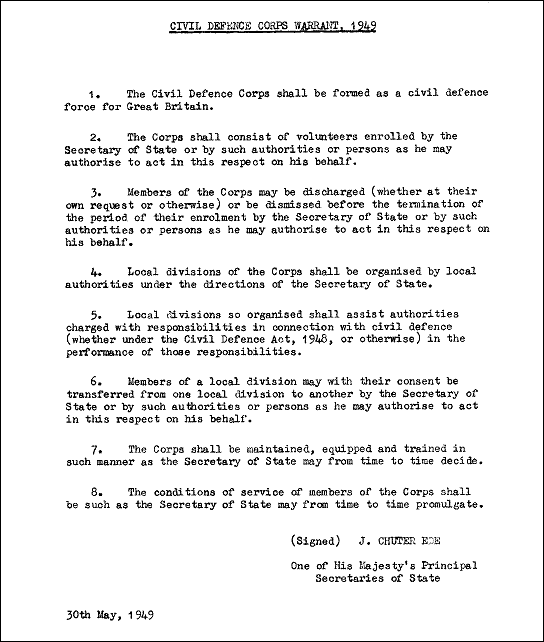
The Corps would provide the basic organisation and staff for local authorities to comply with the newly imposed civil defence functions. It was to consist of Divisions of unpaid but uniformed volunteers enrolled by “Corps Authorities” i.e. the County Councils and County Borough Councils and organised by them. However, overall policy and conditions for the Corps were to be determined by the Home Secretary who announced them in a series of Civil Defence Circulars (or CDCs) to the Authorities. Recruiting for the Corps, the Auxiliary Fire Service and the National Hospital Reserve Service started in late 1949. A copy of the Warrant for the Corps is shown below.
Corps members were trained locally in rescue, first aid and so on by qualified instructors most of whom had been to one of the civil defence schools which were set up in 1956 at Falfield, Easingwold and Tayworth Castle. There was also a Civil Defence Corps Staff College at Sunningdale. But Corps members had no obligation to attend training sessions and they could leave the Corps at any time. They also had no obligation to serve in wartime.
The Organisation of the Civil Defence Corps
For operational purposes, the local Divisions provided by the Corps Authorities would join together into Areas and then Groups. The Group Controller would work under the direction of the Regional Commissioner at the Regional War Room. In this way in the South West Civil Defence Region (Region 7), 76 Group was made up from the Civil Defence Corps Divisions of Devon and Exeter and was split into 5 Areas. The County Borough of Plymouth together with parts of Devon and Cornwall formed 77 Group.
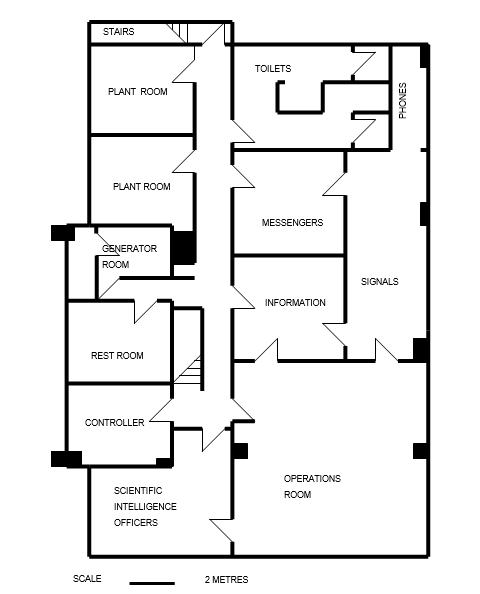
Each of the 400 or so Groups and Areas in England and Wales together with the 70 in Scotland would require its own control centre. The Home Office had given some suggestions about setting up these controls in the early 1950s. These reflected practices from the last war. Controls were to be set up depending on the size of the local population and would normally be away from potential targets such as railway yards and factory complexes. Their role would be, as one report put it “…a communications and intelligence centre at which the controller and his staff will operate during the mobilisation and life saving periods, and if necessary into the survival period”. They would not be used continually and would not need anything other than basic domestic facilities. Whilst many authorities re-used Second World War controls and many new ones were opened a large number of authorities lacked credible control premises. Some more detailed guidance about setting up a control was given to corps authorities in 1961 but due to a lack of funds these would normally be set up in existing premises. A Group Control could have some 3950 sq. ft of usable space and an Area Control 3350. Nominally, they would have staffs of 48 and 30 respectively and both were to be self-sufficient for 21 days. The diagram below shows the purpose-built control built in Wellingborough in 1962 at a cost of £48242. The control was built in the basement of a new fire and ambulance station and has a floor area of some 3300 square feet.
Each Division of the Corps was divided into operational sections reflecting the Corps’s role in responding to the immediate effects of the attack at the local level -
Headquarters Section
This Section’s main function was to man the static and mobile controls at the various local levels of the control chain, to provide communications, to undertake reconnaissance and to provide scientific advice to Controllers. For this latter role specialist Scientific Intelligence Officers were recruited from local people with a scientific background.
Warden Section
A 1960s Corps recruiting leaflet described the Warden as “…the vital link between the individual and the mobile services. In a nuclear war he would become the leader of his neighbourhood, advising and controlling the public and seeing that the survivors get help and attention”. Wardens would be responsible for local reconnaissance and reporting, for the organisation of street parties and the deployment of life-saving services within their areas. They also had special responsibilities in connection with warnings of deadly radioactive fall-out produced by nuclear explosions and control of the public in areas affected by it.
Welfare Section
The members of this section would help the Wardens with any “dispersal of priority classes” as the formal evacuation scheme was called. After the attack, they would provide immediate help with food and shelter and in the longer term with organising community life.
Evacuation was to be an official policy until the early 1960s and the 1956 Defence White Paper said it was the cornerstone of civil defence. The proposed evacuation schemes show the scale of civil defence planning but also perhaps the naivety of some of those plans. The basic plan was changed several times but in the mid-1950s the intention was to evacuate virtually all children and their mothers, together with the elderly and the disabled from the major cities that were expected to be the main targets. This would involve moving over 10 million people in England and Wales and a further 1 million in Scotland partly by road but mainly by train4. This should be done in 7 days - 1 for planning and 6 for the actual movements. The evacuees would be billeted for an indefinite period with families in the Reception Areas that would mainly be rural towns and villages. The married men back in the cities would be expected to carry on as with “business as normal”, without their wives and children, while waiting for the bomb to drop5. At the same time as this mass evacuation was taking place over a million members of the armed forces would be on the move together with all their stores and equipment. Vast amounts of food and other strategic materials would be moved from the ports and 360000 hospital patients would be relocated together with 68 million cubic feet of hospital equipment.
After the attack the welfare section would be expected to find accommodation for any homeless survivors or refugees in rest centres and organise emergency feeding. In the absence of electricity and gas, and the lack of food in the shops most people would have to be fed in this way. For this purpose virtually every school in the country was designated as a rest centre or emergency-feeding centre. Accommodation Registers were held centrally to ensure that the different agencies from central and local government, the armed services, government ministries, etc did not intend to requisition the same premises. The owners of these earmarked premises were usually not told of the intention.
The Welfare Section would be assisted by voluntary organisations particularly the Women’s Royal Voluntary Service, which had been established in the 1930s specifically for an Air Raid Precautions role. The WRVS was active in civil defence during the 1950s and 1960s and it was specifically excluded from the effects of “care and maintenance” in 1968 when the Corps was abolished and its role later expanded into many areas of emergency planning.
Rescue Section
This section would provide units for rescue, giving first aid to casualties, debris clearance and emergency demolition work. They would be working alongside the regular fire service, members of the armed forces, particularly the RAF, and members of the volunteer Auxiliary Fire Service who were trained in home defence fire fighting. At first the rescue section was based on the heavy rescue squads of the last war and equipped with complicated heavy lifting and rescue gear but the scale of damage from an H-bomb meant there would simply be too many injured and trapped to cope with and their role was scaled down and the squads re-equipped with only hand tools.
Ambulance and First Aid Section
Members of this section would provide the organisation for administering first aid to casualties, organising their evacuation to Forward Medical Aid Units and on to hospital. In war, it would merge with the peacetime ambulance service and work alongside the NHS, which would be augmented by the National Hospital Service Reserve. The NHRS would provide qualified nurses and nursing auxiliaries for the expanded hospital service.
The position in Essex
The Essex Civil Defence Corps plans from 1965 illustrate the extent of the planning and the manpower needs of the Corps according to its war establishment.
The Headquarters Section should have had about 800 members who would man the county control, 4 county sub-controls, 31 district controls and various mobile controls that would replace any of the static or permanent controls if they were destroyed.
The operational area for the Warden Section was the local authority district such as a town, which would be divided into one or more “sector posts”. These in turn would be sub-divided into 3 to 5 “warden posts” and reporting to each one of these would be 4 or 5 “patrol posts”. It was these patrol posts each manned by 2 wardens that would have the immediate role of collecting information and passing it up to the higher-level control. Public houses were frequently designated to be warden or patrol posts in wartime. Essex was divided into 55 sectors, 264 warden posts and 1024 patrol posts requiring 3135 volunteers. The war establishment of the Essex Welfare Section was about 5300. The Rescue Section was divided into 5 columns with a total of 2542 personnel. The Ambulance and First Aid Section would provide 8 columns totalling 2624 volunteers
In total, the planned war establishment of the Civil Defence Corps in Essex was about 15000. To this figure can be added the various voluntary groups, the Industrial Civil Defence Service, the National Hospital Service Reserve, the Royal Observer Corps and the police and fire services to give a total of about 20000 people. This would mean that some 2% of the total population of the county would be directly involved in civil defence.
But despite the best efforts of the planners, advertising campaigns and many dedicated members the Corps failed to generate significant public support particularly in the 1960s. Even in 1958, the Civil Defence Official Committee was expressing concern about apathy and shortage of equipment for civil defence. In 1959, the war establishment in England and Wales was some 800000 but there were only 335000 civil defence members and not all of these were active. By 1965, the Corps was only at some 25% of its war establishment. At the same time the Royal Observer Corps strength was 17000 against an establishment of 25000.
Organised in parallel with the Civil Defence Corps was the Industrial Civil Defence Service. This was founded in 1951 to organise civil defence activities at industrial premises particularly larger factories. The Industrial Civil Defence Companies were organised and equipped by individual businesses who did not receive financial assistance although they did benefit from tax relief on the costs. In 1966 there were about 106000 volunteers and instructors in the Service.
In the early 1950s, the Home Office set up a Mobile Civil Defence Column to experiment with the idea of moving a large body of civil defence personnel and their equipment to a city after it had been hit by an atom bomb. The column, which had some 180 personnel and was self-contained was disbanded in 1954 but the arrival of the hydrogen bomb meant there was a much greater need to reinforce the civil defence forces in the directly attacked areas with “a disciplined body under direct military control”. This lead to the setting up in 1955 of the Mobile Defence Corps which would be trained and equipped for fire fighting, rescue and ambulance duties. It would be manned by army and RAF reservists who would receive some basic training at the end of their period of national service. In wartime they would be called up to form 48 Mobile Defence Battalions each with around 600 men. But the end of national service meant that there would be insufficient reservists to man the Corps and it was disbanded in 1957. There was also an attempt in these years to re-establish the Home Guard but this received little public support and was soon abandoned.
The Central Government War Room
In the late 1940s and early 1950s, the civil defence planners expected the next war would follow the same basic pattern as the last. There would be widespread conventional air attacks on cities and from the 1950s some of these would include atomic bombs and chemical weapons. Plans were made accordingly. In the late 1940s, a national survey was made of all available shelter space; plans for censorship and blackout were drawn up and millions of new civilian gas masks ordered. There was even a Working Party set up “to consider the civil defence arrangements for domestic animals and wild animals in captivity”. By the early 1950s, the assumption was that war would begin with an initial onslaught of atomic bombs after which both sides would recover and fight an extended “broken backed” war with whatever resources could be scraped together.
By 1955, plans were being made on the assumption that the UK would be hit by 132 atomic bombs targeted on seats of government, industry and population with London receiving 35 bombs. The planners based their calculations on what they called the “nominal bomb” with an explosive power or yield of 20 kilotons6, roughly equivalent to those dropped on Japan. They predicted that these bombs would kill 1680000 people and injure another 957000. Two-fifths of the country’s houses would be wrecked and half of the manufacturing industry would be destroyed or damaged. The loss of life, casualties and damage would be horrendous but based on experience from the Blitz and the attacks on German cities like Hamburg and Dresden the attacks would not result in the breakdown of society or the system of government. Consequently, civil defence measures were only needed to help the survivors in the immediate “life saving” period to cope with the immediate and localised effects on the attack.
The results of the attacks would need to be monitored both regionally and nationally. The World War ll regions were therefore re-instated again under Regional Commissioners with the same dual responsibilities. They would oversee civil defence operations and if necessary assume complete control of the region if communications were lost with the central government in London.
However, more grandiose plans were developed for the central government. When planning started for World War 3 in 1948 the first idea was that the core of the government machine would remain in London but up to 20000 civil servants would be evacuated to sites used during the last war such as Blenheim Palace, Colwyn Bay and Bletchley Park (the home of “enigma”). This move was not to protect the civil servants but to free accommodation for the expected expansion of government and the influx of allied military staffs and mirrored actual events in late 1940 when the Yellow Move had been re-introduced to free office space in London. By 1950, the plan had evolved and the Soviet Union had the atomic bomb. It was assumed that London would continue as the seat of government but as the bombing steadily destroyed buildings, blocked roads and disrupted communications it would become progressively unusable and perhaps completely so after 6 months. The bulk of the 150000 civil servant and staffs of key organisations would now progressively leave as conditions dictated. The key phrase in planning was now “due functioning” meaning that all essential aspects of government and indeed national life should be able to continue through the war and in particular survive enemy bombing. Many ministries made plans for their areas of responsibility. The electricity industry for example was particularly well prepared with a National Wartime Grid Control Centre built at Becca Hall near Leeds together with a reserve at Rothwell Haigh and 7 other regional emergency control centres. It also had several specially built warehouses containing reserve generating and transmission equipment.
Even though the bulk of the civil service would leave, the nucleus of government would for practical and morale reasons remain in London to control the government machine and conduct the war. The nucleus would consist of people essential to the war effort from the government, civil service and armed forces together with representatives from allied governments and bodies such as the Bank of England, Boards of Nationalised Industries, the Red Cross, TUC and major companies such as ICI. The planners thought this nucleus would need 7800 people but as it would have to operate from the same wartime citadels and steel framed buildings as before numbers were restricted to the 5800 these buildings could accommodate. Some additional accommodation was however becoming available. A new bunker near the wartime Montague House citadel was planned to have places for 1750 people by 1955. The Rotunda site was also being refurbished to take 950 people by 1954. There are also hints in the Public Record Office files of a “deep tunnelling scheme” planned at this time somewhere under London probably in the Whitehall area which was codenamed PIRATE. It would accommodate 800-1000 members of the nucleus together with a large communications centre but it appears to have been overtaken by later plans to evacuate the seat of government from London. At the same time, the armed forces planned to set up a combined war HQ at Northwood in north London.
There is no mention in the available documents from this time of a new Cabinet War Room. The original premises had simply been closed at the end of the war and it may originally have been intended to simply bring them back into use. The 1952 War Office War Book refers intriguingly to a “Central War Room or Map Room”, which would be opened on the instructions of the Secretary of the Cabinet and locates it under The New Public Offices in Whitehall, the former location of the Cabinet War Room.
In February 1953 The Times reported that as well as new Regional War Rooms a Central War Room would be established. But this was not to be a new Cabinet War Room. The Times said that “information from all departments with civil defence responsibilities would be collected and collated” in this Central War Room. This suggests a purely civil defence function and publicly available documents in the 1950s concentrated on this role for the Central War Room or Central Government War Room as it was more often called in official circulars. One of these documents, for example said “It is proposed that the Government will establish an operations and intelligence centre in which information affecting all departments with civil defence responsibilities would be collated and from which advice and information would be distributed and instructions on such matters as inter-regional reinforcement issued”.
In fact, lecture notes had been secretly issued to civil defence instructors in 1952 which said, “A CGWR (as the Central Government War Room was usually called) representing all Government Departments will be established with dual responsibilities -
- Control of civil defence operations : the overall co-ordination of civil defence operational arrangements and issuing of orders on matter such as inter-regional reinforcement.
- Civil administration : the dissemination of information and direction of matters affecting the protection of the population and property and the maintenance of law and order and implementation of emergency legislation.”
This is really a restatement of the roles given to the Ministry of Home Security War Room in 1939 and shows that the CGWR would have repeated its function although there was at this time no intention to set up a separate Ministry of Home Security and the CGWR was the responsibility of the Home Office.
By the mid-1950s a home for the CGWR had been found in the old North Rotunda bunker, which at this time housed the Air Raid Warning School. This may have provided a convenient cover to allow the site to be equipped with the necessary equipment and communications to monitor the effects of air raids. But, the Rotunda site may not have been considered a permanent solution because a 1957 Home Office report advised Ministers that “it would be unwise to establish in NAVE or any of the London citadels the CGWR”. During exercises in the late 1950s the CGWR role was usually simulated. For example during the large scale fall-out reporting exercise called Four Horsemen held in 1957 its role was taken by directing staff at the Birmingham Regional War Room. The CGWR’s role was soon to be absorbed into the much larger SUBTERFUGE emergency war headquarters complex but the Rotunda site was still used and in 1962 it was used as the communications centre for Exercise Fallex62 when it was codenamed CHAPLIN. During the exercise it was also used as the “exercise seat of government” which might suggest that the site was also earmarked for the central government or Cabinet War Room role. However, for “security purposes” the site was not manned by the civilian elements that would occupy it in a crisis. In the 1960s, the huge Marsham Street office block was built over the Rotundas for the civil service and there is some evidence that they continued to be used as at least a communications centre into the 1980s.
The Regional War Rooms
At the local level, the civil defence effort would need co-ordinating and the wartime regions were re-instated under the direction of a Regional Commissioner. The Regional Commissioner’s were now given purpose built War Rooms which according to the 1949 Working Party would be “established outside the central key area of its Regional town, it must also be located in an area where adequate signal communications can be provided to keep the War Room in touch with other civil and military headquarters in the region…and with the Central War Room in London.” In practice, they were built at the sites of the regional civil defence centres from the last war: -
| Region | ||
|---|---|---|
| 1 | Northern | Newcastle |
| 2 | North Eastern | Leeds |
| 3 | North Midland | Nottingham |
| 4 | Eastern | Cambridge |
| 5 | London | see text below |
| 6 | Southern | Reading |
| 7 | South Western | Bristol |
| 8 | Wales | Cardiff |
| 9 | Midland | Birmingham |
| 10 | North Western | Manchester |
| 11 | Scotland | Kirknewton |
| 12 | South Eastern | Tunbridge Wells |
| Northern Ireland | Belfast |
Under the original scheme London was to have its War Room at Ken Wood in Hampstead. From there the Regional Commissioner would control the 4 zones that the city would be divided into. During the last war, the London Region War Room7 had a large staff and this was expected to be repeated with the London Regional Commissioner having a staff of around 1500 although only about 100 would be accommodated in the War Room. However, by 1951, this idea had changed and London was given 4 single-storey surface built war rooms, which were styled “sub regional commissioner’s war rooms” at Mill Hill, Wanstead Flats, Chiselhurst and Cheam.
The Scottish War Room or Scottish Central War Room as it was also styled would have 2 subordinate war rooms at Edinburgh and East Kilbride serving Scotland’s Eastern and Western Zones respectively.
The War Rooms were built to a standard design of a 2-storey building giving some 9500 square feet of space. They were all built on the surface although some had the lower floor below ground level. The roof and walls of the box like, windowless buildings were 5 feet thick and designed to withstand a direct hit from a 500-pound bomb. The rooms were arranged around a central 2-storey map room and the first floor offices were glass fronted so they could look down on the main regional map. In wartime, the Regional Commissioner would be supported in the War Room by an operational staff of scientists, communications operators, members of the Civil Defence Corps, the military, the emergency services (notably the fire service) and government ministries who could assist him with the strategic direction of the immediate civil defence effort during and after any attack. The war rooms were equipped with their own generator and air filters together with extensive communications equipment served by 40 staff working in shifts. Although not intended for continuous occupation they had small male and female dormitories equipped with 2-tier metal bunks, a few showers, a canteen and a small kitchen. The Regional Commissioner would be supported by a Deputy Regional Commissioner and one of his main roles would be to call Post Raid Conferences with representatives from central government, local authorities, the armed services and industry.
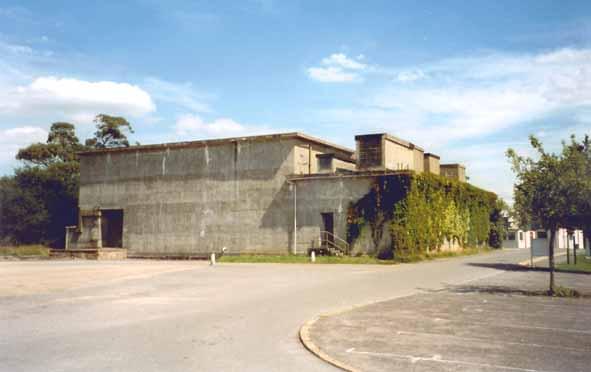
Reading Regional War Room in 1997 (Mark Bennett)
Building of the War Rooms did not start until 1952. The London ones were all built by 1953 but the others took longer and it was not until 1956 that the last, at Shirley in Birmingham, was completed. The War Rooms were soon over-taken by other plans but they continued to be exercised until around 1960/61 when the larger Regional Seats of Government started to become operational.
According to lecture notes given to Civil Defence Corps instructors the role of a regional war room was -
- To report immediately to the Home Office War Room first bombs and flares and other vital information.
- To arrange assistance for towns under attack (eg from other towns and Regional Columns).
- To collate information, send situation reports and disseminate essential information.
- To co-ordinate all operational movements.
If a city or town was badly affected an advanced headquarters would be set up on the outskirts to provide local co-ordination. In reality, these functions were little different to the Regional War Rooms set up during the Second World War and reflected the expectation that in the early 1950s the next war was expected to be fought, at least as far as the home front was concerned, on the same lines. From the mid-1950s the War Rooms were given the task of monitoring the new menace of fall out and their staffs were expanded so that they could operate continuously on a 3 shift basis. They were however to be overtaken by the consequences of the H bomb and their functions and operations were absorbed into the largely theoretical new joint civil military headquarters.
File 3: A Difference in Kind - The Megaton Weapon
Central Government in War - the Strath Report - response to the H bomb
The Padmore Working Party
In 1953 the Hall Committee was set up to consider the “national economy in war”. The Committee assumed that the central government would stay in London although the attack would kill many ministers and their officials. The Committee’s report questioned if the Regional Commissioner organisation could take over from them and highlighted the need for an effective central government in the post-attack period. The report lead to the setting up of a second committee under Hall to consider the economy during the “broken backed” period of the war and another under Maclean to consider the effect of atomic weapons on the armed forces. More importantly, a third committee was established under the chairmanship of Thomas Padmore, a Treasury official who had headed the Committee on the Redistribution of Government Staff in War since the late 1940s. This committee would consider the positioning of the seat of government during the initial stages of a future war.
Some information was becoming available from American tests about the effects of the new hydrogen bomb8 and the Padmore Committee took this into account. Its first recommendation, made in February 1954, was that the seat of government itself should remain in London using existing and extended “protective works” to accommodate 7700 key players. This would only deal with war fighting and foreign relations and other matters that needed to be centrally co-ordinated. As far as possible domestic government functions should physically be devolved to the regions. Padmore then wrote to government departments to ask what staff they would need to operate on a regional basis for the first fortnight of the war and the totals came to a surprisingly large figure of about 1000 in each region.
By this time new bunkers had been built in central London to supplement the original Second World War accommodation. By the early 1950s a new single storey bunker had been built roughly half way between the Rotundas and Whitehall under what is now the Queen Elizabeth ll Conference Centre. More significantly, the military had acquired a major new bunker in Whitehall Gardens near the site of the former Montague House. A building on this site had originally been planned in 1935 with a reinforced first floor and major air raid shelter basement. Part of this was completed and used during the war as the Montague House War Room. By 1954, a new bunker had been completed on the site 20 feet underground and topped with 9 feet of concrete to accommodate 700 people. A massive new building was then built for the civil service on the site which became the headquarters of the Ministry of Defence and is today usually known as “MoD Main Building”.
All these bunkers were linked to the Whitehall cable tunnel that was enlarged to provide underground pedestrian access to the various buildings. Additionally, a new tunnel was dug under Horseguards to provide a new telephone exchange. The General Post Office also expanded a wartime series of 7 feet wide tunnels under central London to carry cables between its main telephone and telegraph exchanges
At the same time, a major trunk exchange was secretly built in London under Kingsway alongside the Chancery Lane underground station by expanding one of the Deep Level Tube Tunnels built during the war as large-scale air raid shelters9. Other underground exchanges were built at Birmingham and Manchester known respectively as Anchor and Guardian. These were major works. Guardian for example is 112 feet underground and its main tunnel 1000 feet long and 25 feet wide. It cost £4 million in 1954, the equivalent of £50 million today.
The early plans envisaged the seat of government staying in London at least until the Whitehall area became uninhabitable but as early as 1949 the Working Party on War Rooms advised that it would be desirable to provide an alternative CGWR outside the London target area. Now Padmore, as well as saying that the seat of government should remain in London, specifically recommended that a reserve facility for the seat of government should be established outside London to be known as SUBTERFUGE. In response, the Home Defence Committee of the Cabinet said priority should be given to SUBTERFUGE over the proposed protective works in London because even if a nucleus of government survived in London the conditions would make it very difficult to exercise effective direction from it. Moving the seat of government from London was seen as “impractical for reasons of morale” but “after the blitz a shadow government in SUBTERFUGE takes over and if something survives in London and it can continue to exercise some nominal direction via SUBTERFUGE, so much the better.” Padmore also said local government could not be relied on after an attack and so the regional civil defence chain of command should be strengthened.
The Strath Report on Fall Out
Padmore took into account the effects of the hydrogen bomb which were beginning to be understood following the first test of it by the Americans in 1952. These effects, and particularly the impact of radioactive fall-out were spelled out in the 1955 Defence White Paper which said of the hydrogen-bomb, or “the megaton weapon”10 as it was often called, “If such weapons were used in war they would cause destruction, both human and material on an unprecedented scale. If exploded in the air, a hydrogen bomb would devastate a wide area by blast and thermal radiation. If exploded on the ground the damage by blast and thermal radiation would be somewhat less but there would be additional extremely serious indirect effects. A great mass of atomised particles would be sucked into the air. Much of it would descend round the point of explosion but the rest would be carried away and descend as radioactive “fall-out”. The effect on those immediately exposed to it without shelter would certainly be fatal within areas of greatest concentration of the “fall-out”. It would become progressively less serious towards the outer parts of the affected region. Large tracts would be devastated and many more rendered uninhabitable. Essential services and communications would suffer widespread disruption. In the target areas, central and local government would be put out of action partially or wholly. Industrial production, even where the plant and buildings remained would be gravely affected by the disruption of power and water supplies and the interruption of the normal complex inter-flow of materials and components. There would be serious problems of control, feeding and shelter. Public morale would be most severely tested. It would be a struggle for survival of the grimmest kind”.
The White Paper went onto say that all home defence plans would have to be completely overhauled as it was no longer possible to think in terms of the experience of the last war or even of the threat posed by atomic weapons. A new approach was called for but the White Paper said that until the implications had been fully assessed it would be unwise to do anything. But this was a deliberate attempt to keep the real effects of the H bomb from the public and the implications were in fact being assessed, and in great secrecy, by the Strath Committee.
This committee of 3 senior civil servants, 2 military officials and a scientist and chaired by William Strath, a Cabinet Office official working for the Central War Plans Directorate was set up in December 1954 to consider the effects of the hydrogen bomb and in particular the new phenomena of radioactive fall out. Its report delivered to the Cabinet some four months later was a pivotal event in British Cold War planning but one which remained secret for nearly 50 years.
The Committee considered the effects of 10 H-bombs each of 10 megatons dropped, at night, on British cities and which would result in “…a threat of the utmost gravity to our survival as a nation.” As well as blast, one bomb could produce up to 100000 fires. Fall out would create “…an inner zone of approximately 270 square miles (larger than Middlesex) in which radiation will be so powerful that all life will be extinguished…”. There would be 12 million dead and 4 million other serious casualties - one-third of the population. A further 13 million people would be pinned to their homes for at least a week by fall-out. This compares with the two and a half million casualties expected from the 132 A-bomb attack.
Apart from the loss of life “The houses of a very large proportion of the working population would be destroyed or rendered uninhabitable by ordinary standards as a result of widespread damage to roofs and walls by blast. The effectiveness of the surviving working force would be seriously reduced by illness…longer term effects would be primarily to reduce the economic power of the country…”. There would be destruction over half the country. Forty per cent of industrial capacity would be crippled with grave dislocation of essential utility services over a wide area. This, in turn, would disrupt the distributive systems of the country and interfere with ordinary social and economic processes including the mechanism of money transmission. Apart from the direct loss of food stuffs widespread contamination would affect most forms of agricultural production and water supply. There could be no reliance on normal imports for a considerable time and the survivors would have to subsist under siege conditions on whatever stocks remained. The continued effect of these and other consequences of nuclear attack would be to set up a “chain reaction” in the social and economic structure of the country. Even those not directly affected would suffer malnutrition and be unable to give their best in the work of restoration. A disproportionate loss of the working population and of key personnel might leave excessive numbers of “useless mouths11” among the survivors.
Some information about the immediate effects of the new bombs was given to the public in a civil defence booklet called simply “Nuclear Weapons” published in 1956. It compared the “nominal” atomic bomb with a yield of 20 kilotons with a new “nominal” hydrogen bomb with a yield of 10 megatons. Its readers were told that a hydrogen bomb exploding at the optimum height of 8000 feet would produce damage over an area 64 times as great as the atomic bomb. A figure that explains the authorities' private concerns that civil defence measures could simply not cope. The following table from the booklet shows the comparative blast damage ranges of 3 possible bombs -
| Effect on houses | Range for air-burst nominal bomb 1000ft high (miles) | Range for air-burst 10 megaton bomb 8000ft high (1 1/2 miles) (miles) | Range for ground burst 10 megaton bomb (miles) |
|---|---|---|---|
| Total destruction | ½ | 4 | 3 ½ |
| Irreparable damage | ¾ | 6 | 5 |
| Moderate to severe damage | 2 | 16 | 13 |
| Light damage | 3 | 24 | 20 |
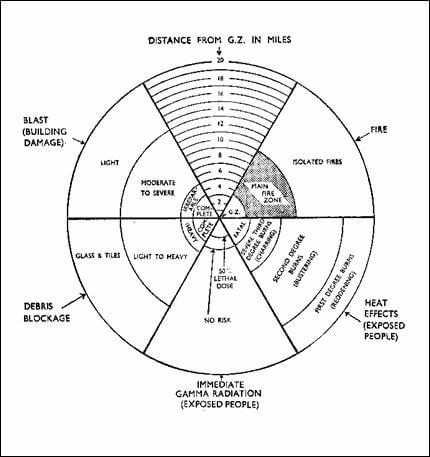
The booklet showed why the Strath Committee were so concerned about fall-out. It said that blast damage from both atomic and hydrogen bombs would be greater with airbursts, which would give only small amounts of fallout. However, the destructive range of a single hydrogen bomb was so great that if exploded at the optimum height of 8000 feet it would exceed the size of all British cities (with the notable exception of London). Consequently, a lot of the blast effect would be wasted. Military strategists therefore expected that the Soviet bombs would be set to explode at ground level where the blast would still destroy the entire city but also create a massive amount of deadly and disruptive fall-out. The diagram below taken from the booklet shows the effects expected from a 10 megaton ground burst at various distances from “G.Z.” or ground zero, the point of impact. Figures such as these have been disputed over the years but they show what the authorities were preparing for -
The following year the 1957 White Paper “Defence - Outline of Future Policy” was even blunter when it said “It must be frankly recognised that there is at present no means of providing adequate protection for the people of this country against the consequences of an attack with nuclear weapons.”
At this time the Joint Intelligence Committee, which advised the government on Soviet military preparations were suggesting that the Soviets were unlikely to launch a nuclear attack in the face of massive NATO retaliation and in any case the Soviets would not have sufficient nuclear bombs or aircraft to carry them to attack until at least 1958. This no doubt accounts in part for the slow build up of the civil defence response to the H bomb although it was assumed that the aim of any Soviet attack would be to -
- Knock out as soon as possible any airfields from which a nuclear attack on the Soviet Union could be launched.
- Destroy the organisation of government.
- To render the United Kingdom useless as a base for any form of military operation.
In practice, the Soviet Union did not have a meaningful strategic nuclear force until the early 1960s and then it would have had to take into account targets throughout North America, Europe and possibly the Middle and Far East. Soviet doctrine recognised the problems that Strath predicted but as material which has become available since the end of the Cold War shows it envisaged a different scenario to NATO and in particular US theorists. Like NATO, the Soviet planners assumed that the other side would attack first and with a devastating nuclear strike. But while NATO strategists assumed the strike would render further military operations impossible or irrelevant their Soviet counterparts expected that the Soviet lead Warsaw Pact forces would absorb it and then go onto the offensive. The strategic nuclear attack would be devastating but a nuclear war would still be winnable in the sense that the object would be to destroy the West’s ability to wage war on the Soviet Union both immediately and in the long-term. The initial role of Soviet nuclear forces would be to destroy NATO’s nuclear weapons, but then nuclear weapons would be used freely to support land operations in Western Europe. More significantly, once NATO’s nuclear forces had been destroyed, which would in itself cause massive civilian casualties, attention would be turned to directly destroying its population centres and economic infrastructure. The result was that the Soviet nuclear attack would be directed at civilian as well as military targets and would continue for as long as the war lasted.
The Strath Committee’s report recommended long-term policies such as siting factories and government buildings in safer areas, devolving work to regions, installing protected basements in new buildings and strengthening the regional organisation. More immediately, from a military viewpoint the report was traumatic. An attack on the scale envisaged would smash the UK home base and render it unusable for global military operations. The armed forces would need to be restructured for a much shorter war with little need for reserves of men or equipment. The focus of military activity would shift from fighting World War 3 to assisting the country during the survival period after it12. One consequence, for example, was the abandoning of Operation Knockout, the plan to repel an invasion and the subsequent closure of all the coastal artillery batteries left from the last war at places like Dover and Newhaven.
Despite the scale of the devastation Strath thought the country could survive and recommended large scale plans for public shelter and evacuation. The idea of requiring all new buildings to incorporate fall-out shelters was however quickly dismissed on grounds of cost and the problems that would result from older properties not having this protection. Evacuation was however considered and resulted in a plan to evacuate 11½ million people in the “priority classes”, mainly children and their mothers from the cities. The workers were expected to stay behind to ensure that the economy continued although some suggestions were made that this would be unrealistic and there were some ideas that plans could be made for the city workers to leave the towns at night and return in the morning - until presumably they were attacked and destroyed.
The Strath Report said it was impossible to forecast how people would react particularly if several bombs hit one city but “…there might be complete chaos for a time and civil control would collapse. In such circumstances the local military commander would have to be prepared to take over from the civil authority responsible for the maintenance of law and order and for the administration of Government. He would, if called upon, exercise his existing common law powers to take whatever steps, however drastic, he considered necessary to restore order. He would have to direct the operations of the various civil agencies including the police, civil defence services and the fire service. In areas less badly hit the civil authorities might still be able to function but only with the support of the armed services”. This suggests that martial law would be needed but later the report seemed to play down the idea when it said “Military authorities support the civil authorities in the maintenance of order and control and where necessary take over from them”. But, the idea of martial law was not apparently pursued and it was not even mentioned in the Chiefs of Staff’s discussions of the report. Instead, for the civil defence organisation, the first response to the report was to order an immediate strengthening of the administration. A Director General of Civil Defence had been appointed the previous year to co-ordinate plans at all levels but now the Home Office’s regional civil defence offices were enlarged and Regional Directors of Civil Defence (invariably ex-senior military men) appointed. These regional offices would oversee the civil defence preparations of the local authorities and look after regional level activities such as the War Rooms and exercises. At the operational level previous plans had assumed the Regional Commissioner would take on the powers and functions of the central government in the region if communications were lost with central government in London. This was now seen as virtually inevitable and to reflect this greater governmental role the Regional Commissioner would now be a government minister or a person of ministerial status rather than a member of what was referred to as “the great and the good”.
Joint Civil/Military headquarters
The existing Regional War Rooms would be too small both physically and in terms of staff numbers to direct the civil defence response to an H-bomb attack and to form the central government for the region. This lead to the idea of setting up a much larger joint “civil-military headquarters” in each region. In 1956 a nominal list of 441 staff was compiled (against the originally suggested 350). This list suggests that the intention was to establish a Regional War Room structure as before but with a much greater representation from the government departments and the armed forces to handle the post-survival period. The headquarters would still lead the regional efforts at “life saving” and it had a large military presence, which included the headquarters of the Army District, reflecting their increased role in the survival period and the large number of reserve formations now allocated to civil defence. But, the new headquarters would now have a more important and longer term role in acting as the government for the region until a proper central government organisation could be re-established months, possibly years, after the attack.
Some instructions for the new headquarters were written for Exercise Four Horsemen in 1958. These said that the “Regional headquarters would be, in effect a smaller nuclei of government at which, under the direction of a Regional Commissioner (in Scotland the Secretary of State) those departments having a home defence function would be stationed. The Regional Commissioner would execute government policy for so long as he was in contact with the central headquarters and act as the Government for his region if and for as long as he was isolated”. The headquarters would be manned at the start of the precautionary period when the Regional Commissioner would have specific powers delegated to him and then gradually assume responsibilities from the peacetime government machine. The Regional Commissioner would be supported by a Principal Officer, the peacetime Regional Director of Civil defence, Regional Police Commander, Regional Fire Officer, Regional Scientific Adviser, Principal Medical Officer and representatives from government departments and the district army command. The main government departments would be well represented according to their post-war roles and the largest contingents would come from the Home Office, Maff and the Ministry of Transport. The Regional Commissioner would be regarded as the effective central government authority for all home defence matters from the time he took up office but the devolution to him of powers would take place in stages. He and his staff would only act as agents for their parent Ministers until the central government nucleus took control when he would assume all powers except those specifically reserved for the centre but he would still act on any policy directives received from central government.
The 2 distinct but overlapping roles were summed up in Civil Defence Corps training notes from the time which said “In each civil defence region there will be in war a Regional Commissioner appointed by central government who will at the direction of central government undertake…
- Control of civil defence operations: the Regional Commissioner will have overall-ordination of civil defence operational arrangements in the Region.
- Civil administration: wide powers may be devolved on Regional Commissioners by Government Departments in an emergency situation. If communications with central government are disrupted they will take decisions affecting their regions which would normally be taken at central government level.”
In 1956 the Regional Directors of Civil defence were told to look for suitable accommodation for use in an emergency. These would probably be in government owned buildings and preferably underground. At the same time plans were drawn up for purpose built headquarters which would be a “windowless concrete structure above ground giving protection against fall-out but not blast”…. built around a 2 storey operations/intelligence room. The building would have first floor and basement levels with the central redoubt basement having a very high protection factor of 1000. An innovation which was to continue in all subsequent proposals for regional level headquarters was the inclusion of facilities for the BBC to allow direct broadcasting from the headquarters to the survivors.
The first of these purpose built headquarters was to be built at an army site in Shrewsbury but, as so often happened there was a lack of funds and in 1958 the Home Office reported that construction of these headquarters had been deferred and efforts were to be put into finding suitable premises which could be adapted at short notice and at little cost.
By 1958 sites had been identified for these emergency joint civil/military regional headquarters (with the origin of the main building given in brackets): -
| 1 | Catterick | (barracks) |
| 2 | Easingwold | (civil defence school) |
| 3 | Nottingham | (War Room) |
| 4 | Cambridge | (War Room) |
| 5 | Dollis Hill | (World War ll bunker) |
| 6 | Reading | (War Room) |
| 7 | Taunton or Exeter | |
| Wales | Brecon | (barracks) |
| 9 | Shrewsbury | (barracks) |
| 10 | Fulwood, Preston | (barracks) |
| 12 | Tunbridge Wells | (War Room) |
| Scotland | Lanark | (barracks) |
The planned building at Shrewsbury was abandoned in favour of a temporary site in World War ll tunnels at Drakelow near Kiddiminster which would in practice be used until the whole structure of control headquarters was abandoned over 30 years later. The Dollis Hill site, which had been used during the last war as the PADDOCK War Room was not developed and it became unnecessary after 1959 when the idea of a separate wartime London Region was abandoned.
In reality little if anything was done to prepare the headquarters. Equipment was not provided and staff were not recruited and when in the very early 1960s some regions held exercises for the new Regional Seats of Government which had evolved from the joint civil/military headquarters concept they often used the old War Rooms confirming that sites for the Joint Civil/Military HQs were not prepared.
Sub-Regional controls
As the 1955 Statement on Defence had put it, following the findings of the Strath Report, an attack with hydrogen bombs would result in a war, which “would be a struggle for survival of the grimmest kind”. In the following year, a civil defence circular13 announced that “the megaton weapon has produced a situation so different in degree as to amount to a difference in kind”. This required a “complete overhaul of our home defence plans…the number of casualties, extent of damage by blast and fire, and restrictions on movement imposed by fall-out will necessitate a much closer co-ordination of effort, over far wider areas than has previously been required”. The circular then went on to announce a new level of control to respond to this need in “certain densely populated industrial areas” although it did not make the obvious connection that these areas were expected to be the prime targets for the megaton weapons. It said that the Regional Commissioner would still direct civil defence operations from the Regional War Room and, as in the last war, he would, if necessary, exercise full powers of central government. But to co-ordinate the lower levels of control in these areas sub-regions would be created each under the control of a Sub Regional Controller. He would be appointed by the Home Office showing that this important level of control would be a central government and not a local government one. The sub region would extend about 20 miles from the centre of its conurbation and the Controller would operate from a protected Sub Regional Control or SRC located near the boundary. This would have a staff of 96-108 people from the central government departments with civil defence responsibilities such as Agriculture, Health, Housing and Local Government, Transport and Works together with representatives of the GPO, the army and in particular the emergency services.
These Controllers would be appointed in peacetime after consultation with the local authorities and with “regard…. not only to their capacity to undertake the control of operations in war, but also to their local knowledge and standing” but they and the SRC would have no peacetime role. After the attack the SRC would control all the life saving civil defence activities in its sub-region in what were called “…large scale operations to succour the homeless”. The Civil Defence Corps Group structure in these sub-regions would be abolished and the Area controls would now report directly to the SRC. There was also to be a change in the role of the civil defence forces outside the sub-regions. Their task was now primarily to be geared towards reinforcing the civil defence effort in the smashed conurbations. It was also suggested that the civil defence forces from within the sub region should be withdrawn before the attack again confirming that the cities were expected to be attacked
The sub regions (with the nominal SRC locations in brackets) were -
- Tyneside (Nevills Cross, Durham)
- Tees-side (Scotch Corner, Richmond)
- The industrial area of the West Riding and North Derbyshire (two sub-regions) (Killinghall Moor, Harrogate and Conisborough)
- Derby, Nottingham and the adjoining parts of Derbyshire and Nottinghamshire (Matlock)
- Southampton, Portsmouth and adjoining parts of Hampshire (Andover)
- Cardiff, Newport and adjoining parts of Glamorgan and Monmouth (Crickhowell, Brecon)
- Swansea and adjoining parts of Glamorgan and Carmarthen (Llandilo, Carmarthen)
- Birmingham, Coventry, the Black Country and adjoining parts of neighbouring counties (two sub-regions) (Stafford and Worcester)
- South Lancashire, Wirral and adjoining parts of Cheshire (four sub-regions) (Rawenstall, Rufford and Macclesfield)
- Bristol, Bath and adjoining parts of Somerset and Gloucestershire (Box)
London was specifically excluded from the Circular but continued to be divided into four parts, each of which was designated as a sub-region to give a total of 19 sub-regions. However, in 1958 the Northwest London sub region was split into two to create a new North sub-region. The rest of England and Wales at this time was divided into 45 civil defence Groups.
However, as so often happened with civil defence once the plan was announced little was done to implement it. In its 1957 annual civil defence report the Home Office said that no expenditure had been incurred on SRCs and also that the programme of local authority controls was virtually at a stop. By 1958 11 of the 19 Sub Regional Controllers, mostly ex-generals or colonels, had been appointed but the 1959 Home Office report said “no premises or staff have been earmarked” adding that county councils may have to be asked to provide them if necessary. In the same year the Official Committee said that “The present lack of any visible provision for the control of operations is one of the manifest deficiencies in the state of civil defence which discourages local authorities and civil defence services.”
In practice, all the planning for civil defence seems to have proceeded at a very leisurely pace throughout the 1950s and 1960s. The main reasons for this appear to have been the constant lack of money for civil defence capital expenditure, the lack of political interest and the planning assumption that the nuclear deterrent made a world war unlikely. But it also seems to be due to a general lack of enthusiasm amongst most civil servants in the government departments involved and the apparent need to set up a committee or working party for every activity. The methods and their effects are well illustrated by the provision of maps. In 1958, a working party was set up to consider the need for maps at all levels of civil defence and it decided that some 250000 maps would be needed. But, although obviously vital, they would be expensive and incur on-going storage costs and consequently nothing was done as a result of the working party’s report. The matter was then reconsidered and deferred in 1963 and again in 1965 before being quietly forgotten.
By 1960, some SRCs were coming into existence. In September, Midland Region held “Exercise Mercian Trump” to test the organisation of its 9.1 sub-region although, as the exercise brief said, there was no organisation yet laid down and they based it on the regional one. The exercise planners took the SRC’s role to be “the control of subordinate centres, the allocation of forces and reinforcements to subordinate controls and the co-ordination of the life saving operations of the subordinate controls”. In the absence of a proper SRC the exercise was held using accommodation at the War Room site in Shirley. The War Room itself was designated as the Regional Seat of Government for the exercise.
It was not until six years after the SRC plan was announced that a working party was set up to consider the organisation of an SRC. Even then, this only looked at its role in the immediate life saving period, which was only expected to last two to three days. Planners now recognised that the SRC would need to have a role in the following “rehabilitation” or survival period but this was not to be considered until the revised role of the local authorities in this area was decided. The working party suggested a nominal SRC with an operational area of 6250 square feet (see outline plan below) plus some 1800 square feet for kitchen, canteen, dormitories, washrooms, stores and plant rooms although they would not necessarily be in permanent or even protected accommodation. As with the War Rooms the emergency services, in particular the fire service would be well represented together with police and civil defence. The Sub-Regional Controller would have a Chief of Staff and an Administration Officer to look after welfare and general administration but staff numbers were to be kept to a minimum and the suggestion was for 88 to 95 people with again the communications teams who would work a shift system making up the largest element.
Nominal layout of the operational areas of a Sub Regional Control
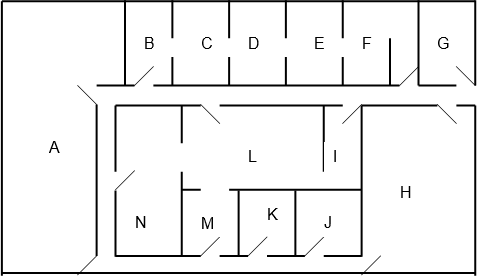
| A | Fire Service | 1200 sq ft |
| B | Army | } |
| C | MAFF, Min of Health | } |
| D | Min of Power | } 1100 sq ft |
| E | Min of Works, Min of HLG | } |
| F | Min of Transport | } |
| G | Admin, messengers, Despatch riders | 200 sq ft |
| H | Signals (counter room, Phonogram & wireless, Apparatus room) | 810 sq ft |
| I | office | 150 sq ft |
| J | Police | 250 sq ft |
| K | C D Operations | 240 sq ft |
| L | Information room/ Conference room | 500 sq ft |
| M | Controller & Chief Of Staff | 200 Sq ft |
| N | Scientific Advisers |
With the inclusion of the SRC a control chain now existed, in theory at least, from the seat of government in the Central Government War Room to the individual Civil Defence Corps Wardens -
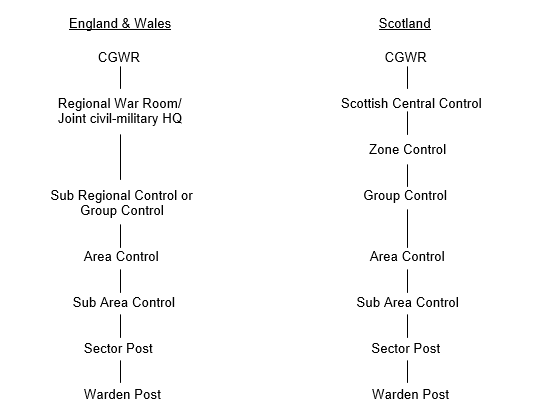
In theory, all these controls would be established in protected accommodation, manned by trained volunteers and equipped with telephones and telegraphs. In reality, most of the accommodation, personnel and equipment never existed.
File 4: The Central Government Nucleus
SUBTERFUGE, BURLINGTON, TURNSTILE, etc - Protecting the Queen
Author’s note - this File has been completely rewritten in Autumn 2006 to take advantage of the mass of information released or obtained under the Freedom of Information Act. It covers the complete history of the central government relocation site and in some instances the information here supersedes earlier information in other Files.
The Strath Report
The Strath Report resulted in many significant changes to Britain’s defence plans. The Chiefs of Staff now thought that the next war would be much shorter but extremely severe with the attack lasting from 2 to 7 days in what was called the Destructive Phase. This would be followed by a Survival Phase during which both sides would be unable to continue fighting and would concentrate on surviving in the post-nuclear holocaust world. After many months this phase would lead into a Reconstruction Phase (sometimes called the Rehabilitation Phase). Up to this time, it had been assumed that there would be 6 months warning of an impending war but now the planners thought that events might develop much quicker and only a short warning or Precautionary Period would precede the attack. The Precautionary Period was a domestic and covert warning measure limited to the UK and declared by the Cabinet when an attack was expected14. It was expected to last at least 7 days during which time the country would be prepared for war. The declaration triggered certain covert measures listed in the War Book such as government departments instituting a 24-hour watch system. As the crisis deepened other measures would be introduced such as activating the Regional Port and Shipping Organisation, implementing the “dispersal of the priority classes of the civilian population” and taking control of agriculture. However, as exercises were to show there was a practical problem in spotting a looming crisis and then an even greater one in taking the political decision to implement the Precautionary Period and the preparations for war that automatically followed15. During the one time that a global nuclear war seemed imminent, the Cuban Missile Crisis in 1962, events moved too quickly for any civil defence measures to be activated. Another problem revealed by the Cuban Missile Crisis was that the Government War Book which dictated what had to be done and when only envisaged a global nuclear war and was not flexible enough to cope with unforeseen situations.
The Strath Report resulted in major changes at the operational level of civil defence with the establishment, albeit largely on paper, of joint civil-military headquarters, SRCs and a revised structure for the Civil Defence Corps. It would also completely change the ideas about wartime central government which were being developed under the guidance of Thomas Padmore.
The Padmore Working Party
As outlined in File 3 Thomas Padmore, a high-flying career civil servant in the Treasury, was to play a leading role in planning a fundamental change in the organisation of the machinery of government in war. In October 1953 he chaired the first meeting of the “Working Party on the Machinery of Government in War” which over the next 2 years, operating under the direction of the more senior Home Defence Committee, would plan a completely new structure for both central and regional government in war. Until this time it was expected that central government in World War lll would operate in basically the same way as it had in the previous war. The bulk of the civil service would be evacuated from London to run the government machine whilst a small ‘nucleus’ of the main decision makers and their advisers would stay in London working, and if necessary sleeping, in Citadels such as the Rotundas.
Padmore was specifically asked to consider how central government control could be maintained under atomic attack. What should such a government do if it remained in London and if it could not carry on from there where should the ‘shadow government’ be established? The Working Party quickly devised a set of proposals. Its predecessor, the Committee on the Distribution of Government Staff in War had suggested that a nucleus of government would need 12000 staff (mainly taken from the 138,000 civil servants working in London) and Padmore’s working party basically continued with this figure. They readily accepted the generally held view that central government, at least in a nucleus form of the Cabinet and main decision makers, must stay in London for reasons of morale. They would have to operate from the protected accommodation in the existing and planned Citadels and Grade A Basements.
Working in parallel with the Committee on the Distribution of Government staff was another committee looking at the availability of “protected accommodation for London headquarters staff”. They were recommending using the citadels used during the last war together with some of the reinforced basements and the new citadels being built at Montague House and as the basement for the projected new headquarters for the Colonial Office in Broad Sanctuary at the southern end of Whitehall. The headquarters was never built and the citadel was to form the foundation for the new Queen Elizabeth Conference Centre. High on the committee’s ‘wish list’ was a new citadel code named PIRATE. This would consist of 3 parallel tunnels dug under Horse Guards Parade (off Whitehall) to provide a new Cabinet War Room with space for 800 -1000 people including meeting rooms for the Cabinet, a Map Room, sleeping quarters for the War Cabinet, etc. This however was a time of severe budgetary constraint and also a major shortage of structural steel and PIRATE was deferred by the Prime Minister in 1951. It kept cropping up in reports for the next few years until it was overtaken by a much larger project. The committee looking for protected accommodation also suggested digging a new tunnel under Abingdon Street close to the Houses of Parliament which would house chambers for Members of the Houses of Commons and Lords. There is also a hint that a ‘bomb proof shelter’ was built for the Royals at the Royal Lodge in Windsor.
At this time the South Rotunda was earmarked to provide a home for the Cabinet Office including the War Cabinet and parts of the Ministry of Defence notably the Chiefs of Staff. The North Rotunda would house the Central Government War Room and parts of the Home Office. The existing Whitehall Gardens citadel was allocated to the War Office whilst the Air Ministry was expecting to get the new Whitehall Gardens citadel. The Air Ministry was also using the New Public Offices (the site of the old Cabinet War Rooms) whilst the Admiralty had its Citadel. The old Dollis Hill War Room was allocated as the main London War Room.
These Citadels and Basements were expected to survive the blast from an A bomb but the surrounding streets would be rendered impassable. This lead to the rather odd suggestion that the isolated government machine living in them could be resupplied by boat from the Thames.
Padmore’s Working Party on the Machinery of Government in War worked on the basis that these Citadels and Basements could accommodate 6000 people who would control the higher strategy of the war, foreign relations and major issues of home defence. But it was still thought that around 12,000 would be needed for all the essential business of government and rest could be housed in SUBTERFUGE.
SUBTERFUGE, as will be shown later, was the adopted code name for Spring Quarry at Corsham near Bath. SUBTERFUGE is first mentioned in early 1951 as an ‘alternate seat of government if London became unusable in another part of the country suitably equipped with accommodation and communications’. It was however kept quiet possibly because the officials concerned feared that they might lose PIRATE if the potential of SUBTERFUGE as a home for the nucleus of government became more widely known and nothing was done to develop it.
Padmore took over the interest in SUBTERFUGE and the committee’s initial idea was that it could accommodate 12,000 people albeit in makeshift conditions, using the communications left behind from its war time use as a factory and even then only after 6 months warning. The Working Party’s first report therefore recommended that a nucleus of some 6000 should stay in London and work from the citadels. Another 12,000 would be accommodated at SUBTERFUGE. If it was necessary to evacuate the nucleus from London they would move to SUBTERFUGE and 6000 of its less important occupants would go elsewhere.
The remainder of the civil service would be evacuated from London at the start of the war in a proposal that was very similar to the ‘moves’ planned some 20 years earlier. Most would be scattered around the country but some 15 - 30,000 of those with the most to contribute to the war effort would be accommodated in what was called the Sterling Area which seems to have simply meant the towns in the Midlands and West Country which would have been occupied under the Black Move planned some 20 years before. It should be stressed that this first set of proposals was only produced in outline and the numbers of people allocated to each site was based on the capacity of the site and not to any consideration of the numbers of people actually needed for the proposed tasks which were themselves only considered in broad outline by this stage.
The Working Party also considered what might happen to Parliament and proposed that it did not continue to meet in London but should meet as soon as possible after the outbreak of war at some place to be decided at the time, such as Stratford on Avon. The idea of a tunnelled citadel for Parliament appears to have been abandoned, forgotten or overlooked.
The Working Party submitted its first proposals to the Home Defence Committee in January 1954 and then turned its attention to considering the regional organisation. But before any action could be taken the scale of the physical destruction that would be caused by the new H bomb started to be realised and Padmore suggested to the Working Party that in the face of such a weapon the London citadels would be untenable and even SUBTERFUGE needed further thought. The Home Defence Committee said that for political reasons a centre of government must remain in London but an alternative should be arranged outside London and this should be manned at the start of the war. Although SUBTERFUGE could no longer be considered safe it was the best site available. The Committee were also in favour of spreading the bulk of the civil service around the country whilst devolving as many functions as possible to regional headquarters with now Ministers acting as Regional Commissioners.
Padmore was asked to reconsider his proposals and the Working Party decided that using the London citadels was no longer feasible as anyone in them would be killed if the Russians attacked London with H bombs. They suggested that even though morale might suffer leaving London should be considered although the final decision should be left for the government of the day. To allow for this the citadels should be maintained but no further work to should be undertaken to build new or modernise existing citadel accommodation. One suggestion made which would allow the nucleus to stay in London whilst avoiding the citadels was that it could use the 3 bunkers in North West London prepared for the purpose before the outbreak of World War II even though the Dollis Hill War Room had been designated by this time as the main London Region War Room.
The Working Party suggested that to supplement the nucleus in the citadels also now to take over from it if it were destroyed or cut off, and to give the government of the day the option to move the higher direction from London, SUBTERFUGE should be kept. But an additional underground site should be found. The Ministry of Works were asked to find suitable sites. They suggested the Meadow Bank salt mine in Cheshire and the Cocklakes Gypsum Mine in Carlisle however both these sites were considered inferior to and more expensive than their third suggestion - the underground factory site at Drakelow. Although none of the sites were considered to be as good as SUBTERFUGE the Working Party would recommend Drakelow, now code named MACADAM as the second site.
The modified idea was now that one of the underground sites would be manned before the start of the war with a team of ministers and officials as an alternative seat of government to London while the second would be physically prepared ready to receive the nucleus should it decide to evacuate from London. At this time Padmore had not approached the government departments for their ideas on the roles to be performed by the nucleus and the numbers of people required and appears to have been assuming that only a few hundred people would be needed and these could all be evacuated from London overnight in a fleet of cars. However, and rather confusingly, whilst a revised set of proposals submitted in October 1954 included all these ideas it also now included the recommendation that as well as the central nucleus responsible for the higher direction of government there would need to be a headquarters staff whose functions would have to be discharged centrally and could not be devolved to the regions. These people should be accommodated near to the central nucleus but not necessarily underground.
These revised proposals were approved by the Home Defence Committee but final approval was deferred until the Strath Group had considered the implications of fall out. The Working Party also stopped further consideration of the regional headquarters for the same reason but by May 1955 they had revised proposals for both central and regional government. These proposals took into account the Strath Group’s conclusions that fall out would spread over vast areas of the country and completely paralyse virtually every aspect of life including government for many days if not weeks. They again said that it should be left for the government at the time to decide whether or not to leave London but the suggestion that such a nucleus based there could not operate efficiently was even more strongly put. The report emphasised the idea of having 2 underground sites set up outside London. As before one would be fully manned in advance and the other only prepared ready to receive the Ministers and officials who would leave London but now the support staffs at both sites as well as the ruling nucleus would be found space underground. There was an initial suggestion that MACADAM should be abandoned in favour of a new purpose built site in the West Country but this was quickly abandoned and the final report only mentioned SUBTERFUGE and MACADAM. There would also be no plans made for the bulk of the civil service who would remain in London. They might be included in any general evacuation plans but otherwise would be told to go to their offices if possible but with a vague suggestion that they might be told of general areas in the country where their departments might at some indeterminate time after the attack reform so that they somehow might make their way there. The final report which was submitted to the Prime Minister in August 1955 also emphasised the need for the headquarters of the Regional Commissioners, who would now definitely be Ministers, to be co-located with the Army District headquarters for mutual support and in a reflection of the Strath Report’s suggestion that in particularly badly affected areas the military would need to assume control. Some consideration was given to the sites and layout for the joint operational headquarters but the detail was to be left to a new Working Party set up by the Home Office. The final report also repeated the earlier suggestions about reforming Parliament after the attack and that consideration needed to be given to where the Queen might go.
The plan was formally approved by the Prime Minister in September 1955 but it seems to have been quickly realised that there was a serious flaw in it. The idea was that one site, probably the smaller MACADAM would be fully manned in the pre-war Precautionary Period by what was often referred to as ‘the second eleven” whilst the other would only be prepared ready to receive ‘those exercising supreme control’ evacuating from London at the last moment. It was recognised that this second group might not escape although in the mid-1950s and for several years to come the strategists assumed the attack would be by aircraft, and radar would give ample time to allow the Prime Minister and his final party to leave London. In the 1960s when ballistic missiles would be used this time would be cut to minutes, possibly just the infamous “4 minute warning”, and the chances of them leaving were much less. As work on MACADAM was not to be started until SUBTERFUGE was complete, a process that would take several years, this could mean that there would not be a central government at all especially given the unprepared state of the regional headquarters. So within a year the working plan had been modified and MACADAM was, to all intents and purposes, left out of the plans. Instead, SUBTERFUGE would be fully manned with the support staff and what would in effect be a reserve nucleus of Ministers and senior officials ready to act as the central government if necessary and only a very small team headed by the Prime Minister would stay in London from which they would, hopefully, leave at the last moment.
The new strategy would be dictated by the scale of the damage and the paralysing effect of fall out. As many central government functions as possible to be devolved to the enlarged joint civil-military headquarters which would be responsible, now under the direction of a government Minister, for the day-to-day running of the country. Any government function not vital to immediate survival would be put into ‘cold storage’ to be reinstated weeks or months after the attack. The much reduced central government in SUBTERFUGE would confine itself to the most important, strategic matters. Implicit in this post-Strath strategy was the idea that SUBTERFUGE’s role was no longer to direct the war. There would be no war to direct, only the survival and restoration phases which would follow the destructive phase.
Over the next 50 years the ‘main relocation site of central Government in global war’ would have several code names and it was invariably referred to by the current name in official documents. In the interests of security the code name was changed periodically as follows -
| 1954 - 1959 | SUBTERFUGE |
| 1959 - 1961 | STOCKWELL |
| 1961 - 1963 | BURLINGTON |
| 1963 - 1969 | TURNSTILE |
| 1969 - 1987? | CHANTICLEER |
| 1987? - 199? | PERIPHERAL |
Spring Quarry
The sites for SUBTERFUGE and MACADAM were chosen in 1951 (possibly earlier) and 1955 respectively. SUBTERFUGE would be in Spring Quarry at Corsham to the east of Bath and MACADAM at Drakelow near Kidderminster.
Although known to the Spies for Peace since at least 1967 and possibly the Russians for several years before that the sites for both emergency seats of government and their roles was strictly Top Secret and would remain so for 50 years until Christmas Eve 2004 when the Ministry of Defence, which had taken over custody of Spring Quarry some 10 years earlier from the Cabinet Office issued a press release (in reality it was written by the Cabinet Office) announcing that “A formerly secret Government underground site, which was a potential relocation site for the government in the event of nuclear war was declassified at the end of 2004”. The disclosure was however not from any particular desire to let the public know but as part of a larger plan to dispose of the redundant but expensive to maintain site which was by this time referred to as ‘Site 3’ (the nearby RAF Rudloe Manor was known at this time as Sites 1 and 2).
Spring Quarry is some 10 miles to the east of Bath and just south of the small town of Corsham. It is one of several sites in the area which were used from the nineteenth century to mine building stone. Although called a quarry the site is in fact completely underground. As fully explained by Nick McCamley in his book ‘Secret Underground Cities’ many of the mines were taken over by the military during World War ll mainly to store ammunition although the northern part of Spring Quarry was converted at great expense into a factory producing mainly aircraft engines and employing several thousand people. Above ground, the area has been the home to many military units from all 3 services and over the years it has became a particularly important hub in the military communications systems. Many of the stores continued to be used after the war and the factory site was taken over by the Admiralty for storage although it was still designated as an emergency factory in the event of another war.
Spring Quarry had been used by thousands of workers during the war and was largely self-sufficient. So, when Padmore came looking for a home for a site for the central government nucleus the quarry must have seemed almost ideal. Most of the original factory site was taken over and the protected area taken for the relocation site measures some 2300 feet from east to west and 900 feet from north to south. The operational areas, which are all on one level, are around 90 feet below ground level. The Bath stone (a type of oolitic limestone) which was mined in the quarry occurred in beds between 15 and 30 feet thick. These are overlain by up to 40 feet of a coarser grained rock known locally as ‘rag’ and this in turn is covered by a variable thickness of sand, clay and other rock The original quarrying operations had left randomly scattered pillars of rock varying in size and shape from 100 to 1000 square feet supporting the roof which take up some 22% of the floor area. When the conversion work started some of these pillars were strengthened with concrete and in some areas the roof was reinforced with girders. The height of the accommodation areas varied from 12 to 20 feet. The original and often wide roadways were kept and the remaining areas partitioned off into some 800 rooms, signals areas, dormitories, kitchens, a canteen, a sick bay and a laundry.
Work begins
Outline planning for SUBTERFUGE was started in 1953 although it was decided that no work would be done on MACADAM until it was completed. Responsibility for the project was given to the Machinery of Government in War Sub-Committee of the Home Defence Committee but they in turn delegated the detailed work to a dedicated Planning Team under Padmore’s chairmanship. Overall co-ordination of the project was handled by the Treasury and the Cabinet Office.
By early 1954 the basic site plans had been drawn up and the Treasury was approached for money to start work on the basic plant and equipment such as reservoirs, drainage systems and lighting. In September 1955 the plan received official approval from the Prime Minster, Anthony Eden and in December the Treasury gave financial approval. The actual building work started in 1956 with the construction of a concrete blast wall between 41/2 and 6 feet thick completely enclosing the working areas.
The post-Strath change in strategy from a headquarters which would direct a lengthy war to one which would direct the ‘struggle for survival’ following the destructive rain of hydrogen bombs seems to have had little impact on underground works and the internal layout was finalised by early 1956.
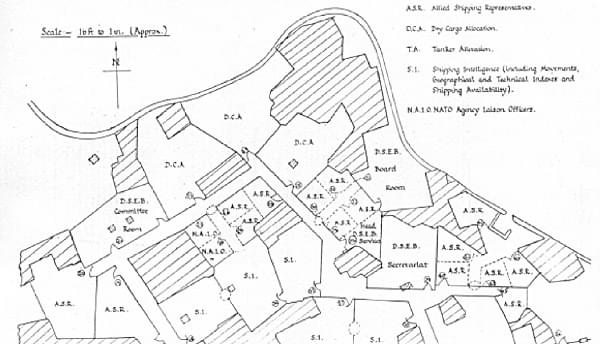
Part of the Ministry of Transport accommodation in Area 10. Note the how the offices and corridors have been partitioned around the pillars (shaded areas)(DSEB = Defence Shipping Executive Board, a NATO civil agency)
The original cost estimate for the construction works and the plant (excluding furniture and communications equipment) was £1.2 million (roughly £30 million today). This however steadily crept upwards particularly as parts of the wartime factory’s plant were found to be inadequate for the new requirements but the expenditure was buried in the budgets of various departments and never came to the attention of Parliament or the press. This was at a time when defence expenditure was being squeezed and SUBTERFUGE probably accounted for up to 10% of the entire home defence budget in the late 1950s. At the time, apart from the underground posts for the Royal Observer Corps it was the only significant home defence expenditure. It should have been paralleled by purpose built regional joint civil-military headquarters and the Sub Regional Controls to form a unified infrastructure for the machinery of government in war but these were constantly deferred. Even with its high status the work on SUBTERFUGE proceeded slowly with much of the delay caused by the interminable references to different committees and the need to have every cost overrun approved.
By 1957 however the structural and engineering work was well underway and the following major structures were complete -
- perimeter walls
- general partitioning
- the installation of various types of plant eg the diesel generating sets to work the ventilation and lighting, laundry, bakery and kitchen equipment.
- installation of oil storage tanks
- 3 lifts and one escalator
- emergency water system
- emergency sewage system
- air conditioning and ventilation plant including filters to keep out radioactive fall out
- internal communications systems including the Lamson tube network
- provision of concrete caps to and mounding and grass seeding of ventilation shaft heads.
The main work still to be done was the installation of additional lighting and ventilation in the communications areas and the testing of the complete installation under shut down conditions. The external communications systems although being planned were not due to be installed until the structural work had been completed.
The site would need surprisingly large quantities of water. This was distributed throughout the site from a pressurised 250mm diameter main fed from the public supply. If this was, as expected, disrupted water could be taken from an underground culvert and treated before being stored in tanks capable of holding 440,000 litres. There was also a spring in the complex. Two further tanks held 1.85m litres of water to provide cooling water for the air conditioning plant and 1.25m litres to provide cooling water to the diesel generators.
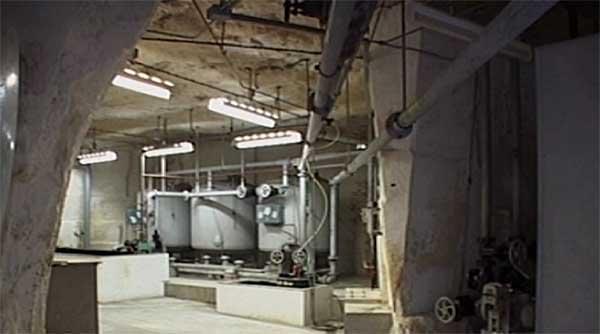
Part of the water treatment plant
Ventilation was provided by a central plant taking in 84,000 cubic feet of fresh air per minute (cfm) and exhausting an equal quantity and if all the fans were running 428,000 cfm of air was recirculated. Air filtration was by electro-static filters. A large floor to roof duct known as the North Drift running round much of the north side of the protected area distributed the air aided by fans with the many internal roadways acting as return ducts. The air was conditioned by 2 Sulzer compressor evaporator condenser units, each rated at 250 tons of refrigeration capacity. The units operated in a heat pump mode, using waste heat from the condenser, to heat the air.
The electrical distribution to the protected areas comprised an 11 KV ring main fed from the surface which supplied 34 500 KVA transformers giving a total transformer capacity of 17 MVA. Standby power would be generated at 11 KV by 4 Mirrless 12 cylinder V type diesel generators. (A 1982 report said that although these were still in good condition they had proved unreliable when used elsewhere). The generators were fed with diesel fuel from 12 tanks which could hold 176,400 gallons.
In 1957 the expected completion date for building work had slipped back from 1959 to September 1960 but there was considered to be no urgency as the regional headquarters which would work to the nucleus did not exist and there was no money for the communications equipment.
By June 1959, the project was about 65% complete and although nothing had been done to stock the site with food, water, etc it was thought it could be pressed into service albeit with a reduced compliment of 2000 staff although the conditions would be very basic. In fact, it had been proposed as early as November 1956 that the site even in its unfinished state would provide a better site for the seat of government than the London citadels.
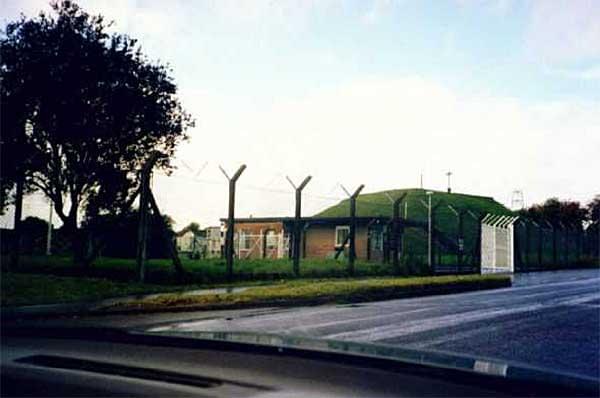
The headworks of Passenger Lift 1 behind the main entrance to the relocation site
The slow progress lead to the planners considering if the work on STOCKWELL, as SUBTERFUGE was now called, and the reserve at MACADAM should be accelerated. It was however realised that there was little point in completing STOCKWELL if the rest of the civil defence system of which it was an integral part did not exist. The building programme was therefore not accelerated although it was considered prudent to authorise further expenditure to enable interim use to be made of the site in an emergency.
By 1958 detailed plans for equipping and furnishing were being finalised and by the end of 1960 the bulk of the furniture, stationery and canteen equipment had been delivered underground and food stocks were available. By May 1960 under an interim plan the site could have taken 3000.
The relocation site in detail
Internally, SUBTERFUGE was divided into various Areas. The inner core of the headquarters was Area 14 where the Prime Minister, the War Cabinet and the War Cabinet Organisation would be housed. Nearby were the governmental departments which would have the most active roles to play such as the fighting services and UK Land Forces (responsible for home defence), the Foreign Office, the BBC and the main communications centre. The government departments which would have little active role and which were, as one report put it, ‘held in cold storage’ such as the Treasury were located in the outer areas.
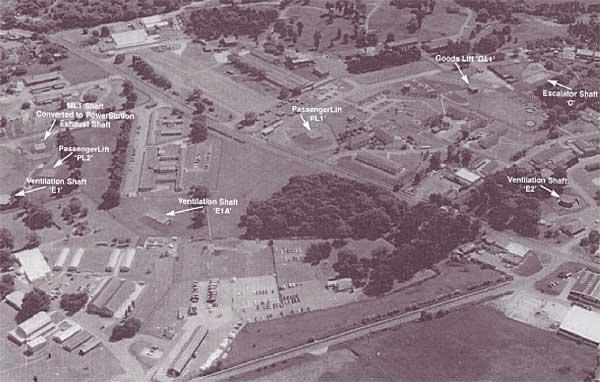
Aerial view of the surface features of the relocation site looking approximately west. Corsham village is off the bottom right hand corner of the photo. Note the positions of the headworks for Goods Lift 1 (GL1), Passenger Lift 1 (PL1) and Passenger Lift 2 (PL2). Photo courtesy of Nick McCamley and taken from his book ‘Cold War Secret Nuclear Bunkers’
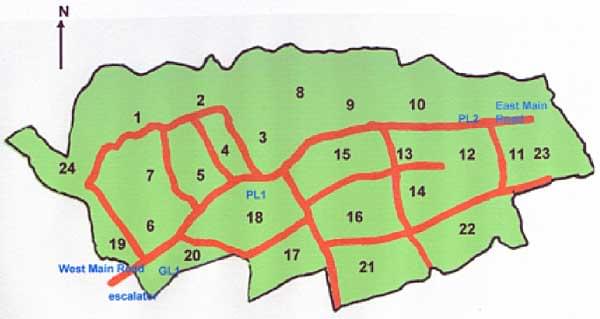
*Plan showing the main Areas of the relocation site and the main Roads. Note the position of Goods Lift 1 (GL1) and the 2 Passenger Lifts (PL1 and PL2) to orientate with the surface view shown above. (There is a more detailed plan later in the File).
- plant
- Board of Trade, HMSO, Office of the Minister for Science, Lord Chancellor’s Department, Customs and Excise, Treasury, Inland Revenue.
- dormitories
- dormitories
- kitchen
- canteen
- main GPO telephone exchange
- hospital and stores
- Ministry of Transport
- plant
- canteen and dining area
- Ministry of Power, Ministry of Agriculture
- War Cabinet, Cabinet Secretariat, Chiefs of Staff Organisation, PM and senior ministers
- Camp Commandant, Establishment Officers, public address system Lamson exchange
- BBC, COI, Ministry of Health, Home Office, Ministry of Housing and Local Government, Scottish Office
- Ministry of Aviation, Ministry of Labour, UKLF
- UKLF, Admiralty, War Office, Air Ministry
- workshops, boiler house
- laundry
- signals organisation
- Colonial Office, Commonwealth Relations, Foreign Office
- water treatment, water storage, sewage ejector
- fuel storage (note - the numbering of Areas 23 & 24 is reversed on some plans)*
The accommodation space was divided into 3 categories -
- The central nucleus with domestic and working accommodation for the Prime Minister, the War Cabinet, the Chiefs of Staff, their supporting staffs and their Map Rooms.
- Support departments divided into -
- service departments (Air Ministry, War Department, Admiralty, UKLF and Ministry of Supply)
- ‘due functioning’ departments (MAFF, Ministries of Health, Local Government, GPO, etc
- other departments (Transport, Trade, Labour, Works, etc)
- ‘cold storage’ departments which did not have an immediate function in the survival period such as the Treasury, HMSO and Lord Chancellor’s Dept)
- General purpose space (Camp Commandant, dormitories, canteens, hospital, etc).
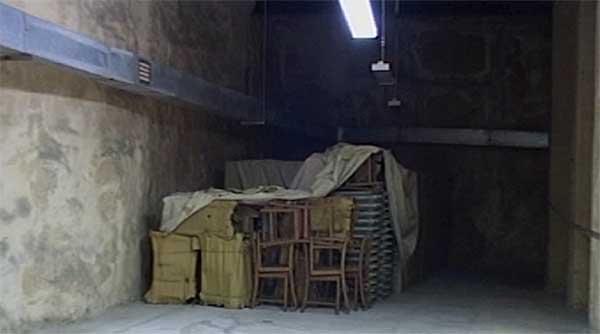
Stored furniture
The rooms in the working areas were divided into 4 basic types and the official lists of furniture for each type hint at the spartan conditions the occupiers would meet when they went underground -
Type A rooms
These would serve as both working and sleeping quarters for the more senior staff who needed to work on a 24 hour basis. The furniture for one person consisted of -
- ‘Bedstead, emergency metal folding’ 1
- ‘Mattress, hair and fibre’ 1
- Blankets 2
- Sheets 2
- ‘Pillows, millpuff’ 2
- Pillow slip 2
- Bedspread 1
- Wardrobe 1
- ‘Table, emergency folding wood’ 1
- ‘Chair, tubular arm metal nesting’ 1
- ‘Chairs, wooden fold flat’ 2
- ‘Mats, coir coloured 4’ x 2'3"’ 1
- ‘Filing cabinet, steel 2 drawer’ 1
Each room would also have an ash tray and a waste paper bin. At one stage 4000 waste paper bins were planned but this was later reduced to a mere 2000.
Type B rooms
These would serve as working space only. Each individual occupant would have a ‘table, emergency fold wood’ and a ‘chair, tubular arm metal’. The room would also have a waste paper bin and an ash tray.
Type C rooms
These would be maps rooms, conference rooms, etc of various sizes and furniture provision would depend on the potential use
Type D rooms
These would serve as dormitories for varying numbers. Furniture and bedding would be similar to the Type A rooms but without the table, metal chair and filing cabinet.
There were also a few ‘VIP’ rooms for Ministers and the most senior officials with the Prime Minister being allocated VIP1. This designation may however not have referred to the quality of the accommodation but to the type of telephone installed in the room.
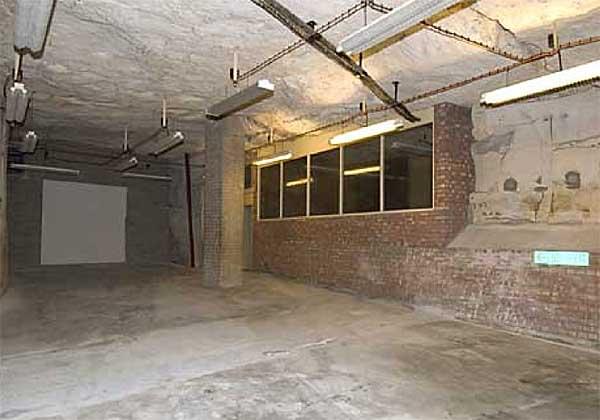
Office area
As well as the domestic and office accommodation large areas were set aside for the plant and equipment which would be needed to allow the site and its staff to function completely independently of the surface for up to 30 days. This included generating sets and their associated fuel stores, ventilation plant, water storage and sewage plants. Personnel access was by 2 lifts and an escalator (left over from the wartime factory) and there was also a large goods lift. There were also 7 emergency exits into adjoining areas.
When converted the main protected area (sometimes referred to as ‘The Keep’ or the ‘Citadel’) was flanked by 2 areas known as the West Lung and the East Lung. These ‘lungs’ were used as air supply reservoirs for the personnel and equipment needs within the protected area and were served by several air supply shafts. There is a comprehensive under floor duct system which takes air from the lungs and distributes it throughout the protected area. Significant amounts of water percolate through the rock into the lungs and this is drained by gravity to a pumping sump in the East Lung. From here it is discharged via a culvert into a storm water drain in the adjacent Box Tunnel.
By the middle of 1961 the massive amounts of office and other furniture, stationery and canteen equipment had been delivered and stored underground. This was not however distributed to the various rooms where it would ultimately be needed. Instead, like most of the communications equipment which would follow it was stored in a few places ready to be installed on the day. This was to disguise the site’s function and help to reinforce part of the cover story that the site was a government stores depot.
The list of stationary items which were provided to keep the headquarters operational for 28 days hints at the scale of the operation. It included -
- 11,300,000 sheets of duplicating paper
- 100,000 plain gummed labels
- 12,000 toilet rolls
- 750 shorthand notebooks
- 700 ‘pencils, lead, ordinary, HB’
- 25 boxes of white chalk (each with 144 sticks)
- 1000 erasers, pencil
- 10,000 ball point pens, refillable, black
- 100,000 rubber bands
There were also 400 typewriters
Apart from a few items which needed to be turned over the majority of these supplies would be untouched and unconsidered for the next 15 years until it was decided that the amounts held could be reduced.
As well as the above items the HM Stationery Office also arranged for copies of some reference books to be held at the site at the request of the various departments. Many of these were updated annually. The list asked for by the BBC is both odd and interesting consisting as it did of -
- Cassell’s Encyclopaedia of Literature
- Guide to the House of Commons
- Holy Bible
- Kessing Contemporary Archives
- Modern English Usage (Fowler)
- Oxford Dictionary - shorter
- Roget’s Thesaurus
- Russian-English Technical and Chemical Dictionary
- Statesman’s Year Book
- Times Atlas
- Titles and Terms of Address
- USSR Atlas
- Who’s Who (International)
To feed the 4000 staff fully equipped kitchens and bakeries were installed under the direction of the Army Catering Corps. It was hoped that a supply of fresh food would be laid in as part of the manning operation and then replaced as necessary. But in the probable event that fresh food could not be obtained standard army ration packs would be used and 120,000 rations were held together with tins of vacuum packed biscuits. These were stored in huts on the surface to allow half of them to be changed very year without compromising the security of the underground site. The NAAFI would also supply an initial stock of canteen items such as toilet requisites, chocolate and cigarettes. To cater for non-physical needs there would be a welfare officer and the army would provide 2 padres - one Church of England and one Roman Catholic. Among the pre-stocked items were an altar cover, an altar cross, 100 Army Prayer Books and 100 Roman Catholic Prayer Books. There were also 3 designated recreation areas although ‘facilities for recreation are limited’.
The site would need its own medical facilities although the extent of these was the cause of much debate. The original plans included a fully functioning hospital with an operating theatre, dental surgery and 40 single bed wards. The cost of this, requiring as it did its own independent ventilation system was prohibitive and the requirement was reduced to only 6 small wards although the examination equipment was retained. The aim was simply to keep the staff fit for work. Once operational, if staff were seriously ill they would be sent elsewhere for treatment and X-ray and other diagnostic facilities were installed to aid diagnosis.
There was an industrial scale laundry but this was only for “house keeping washing”. The staff would be expected to wash their own clothes by hand in sinks provided. The complex contained 31 ablution blocks for both male and female staff. The effluent drained by gravity to an ejector station and was pumped from there to the main surface drainage system. Kitchen waste was similarly ejected. If this system failed sewage could be pumped into the Box Tunnel.
In recent years, there have been ill-informed suggestions in the press that the site had its own pub, usually said to have been called the Rose and Crown. Unfortunately, this is an urban myth. A bar in fact had been considered and rejected with the Planning Team reporting in 1957 that “The provision of a wet canteen for the sale of spirits and beer had been considered and decided against in view of the austerity conditions which would prevail at SUBTERFUGE, the number of additional staff required to run a wet canteen and the difficulties of arranging supplies of beer”. The House Rules drawn up in 1961 which detail the serving times for meals, the availability of canteen supplies, etc also make no mention of such a comfort. However, reliable reports say that a bar was installed in one room in the north west corner of the site but this was in all probability a much later refinement connected with the Quarry Operations Centre or one of the other military facilities which were incorporated into the site in the 1970s and 1980s when the original headquarters areas had been run down.
By August 1962 the construction work was complete. All the telephone circuits had been made together with 50% of the telegraph circuits. Food, furniture and stationery were on site. The departments had drawn up lists of staff, manning instructions had been issued to Departmental Establishment Officers and a transport plan completed. To all intents and purposes the emergency government war headquarters was operational.
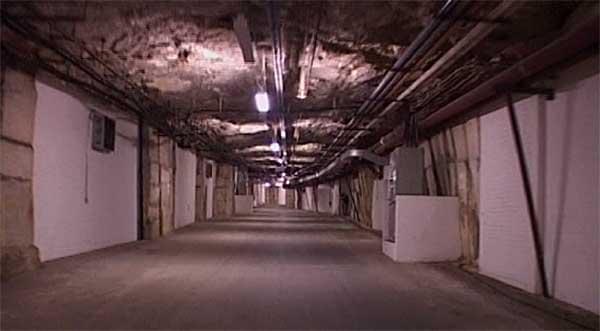
One of the main roads
The role of the ‘relocation site of the central Government in global war’
When it was first conceived in 1953 the ‘central government nucleus’ site was planned to be a reserve for Whitehall in case that key area of central government activity were destroyed. From the site, a nucleus of the main decision makers would steer Britain through World War III. They would be supported by their advisers and representatives of all the government departments and nationalised industries, etc which would have a role in directing and supporting the military effort and directing the home front. This concept had really changed little from the days of World War II when the nucleus operated from the Cabinet War Rooms and the War Rooms of the various fighting services and the “due functioning” departments. With the change in strategy brought about by the Strath Report SUBTERFUGE would now take over from Whitehall at the start of, if not actually before, the outbreak of hostilities but its planned role would not be to direct a lengthy war but to direct the immediate and urgent struggle for survival after Britain had been destroyed as a political and economic entity by Soviet H-bombs.
The structure designed to govern and administer a shattered Britain would be very different and markedly less democratic than its peacetime predecessor. The basic plan for wartime government was now summarised as -
- “SUBTERFUGE would house a central nucleus controlling the higher direction of the war, together if possible with supporting HQs required to administer essential controls.
- There should be a maximum degree of devolution from centre to the regions.
- The central organ of government should attempt to discharge only those functions of government which must be discharged in one place and that place would be the seat of supreme control; and only such of those functions as directly affect the nation’s capacity to survive thermo-nuclear attack.
- On the threat of war Regional Commissioners would be appointed and established with their civil and military advisers in operational HQs away from target areas.
- After attack the traditional system of government of Ministerial and departmental responsibilities will, at both central and regional headquarters give way to a system whereby each HQ will operate as a single entity i.e. as a command post. This system of government would come into full operation when the seat of central government moved to the emergency HQ or nuclear attack had occurred.”
In 1961 Sir Norman Brooke, the Cabinet Secretary, wrote a private paper on cabinet government. In it he described government in war as being based on “…a very small nucleus at the centre concerned in the main not with matters of internal domestic concern but rather with those outward-looking activities of government which must be carried out if we are to remain in control of our affairs - contacts with others and liaison between civil and military power - and the maintenance for as long as possible of the supremacy of the civil power”. He then added “We plan to maintain central direction of that sort, even in the most rudimentary form, for as long as possible in the intensive period of nuclear attack and - and this is the point I want to stress - the capacity to re-assert civil control and, as soon as possible, central political control, for the period of recovery after the initial nuclear phase”.
SUBTERFUGE fitted into the new concept of decentralised or regional government that would create “a machine of government, which relied on the effective executive organisation at regional level and the paramount consideration is to be a truly regional system of government operating under effective control by Regional Commissioners”. It would be a “nucleus of central government to whose directions Regional Commissioners would be subject and which itself would discharge those functions of government which must be discharged in one place and that place the seat of supreme control.” As instructions prepared for Exercise Four Horsemen put it “the headquarters of central government would be established in protected accommodation, equipped with the necessary communications with overseas countries, military commanders and regional headquarters, and would be manned by staff representing almost all departments and services acting in support of the War Cabinet and other Ministers. It would carry out such essential functions of government as must be performed centrally and these would be of 2 kinds: firstly, there would be such activities as maintaining control with other countries, directing the military effort and (in a Home Defence sector) controlling the regional organisation: secondly, such tasks as exercising central control over shipping, land communications and the movement of essential supplies such as food and oil.”.
Another report from 1956 said that the first requirement would be “a machine of government to take the country through the attack and survival periods i.e. until central government can be organised on a larger scale. SUBTERFUGE is concerned only with the national struggle for survival, control of military and civil defence authorities, supervision of the central control of essential supplies, shipping, and communications, and communications with the civil population. Most functions of government which could not be done by the nucleus or regional headquarters would cease.”
Following further consideration of the role of SUBTERFUGE and the joint civil-military headquarters in 1957 the concept of regional government was expanded to create a government machine which would rely on the Regional Commissioners acting as the effective central government authority for all home defence and internal matters from the time they took up post (or possibly when the central government represented by the Prime Minister left London and authority was effectively transferred to SUBTERFUGE) subject only to some general guidelines from SUBTERFUGE if communications permitted.
A Ministry of Defence report on the Machinery of Government in War from 1963, by which time SUBTERFUGE had been renamed TURNSTILE, said “Plans for the maintenance of government in war are based on the assumption that in the face of nuclear attack there would have to be a departure from the traditional system of individual ministerial responsibility and departmental control to a system of regional government by Regional Commissioners.
The essential features of this system are firstly, the establishment in a war time headquarters of a nucleus of central government to whose directions Regional Commissioners would be subject and which would itself discharge “those functions of government which must be discharged in one place and that place the seat of supreme control”; secondly, the appointment of a senior minister in each region as Regional Commissioner who would have full powers of the Crown and Government in his Region subject only to his acting in accordance with any instructions or directions which might be given to him by central government.
“Following attack therefore central government could not rely on being able to do more than give broad policy directions to Regional Commissioners who for the immediate aftermath at least would have to rely largely on the resources of their own Region with little or no help or direction from the centre. Therefore, the extension of central government control would be a gradual and uneven process.”
The directions given to departments to plan what they would do at the relocation site and in particular what staff they would need to do it were not precise and the Planning Team largely left the departments to work out their own plans. In 1958 the communications planners calculated out that to man the communications that the departments, etc were asking for would need 1600 people against a planned maximum number of 1040. This lead to a realisation that some of the departments were not following the command post concept under which the HQ would only deal with the highest levels of strategic decision making and delegate operational activities to lower controls, notably the joint civil/military HQs. The Home Office for example planned to control prisons and children’s homes from the nucleus. New directives were therefore issued telling the departments to plan on the basis of only carrying out at the nucleus those functions which could not be carried out elsewhere and where decisions could only be made at the highest level. Functions should be restricted to broad policy e.g. relations with overseas governments, supreme military control and central control of strategic stocks of food and fuel.
The military had a particular problem. They expected to fight the war from the nucleus. This meant they would need it to be a fully active headquarters not just in the destructive phase and beyond but in the precautionary period which would precede the arrival of the H-bombs and which would involve mobilisation and perhaps some conventional fighting.
In 1961, a study was made as to what extent STOCKWELL could take over central government functions in a precautionary period. It was planned that most of the important tasks would be carried out from Whitehall with STOCKWELL, once manned, taking some of the massive load of preparing the country for war. STOCKWELL and the new Regional Seats of Government, which would replace the joint civil-military headquarters, would be manned in the precautionary period. This would denude Whitehall of many of its senior service and civilian personnel at the very time when they would be needed most.
Matters came to a head later in 1961. The Cabinet Secretary told Departments that in the period of tension the Government’s main task would not be to prepare for war but to avoid it and at the same time keep Parliament and the public informed. Therefore the most senior decision makers and their advisers would have to be in Whitehall throughout. Any move of senior people to relocation sites would disrupt things at exactly the wrong moment and also be bad for morale. From now on the plan would be for the Government to stay in Whitehall throughout the Precautionary period.
This lead to a reconsideration of STOCKWELL (now renamed BURLINGTON) that resulted in a change in role. In July 1961 the Prime Minister directed that “planning should proceed on the basis that central government will remain in London throughout the precautionary period, that the machinery of government will function broadly as it does in peace and that the Prime Minister and his colleagues (with the exception of any who may be sent to Regional Headquarters and to BURLINGTON in order to man the governmental organisation for the survival period), will work at their normal places. Planning of BURLINGTON will continue on the assumption that its functions are -
- Acting as the seat of government in the period of survival and reconstruction.
- To be the alternate centre to London for authorising nuclear retaliation.”
This meant that while BURLINGTON would still be manned in the precautionary period it would have no role and central government would continue from London as usual. This caused problems for the civil and services departments as it meant that they would have to staff their peacetime offices at a time when they would be fully stretched and at the same time provide staff for BURLINGTON and the new Regional Seats of Government.
The directive implies that the Prime Minister would stay in London throughout the pre-attack precautionary period and was probably a response to the increasing threat from Soviet missiles rather than aircraft. It is an oddity of British government that the Prime Minister could not give orders to the RAF to launch a retaliatory nuclear attack. This could only be done through the RAF’s chain of command so that the Prime Minister needed to be in Whitehall at the centre of a communications network in contact with UK and NATO headquarters, the Foreign Office and civil departments. If a missile attack was detected the Prime Minister would ask the Chiefs of Staff to retaliate. They would then order the Chief of Bomber Command to release the V-bombers which would no doubt be airborne and holding at their positive control points and launch the Thor missiles16. In the 1950s before the advent of Soviet missiles the PM could stay in London in touch with the Whitehall machine until the enemy bombers were spotted on radar. This would spell the end. The Prime Minister could either then order the RAF to retaliate or leave for Corsham where facilities would exist to contact Bomber Command to launch the deterrent. However, by the early 1960s this had changed. The Prime Minister and his advisers would now have a matter of minutes from the time the incoming Soviet missiles were detected by the new radars at Fylingdales. If London were not initially targeted they would leave for BURLINGTON by helicopter, but if London were targeted then they would probably never leave.
This revised role for BURLINGTON was echoed in draft plans drawn up by the Cabinet Secretary in 1961 in case the Berlin Crisis escalated. He proposed that the main government departments would establish permanently manned Control Points linked to a Central Control Point in the Cabinet Office but significantly the plan said “we will not go underground nor have executive decisions taken by map rooms”.
At this time, national policy in the post attack period was envisaged as being:
- the prosecution of the war world wide,
- the marshalling of all available resources for national survival and recovery.
Directing this policy from BURLINGTON as “the ultimate source of authority” would be the War Cabinet. This was expected to consist of “the Prime Minister and 5 other Ministers with the Chiefs of Staff and others attending as necessary”. It was assumed that the Prime Minister would take on the responsibility for defence as Churchill had done during the last war.
The operational staff would work as what was termed a ‘command post’ operating as a single unit rather than a collection of independent departments all reporting to their own ministers and permanent secretaries as was the case in normal peacetime government.
Operationally, below the War Cabinet the work would be divided in broadly two areas. The overseas sections would consider foreign affairs and anything to do with the war whilst the home defence sections would concentrate on the domestic situation. Supporting the War Cabinet would be a combined civil/military secretariat and several committees -
- Chiefs of Staff Committee
- Home Defence Ministerial Committee (to co-ordinate the work of the civil and military organisation)
- Civil Defence Official Committee (looking after “the civilian home front” and “the day-to-day executive functions in the battle for survival”)
The military elements supporting the War Cabinet were the Joint Intelligence Committee and its staffs, the staff of the Chief of the Defence Staff and a Map Room staff. The Map Room would collect and analyse all the available information about the situation of the country to support the decision-making committees. It would be the core of the Central Government War Room within the nucleus of central government and the more important decisions would come from it. In total the war cabinet organisation consisted (in 1961) of 210 people of whom about a third were clerks and typists. A breakdown of this group is given in the appendix.
One factor which was hardly considered by the planners was that of basic operational efficiency. The concept envisaged a complete civil and military central headquarters with several thousand people, a major but untried communications system and all their domestic accommodation and facilities being set up from scratch in a matter of days. No training was allowed at the site and this lead the Ministry of Defence to suggest that a dummy site should be set up for the purpose but this was turned down. A 1962 report by the Chief of Staffs Committee aimed “to draw attention again to the limitations of the site as an operational headquarters in war” pointing out that it would take up to 4 weeks to install and work up the communications required by the armed forces. The very existence of the site and everything about it was Top Secret and it was protected by a cover story. None of the departmental planners were told the site’s location. There is a heart felt comment by a Ministry of Defence planner writing in 1962 that he had no idea where the site was and no one in the Ministry had been allowed to visit it although he was making decisions about how it would be used. Eventually, the Cabinet Office relented and allowed “one senior officer from each service in civilian dress to visit the site” but “they must be careful what they say said because most of the workers there do not know what it is for.” The BBC complained, apparently without success, that unless they knew the location of the site they could not make plans to broadcast from it.
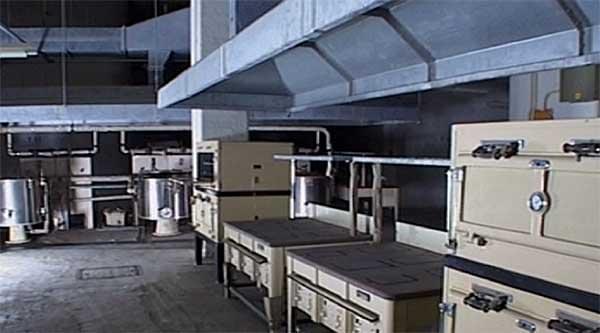
Kitchen equipment
But there was a perhaps a more important problem and one which increasingly occupied the minds of the planners - that of security. It was thought that with the increasing Soviet nuclear capability if the relocation site’s location and function became known to the Soviet Union it would be attacked and destroyed. And if the site were made operational even on a restricted basis before war broke out it was certain to become known to them. In response, various options were contemplated including building a completely new site possibly bored into a mountain. The question of the designated reserve site was also reconsidered but no action was taken on it. The main problem however came down to a choice between operational efficiency and security at STOCKWELL.
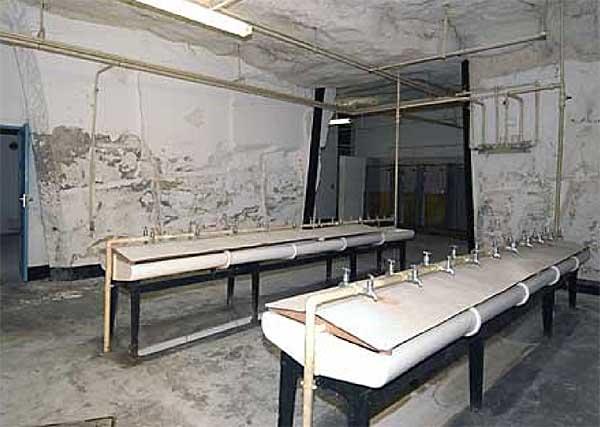
Basic washing facilities
But the needs of security were held to be paramount. Once manned and its communications, particularly radio transmissions, activated secrecy would be lost and if its existence was then discovered it would be attacked. Because of this, it was felt that the implications if manning STOCKWELL were such that Ministers could only take the decision in the light of circumstances at the time. This meant that the site would not automatically be occupied at the start of a Precautionary Period and consequently STOCKWELL could not be given a substantive pre-attack role.
The Queen and Parliament
All these plans related to the continuity of central government which would consist of the decision making War Cabinet, its advisers and those needed to implement its decisions. There is no mention of a role for the Sovereign or for Parliament. The Padmore reports said Parliament would not be able to function during or soon after an attack so it would have to disperse to reform somewhere in the country but by 1959 another report said that no provision existed for Parliament to continue. Later, a 1963 report said, “Members of both Houses would be expected to disperse to their homes or constituencies or (like members of the Royal family other than the Queen and Heir Apparent) to their country houses.” Unfortunately, the file in the Public Record Office from which this information comes did not answer the intriguing question of where the Queen would go.
A Cabinet Office file from 1964 shows that at that time not only did the Royal Household not have a copy of the Government War Book it was not clear which government department was responsible for informing them of the implementation of the Precautionary Period but in 1963 plans had been drawn up for Operation CANDID to protect the Royal Family in war. CANDID was not only Top Secret but on a strictly need to know basis. It would also take priority over any general war tasks the army had.
Although details of the plan changed over the years the basic idea was that a strengthened army battalion plus support troops would constitute a Royal Duties Force. This would be centred on the Guards battalion based at Windsor which would be the mobilisation point for the Force, reinforced with a special squadron of the Household Cavalry equipped with armoured cars to provide a reconnaissance unit together with a light aid detachment and a substantial radio troop. The force would be about 1300 strong, fully mobile and self-supporting for 7 days. It was well equipped with lorries and there is mention of “6 Queen’s baggage vehicles”.
It was given 4 tasks -
- Guard for Her Majesty the Queen
- Guard for KP17 (key point 17 - possibly Buckingham Palace or Windsor Castle)
- Reserve
- Guard for other members of the Royal Family
The Force was to be capable of splitting into 4 independent units and “should be…prepared to move to different locations to provide guards and establish communications with the nearest RSG” and also “it would be in radio communication with CHQ, the HQ of the district it is moving through and other groups in the force”. Information in the PRO gives no details of where the Queen would be but the Force was specifically set up as an infantry unit to provide static guards at one or more places once it had reached its objective. It was not for example just an escort unit to take the Queen from Windsor to a pre-determined place such as Corsham. The impression given is that the Queen would, in a repeat of the World War II practice established only 20 years earlier, find refuge in an isolated country house probably in the midlands.
Ministers
In 1961 senior officials started to give thought to the roles to be allocated to ministers in a war emergency and to divide them between those who would be needed in London during the Precautionary Period, those who would be sent to the relocation site and those who would be sent to the regions to act as Regional Commissioners and their Supporting Ministers. Although it was usually stated in documents at the time that these appointments would be made on the day lists were drawn up and approved by the Prime Minister although the Ministers themselves were not told of their designated role.
In August 1962 the Ministers who would stay in London would be -
- Prime Minister
- Home Secretary
- Secretary of State for Foreign Affairs
- Secretary of State for Commonwealth Relations and Colonies
- Minister of Defence (in practice it was planned that once war had broken out the Prime Minister would assume the role of Minister of Defence Minister Without Portfolio
- Chief Secretary to the Treasury
- Chancellor of the Duchy of Lancaster (as Leader of the House he was assumed to stay with Parliament)
- Secretary of State for Air
- Minister of State at the Board of Trade
- The Lord Chancellor
- The Attorney General
Those who would go to BURLINGTON would be -
- Deputy Prime Minister and First Secretary of State
- Chancellor of the Exchequer
- The Minister of Agriculture Fisheries and Food
- Minister of Health
- First Lord of the Admiralty
- Minister of State, Home Office
- Minister of State, Foreign Office
- Minister of State, Scottish Office
- Minister of State, Colonial Office
- The Solicitor General
At this time the Regional Commissioners would have been -
- Wales Minister of Housing
- Northern Minister of Transport
- North-Eastern Minister of Power
- North-Midland President of the Board of Trade
- Eastern Minister of Labour
- Southern Minister of Public Building and Works
- South-Western Minister of Education
- Midland Lord Privy Seal
- North-Western The Postmaster General
- South-Eastern The Lord Presiden
- Scotland The Secretary of State for Scotland
Each Regional Commissioner would have a Supporting Minister who would be the junior minister who was designated to head the region’s Civil Emergency Organisation.
If all the ministers designated to be at BURLINGTON were joined by the helicopter party ministers there would be an accommodation problem at BURLINGTON as there was only accommodation for five Ministers besides the Prime Minister in the central Area 14. It was therefore decided that the remainder would be accommodated in the VIP rooms originally allocated to Ambassadors.
The planners also recommended to the Prime Minister that he allocate 2 senior ministers to the roles of First and Second Nuclear Deputies who, in the absence of the Prime Minister, would be authorised to launch the nuclear deterrent albeit only after discussions with the US President. They would formally assume their roles at the start of the Precautionary Period. The Second Nuclear Deputy would be among the Ministers who would go to BURLINGTON whilst the First Nuclear Deputy would stay in London. His role would be to act if the Prime Minister were temporarily absent from Downing Street for example when he was travelling. The Nuclear Deputies were first appointed in 1961 and in selecting Rab Butler and Selwyn Lloyd for the roles the Prime Minister, Harold Macmillan wrote against their names ‘First gravedigger’ and ‘Second gravedigger’. The documents detailing these arrangements reveal, probably for the first time, the extent of consultation, which had been agreed with the Americans that would take place before the British deterrent would be launched and also that ‘the competent military authority’ could order nuclear retaliation if he was certain that a nuclear attack had been made and if consultation with the Prime Minister were impossible.
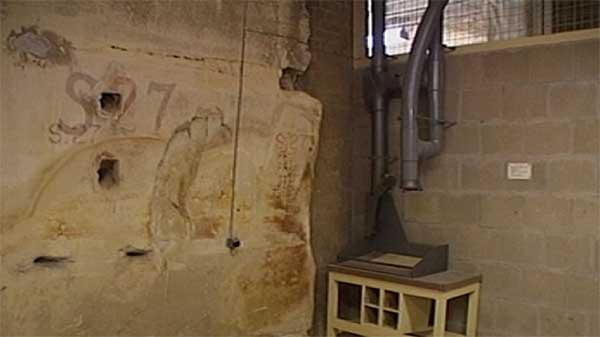
Small office showing terminal for one of the Lamson tubes. Note the unpainted breeze block partition wall and one of the pillars (number S27) left from the original quarrying
Communications
The relocation site would function for up to 30 days completely divorced from the surface and so without extensive, survivable communications to points throughout Britain and the wider world it would be deaf, dumb and blind. The scale of the communications planned and finally installed at the relocation site was in every sense gigantic and within Britain was only matched by the systems installed in and around Whitehall. The telegraph centre alone was 5 times larger than any other centre in the UK. The communications installation even merited its own codename of “woodland”.
At the start of the planning process it was decided that the various communications systems would not be installed until the building work had been completed but a dedicated Communications Working Party was set up at the outset to plan the installations.
The main means of communication would be by telegraph, by which typed messages could be sent and received along a cable, and telephone. The circuits were either carried on dedicated point-to-point private wires which were routed away from potential target areas or on cheaper rented GPO trunk lines although these were more vulnerable because they were routed through major cities which might be targeted. A dedicated spur to the GPO’s Backbone radio system was also installed and a radio tower for it specially built close to the site. There was also a standby radio system provided by the army to link to the regional headquarters.
The principal communications system was the telegraph but the capacity of the system was limited and the transmission times were slow. This would be supplemented by standard telephone calls again either using dedicated private wires or using exchanges and the public network. Both systems were vulnerable in that the lines themselves could be destroyed and the exchanges and their associated repeater stations put out of action. The lines, most of which were rented from the Post Office were also very expensive.
The scale of the communications links considered the minimum acceptable in 1958 illustrates the intended set up and also illustrates the intended role of the nucleus. The main system would be telegraph and telephone lines mostly using “private wires” and directed through RAF switching centres but with many domestic lines available through up to 11 GPO exchanges. Internally, there would telephone extensions linking virtually every room, regular “messenger” runs and a Lamson tube system for sending written messages. The Forces Postal and Courier Communications Service would provide a twice-daily air courier service between the central headquarters and the civil defence regional headquarters and one report recommended that 3 helicopters should be allocated to the headquarters. The principal external communications facilities would be -
- 3 telegraph and 5 telephone circuits to each Regional Headquarters.
- For the service departments and the Ministry of Defence there would be circuits to various naval, military and air headquarters both at national and NATO levels, to switching centres on the Defence Telecommunications Network and terminals of their overseas networks. (Service departments wanted cipher equipment on all their telegraph circuits).
- For civil departments -
- Home Office circuits to Royal Observer Corps Sector Operations Centres.
- Foreign Office circuits to their communications centre and out-stations.
- Ministry of Transport and Civil Aviation circuits to rail, air transport and port and shipping headquarters.
- Ministry of Power circuits to petroleum, electricity, gas and coal headquarters.
- Ministry of Agriculture circuits to their due functioning headquarters.
- Central Office of Information circuits to BBC wartime headquarters and news agencies.
As well as the circuits within Britain connections were needed overseas to allied and commonwealth governments, British embassies, NATO centres, military headquarters, etc
In 1958 a long-term plan existed for the number of circuits needed. But as none of these would be available for several years emergency use could be made of the circuits originally installed in the wartime factory.
The planned and actual number of circuits available in 1958 was -
| Long term plan | Available | |
|---|---|---|
| Internal phones | 1500 | 500 |
| Inland phone circuits | 500 | 22 |
| Inland telegraph circuits | 140 | 22 |
| Overseas phone circuits | 35 | 2 |
| Overseas telegraph circuits | 35 | 2 |
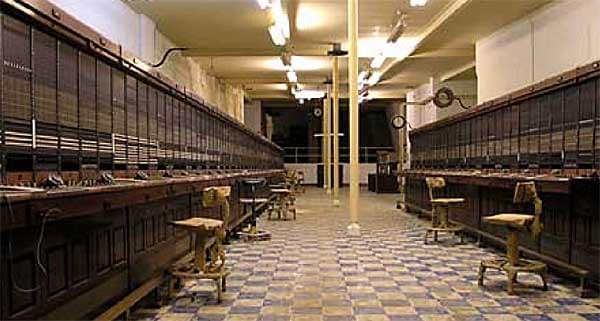
Main telephone exchange
In addition there would be connections to the public trunk network and, by using the RAF’s major switching centre in South West Control situated a few hundred yards to the north of the relocation site, to the various military networks. All together the 1958 plan required 767 circuits which would cost £610,000 to establish and then £919,000 a year to rent and maintain. This compares with the initial cost for the building work of £1.2m. The telephone plan required a PABX capable of taking 2000 extensions and a 40 position switchboard for connecting to outside wires. A 14 position switchboard would also be needed for an overseas service. The planners anticipated 1000 telegraph messages would be sent each day.
There would also be extensive cipher equipment.
progress report in May 1960 showed site was still reliant on the wartime communications facilities but the requirements had now been significantly reduced to -
| Inland phone circuits | 300 |
| Inland telegraph circuits | 225 |
| Overseas phone circuits | 37 |
| Overseas telegraph circuits | 46 |
The magnificent telephone exchange was located in the northern part of the site together with the main telegraph rooms. All incoming and outgoing written messages were handled in the communications centre further south. This was subdivided into 5 operational groups -
| Group 1 | Cabinet Office |
| Group 2 | Admiralty |
| Group 3 | Air Ministry |
| Group 4 | Foreign and Commonwealth relations |
| Group 5 | War Office, Home Office and civil departments. |
Over a thousand people would be needed to man the communications systems on a 3 shift basis. Most of these would be telephone and telegraph operators employed either by their own departments and services in Whitehall or by the GPO.
As with furniture and stationery, most of the telephone and telex equipment was not installed in their final rooms for security purposes and circuits were not connected but it was estimated that if the order to prepare the site was given on Day 3 of the Precautionary Period then 80% of the communications could be working by Day 6 although the necessary lines to Bomber Command needed for the nuclear deterrent could be made ready within 12 hours. This was more than sufficient given the limited need for communications in the early days after the attack when the main task of bringing order to the country would lie with the RSGs. It might take up to 3 weeks to have all the communications functioning. In addition to these systems the site had a BBC studio which would allow the Prime Minister and others to broadcast radio messages to the country via the BBC’s emergency centre at Wood Norton.
To help pass written messages around the site and particularly to and from the communications centre a large Lamson tube system was installed with 40 individual tubes connecting to a central station. A regular messenger service would also be available. There was also an internal intercom to broadcast messages and, apparently music, around the site. The staff could, in theory, send and receive letters and would be given a dedicated BFPO number. Although, how this would work in a bomb blasted Britain is a matter for speculation.
Security
Everything about the emergency central government war headquarters at Corsham - both its role and location were strictly Top Secret and remained so for some 50 years. This secrecy was protected physically by such methods as positive vetting of all those who knew about it and by establishing a cover story.
A cover story was needed from the time the extensive construction work began. There was a problem in that a lot of the initial construction work was carried out on the surface and obvious to passers by, and then many workers would be involved with the work both on the surface and then underground and the later fitting out, all of which would take many years. The story had to be good enough to satisfy the locals and workforce but not attract any particular interest from the press or the Soviets. The first cover story devised was that the site had been acquired during the last war, a fact widely known in the locality, and was being generally tidied up for some general, unspecified war use. By 1959 with, the imminent installation of the massive communications systems the idea of a purely civilian wartime use eg as an art repository would not match the physical work. A particular problem would arise from the need to label where the various communications circuits were going and as these would be mainly military or government sites it would be obvious to many GPO engineers that originating site was a military or government one of considerable importance. Now the story, which would only be given when necessary and not generally spread around, was that it was intended primarily as a Post Office communications centre with other space allocated to a standby regional civil defence HQ and for government storage. At this time a full time Security Officer was appointed for the site whose main task was to vet staff who were or needed to be ‘indoctrinated’ into the ‘central secret’ as the combination of both the role and location was referred to. The Security Service (MI5, or ‘Box 500’ as it was often called at the time after its postal address) were actively involved in the cover story and reported that local rumours suggested that the site was to be used to store Big Ben, as a refuge for the Royal Family or more likely as something for the Admiralty, which at this time were using other local quarries for storage. The Security Service suggested that the idea that it would be used by the Admiralty should be subtly encouraged but this raised a problem in itself because if the Soviets thought it was an important enough naval establishment they might attack it and destroy the central government nucleus by accident.
In late 1959 the Daily Express journalist Chapman Pincher drafted an article mentioning ‘a huge underground city from which the nation would be controlled in the event of an H-bomb attack’. Before he could publish this he was apparently fed part of the new cover story and the article which finally appeared, whilst mentioning a ‘chain of H-forts’ (the proposed purpose built joint civil/military headquarters) did not refer to an underground city.
By 1961 the cover story was revised. The site was now to “provide regional organisations with stand by facilities for the maintenance of emergency services”, as well as a Post Office communications centre and general storage. But by now the problem of the communications circuits was becoming serious. It was thought that about half could be connected and labelled without compromising the central secret. A further quarter could be connected to the neighbouring RAF South West Control communications centre to be connected through to their final destinations when needed. The remaining quarter could be disguised by only connecting them to a nearby repeater station with, again, the idea of connecting to the final destinations when needed. To fit in with the idea that the site was a store and a possible communications centre the large number of telephones and telegraph machines and their associated equipment were generally not installed in their operational areas but were stored in various rooms underground.
The numbers of people knowing the ‘central secret’ was kept as low as possible and they were all positively vetted before being indoctrinated. Nevertheless, in January 1961 the Site Security Officer reported that 562 people knew the ‘central secret’.
By the early 1960s the Security Service was openly speculating that the Russians would be aware of the ‘central secret’. There seemed to be little that could be practically done but it is interesting to note that, when in 1967 the Spies for Peace wrote to the Prime Minister saying that ‘The Government has its own shelter system at Corsham’ it caused little concern.
As a postscript there was an interesting ‘incident’ in 1976 when the navy commissioned a private company to make an aerial survey of the whole Corsham area which included Spring Quarry. This caused great concern and the anonymised photographs were passed to the RAF to see what they might reveal to an expert (i.e. Russian) interpreter. The RAF noted all sorts of signs such as military style flagpoles and anchor designs on well-tended lawns and concluded that there were substantial and significant underground facilities such as a major communications centre or a government headquarters in the area. The Cabinet Office however decided that it would be safer to allow the private company to continue with the work rather than bring attention to the area. It was however accepted that Russian satellites had been over flying the area for several years and could give equally good resolution photos. Even if they were not aware of the true purpose of the site they must certainly know by now that there was something significant in the Corsham area.
The London Citadels
When Padmore suggested that all future planning should depend on SUBTERFUGE and its reserve he suggested that the London citadels which had up to then been intended to house the nucleus of government in war should be abandoned. But it was decided to keep them maintained although without any plans to use them until SUBTERFUGE was ready just in case they were needed and also to hide the fact that they would not be used, a fact which would encourage a potential enemy, or anyone else interested, to look for their replacement. However, in 1957 in view of the progress made with SUBTERFUGE it was decided to review their status. The planners noted that virtually all the citadels were in and around the Whitehall area which would be a prime target for Soviet H-bombs. If the area were attacked, even if the citadels were not “in the crater” they would be badly affected by flooding and “oscillation of the structure”. It was decided to quietly remove any defence use from the central citadels (the Admiralty Citadel, the Rotundas, the 2 Whitehall Gardens bunkers, the former Cabinet War Rooms and the former London Region War Room at the Geological Museum). The ‘peripheral citadels’ at Dollis Hill, Cricklewood and Harrow could however be turned over to civil defence uses.
Although there were no plans to use the citadels in war the North Rotunda was pressed into service as a nominal Central Government War Room for the exercises Cloud Dragon and Fallex62. This however was essentially to preserve the security of the Corsham site and encourage the idea that the government would stay in London during a future war. To further strengthen this idea when, in the early 1960s, groups of journalists asked to see around the citadels they were allowed to tour some parts of the Rotundas but cleverly some parts were kept ‘off limits’ to them even though, in reality, they contained little of importance.
In reality, there would no longer be any protected accommodation maintained in London for machinery of government in war purposes. Also, from the mid-1950s government departments were told that there would be no general evacuation of the civil service as had been contemplated in the last war. Apart from those who would have ‘specific war stations’ the civil servants were divided into those who ‘whilst not needed in the survival period would be valuable in the recovery period’ and the rest. It might be possible to safeguard this first group by sending some of them to existing departmental premises outside London, but no other accommodation could be reserved for them. The remainder, in fact the majority, would be told to come into their usual offices until they were unable to reach them. They should then report for duty to any local government office.
Level of protection
Despite the high level of security and the cover stories it was always assumed that if the ‘central secret’ was discovered the Soviets would consider the site a priority target. Was it therefore proof against such an attack? Even though the site was deeply buried in hard rock the first work was to construct a blast wall completely encircling the working areas and separating them from the adjacent Admiralty storage areas and designed to resist a blast over-pressure of 80 pounds per square inch (psi). The access openings for stairways and lifts were protected by reinforced concrete headworks and blast doors also designed to take 80 psi. The main ventilation shafts were designed so that they did not open directly into the protected areas but into adjoining, relatively unimportant parts of the quarry which would act as expansion chambers and dissipate the blast. The initial thoughts were that the site was protected against collapse or spalling (lumps of rock coming away from the sides of the underground areas) caused by a 10 megaton ground burst weapon exploding between 3/4 and 2 miles away. By the early 1960s the planners assumed that the Soviets would use smaller 3 megaton H-bombs and the safe distance would be one mile from the impact point. However, the accuracy of missiles expected to deliver these weapons had improved and if the missile had 50% chance of landing within 1/2 mile of the site then there would be a 99% chance of it being destroyed, or as the report at the time put it, of the bomb “defeating the protection”. The site was however considered to be virtually invulnerable to an air burst.
The main problem was not however the vulnerability of the site itself but of its vital communications and in particular the cables these relied on. Most of these went through the neighbouring RAF communications centre which was not protected to the same degree and a 3mt bomb up to 31/2 miles away could be expected to put it out of action. Many of the lines also relied on unprotected surface repeater stations. The Backbone spur tower was thought to be vulnerable to a 3mt blast up to 10 miles away.
It was however considered impractical to increase the level of physical protection but at one point the military suggested that it was leaked that the site at Drakelow was the main site to draw attention away from Corsham.
In the early 1970s a Security Service examination of the site suggested that it was vulnerable to an attack with chemical or biological weapons which lead to the recommendation that suitable protective clothing should be held at the site.
Staffing
A nominal maximum figure of 4000 was imposed for the site at a very early stage possibly on the basis of the physical capacity of the site and the planning teams constantly battled to keep the demands of the various users down to this total. The 4000 were however not all to be administrators. Above all, the site had to be a major communications centre and in some ways the number of administrators was dictated by the available communications. The message handling systems, telephone exchanges and in particular the telegraph machines were very labour intensive, and whilst the administrators would work whatever hours were needed the communications personnel would work in three shifts which effectively tripled their numbers. The usual figure for the communications operators was 1024 although at one stage this was projected to rise to 1500 which lead to a reconsideration of the site’s role and the rigid imposition of the idea that it was to be a high level strategic decision making battle headquarters and not responsible for any tactical or day-to-day control.
In 1962 the planned staff totalled 3780. The main groups were -
- War Cabinet Organisation Consisting of 211 people, this would be the hub of the nucleus and would be physically based at its centre. There would be 24 in the Prime Minister’s office supported by their direct advisers, Map Room and support staff.
- Home Defence Secretariat This unit of 103 people would also be at the heart of the HQ responsible for monitoring and directing the ‘battle for survival’ on the home front.
- The establishment Officers Branch With 60 people this branch would be responsible for much of the internal running of the HQ
- Armed Forces These would form a significant proportion of the operational staff. It would have 626 people drawn from the Admiralty (124), the War Office (172), the Air Ministry (126) and UK Land Forces (204)
- Departmental Contingents These were drawn from most of the departments and ministries of the government and the size of the contingent of each one reflected its importance in the battle for survival. The largest, with 208 staff came from the Ministry of Power although 84 of these were part of the NATO wartime oil organisation. The Post Office supplied 154 and the Ministry of Agriculture 80. This understates the role of the Ministry of Agriculture because, in view of its importance, it would have its own wartime HQ based at Aberystwyth. The ‘cold storage’ departments who had no immediate role in the survival period such as the Treasury and the Inland Revenue had only nominal numbers of staff.
- Signals Organisation This was the largest group in the HQ with 1219 members. The armed forces would each supply a significant number of operators for their own communications centres as would the Foreign Office but 584 of these people would come from the Post Office mainly to operate the telephone and telegraph networks.
- Common User Staff These 409 people would be provided by UK Land Forces and would provide the domestic services such as catering and medical.
- Guard Company This unit of 103 soldiers would also be found by UK Land Forces. Rather oddly, these troops would not be quartered underground but in the huts on the site which had been used to store the food stocks before these was transferred underground.
- Site Maintenance Staff The Ministry of Public Building and Works would find 53 people who would be responsible for the maintenance of the fabric of the HQ together with all its electrical and mechanical plant, air conditioning systems, sewage works, etc.
Included in the total figure would be 18 ministers. The original plan also envisaged rooms being found for 15 Ambassadors and 8 High Commissioners but by 1961 they, like representatives from the Trades Union Congress and the British Employers' Confederation were no longer on the lists.
By 1958 planning had advanced to the point where the Treasury who had overall responsibility for planning the HQ and its operations had settled the numbers of staff and issued guidance to departments. The staff for the site were chosen on the basis of their ability to do the job, which usually meant they were designated because they had a similar job in peacetime. They were selected by the Establishment Officers (i.e. personnel departments) of the ministries, etc and in complete secrecy. They were not volunteers and given the secrecy of the site and its function the vast majority of them were not told of their wartime designation. Although the debate about whether or not to tell people of their wartime designation continued for many years it was constantly over-ruled by the need to maintain security. Even when permission was given to inform some designated RSG staff of their designated wartime roles staff those allocated to Corsham remained in ignorance. This meant that they could not receive any training for their role.
Allocating roles to named people really got underway in 1957. Establishment Officers were told to select staff who would be “physically and psychologically” able to stand up to the conditions. Working conditions would be “austere and crowded” and “there is no room for passengers”. No one with a poor sick record, physical handicaps or claustrophobia should be considered. “Adaptability, team spirit and steady temperament are necessary as well as physical fitness”. One concern which worried some, but not all the planners was the position of families. This invariably meant wives, ignoring the fact that many of the staff particularly the junior grades would be female. The same concerns occurred in relation to the Regional Seats of Government and the other controls throughout the Cold War. The usual response was that the wives and children would be included in any general evacuation scheme but the problem was never really tackled and it was usually just assumed that those designated would turn up on the day although there were some suggestions that reserves should be designated.
Getting the 4000 staff to the relocation site would be a major undertaking. The basic plan from the early days was that the site would be manned in the Precautionary Period and then as quickly and unobtrusively as possible. The staff would establish themselves and then wait for the Prime Minister’s party to arrive in the last moments of peace. Their arrival would effectively signal the transfer of power from Whitehall to Corsham. Interim operational orders for manning Stockwell were issued in November 1960 followed a year later by more definitive ones. These said that once the order had been given the Establishment Officers would hand the designated member of staff the “First Information Slip' which told them for the first time that “you are one of a number of key personnel selected for duty at an important wartime headquarters for the department”. They should “go home now, pack up personal effects, make pay arrangements and return”. They would be allowed one bag or suitcase but not a radio or camera. “Clothing may be informal” but as “facilities for entertainment will be limited it is suggested you take a book or so with you”. Just before the final order was given telling them to proceed they would be given the “Second Information Slip” although this told them little more than the first one and neither of the slips gave any indication of where they were going or what their role would be when they arrived. In 1961 passes were printed and distributed in sealed envelopes to establishment Officers.
The interim manning scheme envisaged a fleet of 200 coaches ferrying the staff from London. To preserve secrecy the coaches would drive to a check point several miles from the HQ and then return empty. Other coaches would then ferry the staff to the HQ itself.
By 1961 this transport plan had been simplified. Now the London based departments would be responsible for organising the transport of their contingents to Kensington (Olympia) railway station near Earls Court in west London. There, under the direction of the army, they would board main line trains. The first trains were expected to be ready within 2 to 6 hours of the order to man, thereafter 6 or 7 trains would be needed leaving at 2 hourly intervals. A ‘second station’ is mentioned in one report which would be ‘in the provinces’ and would serve staff working at ‘out stations’ i.e. not in central London. This was possibly Bristol. The trains would take staff to ‘Check Point’ from where they would be taken to the main site.
Even while TURNSTILE was being manned the Prime Minister would be expected to remain in Downing Street at the centre of an established support and communications system until all hope of averting war had gone. He and a few chosen senior people might then make a last minute dash for Corsham by helicopter. The composition of the Prime Minister’s helicopter Party was fixed at 25 -
- Prime Minister and 2 personal staff officers
- The 12 most senior ministers who had remained in London
- The Chief of the Defence Staff and the 3 Chiefs of Staff
- The Secretary of the Chiefs of Staff Committee
- The remaining 4 places would be filled at the last moment.
However, even had all these plans worked like clockwork there would still have been delays for example if the manning order were given at night or at a weekend and then in actually getting people underground using the available lifts and escalator followed by the problems of them finding their places in an untested and hastily prepared site.
Check Point
Check Point was planned to play a vital if low key role in the operation of the war headquarters and its location was treated with the same degree of secrecy as that of the headquarters itself. However, War Office records show that it would have been at Warminster some 10 miles south of the main site. Trains would arrive at the station there (‘Check Point Station’) and then a fleet of coaches would take the staff and their luggage to the cinema block of the School of Infantry which was based in the town and would be designated as Check Point. On the receipt of the code word CARONIA the Garrison Commander of Warminster would arrange for the Check Point to be manned. As the headquarters staff arrived they would be given a ‘stew meal’ from a field kitchen. Once the code word DETONATOR was received Check Point would start moving the staff to the headquarters in a fleet of army lorries. For security purposes the routed would not be sign posted but would be patrolled by a company of Military Police. The idea of Check Point was to protect the secrecy of the headquarters site and to avoid any congestion occurring there. Everyone detailed for the headquarters whether the arrived by train, helicopter or private car would report to Check Point and then be taken onwards in an army lorry. Check Point was also used as an assembly point for the army units with roles at the headquarters and for receiving supplies. Security would be strictly enforced and anyone turning up without the correct identification would be detained. It was expected that all the staff would pass through Check Point in a matter of hours. The responsibility for manning and preparation of the site rested with the Camp Commandant (Designate). The first person to hold this post was Lt Col Hugh Gregory. He took on the task in 1963 and finally relinquished it 20 years later when he was 69. He had semi-retired when he took on the post and continued to be responsible for its maintenance and in particular the supplies of food and materials working from his own home. In the event of war he would have been recalled to the colours to take up his active post.
MACADAM
When Thomas Padmore made his suggestions for the preservation of the machinery of government in war in 1954 he recommended that a site, to be called SUBTERFUGE should be constructed as a reserve seat of government should London become unusable. But following the Strath Report he recommended that any idea of the government remaining in London should be abandoned in favour of basing the wartime central government nucleus at SUBTERFUGE, but with a new reserve site to be known as MACADAM constructed and manned to serve as ‘The alternative relocation site of the central Government headquarters in global war’. The code name MACADAM was used from 1955 to 1960 when it was replaced by QUADRANGLE. This name continued in use until 1962 when it was replaced by LINSTOCK. This code word was withdrawn in 1965.
Since Duncan Campbell’s revelations in War Plan UK published a quarter of a century ago it has been generally thought that this reserve headquarters would be at the Valley Works site at Rhydymwyn near Mold in North Wales. This site included an extensive series of tunnels originally constructed during the last war to store chemical weapons. The tunnels were used into the 1950s and it appeared that some work had been done at the site after this time which fitted in with the idea that the site was at least earmarked as the reserve war headquarters. However, it is now known that in the early 1960s the tunnels were earmarked as a possible war time site for 2 NATO wartime agencies. These had originally been destined for the main Corsham site but had been relocated (without NATO being aware) to the Valley Works to protect the secrecy of Corsham. There were also tentative plans to use the Valley Works tunnels as a war time home for part of the Bank of England’s gold reserves and possibly for a Sub Regional Control. The proposed use by the NATO agencies lead to the tunnels being ‘tidied up’ but although plans were drawn up to convert the site it appears that no meaningful work was ever done although intriguingly the Property Services Agency works office safe at Corsham contained in the 1980s, as well as files relating to Corsham, one on Rhydymwyn although by that time the wartime home for the 2 NATO agencies had moved to the former RSG in Cambridge.
In fact, the plan from 1955 was to base the reserve nucleus at Drakelow in the tunnels dug out during the war as an emergency factory although it was decided at the outset that no work would be done either to prepare the site or to plan for its use until Corsham was completed. The original working idea was that a staff of some 1500 (2000 in some reports) headed by a team of Ministers and senior officials would occupy MACADAM in the Precautionary Period at the same time as SUBTERFUGE was being manned. The Prime Minister and the ‘first eleven’ would however not leave London until the last minute and possibly not at all. If this happened or if SUBTERFUGE was not operational then the Ministerial Team at MACADAM would assume the role as the central government.
In reality there would be many practical problems. Finding sufficient Ministers and staff for Corsham and the regional headquarters was a particular problem and this would only be worsened by the need to find 1500 people for the reserve. Then it was unclear what its real role would be. If the main relocation site was operational MACADAM would have no role but if it was not its 1500 staff and very limited communications would seriously hamper its abilities to act even ignoring the problem that the some at least of the Regional Commissioners might be of higher rank or status than those Ministers at MACADAM. These problems lead to the idea being put forward in 1958 that the site would not act as a true reserve but should be in some vague sense a ‘reserve of experience and expertise’.
By this time the Home Office were looking for sites for the planned regional civil/military headquarters and Drakelow was considered. It was decided that the site was large enough to take the 450 staff planned for the regional headquarters and still have space for a reserve central nucleus. There were concerns that the existence of the regional headquarters, which was expected to become known would jeopardise the secrecy of the reserve site and it was suggested that the 2 should be physically separated from each other although other reports suggested that they could share communications facilities. The Drakelow site was established as an RSG (see File 5) but no work was done to prepare for the reserve nucleus. In 1961 a report suggested that the site could still be used as a reserve for central government but with a team of only 300. Even with this small number security was deemed to be a potential major problem and it was considered that the site was very poorly protected compared to Corsham. Again nothing was done and in 1962 the plan was changed. The site would now be a reserve but only for 100 staff although it would act as an accretion centre or rallying point for other staff (presumably including Ministers not occupied elsewhere).
Outline plans to accommodate this LINSTOCK group within the Drakelow RSG were prepared and a staffing list drawn up. This staff would include a Reserve Prime Minister and Minister of Defence supported by a Reserve Ministers, one for Overseas Affairs and the other for Home Affairs. They would be supported by a team of 37 officials to cover Cabinet Office functions, military affairs, overseas affairs and home administration. They in turn would be assisted by some 60 junior administrators, communications operators and domestic staff. If BURLINGTON were destroyed the LINSTOCK team could offer at least a nominal central government to give political direction to the armed forces, liaise with overseas government and at least suggest to the survivors that there was some overall political control. However, problems soon emerged over the cost of the necessary works in the Drakelow tunnels and work on LINSTOCK was suspended.
TACK
Also in 1962 and in parallel with LINSTOCK another idea known as TACK was developed. This concept would be Top Secret like BURLINGTON and LINSTOCK but would also be on a strictly ‘need to know’ basis. Under the TACK concept small groups would be set up any of which could act as a ‘third line reserve Seat of Central Government’. Each of the 4 groups would consist of a Deputy Reserve Prime Minister, one other Minister and 2 Private Secretaries. They would be supported by an official from the Cabinet Office and 6 from the military, together with 2 officials to deal with overseas affairs and 3 to deal with home affairs. There would also be a communications adviser, an information adviser and a scientific adviser. They would all be assisted by 9 junior administrators. The idea was that one group would each lodge in the RSGs at Dover, Hope Cove, Reading and Shipton but by 1963 it was realised that there was no money for the additional infrastructure required and in any case there was no spare space in the RSGs. It was also realised that the RSG sites were known to the Russians and might themselves be attacked.
Neither LINSTOCK nor TACK was developed and it was realised by 1964 that there was no reserve for TURNSTILE although it was generally thought by then that the Russians almost certainly knew about it. This lead to suggestions that a replacement was needed. It was thought that building a new site which would be safe against any attack was impractical and other ideas were contemplated. One which had been floated in 1963 suggested that the idea of one large relocation site was impractical. It would be better to set up smaller, functional groups to be dispersed throughout the country. The groups that survived could then link up to form a new central government. TURNSTILE would still be maintained as a site both because of its continued potential as an accretion centre and also as a cover story for the new plan. This outline plan appears to have been adopted as the basis for the PYTHON concept.
CHANTICLEER
As explained more fully in File 6 by 1965 the PYTHON concept had replaced the original idea of a single nucleus of some 4000 people with the idea of several smaller teams which would be scattered about the country. The TURNSTILE site however continued to be used for the next quarter century as an accretion centre for PYTHON Groups and their successors. In 1968 following the introduction of ‘care and maintenance’ to all home and civil defence activities the food stocks, then still sufficient for 4000 people for 30 days were halved. This was an economy measure made simply by not replacing the stock of ration packs which were due to be turned over that year.
The planners were however unsure at the time as to how many people might need to be fed in future.In June 1969 the codename TURNSTILE was replaced with CHANTICLEER. About this time, possibly as part of the wholesale reduction in civil defence expenditure from 1968 the accommodation was drastically reduced and only Areas 8 to 16, 21 and 22 were retained in active use. But the site still needed maintaining. Additional water storage was being installed but it was reported that the lifts, boiler house, etc needed updating and the escalator no longer worked. Surplus equipment, notably for telecommunications, was often simply dumped into unused areas and left to rot. In 1976 the site still had its original quantities of stationery although they were turned over on a regular basis. The whole justification in retaining the site was being actively questioned. It was still to be used as an accretion centre but the exact numbers who would man the site were unknown and it was suggested that stationery could be cut to serve just 700 people rather than the original 4000.
There was now a surplus of space in CHANTICLEER. Some parts were taken over for other purposes and in 1977 it was considered as a war location for UKLF. At one stage rations were only held 250 people and that figure would only be reached after 30 days but the army ration packs were however still turned over every 2 years and stored at the site. It appears that at this time the plans were very loose. The exact numbers who would use the site were unknown, and given the flexible nature of the PYTHON concept, possibly unknowable. Accommodation space, unlike 20 years earlier was not a problem or a constraint although by 1978 for planning purposes the total staff was assumed to be 1000.
At this time the School of Infantry at Warminster was tasked with providing a Special Duties Force which would take care of all the administration, domestic duties, etc at the site. The numbers for each role show how the potential manning of the site had fallen since its heyday. The Special Duties Force consisted of -
| Administration | 16 (Camp Commandant, Quartermaster, Chief Clerk, etc) |
| Fire Party | 13 |
| Guard Company | 33 |
| Messing section | 25 (including 9 cooks) |
| Laundry section | 9 |
| Hygiene and medical section | 19 (including a doctor and a dentist) |
| Motor transport | 3 |
| General duties | 25 |
The Special Duties Force together with 41 building, construction and engineering staff provided by the Department of the Environment and 74 communications staff would now occupy the site at the start of a crisis but the site would have no role in any period of tension or conventional war. But after the general nuclear attack it would provide ‘…protected accommodation for selected control elements in the event of a general nuclear attack on the UK’ and act as an accretion centre for the PYTHON-type groups who would act as a basic central government. It was assumed that within 30 days of the nuclear strike (at least) 2 PYTHON Groups (including 8 ministers) would be established at the site together with other supporting groups which together with the advance party would total about 1000. In terms of function the 1000 were expected to break down into -
| Home affairs | 100 |
| Defence and overseas | 150 |
| Supplies (shipping, oil, food, etc) | 200 |
| Communications | 150 |
| BT areas | 100 |
| Administration and services | 300 |
The plan was for the site to be manned covertly and be operational within 48 hours. It would then be able to operate independently for up to 30 days before a strike and then for up to 60 days after.
As well as the Special Duties Force the School of Infantry was also tasked to supply a General Composite Reserve infantry company site in war. This only became apparent during Exercise Square Leg in 1980 and came as a complete surprise to both the long serving Camp Commandant (Designate) of CHANTICLEER and the RAF commander of Rudloe Manor who promptly wanted to include the company in his own defence plans. It was eventually discovered that this company had originally been designated to act as an escort for the Special Duties Force but it was quickly agreed that it was not needed and withdrawn.
The site continued to be maintained throughout the 1980s. In 1980 the stationery stocks were reduced but they would still include 3000 black ballpens, 4000 A5 writing pads and 3 million sheets of A4 duplicating paper. Stocks of toilet rolls were also reduced but now, perhaps of some comfort, they were to be ‘toilet rolls, soft’.
By 1982, as previously mentioned only Areas 8 to 16, 21 and 22 were in use by CHANTICLEER. Areas 1, 6, 7, 17 and 18 had been abandoned as too wet to use. Area 19 was used as the main Property Services Agency workshops and power station and Areas 4 and 20 were earmarked as possible stores. Areas 2 and 3 were held by the RAF and Area 5 was interestingly mentioned as a possible store for art treasures.
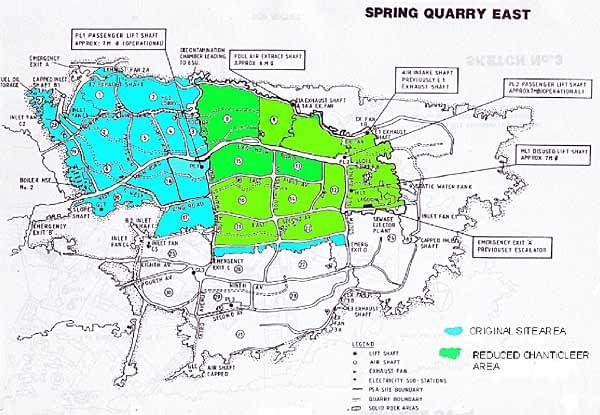
In 1982 a feasibility study called Project Albatross was made into the future use of the Chanticleer facility. The primary aim of the study was to consider ways of reorganising and consolidating the occupied areas. The aim was still to cater for 1000 staff but the study considered how the site could be made secure against conventional weapons (which might penetrate the various openings to the surface), chemical and biological weapons, fall out and ‘unconventional forms of attack’ which meant a direct assault by ground forces or sabotage. Decontamination facilities were also to be provided and the site was to be able to operate in a completely shut down state for up to 7 days. Several schemes were suggested all of which involved reducing the occupied spaces which would be enclosed and isolated from other parts of the quarry. The water supply would be modified (and restricted), chemical toilets would be used, the access to the site reduced to one main entrance plus a few emergency exits and the food supply restricted to army compo rations cooked with microwave ovens. It was however pointed out that irrespective of which if any scheme were adopted significant and costly engineering works would be needed to maintain the site. It was recognised that the size of the occupied area would have a major influence on the running costs both during peace and under active use because the space directly influenced the amount of ventilation, heating and other users of power. The ‘minimum area scheme’ was therefore conceived which would reduce the occupied area to just 8, 9 10 and 11. The communications facilities would be reduced and concentrated and the space available for people cut. Open office space would be provided for 500 people at any time and a hot-bunk system would be set up based on 2-tier bunks and a 12 hour shift pattern. Single bedrooms would be provided for 10 VIPs and smaller combined bedroom/offices for 24 senior staff.
However, it appears that nothing happened as a result of the feasibility study and in 1988 the Cabinet Office, faced with the growing costs and obsolescence of PERIPHERAL commissioned the Project Albatross Design Study which would continue the work of the 1982 study. It would now cost the ‘minimum area scheme’ but interestingly would also consider the possibilities of setting up the site so that it could be made operational within a 28 day period and examine the costs of completely abandoning the site.
The Study which included plans for a BBC studio were still based on 1000 potential staff and included lists of proposed telephone and telex circuits which is interesting to compare with the numbers actually provided 30 years before. Private circuits would go to -
- the emergency manual switching system centres at Worcester, Reading and Merthyr Tydfil
- RGHQs 7.1, 9.2, 4.1 and 1.1
- UKWMO Bath
- BBC Wood Norton and Caversham
- MoD Rudloe Manor
- NCWA Cambridge (NATO)
- BT Defence Network at Shepton Mallet and Oswestry
- DCN Rudloe Manor
- Rugby and Somerton radio station
- 14 circuits to various military HQs and communications sites such as Boddington, Croughton, Fylingdales and Pitreavie
There would also be 20 exchange lines.
It is also possible that by this time the plans had been modified so that CHANTICLEER/PERIPHERAL would be manned not by Python type groups but by an ‘Advanced Party’ to be followed at some later stage by a dedicated ‘Main Party’ of about 500 under a scheme known as FLEX. Whether or not this was the case the surviving facilities at PERIPHERAL were now only a sad shadow of those planned for SUBTERFUGE 30 years earlier.
The site continued to be maintained throughout the 1980s at an annual cost, according to the Cabinet Office, of some £500,000. By 1991 plans were being made to remove all the stores and with the end of the Cold War the site was decommissioned although it took a further 10 years for it to be put up for disposal under plans to redevelop the whole of the still extensive government estate in the Corsham area.
File 5: The Regional Seats of Government
The what’s, where’s and how’s of the RSGs
By 1960 planners in both central and local government were beginning to think that the peacetime local authorities would not be able to cope with the huge problems that the country would face in the post-attack period. Strategists now also thought that the attack, perhaps involving 150 hydrogen bombs each of 3 megatons, would be directed at the many airbases and missile sites around the country capable of launching nuclear weapons as well as the cities. This would mean the destruction and particularly the resulting fall-out would be spread over more of the country than previously envisaged. These problems were considered in 1960 during studies known as Ace High and Cloud Dragon which found, amongst other things, that a more active system of governmental control would be needed. This lead to the setting up of The Bishop Committee to consider the findings on the basis that “the UK would cease to exist as a corporate political entity” after an attack.
The Committee’s conclusions were given further weight by the Berlin Crisis which grew during 1961. One of its main recommendations of the Committee was that the regional control system should be made operational and although this would be expensive the go-ahead was given to implement “Programme X” to build the headquarters by 1966. The title “joint civil-military headquarters” was now dropped in favour of “Regional Seats of Government”, although they were usually simply referred to as RSGs. The new name was adopted to emphasise the RSG’s new role as a policymaking body rather than one directing the immediate life saving effort. The Home Office described the RSGs as “the lynchpin of the preparations for survival” which would “provide a system of administration and marshalling of supplies and services”. It would have no role in the pre-attack period and unlike its predecessors the RSG or perhaps more correctly their Regional Commissioner would now automatically assume power after a nuclear attack with no suggestion that it would only do so if it lost contact with central government. The RSG would now be the central government for its region until central government could be restored at the national level.
Although the idea of an RSG was introduced in 1960, no operating procedures were written to guide its staff until they were needed for the large scale Exercise Fallex62. This was a NATO wide exercise held in September 1962 for which 6 RSGs were activated. These procedures said the real task of the RSG would lie in the weeks and months after the attack in what would have been essentially the task of putting the social and economic structure of the region back together from what would have been, even in the least affected areas, at best a much damaged starting point. Even if the region was not physically affected by blast, fall-out would affect people’s ability to move about, refugees would be a problem, the national distribution system for food and other essentials would have broken down, there would be no imports of food, the national electricity grid would have been put out of action, there would be no effective national leadership and underlying everything would be a sense of confusion, despair and fear for the future.
The Regional Commissioners “would not try to restore anything like normal conditions, but would see that law and order and some machinery of administration was maintained, to see that the best use was made of remaining resources, and to keep in touch with the population”. The Region would probably be on its own and reliant on its own resources for months rather than weeks, until some effective central government could be restored. During this time the Regional Commissioner “would have to exert far more control over the production and distribution of commodities and over the activities of local authorities, public utilities and commercial undertakings than would be tolerable on the part of government in peacetime”. As an example Exercise Grass Seed held in the Bristol sub-region in 1966 envisaged the Regional Commissioner deciding not to abandon parts of Bristol and authorising an increase in the War Emergency Dose of the civil defence workers. He had insisted on payment being made for all food and meals provided by the emergency feeding centres in an attempt to keep the cash economy going. He visited many places “offering encouragement” and made broadcasts to the people. In the wake of a total breakdown in law and order “The Regional Commissioner pronounced drastic measures for the enforcement of law and order, such as death and flogging for looting, and … these sentences have been carried out on the orders of the Summary Courts of Justice”. The Regional Commissioner would also pronounce on such matters as the direction of labour, building priorities, energy usage, restarting the education system, currency (including the possibility of a separate regional currencies with differing rates of exchange for inter-regional trade), and major population movements within the region and perhaps to other regions.
As a Whitehall in miniature, the RSG would include representatives of all the central government departments who would have a role in the survival period and beyond. The staff of an RSG was nominally around 430 and a full list of them and their departments in 1963 is given in the appendix. The scope of the RSG’s role is well illustrated by the inland transport contingent. As well as the Regional Transport Controller and his deputy this would include a Regional Bus Controller, Regional Goods Vehicle Controller, Divisional Road Engineer and Regional Railway Liaison Officer. Most of these people would have come from private industry rather than the civil service. Similarly, appointments would be from trade representatives for the food supply and energy industries. The major banks would supply representatives to assist the Treasury contingent in organising the region’s economy. The military would still have a major role in preserving law and order and the RSG would continue to serve as the District Headquarters for the armed forces under the Regional Military Commander.
The internal organisation of an RSG
The role of the RSG was to be the central government for its region for an indefinite period and the operational procedures generally reflected standard civil service practices. There were however some significant differences. The civil servants would not be acting as representatives of their own Ministries or Ministers but as members of a joint team under the Regional Commissioner. Decisions would have to be made quickly and with relatively little information, methods which would no doubt come as a shock to many.
The RSG would have a nucleus or core consisting of the Regional Commissioner, the Deputy Regional Commissioner, and the Principal Officer supported by the Secretariat with its Information Unit. This nucleus would correspond to the peacetime “Number 10” and the Cabinet Secretariat. In support, it would have a civilian combined operations staff, scientific advisers, legal advisers and so on. Under them would come the representatives of the various departments involved in home defence (which would be virtually all of them with the notable exception of the Ministry of Defence and the Foreign Office whose peacetime tasks would in war be reserved to the central government nucleus), the uniformed services (military, fire, police and civil defence) together with a large supporting staff.
The working structure mirrored that of peacetime cabinet government with the major decisions being taken by the Regional Commissioner’s Committee consisting of the Regional Commissioner, Deputy Regional Commissioner, Principal Officer and Departmental Heads who would meet daily. Its decisions would be put into effect by the Secretariat acting like the Cabinet Office and Cabinet Secretariat. There would also be committees formed to oversee particular areas such as communications. Ad hoc meetings of departmental representatives would be arranged by the Secretariat, which would also circulate the decisions. Many decisions would need to be made in committee as most would effect more than one department for example the decision to evacuate a badly affected area would involve transport, feeding and billeting.
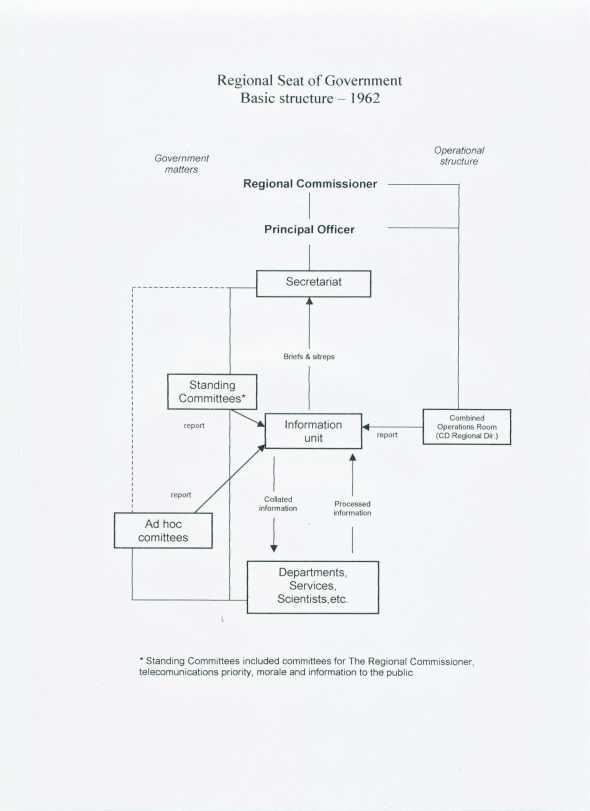
Within the Secretariat, the Information Unit would be responsible for building up and maintaining the strategic picture of what was happening in the region. It would also use this information to forecast longer-term trends and needs. The Information Unit would also compile the twice-daily situation reports, which would be sent to other RSGs and the central government nucleus. Each RSG would have a small BBC sound studio to allow the Regional Commissioner to broadcast to the survivors giving them information and trying to maintain morale.
The Combined Operations Room under the peacetime Regional Director of Civil Defence would direct the strategic reinforcement of affected areas in the life saving phase. The armed forces contingent would principally be concerned with the provision of “aid to the civil power” which was generally taken to mean assisting with the maintenance of law and order. It might be mentioned in passing that martial law was not considered. The Regional Military Commander would be constitutionally under the direction of the Regional Commissioner. He would command the military forces but their actual control was left to the military. Similarly, police forces would remain under the operational control of the local Chief Constables although overall command of the police would be vested in the Regional Police Commander who would come under the direction of the Regional Commissioner.
Supporting the nucleus and the operational staffs was a substantial “common services” contingent under a Chief Clerk. They would be responsible for providing clerical, typing and duplicating services. The Chief Clerk was also responsible for stationary supplies although departmental representatives would be expected to bring specialist materials, reference works, maps, etc with them. Rather than use many large maps they were equipped with a projector that could take ten-inch square acetate maps that could then be used to show fall out zones, etc. Each RSG had a BFPO (British Forces Post Office) address and outgoing mail would not be censored. This service presumably only relates to the pre-attack period, as there was not expected to be a functioning postal service afterwards.
Unlike the Regional War Rooms RSGs would have to operate on a continuous basis for a long time and they were expected to be self-contained for 30 days. Communications and canteen staff would work on a two-shift basis providing 24-hour cover but most operational staff would work as necessary. Most RSGs had well a equipped kitchen and canteen. Rations of fresh food if available and an initial supply of 30 days composite rations would be provided by the army who would also provide the kitchen and security staff. According to the draft operating procedures tobacco, cigarettes, sweets and toilet requisites would be on sale at normal retail prices possibly organised by the NAAFI. Spirits and canned beer would also be available. These items were not permanently held at the RSG and in reality, given the short length of time which would have been available to bring the RSG to operational readiness it seems very unlikely that anything other than the basics could have been organised. The Chief Clerk would be responsible for keeping stock records and could also make cash advances of salary of up to £5 per week for staff in need. After the pre-stocked stores had been used the Chief Clerk would be expected to organise their replacement. These feeding arrangements however were largely theoretical. In 1964 The Home Defence Committee decided that the Ministry of Agriculture would be responsible for stocking food supplies in the form of ration packs for all non-local authority civil and home defence staff. These included approximately 7200 manning the regional government system, 11000 in UKWMO (see File 16), 3800 from the power industries, 12000 from the Post Office and some 3000 in ports and shipping, mainly dockers moved to the emergency ports and anchorages under the powers to direct labour from the emergency legislation. However, as so often happened apart from meetings and memoranda nothing happened until 1972 when the Ministry of Agriculture announced that in view of the moratorium on civil defence expenditure it could no longer undertake to supply food and the regional controls and other organisations would have to arrange for their own stocks before the attack. The Post Office and UKWMO did however obtain ration packs for their people.
Each RSG also had a Camp Commandant who would be responsible for the building and its physical facilities. His initial task was to prepare the site, allocate rooms to the various uses, and acquire furniture and rations where necessary. This role would have been particularly important in the ad hoc RSGs based at barracks. The Camp Commandant was also responsible for ensuring the reserve water and fuel tanks were full but it was expected that water rationing would be necessary if the main supply failed. At some sites, Elsan toilets would be available if the sewers became unusable. A generator would be available to provide power for the inevitable loss of the main supply and some RSGs would have used Calor Gas for cooking.
The RSG would be manned at some time during the precautionary period. Initially a small team from the Home Office, possibly from the Regional Director of Civil Defence’s staff, would be dispatched to prepare the RSG. But actual activation or overt preparations would be delayed for as long as possible so as not to alarm or alert the general public or to give them the idea that the government thought the much-vaunted nuclear deterrent had failed.
The Camp Commandant would also be responsible for security and reception of the staff. They would be instructed to arrive at the RSG independently or in small groups At all the RSGs some staff would have come from London whilst others would have come from regional offices of their departments. Many of the junior staff would have come from local offices of central government. Most of the staff would have slept on 2 or sometimes 3-tier iron bunk beds in dormitories although where space permitted the senior staff had single beds in their offices. Bedding was provided but there does not appear to have been any facilities for washing it or clothes, although showers were provided. The living accommodation was generally very spartan and conditions, even in the better RSGs would have been far from pleasant particularly after several weeks of occupation.
The RSG sites
Under Programme X the old plans to build 6 specially designed buildings as joint civil/military headquarters at Hexham (North region), Shipton (North East), Reading/Oxford (Southern), Taunton (South West), Llandridnod Wells (Wales) and Lancaster (North West) were revived. They would have had 57000 square feet of usable accommodation and cost about £2 million, equivalent to £25 million today. To retain some secrecy they would be referred to as “Home Office Training Establishments”. Sites for the remaining RSGs were quickly acquired. In Nottingham, work was already under way on an extension to the original Regional War Room and a similar extension was started at Cambridge. The tunnels at Drakelow had already been acquired as had those under Dover Castle. The purpose built RSGs would take several years to complete and until then barracks in Catterick, York, Preston and Brecon were earmarked as emergency regional headquarters and in Devon the ROTOR station at Bold Head was fitted out.
By 1961, some RSGs were becoming operational and some exercises were held such as De Novo in Eastern region and Mercian Trump ll in the Midland. There were however no procedures written and the regional civil defence staffs still tended to consider the short-term problems much to the annoyance of the Home Office.
But, the Berlin and Cuban Missile Crises in 1961 and 1962 showed that a war could develop much quicker than previously planned for and consequently following a rather rapid home defence review the assumption of a 7 day Precautionary Period was reduced to one of 2-3 days. The RSGs particularly those in ad hoc accommodation could not be prepared in time and the purpose built RSGs became, at least according to the Home Office, a necessity. They had however become a source of heated debate between the Treasury and the Home Office which centred on cost rather than need and eventually a decision was made in December 1964 by the Prime Minister “to delay any further consideration”. In reality, the idea of purpose built RSGs was abandoned.
The shortened warning period had other effects and for example, there were doubts as to whether the Regional Commissioners could be appointed in time. One Ministry of Defence report doubted that little more than a start could be made on the necessary preparations in this short time and said “It is quite clear therefore that much of our present ability to react effectively to a crisis developing as quickly as the Cuban affair is severely limited”. The massive nation wide evacuation scheme could not possibly be completed in this time frame and although subsequent plans to evacuate fewer people from the major cities and only moving them up to 50 miles were suggested following the 1965 Home Defence Review evacuation as a strategy was effectively abandoned.
Another plan rendered unworkable by the shortened precautionary period was the one to evacuate the Bank of England’s gold reserves from London. The plan which had been in the Treasury War Book since the 1950s was to take the gold, under military escort to the Valley Works at Mold which was at the time also nominally the reserve emergency central government war headquarters, where 10000 square feet of floor space was reserved. Other sites which had been considered were the former ordnance factories at Brackla and Swynnerton (both also used for civil defence controls) and the old ROTOR site at St Twynells in Wales. The plan was reconsidered in 1964 when the Treasury War Book was being revised but no decision was taken about its future. There is a file retained at the PRO dealing with removing the reserves from London between 1964 and 1968 but it is not available to the public. However the allocation of an army battalion in the MoD War Book from the late 1960s to guarding the gold reserves suggests that plans of some sort still existed into the 1970s.
The impetus that the RSGs enjoyed from 1960 to 1962 did not last and by May 1965 no major exercises had been held involving RSGs for nearly 3 years and four of them had not been activated for a longer period. In May 1964, planning had started for an RSG exercise to be held in May 1965 called CIVLOG65 but this was overtaken by events which resulted in a major change in the structure of the RSGs.
The list below shows the designated RSG sites in April 1963. They were a motley assortment of buildings with perhaps one overriding similarity - they were cheap. All the sites were already in government hands and to some degree fitted with communications and domestic services.
| Region | Site | Support |
|---|---|---|
| 1 (Northern) | Gaza/Sandhurst Block, Catterick Camp | RAF Catterick |
| 2 (North Eastern) | The Keep, York Castle - interim location | Imphal Barracks |
| 3 (North Midland) | Chalfont Drive, Nottingham | Bestwood Lodge, Arnold, Notts - interim location |
| 4 (East) | Government Buildings, Brooklands Ave. Cambridge | The Leys School, Cambridge |
| 6 (Southern) | Warren Row, near Maidenhead | None |
| 7 (South Western) | Kingsbridge, Devon (more commonly known as Bolt Head) | Marine Hotel, Salcombe, possibly BRNC Dartmouth |
| 8 (Wales) | Depot Barracks, Brecon | Lansdown Restaurant, Brecon |
| 9 (Midland) | Wolverly Near Kidderminster (more commonly known as Drakelow) | HQ 48 Division TA Shrewsbury |
| 10 (North Western) | Fulwood Barracks, Preston | Imperial Hotel, Blackpool |
| 12 (South Eastern) | Dover Castle | Another part of the Castle |
| Northern Ireland | Gough Barracks, Armagh | Not known |
| Scotland | Scottish Central Control, Barnton Quarry, Edinburgh | Tulliallan Castle, Kincardine |
| Scotland (Western Zone) | vicinity of Torrance House, East Kilbride | Torance House |
| Scotland (Eastern Zone) | Civil Defence HQ Kirknewton | Howden House, Kirknewton |
| Scotland (Northern Zone) | Civil Defence HQ Anstruther | Not known |
On a regional basis the sites were -
Region 1 (Northern)
North Region’s RSG was to be at Catterick Barracks although no purpose built or special accommodation was available. Existing buildings would have to be modified with their doors and windows blocked and the walls sandbagged. The resulting accommodation was considered adequate but it would take several hundred men at least 2 days to prepare.
Region 2 (North Eastern)
Initially North East Region’s RSG site would have been in York Barracks but by 1964 it had relocated to Shipton to the north of York where it was housed in one of four massive 3 storey underground bunkers built in the early 1950s as Sector Operations Centres (usually known as SOCs) for the short-lived RAF Rotor radar scheme. Whilst completely self-sufficient the bunker was shared with Royal Observer Corps Sector Control which had stayed behind when the RAF had moved out and this caused serious space problems. At an almost identical SOC at Kelvedon Hatch, which was at this time used as a smaller Sub Regional Headquarters the lack of space, meant that some bunks were put into the long entrance tunnel. A long-term solution was to add a fourth floor to these already massive buildings to house dormitories and extra fuel and water tanks. This was eventually done at Shipton but in the meantime some of the RSG staff would have to use York Barracks with the old Regional War Room at Leeds acting as its communications centre.
Region 3 (North Midlands)
The regional War Room site at Nottingham was not designated for use under the “joint civil/military headquarters” plan and a site in Grantham was earmarked. However, by 1959 revised assumptions about Soviet targeting strategy put Nottingham into a “neutral area” as far as fall out was concerned and plans were quickly made to build a major extension to the War Room. The War Room was left as the core of the new RSG3 and retained its original plant rooms but extensions were added at the sides with concrete walls about 2 feet thick. A new third floor was then added so that the RSG had over four times the space of the War Room. The lower floor of the War Room was partly underground and this extended to provide space for large water and diesel tanks. The resulting building was full of narrow corridors, small rooms and staircases which would not have helped operational efficiency. It was however much larger than most RSGs and could accommodate 400. The extension work was completed by 1964 but soon after the plans were changed and permanent RSGs were no longer maintained. The Nottingham building was however kept as a potential “accretion centre” for the new style RSG Groups and as a possible sub regional headquarters. The building, which is in the middle of a sprawling complex of government offices, acquired the nickname of “The Kremlin” sometime in the 1950s and this is still used today.
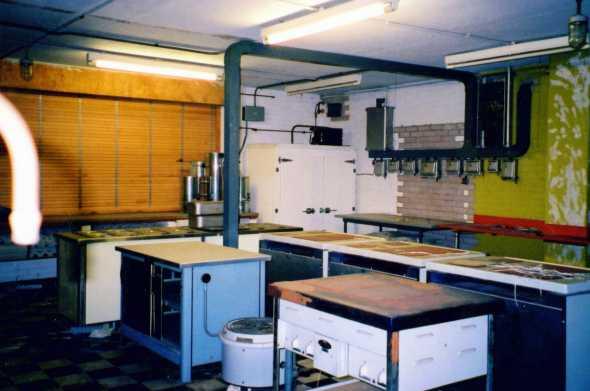
Kitchen at Nottingham in 2004
Region 4 (East)
East region actually had a surfeit of suitable accommodation. It had two of the massive Rotor SOCs at Bawbugh near Norwich and Kelvedon Hatch near Brentwood both of which were used as Sub Regional Headquarters. RSG4 was located at the Regional War Room in Cambridge that was extended by 1964 with a 2 storey windowless extension with walls some 2 feet thick to the side of the War Room that added some 30000 square feet of floor space. The first floor housed the dormitories and domestic accommodation whilst most of the operational areas and plant were on the ground floor. The old War Room was integral to the construction and housed the Regional Commissioner and his team and the communications.
Region 6 (Southern)
Southern region was particularly badly prepared. The main RSG site was at Warren Row near Maidenhead which was acquired under Programme X. It used part of an underground chalk quarry that had been taken over as an aircraft components factory during the Second World War and subsequently used as a store by the Science Museum. The “New Mine” which became RSG6 consisted of a meandering brick lined tunnel about 300 yards long with an entrance at each end. The tunnel was generally about 15 - 20 feet wide and one level high with the office accommodation formed by partitioning spaces off to one side. In some places, the tunnel was high enough to squeeze in a second floor that was used for dormitories. In 1964 it could only accommodate 250 of the planned 430 staff in conditions which were described as “primitive, unhealthy and in parts unsafe”. The rest of the staff would be housed in, or near, the Reading Regional War Room which would also serve as the communications centre, although its effectiveness is questionable as the two sites were only linked by vulnerable overhead lines.
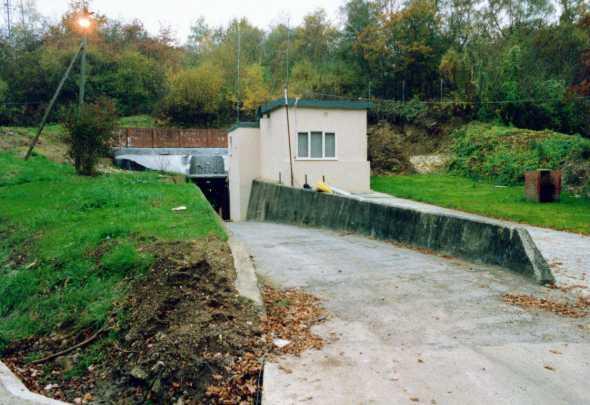
Main entrance to Warren Row, now a commercial store, in the 1980s
Region 7 (South West)
RSG7 was one of the earliest RSGs and was based in a former RAF Rotor Ground Control Intercept station. This 2-storey bunker was built on the surface at Bolt Head on the south Devon coast. The roof and walls were about 2 feet thick which would give adequate protection against fall-out. The bunker was quite small and a large unprotected building nearby was converted to be used for domestic accommodation. Even so, the whole site could only take 250 staff. Although it was used during the 1962 Exercise Fallex62 the site’s emergency generators and some other building works were not ready until 1964. The site is rather exposed and close to the sea, which no doubt accounts for its 1960s local codename of Gull Perch.
At this time the South West Civil Defence Region consisted of 12 Civil Defence Corps Authorities - Bath, Bristol, Exeter, Gloucester City, Plymouth, Swindon and North East Wiltshire, Cornwall, Devon, Gloucestershire, Somerset, Wiltshire and the Isles of Scilly. In wartime they would be divided into 7 Groups which would report to the RSG - Gloucestershire, Swindon, Wiltshire, Somerset, Devon, Plymouth and Cornwall. Bristol together with Bath and neighbouring parts of Gloucestershire and Somerset would form the Bristol Sub Region with its Sub Regional Control at the civil defence school at Falfield. Most of the Group Controls would be established in County Halls although a wide range of buildings were earmarked for the lower Area Controls for example Area 71A would use the Guildhall in Bath and Area 76A The Old Rectory in Honiton. The vast majority of the designated Group and Area Controllers were former army officers.
Region 8 (Wales)
Wales was badly provided with suitable accommodation. Although several Second World War underground stores were available, RSG8 was housed in the barracks at Brecon. It suffered the same basic problems as Catterick and could only accommodate 100 people.
Region 9 (Midlands)
RSG9 was housed in an underground factory dug into a remote bracken covered hillside at Drakelow near Kidderminster during the Second World War. The accommodation consisted of a network of square tunnels about 16 feet wide laid out on a grid pattern. Originally, the tunnels provided some 250000 sq feet of floor space but the RSG only used half of this and at one stage it was suggested that they could also accommodate one and possibly two Sub Regional Headquarters as well. As at Warren Row the offices were partitioned along the tunnels.
Region 10 (North Western)
At one time, it was proposed to use a World War Two underground bomb dump at Harpur Hill near Buxton as RSG10. This massive site could have housed the RSG, its support staff, a Sub Regional Control and a wartime headquarters for the Ministry of Agriculture. However, installing land line and radio communications to the site proved to be prohibitively expensive came to nothing and the RSG was located in the barracks at Preston.
Region 12 (South East)
During the Napoleonic wars, a series of tunnels were dug under Dover Castle to accommodate troops. Further tunnels were dug during the Second World War to serve as military headquarters, dressing station and communications centre. These were taken over in 1960 to be developed into RSG12 but as elsewhere matters proceeded very slowly and the conversion was not completed until 1964. The operational hub of the RSG was on the lowest level of tunnels known as “Dumpy” which consisted of a series of narrow tunnels lined with corrugated iron linking larger rooms. Accommodation, canteen facilities, plant rooms and oil and water storage tanks were installed on the upper two levels. The middle level of tunnels ended at the cliff face and although blocked off faced out onto Dover docks, which made the site vulnerable to any attack on these strategically important facilities. Unusually for a bunker a lift was installed connecting all 3 levels to the surface and the winding gear together with offices were housed in an anonymous windowless building in the castle grounds where it was passed by thousands of tourists who were completely unaware of its function or what lay beneath. Part of the site is open to the public and the restaurant and kitchen occupy the same area as the old RSG canteen.
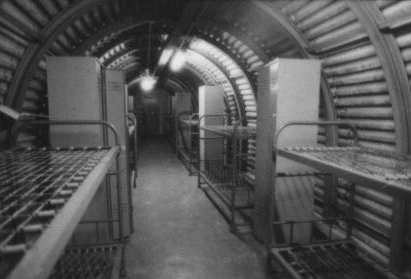
Dormitory - Dover
Scotland
The control chain in Scotland and Northern Ireland was slightly different to that in England and Wales because of their differing political systems.
A Scottish Central Control was planned in 1948 and built to the standard regional war room design at Kirknewton near Edinburgh. It would be under the direction of a Scottish Minister rather than a Regional Commissioner and had two outposts or Zone Controls based on Glasgow and Edinburgh. By 1959, the country was divided into 3 zones: Northern, Eastern and Western reporting, under the joint civil/military headquarters scheme to the Scottish Central Control in the barracks at Lanark. In 1960, building started at the Kirknewton site to extend it on similar lines to the development at Cambridge. At this time the RAF’s former 3 level Rotor bunker at Barnton Quarry in Edinburgh, a few miles away, was adopted as the Scottish Central Control, the equivalent of an RSG, to operate under the Secretary of State for Scotland. Some reports suggest that when Kirknewton’s redevelopment was complete it resumed its role as the Scottish Central with Barnton Quarry being redesignated as the Eastern Zone Control.
The Northern Zone control was established by the mid-1960s at Anstruther in Fife in a 2 level RAF underground Rotor bunker. A new control was proposed for the Western Zone at Lanark but this was scrapped in favour of using a former anti-aircraft operations room17 built for the army in the early 1950s at East Kilbride.
Below the level of the zones, Scotland was divided into 20 civil defence groups and then areas, sectors and warden’s posts as in England and Wales.
Northern Ireland
Northern Ireland had its war room in Belfast but by 1959 plans were made to establish a Northern Ireland Central Control (also called the Northern Ireland Civil Defence Headquarters) at the Gough Barracks in Armagh. This plan was delayed for several years in part by a petty squabble between government departments about who would fund the cost of the single landline to the STOCKWELL central government headquarters. Northern Ireland was then divided into 8 Areas and then district or sub-controls and then sectors as elsewhere.
London
London posed a major problem for the civil defence planners because of its size, population, communications links and particularly its place as the centre of government. These made it an obvious target. The early 1950s plans divided the capital into 4 sub-regions each with a War Room and Sub Regional Commissioner. A London War Room was never built although nominally the World War 2 bunker at Dollis Hill served as the Joint Civil/Military HQ for the region. But by 1959 the planners had accepted a plan which had been under consideration since 1956 that London would not be a separate region in wartime. Its sub-regions, increased from 4 to 5 in 1958, were now to be allocated in war between East region at Cambridge and South Eastern region at Dover. London region would however continue to exist for peace time planning purposes.
Early plans for the 5 London sub-regional controls were extremely vague and the general idea was to locate them well outside the London area preferably alongside the control for the neighbouring Civil Defence Corps group for example at Chelmsford and Maidstone. By 1960 the ROTOR bunker at Kelvedon Hatch was adopted as the control for the North East sub-region (5.1) although this would continue to use the old Wanstead control until 1962. The former war room at Kemnal Manor was no longer available and Fort Bridgewoods at Chatham was nominally the SRC for south east London possibly using the former AAOR site. The south west SRC was nominally at Cheam although by 1960 the idea of using Stoughton Barracks at Guildford was under consideration and this was later adopted. The former north London control at Mill Hill may have been allocated to the northern sub region (5.5) leaving the north west without a control until the premises at Southall were adopted, although there is a possibility that the Dollis Hill War Room could have been used.
The distinction between a wartime and a peacetime organisation appears to have caused some problems amongst the planners but it continued although in 1965 London lost its formal numerical classification as No 5 region possibly to help with establishing the formal communication links with the wartime RSGs. North West London was now allocated to Southern Region with its SRHQ (probably) at Warren Row. The numeral 5 was now adopted by South Eastern Region (formerly 12 Region) with the SRHQ at Dover covering south east London and the nominal one at Guildford covering the south west. The north and north east areas were covered by Eastern Region SRHQs at Hertford and Kelvedon Hatch.
In some cases, the RSGs were not large enough to accommodate all the 430 or so staff. In addition, some agencies such as the army and MAFF would require additional accommodation for their regional staff or those who did not need to be in the RSG itself. This lead to the majority being allocated support headquarters in nearby accommodation chosen to provide living as well as working accommodation but with no special protection against fall out. The support headquarters for RSG4 at Cambridge was for example to be The Leys School, a large imposing public school a few hundred yards from the main RSG site.
Staffing the system
The Regional Commissioner’s in the War Room era would have been, like their World War ll predecessors members of the “great and good” probably with a military background and in 1948 a list of potential Regional Commissioners had been drawn up. Certainly, the majority of the Sub Regional Controllers who were appointed were ex-generals or colonels although at least one was a local businessman. There was also a suggestion that if necessary County or Town Clerks could be appointed to this role. At the local level the civil defence organisation would have been lead by the Group and Area Controllers supported by the County Clerks and the authority’s full time Civil Defence Officer.
The War Room staffing was the responsibility of the Regional Directors of Civil Defence. The staff would have been a mixture of “professionals” from the Civil Defence Corps, police, fire brigade and health services with some volunteer scientists acting as Scientific Intelligence Officers. They would be supported by a “common services” staff mainly operating the communications systems. These would have been junior civil servants apparently mostly from the Ministry of Pensions and National Insurance. Unusually for civil defence, junior civil servants were actively sought or “trawled” in civil service jargon to volunteer to work in both the regional war rooms and the CGWR.
When the RSGs were introduced, the Regional Commissioners would have had a different role from their War Room predecessors. They would now primarily be lawmakers, long-term representatives of the central government with almost unlimited power to govern. The only authority that could over-rule a decision of a Regional Commissioner would be the War Cabinet. These Regional Commissioners would be appointed from “Ministers (or persons of ministerial status)” or “senior ministers” and each would have a junior minister as a deputy but they would probably not have been cabinet ministers. In practice, ministers might be in short supply.
The 23 Sub Regional Commissioner posts would have been filled by Under Secretaries, the third highest rank in the civil service. (Many of the most senior civil servants would have to be with their Ministers). This helps explain the remark in a Home Office paper that “manning the central government war headquarters would denude Whitehall of senior officials”.
There were frequent concerns expressed throughout the 1950s and 1960s that there were insufficient volunteers from the civil service and these shortages caused problems during exercises. In some cases, Civil Defence Corps members were called on to assist with communications although manning the War Rooms was not a Corps function. These shortages became more acute with the introduction of the RSGs with their much larger staffs especially when this was coupled with the need for the central government rather than the local authorities to find the staff for the Sub Regional Controls (and later the Sub Regional Headquarters) as well as the central government nucleus at the same time. The bulk of the domestic and communications staffs for the RSGs would have been provided by the Territorial Army although the latter in particular would have been a problem as the signals units were only at half their established strengths.
Apart from a few senior appointments, the staffs of the Government War Headquarters and the RSGs were not told of their wartime designation although civil service personnel departments selected all staff, either by name or post down to individual typists. This would cause obvious problems when the decision was taken to man the RSGs. But it was felt that to tell people they were earmarked for a wartime role would cause problems with and between those selected and not selected and with the trades unions, and bring unwanted publicity to the plans. This idea of not informing staff seems to be in contradiction to the idea that there were insufficient volunteers but the volunteers would have formed a pool of potential staff and the people who actually took part in exercises were not told if they were the people earmarked for a war role. There were no special arrangements to look after the families of staffs in the various controls, but at this time it was expected that there would be a general evacuation from the major cities of all children accompanied by their mothers together with most disabled people.
In 1961, the Ministerial Committee on Civil Defence considered the problem of the lack of volunteers and asked Ministers to encourage volunteering in their Departments. They also considered offering volunteers additional payments or, significantly, making provision to safeguard their families. Nothing however was done at the time to encourage more volunteers although in 1964 the Committee finally agreed that senior staff could be informed of and trained for their wartime roles. In 1966, some senior staff for the RSG Groups were appointed and junior staff were designated but not informed of their roles. None of the Under Secretaries destined for the newly designated Sub Regional Controls were informed of their wartime role.
In 1967 the Home Office again made attempts to consider staffing the RSGs and SRCs and Establishment Officers of various government departments were asked to look for volunteers who would be “…physically fit and psychologically able to withstand adverse conditions”. People with a poor sickness record, a physical handicap, suffering from respiratory ailments or who needed special diets would not be suitable. Normal security vetting would be applied but no “special check” would be made on police records but “The selection of unilateralists should be avoided as far as possible."18. The problem of what to do about the families of RSG and SRC staff was also reconsidered but no answer was found and it was considered insignificant compared with the other problems which would exist in the period leading up to war such as the setting up of emergency ports and the transferring of dockers from major ports like London and Liverpool. This provided a good excuse to defer further consideration of the problem. Some Departments however continued to keep lists of nominal staff for the SRC and RSG teams well after the system was mothballed under “care and maintenance” in 1968 although in 1972 only 807 of the required 1604 staff had been nominated for the SRCs.
The majority of the RSG staff would have had no idea of their wartime role until they received a letter from their personnel department telling them. A draft call-up letter in a Ministry of Health file informed the recipient that they had been “…selected for duty at an important wartime HQ. So far as anyone can say at the moment you may be there for about a month…” The letter told the civil servant to go home immediately and pack their personal effects. They were warned that they would have to do their own washing but “clothing may be informal” and as entertainment would be limited they should take some books. They were allowed to draw up to £25 in advance of their salaries but should make arrangements for their salary to be paid to their spouse. Apart from this there was no mention of what their families should do. The newly appointed staff would travel to the RSG independently using their own cars or by train for which a railway warrant would be made available. This of course ignores the reality that at this time the railway network would have been totally disrupted by the needs of the armed forces and the plans to evacuate civilians.
It was expected that most staff would not need any special training but this did not apply to communications staff. Originally, the army would have manned the communications centres in the RSGs and other regional controls but by the end of the 1960s this was no longer practical and consideration was given to recruiting volunteers from local civil service offices who would be trained in communications procedures in peacetime ready for a wartime role.
The training need applied to a more limited extent to the scientific teams and in 1967 the Royal Observer Corps agreed to provide up to 12 Observers at each SRC to assist the scientists particularly in plotting fall-out.
Spies for Peace
The Regional Seats of Government, and in practice most other civil defence activities were virtually unknown to the general public until a group of “ban the bomb” protesters broke into the RSG at Warren Row in 1963. Calling themselves “Spies for Peace” they wrote a pamphlet described by The Times as “a crudely produced collection of what are claimed to be factual details, annotated with uninformed conclusions” giving the general locations of the RSGs together with a broad, albeit politically biased, description of their roles and staffing. The pamphlet which in reality was very accurate was widely distributed amongst the marchers on the annual Aldermaston to London “Ban the Bomb” march in time for several hundred of them to leave the route and, to the concern of the official organisers, head for Warren Row a few miles up a narrow side road. The protesters found that the RSG site was unfenced and, again to quote from The Times, “several hundred bearded youths and their dishevelled female friends” promptly picketed the main entrance to the bunker. This resulted in some minor scuffles and arrests. The pamphlet called “Danger! Official Secret RSG6” was quickly copied and distributed in thousands around the country despite attempts by the police to prevent it. The RSGs in Cambridge and Edinburgh were picketed soon after. The matter was even debated in Parliament where the Prime Minister deplored the actions saying that the RSGs were no more than places from which the Regional Commissioners would operate. Several people were arrested and the security services were ordered to find the authors but never did.
The government argued that whilst the locations of the RSGs was not secret it would be contrary to the interests of the country if their functions and functioning were widely known, although thanks to the Spies for Peace and probably the government’s reaction they now were. The British press were hit with a D Notice forbidding publication but this did not apply to the foreign press. The episode blew over after a couple of weeks but the RSGs were now in the public domain.
The episode inspired a protest song about the Warren Row bunker, which is near, what some have said, is the appropriately named village of Wargrave -
“Near a neat little town they call Wargrave there’s a funk-hole they’ve built underground but it’s on the D-List, so it doesn’t exist and it’s no use you poking around.
But ask your best friend and he’ll tell you The place is called RSG6 An establishment for the establishment And not for us tax-paying hicks”
Shortly after the Spies for Peace affair the Joint Intelligence Committee suggested that because the RSGs were now known to the enemy, they might be targeted in a future war and this was one of the factors leading to their abandonment. The Spies for Peace would not have known this but would no doubt have hailed it as a victory if they had.
File 6: Regional Government
Sub Regional Controls - the end of the RSGs and the Corps
A new role for local authorities
The civil defence control system which had evolved by 1960 was essentially on two levels. The local authority based Civil Defence Corps and its associated organisations, supported by the Sub Regional Control, would organise the immediate life saving effort while at the regional level, the joint civil-military headquarters would assist with this and act in support of the Central Government War Headquarters if adequate communications survived or if they did not it would provide an interim central government.
The introduction of the RSG was recognition that there was a need to think in the longer term and to devolve central government down to a regional level to direct the “rehabilitation” or “survival” phase after the initial “life saving” phase. However, planners also began to recognise that much of the work of administration in this period would need to be done at the local government level but that the local authorities were not equipped for the role. This would require a radical rethinking of the structure of local authorities in war and lead to the introduction of a new level of post-attack central government - the Sub Regional Headquarters or SRHQ.
In parallel with these new ideas for administration there was a growing recognition that thinking in terms of life saving efforts based on experiences of the Blitz was totally unrealistic in the age of the H-bomb. These two ideas came together in 1962 when the Ministerial Committee on Home Defence accepted the suggestion from the Official Committee that the emphasis in civil defence should change from an operational, life saving approach to one stressing the preservation of a framework of administration.
The start of this revised policy was announced in 1963. The Whitehall strategists accepted that below the RSGs there were no plans to organise local administration after the life-saving phase though “the survival phase, which would follow the life saving phase, might be long and would certainly be grim.” Whilst “the immediate needs would be to provide food, water, shelter and medical attention for survivors, to marshal and co-ordinate the available resources of essential services and to provide a framework of administration for the taking of necessary measures” which the organs of government would continue to meet they would significantly now “…also preserve a framework of administration to use remaining resources in the best way to keep the rest of the people alive, and to maintain law and order, and to prepare for the restoration of a more normal life.”
The Circular19 which announced this went onto say that the existing system based solely on operational considerations would not necessarily be the most effective given the need to balance a control system for the life saving operational stage, with that of a “system which could function effectively in the much longer period during which all the governmental resources of the country would have to be used to their utmost to enable the nation to survive.” To meet this revised need the existing sub-region and Civil Defence Corps Group structures were abolished. Each region would now be divided into 2 or 3 sub-regions with a total of 23 in England and Wales. Each sub-region would have a protected Sub-Regional Headquarters or SRHQ with a projected staff of 250. These new SRHQs would be smaller versions of the RSGs, with representatives of the main government departments as well as the emergency services and armed forces. If communications with the RSG were severed the SRHQ could carry on independently. The Sub Regional Commissioners would be appointed by central government and their responsibilities “will not be limited to the control of life saving operations but will extend to the co-ordination and control (subject to the Regional Commissioner) of all services necessary to survival”.
The circular was a public document but the classified notes issued in the same year to Scientific Intelligence Officers gave more information. They said that the functions of the Sub Regional Commissioner would be a reflection at a lower level of the RSG. His responsibilities would be two-fold: -
- Overall responsibility for the control of civil defence operations within the sub-region, including the deployment of mobile forces and organisation of reinforcement to counties and county boroughs requiring assistance after the attack, and,
- To provide for a further decentralisation of the machinery of central government and a “forward executive headquarters within each region”. Many of the Regional Commissioner’s powers might be delegated to him and he could take all decisions if communications with the Regional Commissioner were lost.
The SRHQs would have a pivotal role between the policymaking RSGs and the local authorities with their extended wartime functions. But, as usual, little was actually done to prepare them. The Bishop Committee had stressed the need for SRCs to be prepared and some money was made available although it was hopelessly inadequate and the plans envisaged finding Crown property or premises that could be acquired rent free from local authorities to adapt but little was actually done. The new plans called for 23 SRHQs to be established with a pivotal role between the RSGs and the local authorities. Plans were drawn for a standard purpose-built semi-sunk control allowing 40 square feet per person for working accommodation and a further 60 square feet for sleeping areas, kitchen, passages, etc. However, none were ever built and in 1964 the designated SRHQs in each region were -
| North | none |
| North Eastern | none |
| North Midland | none |
| East | both the former Rotor SOCs at Kelvedon Hatch and Bawbugh were available but awaiting rebuilding. The former London War Room at Mill Hill was also available pending completion of a purpose built SRHQ in the basement of a government building being built in Hertford. |
| South Eastern | the old Tunbridge Wells War Room was available and Stoughton Barracks in Guildford could have been used although it had no accommodation. |
| Southern | a World War ll two-level underground site at Harrow was available but it had minimal facilities. |
| South Western | a former Anti Aircraft Operations Room at Ullenwood near Cheltenham previously used as a Civil Defence Corps Group HQ was nearly ready for use. |
| Wales | none |
| Midland | a former ammunition store at Swynnerton, previously used as a Civil Defence Corps Group Control was available and Norton Barracks at Worcester could have been used but it had minimal accommodation. |
| North Western | as at Hertford a purpose built bunker was nearing completion under a government office block at Southport |
The SRHQ system was therefore hardly operational. In an emergency ad hoc controls might have been pressed into service but they would have had very limited communications and accommodation. Alternately, the local authority controls could, in theory, have operated directly to the RSGs. Although in many cases the RSGs were in as poor a state of preparation as the SRHQs.
The Scientific Intelligence Officer’s Notes said that the revised control structure was to be based on the peacetime administrative patterns of local authorities “to ensure the maximum continuity of direction through the mobilisation, life saving and survival periods.” Executive or central government functions were now to be exercised by, or devolved to various tiers from the Regional Commissioner through Sub Regional Commissioners to County and District Controllers. There was now to be a layered system of regional government operating for months, possibly years, and no longer just a control chain to direct the immediate life saving effort. Moreover, this would be a system akin to a military chain of command and it would bear little relationship to the peacetime democratic structures of government and administration. The peacetime structure of local authorities with officials and administrators putting into effect the decisions of elected members made in committees could not hope to cope with the wartime need to make and implement decisions, often very difficult ones, quickly and with incomplete information. In war, local authority structures would need to change so they could play their part in the new scheme of regional government.
Local authorities were now told that following the practice in the last war the elected county, county borough and district councils would, in wartime, have all their powers and functions vested in an Emergency Committee of 3 members. They would also need to nominate a Controller who would be appointed by the central government. He would be a member of the regional government hierarchy answerable not to the Emergency Committee but to the Sub Regional Commissioner.
The exact relationship between the Controller who would be an official rather than an elected councillor and the Emergency Committee was not made clear but he would be empowered by the emergency legislation to take over from the Committee on his own initiative. The Controller would also have central government authority delegated personally to him and he would have the power to co-ordinate the exercise of central government and public utility functions such as determining priorities in the allocation of labour, materials and transport. A similar system would be established in districts and the District Controller would act under the direction of the County Controller.
The Circular was not very forthcoming about what exactly these governmental functions delegated to the Controller might be. However, in February 1964 a study was held at the Civil Defence Staff College at Sunningdale called JANUS 64 involving representatives of various local government organisations, government departments, the utility companies, armed forces and so on. The aim of the study was “to examine what is required at county and county borough level and within counties to enable services essential to the continued existence of the nation to be carried on or restarted after attack with nuclear weapons”. The delegates came up with a list of things which would be either essential or desirable and which the Controller would need to be involved with and therefore what his staff would need to be able to carry out. The essential tasks would be -
- Maintenance of the national chain of control
- Maintenance of law, order and morale
- Provision of food and water
- Restoration of power
- Provision of fuel for transport
- Preservation of public health including sanitary measures and the burial of the dead
- Essential repairs to roads, bridges, houses and other essential buildings
The desirable aims could include -
- Registration and documentation of the surviving population for morale purposes
- Provision of shelter, clothing and bedding
- Keeping people clean
- Organisation and employment of labour
- Resumption of agriculture
- Resumption of chlorine manufacture (for water purification)
- Salvage of materials
- Resumption of cultural and recreational activities
- Organisation of school children
These lists might also serve as an indication of the tasks expected of the RSG and SRHQ at a higher level. They also show how different the role of the County Controllers would be from those of the peacetime councils and how the thinking had moved away from immediate rescue to longer-term survival.
The end of the RSGs
In 1965, the recently elected Labour government ordered a fundamental review of home defence. One of the main driving forces for this was the need to save money but another was the more practical need to respond to the problems caused by the assumption that the precautionary warning period might not last 7 days but might be as short as 2-3 days. The review continued with the assumption prevalent since the 1950s that the nuclear deterrent meant that there was little risk of a major war although it warned, no doubt with the Berlin and Cuban Crises in mind, that “misunderstandings and miscalculations needed to be planned for”. But because of the precarious economic situation future civil defence preparations would have to be “restricted to measures which would be likely to make a really significant contribution to national survival”. The control chain would still be developed but the idea of a permanent RSG that would be manned before an attack was abandoned supposedly to give more flexibility to the control system. In reality, the RSGs were abandoned primarily to save money and also because the Joint Intelligence Committee, which advised the central government on the military threat, was suggesting that as the RSG sites were now widely known they might be directly attacked20. One suggested response to this last problem was to man up the existing RSGs effectively as decoys and then establish other secret ones. But this idea was quickly dismissed. The Review in fact said that in future RSGs would “…be established as soon as possible after attack, under pre-arranged plans at locations that would be selected in the light of prevailing circumstances”.
Only the SRHQs would now be permanent controls, to be manned in the pre-attack period. As such they would be pivotal, with their role even more directed towards governing the sub-region rather than supervising the life saving effort. They would gain a BBC studio but their staffs would be reduced from a nominal 280 to about 200. To show their redefined role they would be redesignated, confusingly, as Sub Regional Controls although their task was completely different from the 1950s SRCs. The role of the new SRC was to organise help for any local authority which was overwhelmed, to deploy resources over a wider area than a county and deal with functions such as trade and electricity distribution which were not local authority functions. They would also be essential in the command and control of the armed forces, fire police and the maintenance or resumption of power and water supplies, transport food and other essentials. The Home Office maintained that without them there would be no means of organising any government above the local authority level after a nuclear attack.
The scrapping of the RSGs as permanent facilities allowed some SRCs to use their buildings. By 1966 the designated SRC sites in each region were -
| North | Shipton (SRC 1.2)21 (ex RSG) and Carlisle Castle (SRC 1.1). In practice Catterick Barracks would have been used). A long term plan to build a site at Hexham was abandoned when all new capital projects were frozen following the introduction of “care and maintenance” in 1968. |
| North East | Craiglands Hotel, Ilkley was designated as SRC 2.1 but not fitted with communications equipment. Instead land lines terminated at the Shipton site and would be connected to the hotel in the pre-attack period. In 1968 a former ROC Group Control at Yeadon was taken over to replace the hotel. Conisbrough (a former anti-aircraft operations room) would be SRC 2.2 and York Barracks SRC 2.3 (to be replaced by the former Rotor site at Bempton in long-term plans). The Grand Hotel Scarborough was also considered at one stage. |
| North Midlands | Skendelby (a former Rotor site which was about to be expanded) was SRC 3.2, a Derbyshire County Council depot in Matlock SRC 3.1 and Corby Civic Centre SRC 3.3 (this could only hold 40 and would mean dispossessing the existing council control). The former RSG at Nottingham was retained to act as the forward communications centre for all the SRCs in the region. |
| East | Bawbugh (SRC 4.1), Kelvedon Hatch (SRC 4.2) and Hertford (SRC 4.3) |
| South Eastern | Dover Castle (SRC 5.1) and The Keep at Stoughton Barracks, Guildford (SRC 5.2) which could only accommodate 75 (possibly to be replaced by the former Rotor site at Wartling when funds became available). Some civil defence communications lines still terminated at the Tunbridge Wells War Room. |
| Southern | Warren Row was listed as SRC 6.1 with the Reading War Room as its communication centre. Winchester Prison would be SRC 6.2 until Basingstoke was ready in 1970. Aylesbury Prison was also considered. |
| South West | Hope Cove was SRC 7.2, and Ullenwood was soon to be acquired from Gloucestershire County Council to become SRC 7.1 although it could only accommodate 100. |
| Wales | Brecon Barracks was SRC 8.1 although Bangor University was considered and long-term plans envisaged a site at Colwyn Bay. Brackla was SRC 8.2 using an ammunition storage tunnel at a former ordnance factory. |
| Midland | Swynnerton was SRC 9.1 accommodating only 100 although Stafford Prison was considered, with Kidderminster as SRC 9.2. |
| North Western | Southport was nearly ready although the barracks at Preston still acted as SRC10.1. The Hack Green ROTOR bunker was earmarked as a site pending completion in the early 1970s of a control in the basement of a new office block in Macclesfield as SRC 10.2 but this was cancelled. |
In 1970 the Home Office drafted some guidance for SRC staff. The control would be opened by an advance party which would contact the local authorities and departments, arrange with HMSO for stationery supplies, obtain and install laundry facilities, set up local banking arrangements, designate desks, etc. The bulk of the staff would follow and would be told to report to a reception area from where they would be taken to the SRC in a coach acquired under a “dormant hire contract”. On arrival they should report to the Camp Commandant and be issued with bedding and cutlery. The nominal holding was for a staff of 220 so that each SRC should have 220 beds mainly in 2 and 3 tier bunks each with 2 blankets, 4 sheets and 2 pillows. Among the other standard furniture would be 156 desks , 100 waste paper bins, 200 ashtrays and 24 Elsan toilets. Everyone would be issued with a knife, fork and spoon which they would be expected to wash up themselves. They would also be expected to make their own beds as “no domestic help is available.” The organisation of the SRC would be very similar to that of an RSG. The Secretariat would be the administrative centre and would exercise a general co-ordinating function, identify major problems and assessing priorities. It would be supported by the Information Room. The main work of the control would be organised through standing committees on law and order, communications, welfare and food. In addition to the specialists and government staff there would be the scientific team, communications team, common services and domestic staff.
Reports in the late 1960s suggested that in view of the short precautionary period these sites should be pre-stocked with food, etc and their designated staffs trained but this did not happen. In reality, in 1967 of the required 23 only 6 SRCs were complete, 6 more were considered operational and 5 had been temporarily fitted out . Tentative plans were made for 8 purpose built SRCs but there was never any money for them. At the same time, only about 150 local authority controls were completed, less than half of the planned number. Even then, only about 75% of the required telephone lines for the completed controls existed. A 1967 report summed up the situation by saying “Plans to maintain Government in war are not viable at present and will not become viable without buildings and communications for a control system…”
The RSG team would no longer be operational during the survival period and would not need its own communications and domestic staffs so the nominal compliment could be reduced from around 430 to 200. In the warning period they would be dispersed to 2 or 3 pre-selected sites in the region, called “bolt holes” in one report. Originally, boarding schools were favoured for these sites but this plan was abandoned when it was decided that although schools and universities would be closed during the warning period this would not apply to boarding schools. Prisons were often chosen, as they were government owned, strongly built and equipped with domestic facilities. (About 90% of prisoners - those serving less than 3 years - would have been released on license in the precautionary period). In this way, in the North Region Durham Prison, Langley Castle, Brancepeth Castle and Kendle Town Hall were earmarked. As with the designated SRCs which were not in government owned buildings the owners of private accommodation were not told of the designation and would not have been until the last moment when the site would have been requisitioned. This meant that no communications could be fitted in advance and no equipment was acquired for the dispersal sites. The Regional Commissioner and his senior staff (perhaps 18 people) would have lodged in one of the SRCs in the region so they could keep abreast of the situation and begin planning for the establishment of regional government.
As soon as practical after the attack, perhaps as little as 2 weeks, the dispersed RSG teams would gather at a suitable “accretion centre” to set up a regional capital and provide a central government for the region. Exercise Olympus held in 1967 to study the control system suggested that the Eastern Region accretion centres might be at Cambridge, Chelmsford and Colchester. Those for South West would be Taunton, Exeter and Weston-super-Mare. Former RSG sites not used for SRCs such as Nottingham were considered possible accretion sites. The SRCs would continue to be used as communications centres for as long as necessary and for at least 3 months until more normal communications could be established. The SRC teams would join the RSG staff and others recruited locally to form the government for the region. The regional system would then continue for many months, possibly years until conditions in the country allowed normal democratic government to be re-introduced at all levels.
Under the original RSG concept, the Army District Headquarters would be based at the RSG. Now, under the revised scheme, the Regional Military Commander would be located with the Regional Commissioner but a separate Armed Forces Headquarters would be established in each region.
The new dispersed RSG teams and the Armed Forces Headquarters were given a dedicated radio system provided by territorial army signal units known as CONRAD, (for “control radio”). CONRAD had originally been designed to provide radio and radio teleprinter connections between TURNSTILE and the fixed RSGs but it was now adapted to serve the new dispersed teams. The idea was that after an attack all surviving radio stations would open up on a pre-determined “guard wave” to contact one of 3 “Gateway” stations which would then patch them into the grid. This would provide a basic communications net between the Armed Forces Headquarters, the dispersed RSG groups and the SRCs.
These changes did not apply in Scotland where the Scottish Central Control was retained. This would continue to operate under the Commissioner for Scotland. He would be advised by a senior scientist and senior representatives of the police, fire and health services and have with him representatives from all the Scottish departments and all the Great Britain departments with home defence responsibilities for Scotland. The gas, electricity and fuel industries; and sea, road and rail transport organisations would also be represented. To ensure the closest co-operation between the civil and military services the Scottish Central Control would also be the headquarters of the General Officer Commanding in Chief Scottish Command. The Royal Navy and RAF would also be represented.
Scotland continued to be divided into 3 groups each under a Zone Commissioner who would be responsible, subject to the overriding control from the Central Control for the conduct of civil defence operations in his zone and the government of it. He would be assisted by a scientific adviser, a Zone Police Commander, a Zone Fire Commander and a Senior Administrative Medical Officer. Most government departments and all public utility undertakings would be represented at the Zone Control. The Control would be shared with the Zone Military Commander and all 3 services would be represented. In North Zone, because of its size a Deputy Zone Control would be set up. Below the zone, Scotland continued to be divided for operational purposes into Groups of neighbouring local authorities on a similar, but larger basis to an English county and under a Group Commissioner. The Groups in turn would be sub-divided into Areas.
Python
The cost considerations affecting the RSGs applied even more to the Emergency Government War Headquarters, as did the problems of appointing its 4000 staff and moving them to the TURNSTILE site at Corsham in the 2-3 day warning period. But there were other problems associated with TURNSTILE. The concept really belonged to the days of “due functioning” and although the plan was modified for a short, sharp H-bomb war the idea of an embunkered rump of a central government trying to direct national recovery from an untested facility was never a practical reality. The control chain until 1965 was a rigid top-down command structure from TURNSTILE through the RSGs and SRHQs to the local authority controls. Now that the RSGs would not be set up until the recovery period, the chain was broken and TURNSTILE would have no effective way of giving orders to the more parochial SRCs or of receiving information about the state of the country. The control chain was therefore effectively turned on its head. Rather than a rigid hierarchy of controls the new system was expected to grow from the grass roots. Local communities, guided if possible by the Civil Defence Corps Wardens would have to organise themselves probably with little outside assistance. It would then take the District and County controls days to sort themselves out and find out the situation in their areas. In reality they would have to think of the longer term more than of life saving and start to plan emergency feeding, housing the homeless, restoring power, etc. Until County Controls were properly functioning the SRCs would receive little information and would have little way of getting their orders put into practice.
These basic problems together with the practical difficulties of establishing TURNSTILE as a viable governing body lead to what was described in a Chiefs of Staff Report as the “proposal to abandon the single location concept (Turnstile) for central government in war in favour of one based on dispersal (Python)”. The idea was that although TURNSTILE could not be manned in 2-3 days it would be possible to organise groups of say 80 people any one of which could function by itself as a nucleus or an embryonic central government. Some reports suggest the groups would be 150 strong but this may have included communications and non-operational staff. Each Python Group would be headed by a Senior Minister designated to act as the Prime Minister and supported by 2 other ministers. One would be designated to act primarily for defence and overseas affairs and the other for internal matters. Up to 8 Python Groups would be dispersed around the country to Survival Locations with the possibility of some groups being airborne or sea borne22 and even going overseas. Each Python Group could act as the central government albeit on a very limited, nucleus basis. After say 30 days the surviving groups would come together at TURNSTILE, if it survived or some other “accretion centre” to establish a Central Government Authority for the recovery period. The abilities of the Python Groups would be even more limited than those of a fully operational TURNSTILE and would have meant the regions being left even more to their own devices. The Python Groups would have little knowledge of the state of the country at this time and would lack the information gathering facilities of the Central Government War Room which would have served the central government under the earlier schemes. It is possible that this deficiency was addressed by establishing a unit at TURNSTILE under the control of the RAF, possibly at a rebuilt part of the complex later known as the Quarry Operations Centre, which could have built up the strategic picture and, after accretion, provide communications and other support to the newly established central government.
The functions of the Python groups acting as the central government would be -
- The ultimate control of military forces.
- The conduct of foreign and commonwealth relations.
- Policy direction of the control of air transport, merchant shipping and ports.
- The co-ordination of the activities of the regional Commissioners.
Additionally, the senior surviving Python Group would have political control of any remaining nuclear forces.
The end of the Corps
Up to this time the Civil Defence Corps had been largely unaffected by changes in civil defence thinking. By 1960, the Official Committee had been suggesting that the Civil Defence Corps was an anachronism and its activities would not significantly reduce casualties although it could provide a valuable element in public control, welfare and first aid. The idea dating back to the Blitz of an army of trained and equipped rescuers digging out a handful of survivors was untenable in the face of the scale of destruction from the H-bomb, the resulting fires and the problems of fallout. Whilst Civil Defence Corps members were taught how rescue people trapped in buildings and to organise the evacuation of survivors from the areas most badly affected - the so-called Z-Zones the officials knew that the idea was a fiction both in practical terms and in the face of the reality that the Corps was, and had always been, under strength and short of equipment particularly for communications.
The idea of dividing the area around a nuclear explosion into W, X, Y and Z-Zones had been published in 1956 as the “Provisional Scheme of Public Control”. The Z-Zones would be categorised as areas where any movement outside a refuge would be extremely dangerous. No one would be sent in to assist and evacuate any survivors for at least 48 hours even then most of those who might be evacuated would not be expected to survive. The Z-Zones would then be abandoned for at least 3 months. The problem was revealed graphically during Exercise Fallex 62 in 1962 when the exercise “bomb plot” had 200 megatons dropped mainly on eastern England and the whole of East Region was declared a Z-Zone in which no one could safely leave cover.
By the mid-1960s, all aspects of civil defence expenditure were under pressure. The new Labour government had been elected on a programme of reducing all military expenditure and was, at the same time, faced with immense financial problems. The Corps was an obvious target and there were major battles within government between the Treasury (against) and the Home Office (for). Eventually, the 1965 Home Defence Review concluded that there was a need to retain some semblance of civil defence activity largely to demonstrate to the public that the government was committed to its civil defence responsibilities. Civil defence activities would however be concentrated on “those measures, which would be likely to make a significant contribution to national survival.” The Corps was to be retained but its establishment was slashed to 75000. Its role would now be to help the local authorities man the control system and to provide limited numbers of specialists to help organise the first aid and welfare resources of the community after an attack. This meant the end of the Corps’s roles in rescue, first aid and welfare - the very roles it had been set up for in 1949. Local authorities should now discharge their civil defence responsibilities mainly with their own employees and look to the Corps and other agencies such as the Red Cross and the WRVS for any specialist skills needed. Civil defence was now to be “essentially the carrying on of government in war” and the role of the control system was now “to save lives and provide a framework of administration to utilise the available resources to best advantage, to maintain law and order and to prepare for the restoration of a more normal life”.23
Considerable guidance was now given to local authorities about controls or “control premises” as they were sometimes called which they were now urged set up. Previously these controls had been essentially places from which the short-term life saving effort would be directed but now they would be more involved with longer term administration. They should be close to the authority’s normal administration offices and supplied for up to 21 days. No sleeping accommodation was thought necessary as staff could use nearby accommodation except in period of high fallout when they would seek shelter in the control, which should have a Protection Factor of 10024. A typical county control might have a staff of about 90 under the County Controller. These would include -
- Operational staff for organising the life saving effort eg signals and Scientific Intelligence Officers
- Local authority staff concerned with welfare, highways, etc
- Representatives from government departments, the uniformed services and public utilities
- A common services staff such as a cook and a maintenance man
It is interesting to note that there is no suggestion in the guidelines that the Emergency Committee made up of elected councillors would have a place in the control.
As well as county and county borough controls, counties could establish county sub-controls as a level between the districts and county to assist in the life saving operations and to provide communications. In this way Essex that formed part of Sub Region 4.2 with its SRC at the old Kelvedon Hatch bunker (the other SRCs for Eastern Region were at Hertford and Bawburgh) had its County Control in Chelmsford. Below this were 4 county sub controls at Mistley, Chelmsford, Billericay and Harlow each of which linked between 6 and 10 urban and rural districts. Below the district council control would be the “sector post” which was, in effect, the old Civil Defence Corps warden post where the control officer, as the warden would be renamed, would try and organise the survival around 2000 people.
The numbers of controls required was enormous (and, it could be added, totally impractical). The 1966 Working Party on the Civil Defence Corps envisaged for England and Wales 178 county level controls and 1441 at district or borough level. They had also suggested a need for 1844 sector posts, 11560 warden posts and about 60000 patrol posts.
To reflect the changes new Regulations were introduced. The Civil Defence (Public Protection) Regulations 1967 made it a function of every County Council, County Borough and London Borough: -
- To make plans for -
- collecting and distributing intelligence about the attack
- controlling and co-ordinating action necessary as a result of the attack
- rescue
- protection against fall out
- advising the public on the effects and protective measures
- To carry out such plans
- To train staff in the administration of the services to be provided by the plans.
The list of actual tasks is the same as the original 1949 Regulations but the difference is that while in 1949 they were actual active functions of the authorities the 1967 Regulations only required the local authorities to make plans ready to be put into practice if needed.
For the Civil Defence Corps the writing was now firmly on the wall and it could have come as no real surprise when in January 1968 it was announced that home defence (not just civil defence) would be placed on a “care and maintenance basis”, which as one report put it would “cocoon the control system”. Corps authorities were instructed to stop recruitment and training for the Corps but they were to keep and prevent any deterioration of the existing controls and the equipment in them. The Auxiliary Fire Service and the Ambulance Reserve would be put onto the same basis. The TAVR lll which had been set up as a military force to assist with the preservation of law and order was also scrapped. However, the authorities were told that “The Government envisages that emergency planning should continue at the minimum level needed to enable more active preparation to be resumed if necessary without losing too much ground."25 The existence of the Civil Defence Corps and local authority responsibility for it was formally ended on 1 April 1968 by the Civil Defence Corps (Revocation) Warrant 1968. Corps members were allowed to keep their uniforms and received a note of thanks from the Queen although in reality it was written by the same civil servants who had decided Corps' fate.

At the same time the civil defence schools at Sunningdale, Falfield and Taymouth Castle were closed. This lead to some debate about what to do with their “training grounds” which had been used for rescue training. They might be dangerous and should be demolished which is rather ironic as they, and many others around the country, were built as ruins. The school at Easingwold was retained for essential staff training in the local authority’s planning functions and to “maintain a body of knowledge”. The Home Office’s regional civil defence offices were also closed giving the lead government department no real contact with the local authorities that were still, in theory at least, responsible for civil defence at the grass roots level. These offices would also have had a pivotal role in the transition to war period acting as the link between local civil defence authorities and other agencies involved in civil defence. They also maintained the regional level controls in their Region and would have overseen their preparation and manning. To do this they kept their own Regional War Books. The closure of this local presence was a major loss to civil defence.
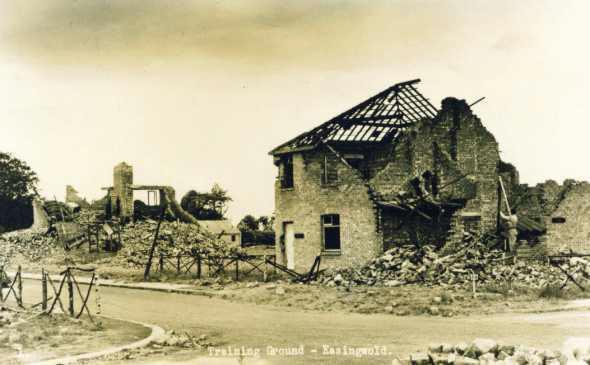
Training ground, Easingwold
Elsewhere, further expenditure on emergency equipment for ports, the railways and power industries was stopped. Some of the emergency food stockpile was steadily sold off to pay for the upkeep of the remaining stocks. The SRCs were to be maintained and the programme to install broadcasting equipment in them continued. There was to be no further training of any staff although after much deliberation about the cost it was decided that around 200 junior civil servants should be trained to operate the communications equipment in the SRCs. Overall, the already rather meagre home defence budget was cut by two-thirds to only £8 million a year.
However, things seemed to have got out of hand and what should have been a mothballing of the home defence became a wholesale abandonment of it. So much so that later in 1968 the Home Defence Committee was saying that the planned arrangements for the establishment of the Python system and the rest of the control system would not be effective unless there was a minimum of 3-4 weeks notice. The Ministry of Defence was saying that it would require months to re-establish the system and the Home Office was reporting that in the absence of the Corps the control system below county district level did not exist.
There was however to be an afterthought and in 1969 local authorities were told that “The Government’s decision must not be construed as implying the abandonment of all civil defence measures. The objectives of the care and maintenance policy are to retain the very considerable physical assets of operational value (such as existing sub-regional and local authority controls, and central government stockpiles of essential supplies and equipment), to maintain among senior local authority staff some general knowledge about nuclear warfare, to maintain a nucleus of knowledge about civil defence techniques and to continue with essential central and local government planning to enable the level of civil defence preparations to be raised again should the need arise. In other words civil defence activity should consist primarily of planning how to raise the level of preparations should circumstances demand….”.26
At this time planners started to think in terms of new strategies. It was now thought that the next war would not happen “out of the blue” but that there would be a political warning period lasting perhaps months and an actual warning of 3-4 weeks before fighting broke out. The idea of a Precautionary Period was abandoned and replaced by a more flexible sequence starting with a period of tension, then a warning period when Government War Book measures would be considered and a final phase when preparations would become overt. This would be followed by the pre-attack period when there was a real threat of nuclear war. However, the strategists now suggested that the war would not necessarily start with an all-out nuclear exchange. Some conventional fighting might be anticipated and military planning assumed there would be 3 weeks of sustained conventional fighting followed by a period of intensive fighting which might last a week and during which tactical nuclear weapons might be used. After this period, the war would either end or escalate into an all-out nuclear exchange. As a result of these ideas, the planners started to consider the need to protect the “home base” during the periods of tension and fighting from saboteurs and disaffected groups such as “communists and Welsh separatists”. Consequently, civil defence was redefined in terms of home defence within the setting of a general war. The armed forces in particular began to concentrate on this role rather than preparing to assist national recovery after an attack.
File 7: From Civil Defence to Emergency Planning
New strategies for the 1970s and 1980s - Protect and Survive - Exercise Hard Rock - new roles for local authorities
In 1971, the newly elected Conservative government undertook a review of home defence in the knowledge, following comprehensive reviews by the departments concerned with war planning, that the current state of preparedness meant that civil defence did not exist in any practical form. The review was to be completely cost-driven and the civil servants considered various options based on expenditure. They recommended that the civil defence budget be increased to £15 million which might, just, see the basis of a workable system. However, the Ministerial Committee on Home Defence decided that no increase in expenditure could be allowed even though this would actually mean that the state of preparedness would decline further. A budget of £10 million was decided on and the emphasis was to be directed more to civil emergencies. One immediate result was an attempt to revive civil defence at the local level, but given the political problems surrounding the very idea of civil defence it was now this was to be sold as more politically acceptable “emergency planning”. Emergency Services circulars replaced the former Civil Defence ones and the first, ES1/1972 told County Councils to establish small emergency planning teams to draw up the war emergency plans required under the 1967 Regulations. They could go on to draw up plans for peacetime disasters, but only after the war plans had been completed. Counties also had to “nominate” one wartime headquarters that would normally to be co-located with the peacetime headquarters and a standby one. The word “nominate” meant that no physical preparation was required and reflects the fact that under the Regulations there was no requirement for such a headquarters to be prepared.
An exercise called Survival 1 had been held in 1970 which found that local authorities could cope with any emergency from their own resources which allowed the announcement to be made that “national volunteer force” (ie a re-established Civil defence Corps) would not be set up and local authorities were encouraged to incorporate volunteer bodies such as the Red Cross into their plans. All active civil defence training at Easingwold was stopped and it would become a staff college. It would now only train staff designated to hold administrative and decision-making posts in wartime and was renamed the Home Defence College.
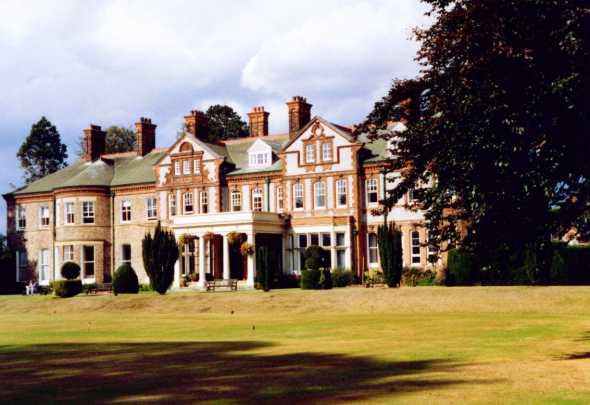
The College, Easingwold
Other Emergency Services circulars quickly followed during the 1970s giving local authority emergency planning officers background information about the government’s home defence plans. An early one27 outlined, for the first time, some basic assumptions about home defence planning. It was issued to the Clerks of Local Authorities but marked “Restricted - the information given in this document is not to be communicated directly or indirectly to the Press or to any person not authorised to receive it “. Local authority emergency planners were told to assume there would be a warning period of 3-4 weeks. This would be followed, possibly after a few days of conventional fighting, by a devastating strategic nuclear exchange. This would put a stop to any further fighting. For up to 3 weeks after the attack movement anywhere might be restricted by fall out but this would give way to a survival phase “…of many months possibly a year or two in which internal regional government would be established for the provision of services for the survivors, to avoid further loss of life and to improvise a subsistence economy.”. Eventually this would become the recovery phase when policies would be made on a national rather than a regional basis.
The planners were told to assume that between 60% and 95% of people would survive the attack, but the loss of essential services and productive capacity could be up to 80%. The attack would affect everybody and planning should be “…orientated primarily towards measures necessary for the provision of the basic essentials of life for the surviving population…”. The Circular went onto say that “…the war-time structure of local government should therefore be designed to marshal and co-ordinate surviving resources of essential services and to provide, in the longer term within the framework of central government operative at first on a regional basis, the administrative framework necessary for a more stable existence”. In a restricted briefing in 1977, NATO planners were told that the UK expected 80 targets would be attacked with nuclear weapons of within a 48-hour period. This would result in 3-4 million being killed directly and a further 5-9 million seriously injured.
The early 1970s saw a significant change in the structure of local government resulting in the emergence of larger and more competent authorities at county level. It was thought that these would be more able to cope with the planning and operational needs of civil defence than their predecessors. Consequently, in December 1973, revised Regulations were issued under the 1948 Civil Defence Act requiring local authorities to make plans “for the purposes of civil defence”. They came into force the following year as the 1974 Regulations and are covered in detail later in File 12. The new Regulations were debated in Parliament in December 1973, the first time civil defence had been discussed there for five and a half years. However, neither the debate nor the Regulations raised sufficient public interest to merit a mention in “The Times”.
In the mid 1970s, many government departments reviewed their home defence plans and these were circulated to the Emergency Planning Officers to incorporate into their local plans. For example, guidance was given on “wartime arrangements for emergency food control…”, “construction work and building materials in war” and “the provision which would be made by central government to ensure that the necessary advice and information could be conveyed to the public…”.28. A 1977 Circular29 told local authorities that the government had given all the necessary policy guidelines. It then added “It is now hoped that all local and other authorities will, within the limitations imposed by financial constraints, move rapidly towards completing and subsequently testing and updating their wartime plans to provide and maintain services essential to the life of the community.”. However, few counties prepared the required plans. Whilst the Regulations required them to make the plans they did not impose any time scales nor did they give any guidance on what the plans should consist of. The Home Office considered that these plans were the responsibility of each local authority and it did not check that the Regulations were being complied with, hence the use of the word “hope”. Some of the central government departments did however restart planning for home defence although this was not on the scale seen during the 1960s and earlier.
The Home Defence College ran short courses for local authority officers who would have wartime roles and for councillors. Its list of course in the 1970s noticeably did not include anything for the staffs of the regional level controls. One accepted but unannounced aim of the courses was to spread the official word about the potential effectiveness of civil defence measures and the College claimed it was successful in this. However, in reality, there was very little interest in civil defence and little was done in a period of great upheaval for local authorities and restrictions on public spending. No politicians championed the cause and to judge from the lack of newspaper coverage there was no public interest in the subject. The impetus was however soon to change and the first half of the 1980s would see the biggest advance in civil defence preparations since the 1960s and arguably the late 1930s.
Towards the end of the 1970s the Cold War began to heat up. The Soviet Union invaded Afghanistan and began to deploy new mobile, intermediate range SS-20 missiles. NATO responded by deploying Cruise and Pershing missiles in Europe. At the same time, NATO began increasingly to adopt a new flexible response strategy to meet a Soviet Union lead Warsaw Pact attack on its member countries. This strategy assumed that a European war might not immediately and automatically lead to the use of nuclear weapons. To a lesser extent Soviet doctrine mirrored this idea. Throughout the 1970s and 1980s NATO and in particular US strategists thought that if nuclear weapons were used escalation could be controlled and limited. The Soviets however assumed that this would be impossible and any use of nuclear weapons would result in an all out strategic and tactical attack as an integral part of the overall war strategy.
The new flexible NATO strategy implied a period of conventional war fighting which would either be followed by the cessation of hostilities or escalate into a nuclear exchange. This would require a strengthening of NATO’s conventional armed forces including its reserves and war stocks. It also implied that there would be time to reinforce Europe from North America. Plans were consequently made to move huge numbers of US troops and millions of tons of equipment through the UK in a matter of days. This would need, under the Wartime Host Nation Support Plan massive assistance from UK civil and military authorities. At the same time, some 125000 British troops would move to the Continent with 21000 vehicles, and 125000 service families would be brought home. These moves would inevitably conflict with civilian “transition to war” measures such as the moving bulk food stocks from ports and preparing the National Health Service for casualties. Of more direct relevance to civil defence planning was the new need to plan for the effects of conventional air attacks, possibly over a long period. Information was given to planners in 198430, which warned of small, but widespread air attacks against such targets as sea and airports, rail yards and fuel storage sites. Civilian casualties would be low compared to the last war but “…shipping losses, the disruption of ports and communications, shortages of fuel, the diversion of transport assets to meet military needs and the continued effects of the reinforcement of Europe…could lead to the possibility of a breakdown of essential services and a general atmosphere of strain and disruption.”. The main civil defence tasks for the local authorities during a conventional war would “…probably be to maintain the distribution of food, fuel and other essential supplies to the civilian population, to assist with fire fighting, rescue and other emergency tasks in the damaged areas, to provide food and shelter to those made homeless and to provide information to the public and government on casualties”. In addition, they would need to prepare for a nuclear attack.
No predictions were given about the scale of a nuclear attack, which might be anything from a single “demonstration” weapon to a full-scale attack aimed at completely destroying the civil and military functioning of the country. Ground bursts of 150-500 kilotons might be used against military targets whilst airbursts of up to 5 megatons might be used against cities. Attacks against civilians with chemical weapons were not considered likely and in practice nothing was ever done to prepare for such an attack after the mid-1950s. In reality, the Soviet Union had a massive chemical and biological warfare capability and was expected to use it.
The new impetus in home defence waned with the return of a Labour government but in a repeat of 1971 when a new Conservative government was elected in 1979 it soon set up a review of “civil preparedness for home defence”. Some of the results were announced in 1981 but despite the government saying that local civil defence measures should be made public this was not to apply to national plans and most conclusions of the review remained secret. Significantly, the warning period was now to be measured in days rather than weeks and accordingly the government considered it prudent to expand the civil defence programme. Emergency Planning Officers were now told that there might be as little as 7 days warning of attack, and “essential plans”, a phrase which was not defined, should be capable of implementation within 48 hours. This meant that the warning period was reduced to the same as it had been in the aftermath of the Cuban Missile Crisis and, as the Principal of the Home Defence College told delegates to Easingwold, that the country was on a permanent two day notice of a world war. Specific measures announced soon after the review were a modernisation of the UK Warning and Monitoring Organisation which organised the Royal Observer Corps, and improvements to the Wartime Broadcasting System, the Green Goddess emergency fire engines and the “sub-regional headquarters for decentralised government”. More money was to be made available to county councils to double the number of emergency planning officers. In an unannounced recognition that civil defence would need some foot soldiers more emphasis was to be put on local involvement in civil defence and Air Marshall Sir Leslie Mavor, the Principal of the Home Defence College was given the additional role of co-ordinator of voluntary effort in England and Wales. Another unannounced change was the re-instatement of the phrase “civil defence” after a decade of “home defence”.
Protect and Survive
Part of the new policy was to be an end to secrecy in civil defence, or at least secrecy at the level of local authority plans. In early 1980 as part of a low-key campaign to publicise civil defence the booklet “Protect and Survive” was put on sale for 50p. Local authorities were sent two copies free but told that if they wanted any more they had to buy them. This booklet and some 20 TV videotapes together with radio tapes and newspaper inserts covering such subjects as preparation of a fall-out room and fire precautions had existed secretly for some 5 years. The main aim of this material would be “…to convince people that although a nuclear attack would have devastating effects, everyone could significantly increase their chances of survival by improving the protection afforded by their own homes and by taking simple precautions.”
The emerging peace movements spearheaded by the revitalized Campaign for Nuclear Disarmament ridiculed the Protect and Survive booklet. The booklet said that it “tells you how to make your house and family as safe as possible under a nuclear attack”. In practice, after saying that “everything within a certain distance of a nuclear explosion will be destroyed” it concentrated entirely on how to improve the fall-out protection a home could provide by preparing an inner refuge within a fall-out room. The family would have to stay in this inner refuge for at least 48 hours. The refuge should be surrounded by dense materials such as “bags or boxes of earth or sand, or books, or even clothing.” The booklet’s attackers lampooned this idea suggesting that the government’s only answer to a nuclear attack was to take cover under a pile of books. In reality, the booklet was a sensible approach to a difficult practical and presentational problem and in fact a 14-inch thickness of books would give the same degree of protection against fall-out as 4 inches of concrete.
Protect and Survive replaced “Advising the Householder on Protection against Nuclear Attack” which had been published in 1963. This short booklet had given very similar advice but was much less realistic suggesting for example that the window frame in the chosen fall-out room should be removed and replaced by a double thickness of bricks. It also showed extensive use being made of sandbags but Protect and Survive used more immediately available things like bags, boxes and drawers. A smaller pamphlet had been published earlier in 1957. Called simply “The Hydrogen Bomb” it gave as much emphasis to protection against blast, which was not covered by the later two booklets, as fall-out. Whilst mentioning a “refuge room”, “The Hydrogen Bomb” recommended using a slit trench. “Advising the Householder” also suggested a trench could be used but then showed a well built and equipped “trench” 6 feet deep and wide without any suggestion about the amount of labour needed to shift such a huge amount of earth or the subsequent problems of living in it.
Your survival kit
What Protect and Survive tells you to put in your survival room:
- Drinking water. Enough for at least 2 pints a day each for 14 days
- Food for 14 days which can be eaten cold.
- Portable radio and spare batteries
- Tin opener, bottle opener, cutlery and crockery.
- Warm clothing
- Bedding, sleeping bags.
- Portable stove and fuel, saucepans.
- Torches with spare bulbs and batteries, candles, matches.
- Table and chairs.
- Toilet articles, soap, toilet roll, bucket and plastic bags.
- Changes of clothing.
- First aid lit.
- Box of dry sand, cloths or tissues for wiping plates and utensils.
- Notebook and pencils for messages.
- Brushes, shovels and cleaning materials, rubber or plastic gloves, dustpan and brush.
- Toys and magazines.
- Clock (mechanical) and calendar.
The government did little to defend or explain Protect and Survive or its policies and met a significant defeat in the propaganda war waged by the “peace” groups. It was about to suffer another.
Exercise Hard Rock
During the 1970s, the military conducted a series of home defence exercises31. The main ones were Scrum Half held in 1978, which considered the post-strike situation at sub-regional level and Square Leg in 1980 that concentrated on transition to war and the post recovery phase. They had small civil elements mainly to raise problems at the local level for the army to respond to. Also, Royal Observer Corps exercises sometimes used civilian facilities such as the SRHQs to pass fallout information. None of these exercises really tested the civil defence systems but in May 1981 the Home Office wrote to County Councils inviting them to take part in a major home defence exercise called Hard Rock. According to the exercise specification prepared by the Joint Exercise Planning Staff of the UK Commanders in Chief Committee and the Home Office Hard Rock was to be a national civil and military home defence command post exercise with conventional warfare and post-strike phases. The aim would be to practice and test civil and military plans and procedures for home defence in the UK in conventional and nuclear war. It would consist of 2 phases -
Phase 1
This would start with a short lead-in period to allow for the setting up of headquarters and then a response to conventional warfare within the civil community. It would allow the testing and evaluation of local authority and military plans, consideration of self-evacuation by the general public and prioritising the allocation and deployment of resources32. This phase would involve 54 hours of real time play.
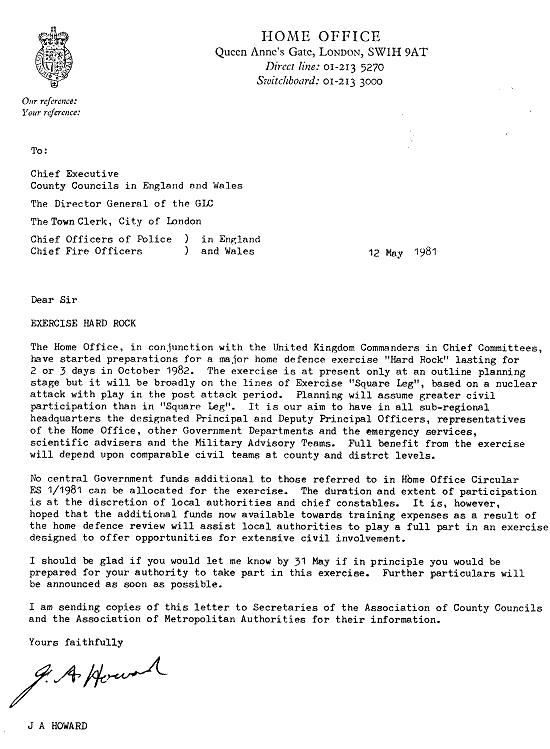
The invitation to take part in Exercise Hard Rock
Phase 2
This would follow a nuclear attack with survival and recovery periods to exercise all levels of regional government, UKWMO, the military in support of civil authorities, resource allocation and voluntary effort at local level. The survival period immediately after the strike would look at the first 24 hours and be played real time. This would be followed by play for 30 hours on a recovery period starting 28 days after the strike.
Detailed background and lead-in scenarios were prepared. Play for the conventional attack period would start on 30 September 1982, which was assumed to be 3 days after fighting had actually started. The nuclear attack started at midnight on 2 October. The original scenario envisaged 104 nuclear bursts but this was whittled down to 54. These were predicted to have caused 1.5 million deaths immediately or within a month and a further 400000 would die within the next 4 months. These very low figures have lead some people to describe the “bomb plot” and the level of casualties as totally unrealistic and produced more for political than practical purposes. Some of the bombs were certainly predicted to fall on very odd places such as Mersea on the Essex coast and Bideford in Devon.
However, Hard Rock became a public relations disaster for the government. CND attacked it with a publicity campaign called Operation Hard Luck. But more direct impact came from the growing Nuclear Free Zone movement among local authorities. This had started in November 1980 when Manchester City Council passed a resolution calling on the Government to refrain from manufacturing or positioning nuclear weapons within the boundary of the city. By October 1981 119 local authorities had declared themselves nuclear free zones and a National Steering Committee had been set up in time to respond to the planning for Hard Rock.
The 1974 Civil Defence Regulations required local authorities to make plans for civil defence but there was no requirement to take part in exercises like Hard Rock. As well as ideological objections, many had no realistic plans in place and the government made no extra funds available for them to take part. In the end, 20 out of 54 county level authorities declined to take part in Hard Rock and a further 7 would only play on a limited basis. This effectively killed the exercise and in July 1982 the Home Secretary announced that Hard Rock would be postponed. In practice, the central government was as ill prepared to take part in the exercise as most local authorities. It was envisaged that all 17 SRHQs would take part and be at least partially manned, although in reality, many were not operational and temporary accommodation would have been used for some. A few senior SRHQ staff had been appointed and took part in Scrum Half and Square Leg but no other staff were appointed or trained and no operating procedures existed. In fact the peace movements may have saved the government from having to admit that its own planning was in the same lamentable state as that of most local authorities. However, it did not have to and the Home Secretary laid the blame firmly on the local authorities. He announced to Parliament “I am not satisfied with the state of local planning for Exercise Hard Rock and have decided that it should be postponed. I am considering urgently with my Right Honourable friend the Secretary of State for Scotland the need to amend the planning regulations made under the Civil Defence Act 1948”.
Matters then moved surprisingly quickly. New regulations were drafted and consultations started with the Association of Metropolitan Authorities and the Association of County Councils in December. They were then laid before Parliament in April 1983 and came into force 6 months later. According to the Home Secretary the new Civil Defence (General Local Authority Functions) Regulations 1983 put “…stronger and more precise obligations on all authorities.”. The impact of these new Regulations is discussed in File 12 on the role of local authorities.
Emergency Planning Guidelines
In July 1984, the draft of what was initially called the “Consolidated Circular” was sent to the local authority associations for their consideration. It was eventually published in June 1985 as the “Emergency Planning Guidelines for Local Authorities” although it was usually called the EPGLA. In the spirit of making civil defence an open subject the councils were recommended to make copies available to the public through their libraries, and the public could buy a copy for £4.00. EPGLA was also called Emergency Planning Guidance Handbook No3 and at the same time EPG Handbook No2 on communal shelters was issued. Handbook No1 on “The Protective Qualities of Buildings”, dealing largely with the protection factors provided by buildings against radiation had been issued in 1981.
EPGLA was intended to be a guide for local authority plan writers and the bulk of it was taken up with the background to the government’s assumptions which had been previously issued as Circulars and the outline plans of various government departments and agencies covering, for example, inland transport, construction work and emergency feeding. There were 4 short sections on peacetime emergencies but the bulk of the book dealt with planning for wartime.
EPGLA however gave very little practical assistance to local authorities in drawing up the plans required by the 1983 Regulation that they had been asked to complete by the end of 1985. In practice, many county councils were slow in compiling the plans or they were incomplete. As a result, the government introduced a monitoring system called the Planned Programme of Implementation that is discussed in File 12.
Civil Protection
Whilst the emphasis as far as the councils were concerned was on preparing civil defence plans by the mid-1980s planning for peacetime emergencies was receiving increasing attention. In its 1983 election manifesto, the Conservative Party announced that they would introduce legislation to enable civil defence resources to be used in peacetime emergencies. This became the “all hazards” approach to emergencies and resulted, with the assistance of the Chernobyl accident, in the passing of the Civil Protection in Peacetime Act in 1986. The EPGLA revision which followed said that there were common features in plans for wartime and peacetime emergencies and the Act allowed a local authority to use its civil defence resources including the emergency planning staff, emergency centres and communications equipment for peacetime emergencies. In the days of the Civil Defence Corps such resources were quite often used as for example at the Aberfan disaster in 1966 but this was not strictly speaking allowed for in the provision of the Civil Defence Grant that the local authorities received. However, there were still restrictions on the use of these resources, which were largely funded by central government. The primary task of the emergency planning teams would continue to be the preparation of civil defence plans and the civil defence grant could not be used for any activity directed towards purely peacetime emergencies.
The Civil Protection in Peacetime Act was followed in December 1986 by a professionally produced public relations package called “Civil Protection” consisting of a video called “When Disaster Strikes: Civil Protection in Action”, an accompanying leaflet, a booklet “Civil Protection” and the first edition of a quarterly glossy magazine called “Civil Protection”. One apparent aim was publicly to move civil defence into the less controversial area of civil protection and the all hazards approach. The peace groups attacked the package as government propaganda but the vast majority of the public did not notice it. Research by the peace groups showed that around 90% of the public knew absolutely nothing about civil defence, took no interest in protesting about it and generally did not care.
The first amendment to EPGLA was made in 1988. It included minor changes to take account of the Civil Protection in Peacetime Act. More importantly, after a long battle with the local authority associations and the NFZ movement it gave guidance to local authority planners as to what to include in the plans and how to compile them. It also allowed “planning assumption studies” to be made as part of the plan writing process.
One of the stronger arguments advanced by the NFZ movement was that EPLGA did not give sufficient background detail on which to base plans. Their response was to commission a series of “planning assumption studies” for regions or counties covering the background to civil defence as they saw it, public opinion, possible targets, etc. The biggest study was made by the Greater London Council and was published in book form as “The Greater London Area War Risk Study”. This Study considered the effects of various types and scales of attack on London and conducted extensive opinion surveys. These suggested for example that 70% of Londoners would try to leave the city if there was a threat of nuclear war and 63% would stay away from work. Such figures would make the government’s “stay put” and “business as usual” policies in the crisis period meaningless and would mean the London would be effectively paralysed if the public thought there was a danger of war. The Study also raised the question of the psychological impact of a major nuclear attack. This was sometimes considered by the Home Office but did not appear in any plans. It was assumed, as the Study said, that the survivors would simply dust themselves off and carry on without being affected by psychological problems. Overall, the Study concluded that civil defence measures could be useful against a limited attack but would be of no assistance to London if it were subjected to a direct nuclear attack of any size.
Vireg
When the Home Secretary announced the end of Exercise Hard Rock in 1983 he said it was only to be postponed. However, such a national exercise was never to be repeated and there was never a serious attempt to exercise the regional level parts of the Regional Government system. Instead, a series of “table top” exercises were held which although called regional were in practice limited to county level involving the individual counties in a region with some of their subordinate district councils together with local utility companies, government departments and uniformed services. In November 1983 Exercise West Wind was held to test transition to war planning in Region 7 (South West). But the first of the larger exercises called Exercise Vireg33 was not held until 3 years later in Region 6 (South East). Its main aims were to evaluate the counties' transition to war plans (i.e. the 1983 Regulation plans) and to examine the relationships between the districts, counties and the Regional Emergency Committee (see File 9). It did not deal with the post-nuclear strike situation. The exercise was held in November 1986 after nearly 18 months of planning which clearly shows the amount of effort put in, mainly by the county Emergency Planning Officers in the region to prepare for such an exercise. Detailed plans were produced showing the situation at “startex” and the players were lead into their roles with a series of briefings and then in the week prior to the 3 days of actual real time exercise play they were given simulated “newspaper” reports giving the background to the developing crisis. (See overleaf for a sample of theses reports issued as part of the later Exercise Ninex). All 9 counties in the region played to some extent, as did many of the districts although the levels of involvement were very variable. The exercise was essentially a “desk top” one with the “directing staff” feeding in various incidents which the local authority and other players had to react to by making decisions, preparing situation reports, etc. The exercise was judged to be a success and a lot of lessons were learnt although its main finding was probably to bring home to the Home Office as well as the players in the counties the huge range of problems that would be met in a transition to war period and the inadequacy of the plans that then existed
Vireg was followed in 1988 by Heptad in 7 Region and Ninex in 9 Region. Triex and Ivy were held the following year in 3 and 4 Regions respectively but by 1990 the international situation was changing rapidly. All the exercises held up to this time had used the same basic Warsaw Pact v NATO nuclear war scenario, and it might be added all ran into the same basic problems showing that whilst lessons were being learnt they were not being passed on. This scenario was now obsolete. Exercise Norex in 1990 was held against an unrealistic scenario and the planned Exercise Nexus never came to terms with the requirement implement war plans in a world where the Cold War had ended.
The local authorities were however not the only bodies preparing for war in the 1980s. Behind the scenes, quite a lot of other plans were being made. Working parties were set up to consider volunteers and their training, civil defence communications and the role of industry in civil defence. The Ministry of Agriculture devised a rationing system and published a booklet on “Civil Defence and the Farmer”. Other departments reviewed their war plans. For example, the department of Transport now planned to establish a Surface Transport and Shipping Co-ordinating Centre in the transition period. The Department of Health revised its procedures and investigated stockpiling medical supplies. The water industry in particular received attention. It was told to draw up war plans and several water companies built small control bunkers. The army also appears to have revised its plans to establish Armed Forces Headquarters in the mid-1980s and built or refurbished several bunkers for example at the barracks in York. At the same time, the armed forces updated much of their national home defence communications infrastructure. In the very late 1980s the BBC also started to build protected control centres at several of their transmitter sites although none were completed before the end of the Cold War.
In 1980 a Home Office working party reported that it would cost £70 billion to provide shelter spaces for the whole population. Needless to say this was out of the question and apart from issuing some guidance on domestic shelters little was done. In 1986, the Home Office set up a pilot study in which 9 local authorities were sponsored to carry out local shelter surveys. This was done in two parts - a residential survey looking at the protection factors afforded by dwellings and a communal shelter survey to identify buildings that could be used as communal shelters such as large basements and underground car parks. This related solely to the protection they had against fallout and not blast. One main aim appears to have been to see how cheaply the surveys could be done. In practice, they were done simply by looking at the outside of buildings, sometimes of whole streets and then slotting the buildings into standard types for which the protection factors had been calculated. In 1988, the Home Office issued some further guidance and instructed local authorities to submit shelter plans by 1989. The surveys generally found that some 60% of dwellings had a protective factor of 20 or less although this ignored the effects of any “protect and survive” measures. The communal shelters would have provided some protection for people whose homes offered very low protection.
While people were not given any special protection this did not apply to the nation’s art treasures. At the start of the last war many of these had been dispersed to safe places in the country. Many large country houses were used but the most important works were lodged in specially converted mines at Westwood, near Corsham and Manod in north Wales. These two sites were retained after the war although little active planning was done until Operation Methodical was drawn up in the early 1960s and included in the Treasury War Book. This plan required 12 pantechnicons to be filled with works of art from the major London museums and galleries and then driven under military escort to the refuges. At the same time the Domesday Book would be taken from the Public Record Office in a suitcase. However, as with so many plans whilst parts of it were considered in detail such as the actual routes to be taken it was completely impractical. It was decided, for reasons of morale that the art should stay on view until the start of the Precautionary Period. This would then give the galleries 2 - 3 days to chose and pack the works to be saved, arrange transport (including guards to be provided by the army), load the lorries and drive them to Westwood or Manod. The plan then stopped at the entrances. There was no mention of any consideration about what would happen when the lorries arrived, how the art would be stored or who would look after it. The two mines were in any case poorly maintained and unsuitable for the task. Nevertheless, the plan was retained until at least the early 1970s and the mines were not abandoned until the early 1980s. In 1985, replying to a Parliamentary Question the Home Secretary said “arrangements exist for safeguarding the most important of the nation’s art treasures against the risk of damage or destruction in the event of war” adding that the directors of national collections had been asked to arrange for the earmarking of items to be moved in an emergency and to arrange for transport and accommodation. This was an oblique reference to the revised plan to move art treasures from the main London galleries to the tunnels at Rhydymwyn in north Wales which had nominally been the reserve Central Government War HQ in the late 1950s. The curators of provincial galleries were expected to make their own arrangements.
The role of the now renamed Civil Defence College at Easingwold was also reviewed. In the mid-1980s the College had a tutorial staff of about 19 and was running a variety of courses usually lasting 2 or 3 days to introduce some 3000 people a year to the background of civil defence and to give them some exposure to their wartime roles. Most of the tutorial staff had a military background, as, at this time, did most of the county council emergency planers. Following the review, the College was given a greater analytical and development role in civil defence planning. It would now concentrate its training effort more at the higher levels and would also start courses on purely civil emergencies. As a result in 1989 it was renamed the Emergency Planning College. A review of civil emergencies was made in 1989 that resulted in the appointment of a Civil Emergencies Advisor to replace the post of Civil Defence Adviser.
In 1987, changes were made to the way local authority civil defence activities were funded through the annual civil defence grant. Now, central government, through the Home Office, would now pay the whole cost of emergency planning staff. Up to this point central government assisted local government by paying 75% of the costs of emergency planners and approved costs of setting up, but not maintaining emergency centres. Figures for the total expenditure on civil defence are not readily available as they are spread across numerous government departments and dozens of local authorities but overall annual expenditure amounted to a only a few pounds for each member of the public. Salaries took up most of the costs. The biggest spending department was the Home Office whose civil defence budget in 1987/88 was some £69.2 million. At the time it had 166 full time staff engaged on civil defence most of whom would have been at Easingwold. In contrast, the Cabinet Office’s budget was only £350000. The local authorities in England and Wales were employing 659 Emergency Planners in 1987/88 who were spending some 51% of their time drawing up plans under the 1983 Regulations.
The beginning of the end again
By now, momentous events were happening on the world stage. In 1989 the Soviet Union began withdrawing its troops from Eastern Europe and the Berlin Wall fell. The Cold War was effectively over. The Government soon started to receive representations to repeal the civil defence legislation and in October 1990 the Home Secretary initiated a “review of future options for civil defence arrangements in the light of developments in East-West relations”. It was then quickly announced that the Planned Programme of Implementation would continue but all civil defence building and other capital work would cease.
The results of the review were announced in July the following year as a Statement on Civil Protection. The basic planning assumption was now that there would be at least 3 months rather than just 7 days in which to bring civil defence plans to readiness. The Government would pass most of its responsibilities for civil protection onto local authorities and abandon or downgrade its own arrangements. UKWMO was stood down and arrangements for wartime regional government abandoned. From now on central government would only fund one emergency centre for each county and none for the districts. One conclusion was that “a new, more flexible approach to civil defence planning should be developed” but “…the overall aim is to maintain a civil defence preparedness based on an extension of the arrangements for civil emergencies” within an “integrated approach to emergency management”.
Local government pressed for more guidance and in November 1992 further changes were announced which amounted to the complete abandonment of civil defence. New regulations were promised and there would no longer be any funding for emergency centres. What remained of the national systems - the RGHQs, which were referred to as “special protected administration centres”, Royal Observer Corps sites and air raid sirens would be sold or removed. In future, TV and radio would give any air raid warnings. In 1993, new Civil Defence (General Local Authority Functions) Regulations were introduced to replace the 1983 Regulations. From now on counties only had to “make, keep under review and revise” plans for what were referred to simply as “civil defence purposes”. There was no longer a requirement to maintain a “protected emergency centre” and central government would no longer fund the training of local Scientific Advisers.
Further information about the thinking behind the integrated approach to emergency planning was given later in 1993. Whilst the threat from the Warsaw Pact had gone other unspecified states with “objectives inimical to the interests of the UK…” could still offer a threat “…consequently, there is a need to maintain a basic framework of civil defence arrangements in peacetime both as an insurance policy and as a contribution towards deterrence…”. Therefore, “core plans for civil defence…should be linked to peacetime plans” as “effective civil defence is best secured by building on arrangements which are tried and tested in times of peace…”. The Planned Programme of Implementation would be scrapped but as the civil defence grant would still be available to fund emergency planning teams the Home Office would continue to monitor plans but by questionnaire and “review visits”. Although it was never officially announced, civil defence was now dead. Local authorities developed plans for civil emergencies such as floods and industrial accidents without reference to civil defence. All pretence at central government planning for civil defence was also abandoned. The Civil Defence Act 1948 however remained on the statute books until 2004 when it was replaced by the Civil Contingencies Act.
File 8: Rethinking Regional Government
Changes at regional level - Exercise Regenerate
Since the late 1950s, the planners had assumed that a completely new form of government would be needed after a nuclear attack - regional government. The basic reasoning was summarised by a Home Office representative speaking in 1982. He said, “Nuclear attack would, in all probability, cause such damage to everyday communications that our peacetime system of central government would become impractical. In many areas, telephone communications would be severely disrupted. Road and rail transport, and with them the postal service, would cease to be usable in anything like their present form so the mass of paper on which we depend in peace would not circulate. What would be needed would be a system that would operate over shorter distances with some prospect of success - quickly and decisively, with a much simpler structure than we have today. The answer is a form of regional administration, more autocratic in style to cope with the urgency of the critical situation as long as it lasts.”
When home defence was mothballed in 1968 the regional government structure started at the local level with the local authority Controllers. They would be directed by a Sub Regional Control and then in time a Regional Seat of Government would be established with the Regional Commissioner having full power to govern the region. This decentralised government was to continue throughout the 1970s and 1980s and it was described as “the machinery of government in war, which is designed as a whole to direct national survival”34. However, until some changes were introduced in the early 1980s to cope with the build up to war the system was not really “machinery of government in war” but rather the machinery of government after it given that the next war would last only a matter of days. There would be normal democratic government before an attack and regional government based on rule by Commissioners and Controllers after. Regional government would assume control “once the central government capability in its customary locations ceases to operate in wartime” and it would only be concerned with domestic and internal affairs.
In 1973, the plan was modified slightly. Britain had been divided into regions for civil defence purposes since before the last war and their boundaries had remained largely unchanged since then with the major exception of the London region, which had been divided between its neighbours. In 1973, some changes were made to the boundaries of the civil defence regions in England largely reflecting changes in local government boundaries. The northern regions were restructured, while the Southern and South Eastern Regions were merged which released the regional number 5 to be adopted once again by London Region, which had been re-established as a wartime region in 1971. Since the mid-1960s the regions had been divided into sub-regions each of which, in theory at least, had a Sub Regional Control. This continued but the number of sub-regions was now reduced from 23 to 17 and the Controls were redesignated as Sub Regional Headquarters (SRHQs). Scotland continued to be divided into 3 Zones under a Scottish Central Control while Northern Ireland still had its own Northern Ireland Central Headquarters. The nominal staff of an SRHQ would be 180.
The SRHQ would have no pre-attack functions. Instead, its role came after the attack when its function would be “to obtain, process and disseminate information about the extent and effect of the attack; to determine priorities and arrange for the re-location where appropriate, of resources to meet immediate needs; to co-operate and support the activities of county controllers; and to prepare the administrative groundwork for the establishment of regional government”. There is no mention of any life-saving role for the SRHQ that featured in the 1960s when the earlier incarnation of the SRHQ had as one of its principal roles the strategic control of the remaining civil defence organisation. Indeed, the 1973 Circular said clearly “…the SRHQ would aim at the conservation of resources…for longer-term survival…rather than short-term aid to the hardest hit areas.” Sub Regional Commissioners would be concerned with “the administration of justice, with the maintenance by the police of law and order and the general behaviour and morale of the survivors.” This was a reflection of the increased operational role given to the local authorities allowing the SRHQ to concentrate on the larger picture.
The 1973 plan continued the idea that the Regional Commissioner and his staff would be dispersed around the region pre-attack and then “as soon as possible, regional government would be established at a location in each region that offered the best surviving communications and accommodation for the purpose.”. It appears probable however that by the mid-1970s the idea of a separate, dispersed Regional Seat of Government team had been abandoned. Now the Regional Commissioner would only have a senior staff of about 18 with him and they would probably lodge in one of the SRHQs in the region until the regional level headquarters was set up. The title Regional Seat of Government was not used in circulars or briefing notes in the 1970s, although occasionally the term Regional Government Headquarters was used in contradistinction to Sub Regional Headquarters.
A wide ranging circular on “Machinery of Government in War” was issued in 1973. It said that “The primary task of regional government would be the production and administration of a strategic plan for the continued survival and eventual restoration of the region to a more normal pattern of life. The execution of regional strategy would depend upon the actions of local authorities, nationalised industries, reconstituted government departments and key sectors of commerce and industry.” This shows that the SRHQ was only a decision making body. It had no facilities to implement its decisions. This would be left to lower levels of the regional government system and in particular, to the local authority Controllers and their staffs who would effectively become the civil service of the regional government. There is no mention of any central government organisation or its restoration in the Circular but “In time, regional plans would be modified to come within national policy.”
Below the SRHQ, the plan was unchanged with local council powers vesting in an Emergency Committee but with Controllers running the counties and districts as part of the regional government structure. They would be answerable not to the Council or the Emergency Committees but to the Regional Commissioner. As well as working through county officials and District Controllers, the County Controller would have representatives of nationalised industries and the uniformed services on his staff.
Below the county level would come the districts (boroughs in London) with a District Controller and an emergency committee on a similar basis to those in the counties. The District Controller would be answerable directly to the County Controller, but there is no mention of him exercising full powers in the event of a failure of communications like the County Controllers.
The police would not be under the control of the County Controller. They would remain under the operational control of the Chief Constable who would be answerable through the Regional Police Commander (appointed from the Chief Constables in the Region) to the Sub-Regional or Regional Commissioner.
In February 1976, a Circular35 was released on “Briefing Material for Wartime Controllers”. This gave local authority Controllers (Designate) some information which had previously been released to “…certain officers designated to be senior members of staff of regional and sub-regional commissioners in war” although the available evidence suggests that few if any such staff had actually been designated. The Circular was “Restricted” and only available to designated controllers or “exceptionally” and on a “strict need-to-know” basis they could make it available to other senior staff. Such secrecy would do nothing to help implement the regional government system should it have been necessary. The Circular outlined thinking on four areas that might be relevant to regional government and gives some idea of its expected role. The areas were - law and order, the use of surviving industrial resources, manpower and the collapse of the monetary economy.
Law and order was expected to be a major problem after the attack and it was generally assumed that widespread anarchy would prevail unless actively prevented. The Circular however only dealt with what to do with offenders who had been caught. It said that emergency courts would be set up aimed at “anti-social behaviour of individuals which seriously interfered with the essentials of the life of the community”. There would be no appeal against their decisions. In post-attack conditions peacetime penalties would not be effective and “such penalties as communal labour, restricted rations and exposure to public disapproval might be appropriate for all but the gravest offences, but in the case of flagrantly anti-social behaviour there might be a need for harsher penalties than would generally be acceptable in peacetime.”. Reference was made to “provision for appropriate penalties, not normally available to courts…” and the use of juries for “capital cases”. It is apparent that corporal and capital punishment was envisaged (hanging had been abolished in 1965) and “Regional Commissioners…would be empowered to impose such penalties as they thought fit in the light of conditions and circumstances at the time.”. The Circular did not mention any law and order problems which might happen before a nuclear attack although in 1969 the Joint Intelligence Committee produced a comprehensive report on “The Security of the UK Base” which suggested that as tension mounted “motives of self preservation would become dominant in the public mind”.
The Circular also gave some indication of the widespread, if not total breakdown of industrial and commercial activities and the loss of power supplies that the attack would cause. Agriculture would have to “…revert to more primitive working” which really meant that survivors would be sent to work on farms to provide manual labour to replace machinery. People would be directed to work to sustain morale but there would be no effective way of enforcing this. The monetary economy would be wrecked but it was considered essential to establish a new system as soon as possible. This might take a year or more and until then reliance would be put on barter. The Circular said that “…the creation of a new monetary system would be a national matter and not one for which individual Regional Commissioners could devise their own policies.”. This is however at odds with exercise material from both the mid-1960s and early 1980s which envisaged individual regions setting up their own currencies and central banks with fixed exchange rates to enable trading between regions in the local currencies.
When home defence was reviewed in 1981 the regional government system was essentially the same as in 1965 and had really evolved by default. The SRHQ and local authority levels were well established but the idea of the Regional Commissioner and his staff sitting in an SRHQ or scattered around the region waiting a suitable time to take over did not make much sense. There was also a need emerging for some form of regional level of administration in the newly conceived “transition to war/conventional war” period before strategic nuclear weapons were used. The idea of combining the top two layers of regional government had been considered in the mid-1970s and was apparently reconsidered as part of the Home Defence Review or by the Transition to War Working Party that had also been set up. Exercise Hard Rock for which planning started in 1981 worked on the existing basis of SRHQs being manned pre-strike but not having any executive function. They would oversee the situation for say the first 14 days post-strike before the Regional Commissioner took charge. But the outlines for the 1981 course for SRHQ staff called Exercise Regenerate assumed there would be only one tier of government at the regional level under the Regional Commissioner. More significantly, perhaps the course assumed that the SRHQ team would have a pre-nuclear strike function. It seems likely that this change came about as a result of the Review but it was not finally announced until 1984 as part of the “Revised Arrangements for the Wartime Machinery of Government”36. From now on only a single tier of government would be used at regional level. Each region would be divided into two zones (except London and Northern Ireland that would have only one each) although, in fact the regional boundaries had been changed in 1983. In Scotland, the East and West Zones were combined to become South Zone. In England, Regions 1 and 2 were merged as 2 Region allowing Scotland to become 1 Region. Northern Ireland became 11 Region. The regions continued to be called Home Defence Regions in most documents throughout the 1980s although on occasion they were referred to as Civil Defence Regions particularly by local authority planners whose interests were confined to the more parochial idea of civil rather than home defence. Traditionally, a change of name in home defence indicates a change of function and in 1983 the SRHQs had been redesignated as Zone Headquarters reflecting perhaps the idea of a pre-strike role and the elimination of the separate sub-regional and regional levels in the hierarchy. But, in 1985, they were again redesignated, this time as Regional Government Headquarters or RGHQs.
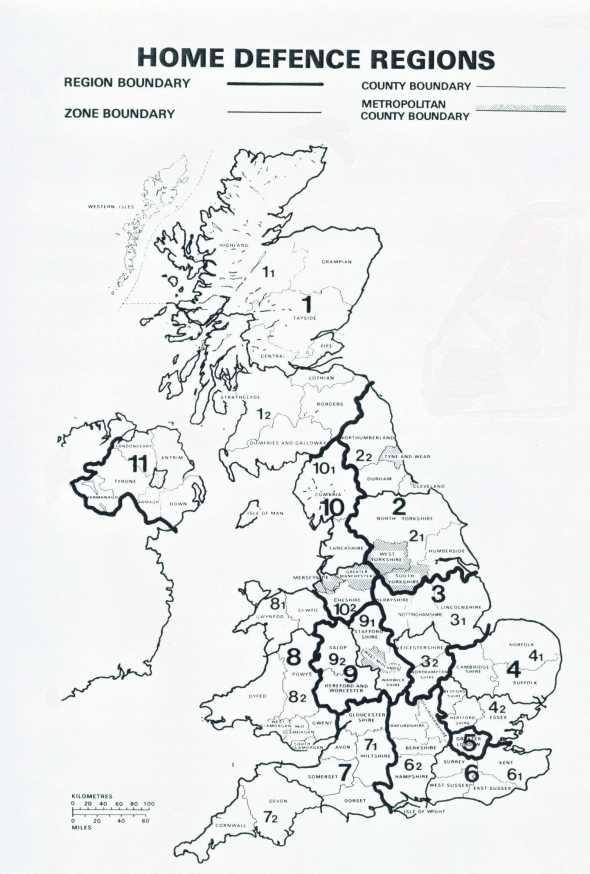
Home Defence Regions and sub-regions mid-1980s
The Regional Commissioner would be in charge from the outset taking over as before when the scale of attack made it necessary and central government could not operate. He would be based in one of the ex-SRHQs in the region that would now be called the RGHQ(C). He would have a Deputy Regional Commissioner in the other designated as the RGHQ(DC). Which one was which would be decided at the time. The SRHQs would have been responsible only for their sub-region pending the Regional Commissioner taking full command. But, the RGHQs did not have such divided responsibilities and the main purpose of dividing regions geographically was to determine which RGHQ the communications from the County Emergency Centres, etc would be routed to. Like the SRHQs and the SRCs before them, RGHQs were numbered according to their region and then by a sub-number such as 1.2 and 6.1, although in practice RGHQs were usually referred to by their location. In the RGHQ (DC) the Deputy Regional Commissioner would act under the direction of the Regional Commissioner or, if necessary, because communications were lost, or perhaps to be realistic the RGHQ(C) was destroyed, on his own. There would also be a small reserve team in each region capable of taking over from either or both main teams if necessary. In a training course called Exercise Regard, which is discussed later, the RGHQ(DC) was attacked and destroyed and the reserve team simply disappeared.
The Property Services Agency War Book from 1985 gave the functions of wartime regional government as
- determining priorities between local authority controllers and other authorities,
- control of broadcasting,
- maintaining public order and the administration of justice,
- allocation of assistance from the armed forces,
- provisional fixing of any new agricultural and industrial priorities,
- the subsequent co-ordination of the survival and recovery of the nation under central government control.
Draft Standard Operating Procedures for RGHQs written in 1988 suggested that an RGHQ would be manned in 2 phases copied from RSG practice -
- An initial advance party would open up the RGHQ, then -
- As the crisis deepened staff would be fully deployed and the RGHQ made operational37
Once manned the RGHQ’s first role would be to establish contact with the Regional Emergency Committee, the local authorities and other wartime establishments. It would then gather data about the region and wait.
Following the attack, the Standard Operating Procedures said that the RGHQ’s first task would be to ascertain the scale and pattern of the attack, the intensity and paths of fall-out and the probable extent of damage and casualties. This would primarily be the function the Scientific Team in the RGHQ. The tasks of departmental teams in this initial period would be to assess the information they received and apply it to their respective services.
The basic function of the Regional Commissioner and his staff would be “to co-ordinate survival and recovery operations.”. During the immediate post attack period their tasks would include -
- Provision of information and guidance to the public
- Determining priorities between local authorities and other bodies
- Allocation of assistance from the armed forces
- The maintenance of public order and the administration of justice
- The fixing of agricultural and industrial priorities
The RGHQ has no role in assisting those directly affected by the attack. It would only be a decision making body and it would still be up to others notably the County and District controllers to put its decisions into effect.
The expected role and operation of an SRHQ or RGHQ is seen more clearly from looking at exercise material prepared by the College. A course for designated senior SRHQ staff was planned in 1981 called Exercise Regenerate. Its main aim was to examine how those staff would cope with a “distraught and demoralised population, a fragmented infrastructure, critical and conflicting resource constraints and disrupted communications”, and then to meet them in the face of fall-out. The students would, as usual with such courses, role-play situations given to them by the “Directing Staff” provided by the College tutors against the background of a given scenario. The situations would reflect different phases of the wartime situation. Regenerate had 5 phases from a pre-strike period when central government would be dispersing and designated regional staff would find themselves acting as an executive arm of central government to a final one where they would have to “grapple with almost insurmountable problems associated with social and economic regeneration.”. The course was however never run but it provides some illustrations of the anticipated role of regional government.
After the nuclear attack, the Regional Commissioner’s team considered power distribution and its re-establishment, the ability of Controllers to impose their decisions, rewards for workers, working hours, industrial recovery, regional taxation, regional trade and later local elections. The region in effect becomes a state in its own right and there is no mention of any input from a national government as had been envisaged in the 1950s and 1960s. The introduction of regional currencies and taxes implies that this form of government would continue for a long time.
Exercise Regenerate was never run but from 1985, the College held a 2½-day courses called Exercise Regard, the aim of which was “to expose those designated for staff appointments in RGHQs to some of the problems and tasks with which they might be faced after a nuclear attack.”. Later this was expanded to include consideration of the relationships with other representatives within the regional government system.
Staff attended who would have formed the decision-making teams in the RGHQs and they came from a wide variety of central government departments. It appears that many if not most had no idea they had been marked out for such a designated role and it was suggested that the letter inviting them to attend the course should be used as an indication of designation. Secrecy was still prevalent and the course briefing notes stated firmly that “…the concept of training regional government officers and the fact that such courses are held are classified “restricted””. The delegates on Exercise Regard received short introductory lectures on home defence and regional government at Easingwold followed by a visit to the nearby RGHQ at Shipton. The exercise was however not held at the RGHQ but at the College. The main part of the course was a desktop exercise to consider problems that might face the region after attack. The course was well prepared with inputs from various government departments including the Cabinet Office. After a standard lead-in scenario the exercise started at N+2 (rather than the usual D+2), 2 days after a nuclear attack during which the region had been hit by several nuclear bombs but was far from being totally devastated.
At N+2, in the “primary survival phase” there would have been little that could be done at regional level. The immediate tasks would be for the lower levels but there was the suggestion that the control chain would need repairing as 2 county main emergency centres had ceased to function and there was a widespread loss of communications. The early efforts of the RGHQ would be devoted to assessing the balance between resources and demands.
By N+14, the RGHQ was expected to be looking to make an impact on the regional situation and to establish itself as the effective governing body. It must provide some degree of law and order and public confidence before apathy and anarchy could set in. Its general tasks which the delegates were asked to consider problems about were given as -
- To support and co-ordinate the recovery operations of the counties.
- To maintain and improve information for the public.
- The allocation and distribution of bulk food stores under regional control.
- To maintain law and order.
Expected problems might relate to food distribution and the lack of electricity and other power sources. There would be a need to re-start industry and solve problems of absenteeism and how to reward workers in the face of the collapse of the monetary system. Re-establishing a means of exchange (i.e. money) was seen as vital to re-organising society. The situation varied widely across the region. In the worst affected areas there were “appalling and continuing mass burial problems” aggravated by some religious leaders objecting to mass burials. The question of redeploying or preserving medical resources was considered. The Regional Oil Emergency Committee asked the RGHQ to prioritise the use of remaining oil products.
At the N+30, stage delegates were told to direct their thoughts to -
- Maintaining and adjusting the provision of resources to the Counties.
- Regenerating the economic base of the region.
- Responding to the situations reported in the counties by the Controllers.
- Extending and improving communications.
The primary need at this stage was seen as maintaining the credibility of the regional government and to ensure its acceptability to the survivors. The Regional Commissioner would visit parts of the region. The economy should be regenerated and resources controlled and directed. One problem posed was how to react to the emergence of local leaders outside, and in conflict with, the legitimate leadership structure of regional government. In Exercise Regard Newark declared itself independent “under an able but despotic leading citizen” and with the acquiescence of the local police. In Exercise Regenerate a large part of east Scotland had declared itself independent under a local Parliament and supported by an army battalion. Should these people be stopped, if so how, or should they be accepted and integrated into the system? On a different level, one County Controller was being thwarted in his efforts by the Emergency Committee of Councillors which was co-opting members and setting itself up as a rival source of authority.
Delegates were told that at this time there would be no contact with central government, which “…would be in the business of gathering information not giving it out.”. Central government’s main concerns would be to establish contact with friendly overseas governments, to procure essential supplies and seek peace. It would be up to the Regional Commissioners to get their regions into shape ready for a return to a system of national government. There would be continuing problems of health care and disease control, food shortages and a need to establish inter-regional trade. Law and order would be a problem.
By N+60, 2 months after the attack, it was time for the RGHQ to review progress and consider recovery. The problems posed included how to re-establish some form of educational system, introducing a national policy for money and how and in what form to re-introduce democratic government.
In a College course for senior local authority staff called Exercise Hot Seat which was run throughout the 1980s the Regional Commissioner told the County Controllers at N+14 that “In order to promote survival County Controllers should carry out whatever actions are required to take control of surviving resources of all kinds, if necessary by requisition, and may effect within the county whatever movements of resources and population they deem essential for survival.”. Two months after the attack the Regional Commissioner was concerned to keep the momentum of recovery going. He was anxious to re-establish a money based economy, to restore property where it had been requisitioned or occupied, to restore democracy at least at local authority level and to secure the coming harvest if necessary by transferring people within the region to assist.
Regional government would have been introduced at a time when the nation had suffered the most destructive and traumatic event in human history. Every aspect of the nation’s life would have been brought to a sudden halt. As well as the physical damage and the problems of fall-out there would be the psychological impact on the survivors. Literally in a flash their ordered twentieth century lifestyle will have disappeared. There would be total confusion and fear. Those who looked to the future would see nothing. Some people would rise to the occasion, others would degenerate, and many would be too stunned to react at all.
Over this would be set a new system of government. A command dictatorship owing very little to the pre-war structures ingrained in the national consciousness. Run by a handful of people largely unknown to the survivors and who would have had very little preparation for the task placed upon them. If the various levels of regional government could actually be established and those designated took up their posts in the RGHQs and emergency centres would they be able to govern? The College Principal told delegates to local authority courses that it would be a battle for survival and recovery, “…a battle fought from command posts by local controllers heading their wartime headquarters staffs, not by management teams of chief officers responding to a Chief Executive’s peacetime management style, not by the remnants of central government departments and certainly not by committees; fought with what’s left of peacetime resources and nothing more. A battle merging into a long war of attrition between man and an unsympathetic environment in which his most valuable resource may be as much of the spirit as physical.”. In the nuclear aftermath “…all the associated extremes of hardship, strain, discomfort and want will be hitting a battered, shocked, sick, dirty, deprived, hungry and isolated people; people who had grown up in all the ease, comfort and benefits…of a modern society.”. Designated Controllers and their staffs were told that leadership would be paramount. Those put in authority would have to win the support of the survivors as there would be no means of commanding it. Controllers should seek consensus, to persuade people of the benefits or at least the necessity of actions many of which would be unacceptable or illegal in peacetime. There would be little time for consultation and deliberation. Decisions would have to be made quickly based on very little information but the Controller’s role would be to govern and administer which does not mean to dictate.
The Regional Commissioner and the Controllers would have a legitimate authority for their actions under the emergency legislation. However, there would be little democratic legitimacy behind it. The Commissioner would be a Minister and therefore probably a Member of Parliament but the Controllers would be unelected. The emergency legislation would be bulldozed through Parliament in hours without proper debate or perhaps simply imposed under the Royal Prerogative. The ability of the Commissioners and Controllers to make things happen would depend on the acceptance of the people. The pre-war structure of laws and the means to enforce them through the police service, courts and punishments would be largely irrelevant. The police would be hopelessly overstretched and pre-war punishments even if they could be enforced would have little meaning.
The problems of the governors would be worsened by the very factor that forced the introduction of regional government - the failure of communications. The amount of information that the governors would receive would be very limited, as would their ability to communicate with the survivors. The Commissioner would be almost totally dependent on situation reports from the Counties who in turn would rely on reports from the Districts. Where the information originated from would be an unknown factor.
Many of the more difficult problems that would face Commissioners and Controllers were simply ignored by the Circulars and College courses. It was assumed that all the designated staffs would report for duty, that all those who had been allocated roles in the war plans without their prior knowledge such as most local authority employees, teachers, nurses, traffic wardens and driving test examiners would play their parts; that the survivors would simply all do as they were directed, that requisitioned food and other resources would be handed over, that people would open their houses to refugees, that the sick would simply die quietly. Most College courses were really resource management exercises. There were a certain amount of resources available that had to be matched to certain problems. If the right requisition orders were made out, if the right food convoys organised, if the right roads were cleared, etc all would be well. The problems of what would happen if the decisions of the governors were ignored, if people or communities went their own way, if people refused to share scarce resources were largely ignored.
Return to normality?
Plans from the 1950s and 1960s envisaged a single devastating nuclear attack which would destroy the cohesion of Britain as a nation-state and which would take the regional government structures some years to restore even with some input from a nucleus of central government. This idea was moderated through the 1970s and by the 1980s, the planners assumed that the attack would be less devastating and possibly might not result in a nuclear exchange. If it did, the social and economic fabric of the country could possibly be restored in months rather than years although different regions would recover at different rates. As communications were restored central government would begin to take back control. The Commissioner would then, perhaps progressively, lose his devolved powers and regional government would operate as an arm of central government (ES2/1984). This Circular implied that the initiative to restore a national central government would come from an unspecified central government but Easingwold briefings suggested that a new central government would be formed by bringing together the regional governments. Generally, throughout the 1970s and 1980s there is no mention of a wartime post-attack central government either as a function or a facility in the way the CGWR was mentioned in earlier decades. For practical purposes, it was irrelevant. Regional Government would be all there was, all that was needed and all that would be able to function. However, whilst the imposed regional government would continue at the regional level more democratic government at local level would be restored “as soon as circumstances permitted”.
File 9: Central Government in War in the 1980s
Conventional war - COBRA and PINDAR
Even though the planners assumed throughout the Cold War that governing the country on a national scale would be impossible after a major nuclear attack they always saw the need for some form of central government, albeit in a much reduced nucleus form. In the late 1950s, this would have been based at the Corsham site giving strategic direction to the regional governments and to foreign affairs. Later this idea was replaced by the much smaller scale Python concept that would still oversee foreign affairs and retain some semblance of a central government. In the 1950s and 1960s the existence of a Central Government War Room which would co-ordinate both civil defence operations and civil administration was publicly admitted albeit on a very limited basis. But since the start of the care and maintenance period, there has been no public acknowledgement that any special post-war central government function or facility exists. Preparations for the “continuity of government”, to use a phrase used by American civil defense planners, is the responsibility of the Cabinet Office. They refuse to release any information about the plans so any comments about the machinery of government in war above the regional level after 1968 are necessarily speculative. But there are some hints available.
The circulars on regional government issued in 1973 and 1984 refer to the Regional Commissioners being responsible for domestic and internal affairs which implies, albeit by default, that some other body would exist to run at least external affairs, notably ending the war, and possibly some domestic matters which needed to be dealt with on a national scale. Delegates to Exercise Regard were told that central government would be re-established by merging the regional teams and that the RGHQs could not expect guidance from central government in the immediate survival period because central government would be in the business of receiving information, not giving it. This seems to confirm the existence of a post-strike central government albeit in a limited strategic decision making role rather than a broad based executive one.
The 1979 Joint Service Manual of Home Defence showed “central government” and “defence staffs” as collocated, although significantly there would be a “liaison link” to the UK Commanders in Chief Committee (Home), which would be responsible for all military home defence activities. Under the original TURNSTILE concept this committee was located with the other service chiefs and the War Cabinet. But this was not the case under the Python Concept implying perhaps that something at least similar to it was used in the 1970s. There is however no evidence that this concept was actually adopted and it may have been replaced by a return to the idea of using permanent sites for central government which would be orientated towards the new problems of transition to war, conventional war and a limited nuclear attack rather than the massive strategic attack envisaged in earlier decades. This suggestion is perhaps supported by the wave of new bunkers built in the 1980s for central government.
The problem of transition to war
The TURNSTILE and Python Concepts were designed to cope only with the aftermath of an all out nuclear war. No significant period of conventional fighting was expected prior to the nuclear attack so there was no need to plan for the continuity of government during a conventional war. This changed with the new strategic doctrine introduced in the late 1970s. This expected what was called a period of “transition to war and conventional war” which would require all levels of government to move to a war footing and then continue to operate throughout the period of conventional fighting. This would entail massive disruption to the normal life of the country and new demands being put on the governmental and administrative system and is in many ways a return to the “due functioning” ideas of the early 1950s.
Until this time, little thought had been given to the period leading to war. The War Books said that departments would set up Control Points, headed by the Cabinet Office Control Point (known as “Cockpit” until the late 1960s then “Monmouth”), to oversee the implementation of War Book messages. However, these were little more than a contact point with a permanently manned telephone. By the late 1960s thought was being given to setting up a new facility which was referred to by various titles such as the Whitehall Situation Centre and the Central Operations Room. In a 1971 report its main purpose was said to be “…to enable the government to co-ordinate executive action to the requirements of NATO” which implies a war role however, at this time, which was one of considerable industrial unrest, it was suggested that it would also “fulfil a useful function in relation to civil emergencies…”. A briefing document gave it 3 specific functions -
- “Central point for collection, collation and display of information
- Additional facilities for briefing officials and ministers
- A point at which the principle staff would be and where decisions would be made.”
This facility would soon acquire the designation as the Cabinet Office Briefing Room popularly known as COBR or COBRA. By the 1980s COBR had become the term for both the facility and the Cabinet Committee consisting of senior ministers and representatives from relevant central government departments which would co-ordinate the Government’s response to any crisis.
Any serious crisis would be monitored by the Civil Contingencies Unit. This was set up after the Miners Strike of 1972 when the then existing Home Office Emergencies Organisation was found wanting. The Civil Contingencies Unit would be supported by the crisis management facilities of the Cabinet Office Briefing Room. Actual management of the emergency would be lead by the Civil Contingencies Committee which was first established in 1974. This is a mixed Cabinet Committee consisting of senior ministers and representatives from relevant central government departments. The peacetime terms of reference for the committee are “to co-ordinate the preparation of plans for ensuring in an emergency the supplies and services essential to the life of the community; to keep those plans under regular review; and to supervise their prompt and effective implementation in specific emergencies”. If war seemed likely the Civil Contingencies Committee might be replaced or supplemented by a War Cabinet (constitutionally established as a Cabinet Committee) made up of the Prime Minister, a few senior ministers, defence chiefs, intelligence advisers, etc.
The 3 functions given above for COBR are remarkably similar to those given for the 1939 Central War Room. But there is an important difference. COBR is a suite of offices within the Cabinet Office building and as such would not give any protection against an attack. With this in mind it is interesting to note that from the 1980s a large complex was built under the Ministry of Defence Main Building just off Whitehall centred on the bunker developed there in the early 1950s and known as PINDAR.
Design work for Project PINDAR started in 1979/80 but the main construction contract was not awarded until 1987. The project was beset with problems such as design changes, arguments between the contractors and the government agencies, arguments within the civil service as to which category of expenditure it would be put under (in other words, who would pay for it) and chronic cost over-runs and was not completed until 1992 at a reported cost of £126 million (of which £66 million was for communications). The delays in completing the PINDAR complex has lead to some speculation that a temporary site was fitted out a few miles away in the redundant tunnels dug in the 1950s for the Kingsway trunk telephone exchange.
It has been referred to in Parliament as a “joint operations centre” to “…provide the Government with a protected (author’s emphasis) crisis management facility.” The PINDAR complex could provide a secure meeting place with extensive communications and accommodation facilities that would survive up to and even beyond a nuclear attack. If the Second World War is taken as a model then perhaps COBR could act as the Cabinet War Room supported by PINDAR in times of actual war to provide the necessary facilities for the Cabinet and other Ministerial and Official Committees, together with their staffs to receive and act on information from all government departments, UK and NATO military headquarters, allied governments and other government agencies such as the Regional Emergency Committees. Its role is described in one file as “…offering accommodation for all Ministers and staff concerned with the central direction of the nation in transition to war”. In fact it, has been described specifically as a facility for the Cabinet Office Briefing Room although this was considered sensitive. Conveniently, the Defence Situation Room was also located in the complex allowing the funding of it to be described as “refurbishment of the MoD Defence Situation and Communications Centre for use by military operational staff.” Originally PINDAR was planned as a relatively small, short term facility but by the mid-1980s its role had changed to one where it would be used much more often and for longer periods. The fact that one of the modifications added at this time was the installation of EMP or electro-magnetic pulse shielding suggest that the plan was to continue to use it after a nuclear attack.
In addition to PINDAR, each of the armed forces has its own central bunker. These were used during recent conflicts such as the Falkland and Gulf Wars but they were supplemented in 1996 by the new Permanent Joint Headquarters. This is located in a large refurbished bunker at Northwood in north London and acts as the central command headquarters for all strategic military operations.
Most Government departments and some non-governmental organisations such as the BBC and BT would have their own Control Point. Each department would also have its own contingency plans (the War Book) detailing the various steps necessary to meet each stage of a crisis. Authority to implement the emergency measures would come from the Central Government Control Point. Actual implementation would then be the responsibility of the Secretary of State or Minister in charge of the individual department.
As a crisis developed, the Whitehall machine would gear itself up for the expected extra demands. There would be similar demands placed on the regionally based parts of the administration including the local authorities and public utilities. To assist these bodies the SRHQs were apparently given a transition to war role in around 1980. This was hinted at in the notes drawn up for Exercise Regenerate that was developed in 1981 as a course at Easingwold for designated SRHQ staff. The Regenerate scenarios showed emergency powers being granted to Regional Commissioners who took up their posts shortly after the conventional fighting started. They also suggested that regional policy in the pre-nuclear period, decided by the Regional Commissioner and his Regional Policy Group would include such things as control of wage rates, restrictions on bank lending and compensation for requisition.
This revised role for the SRHQs was also mentioned in 1981 by the head of F6, the Emergency Planning Services Division of the Home Office responsible for regional level home defence. At a planning meeting he said, “We intend to reconsider the need for two levels of government above the county and to consider whether there might not, in crisis and conventional war, be a more positive and dynamic role for dispersed regional government…”. He suggested that this might be a type of regional emergency committee, not only assisting with the extra load on government but introduced because regional government would be more effective and efficient post-strike if it had been involved since the beginning. But rather than use the SRHQ teams in their bunkers the Regional Emergency Committees, which had existed in embryonic form at least as early as the 1950s for peacetime emergency purposes were given a formal transition to war role
Each region would have a Regional Emergency Committee, or, as it was usually referred to, a REC although Northern Region would have 2. It would be chaired by the Regional Director of the Department of the Environment and include representatives from most government departments, local authorities, the police, military, and other appropriate organisations such as British telecom
The RECs had no permanent structure or offices and would meet in a suitable government office in its region as required. Circular ES2/1984 suggested that a REC in a region would only be activated if required and went on to give its function as “…ensuring that resources under the control of civil authorities were deployed and co-ordinated in the way most beneficial to national interests: acting as a clearing house and allocating priorities as necessary, for requests for assistance from all public authorities; acting as a channel of communications between central government and the local authorities and other bodies; and keeping regional government headquarters, once manned, of the situation in the region.”. The actual wartime terms of reference quoted by McGuire add that the “…way most beneficial to national interest” would be in accordance with the priorities laid down by the Transition to War Committee38 and the War Measures Committee of the Cabinet and it would report to these two bodies as occasion demanded. The RECs would also “…give sustained and positive publicity to government policy as directed by the Standing Committee on Information Policy or the Press Working Party.”. The Emergency Planning Guidelines for Local Authorities refer to the REC responding to requests “…from all public authorities” whereas the less public wartime terms of reference refer to “…requests from the military authorities for civil assistance and requests from civil authorities for military assistance.”. This firmly suggests a role for the RECs in putting the country onto a war footing and assisting the deployment of armed forces, both British and allied. The Chairman and members of the REC would not have any specific powers unless these were granted under emergency legislation. Instead, they would act under the authority of their parent Minister.
“REGIONAL EMERGENCY COMMITTEE TERMS OF REFERENCE
Terms of reference within the delegated powers: -
- To ensure that resources over which civil authorities have control are deployed and co-ordinated in the way most beneficial to national interests in accordance with the priorities laid down by the Transition to War Committee and the War Measures Committee;
- To act as a clearing house and to allocate priorities as necessary, for requests from the military authorities for civil assistance and requests from the civil authorities for military assistance;
- To act as a channel of communication between central government and local authorities and other bodies in the region;
- To give sustained, positive publicity to Government policy as directed by the Standing Committee on Information Policy or the Press Working Party;
- To report to the Transition to War committee and War Measures Committee as occasion demands;
- To keep Regional Government HQ, once manned, informed of the situation in the Region.”
(As given to the Region 10 Regional Co-ordinators Meeting in 1985 and quoted by Stella McGuire in “Emergency Legislation and Civil defence in UK NATO”)
The impression given is that at the start of a crisis central government would keep in contact with the local authorities and other relevant bodies in the regions through normal peacetime channels. As the crisis deepened and the need to co-ordinate effort and resources increased the RECs would be activated primarily as a means of communication but also possibly as an intermediate level of decision-making.
The RECS were involved in all the regional based local authority exercises in the 1980s. Two of the aims of Exercise VIREG were “to examine the relationship between county and the REC” and “to test procedures/liaison between counties and the REC”. The REC was simulated at the exercise control point at the Home Office. It told counties when to collect RADIAC39 kit, to announce rationing and to accelerate the discharge of hospital patients. However, the simulated REC only met once for 2 hours to discuss the refugee problem and the government departments involved in the exercise answered most local authority requests to the REC directly themselves, although in war this might not be a practical option. In the post-exercise report the Department of the Environment said that “…it is incorrect to assume that once RECs are convened they move into permanent session and assume executive powers similar to those of regional government. When RECs are activated (individually or collectively) the Secretariat would become a permanent reporting centre but the committee itself would only meet as a clearing house when there was business to discuss…” The REC’s main function “would be to resolve conflicts in priorities as required and to keep central government informed of the situation in their region.”
However, the original declared aim of the RECs either seems to have been diluted or forgotten. They were little used in the regional exercises after Vireg even though the exercise aims continued to include them and McGuire quotes a Cabinet Office spokesman as saying in 1987 that the REC was “…a local forum to resolve problems”. This is in many ways contradictory to the written guidance given in the earlier circulars and the lack of clarity would not have helped the local authorities at a time when simple, unambiguous lines of command and communication would have been vital.
File 10: Emergency Laws
New laws for wartime
Throughout the Cold War the planners were anxious to ensure that any measures that had to be taken would be within the rule of law and sanctioned by the appropriate authority. This lead to the preparation of many new laws, some of which would have been completely unacceptable in peacetime.
The government has a responsibility to defend the state under its general duty of care. Many of these responsibilities such as preserving the peace could be exercised using common law powers or the body of powers loosely called the Royal Prerogative. This is ill defined and has largely fallen out of use with the rise of Parliamentary democracy and specific legislation. It certainly includes the power to make foreign policy and to declare war. Some constitutional authorities suggest prerogative powers could be used to legitimise virtually any action by the Government although they would lack a democratic foundation. As an example, during the 1982, Falklands War prerogative powers were specifically used to requisition British merchant ships under an Order in Council.
However, a full-scale war would need additional powers. In the months leading up to the last war the Emergency Powers (Defence) Act 1939 was passed. This empowered the Crown (in practice the Government) to make, by Order in Council, defence regulations for the purpose of securing the public safety, the defence of the realm, the maintenance of public order, the efficient prosecution of any war and the maintenance of essential supplies and services. As well as general regulations, some specific ones were made to control for example agriculture, building societies, patents and trading with the enemy. The Act and its regulations were repealed after the war but similar powers would again be needed for a future war.
Consequently, a series of draft laws were prepared in the late 1950s, the existence of which was known only to a few senior officials. The key measure was the Emergency Powers (Defence) Bill, which would have been, as far as home defence was concerned, an enabling Act40 allowing Ministers to bring in detailed measures by Regulations. These Regulations would be made law by Order in Council and would not require to be debated in Parliament. They could consequently be implemented very quickly. The Bill was not enacted in advance because this might mean one Parliament determining the actions of a future one which was considered to be unconstitutional. Instead, it was planned to push the Bill through all its Parliamentary stages in a few hours as and when needed and the Regulations would be issued straight after. However, Exercise Felsted in 1962 found that this was unrealistic because for one thing it would take four days to print the Regulations.
The key provisions were the Defence (Machinery of Government) Regulations, which would allow the functions and powers granted to individual ministers to be exercised by any Minister and so legitimise regional government. The actual transfer of power from the Parliamentary system of cabinet government to the War Cabinet and the Regional Commissioners would be made by Royal Proclamation. The Regional Commissioners would be appointed by the Queen (in practice the Prime Minister) and receive full powers both to impose any existing law and also to deal with new situations as they developed by making laws by Ordinance. This is an archaic device usually only used for making laws in the Colonies whereby an authorised person could simply announce what the law was.
The powers of the Regional Commissioner would not be limited under the Regulations but in practice certain areas of government would be “reserved to the centre” so that foreign policy, prosecution of the war and the control of resources at a strategic level would remain in the hands of the central government nucleus. Additionally, Regional Commissioners would have to follow any policy directives laid down by the central government before or after the attack. These powers would continue until revoked by the Queen or any Minister authorised by Her to act on Her behalf. The Regulations were revised in the mid-1960s and a measure introduced so that the powers would cease 6 months after a resolution by both Houses of Parliament.
Other pre-drafted Regulations included -
- The Defence (Public Safety) Regulations that allowed for such things as the prevention of interference with essential services and the control of newspapers and other means of communication.
- The Defence (Essential Supplies, Works and Services) Regulations that would give the power to control all land and property, industry and transport.
- The Defence (Public Safety and Order) Regulations that were concerned with such matters as public shelter, the control of lighting and sound and the restriction of the public electricity supply.
- The Defence (Births, Marriages and Deaths) Regulations.
- The Defence (Cash) Regulations
The Defence (Cash) Regulations were drafted in 1963 with the aim of limiting withdrawals of cash from banks to prevent a breakdown of cash supplies which might lead to a failure of confidence in the currency. The Regulations would however not restrict transactions by cheque. This measure was seen as an alternative to maintaining large reserves of cash to meet a run on the banks in the precautionary period. The Regulation was drafted and a printed copy prepared but it was then apparently forgotten until 1969 when the issue was again raised and it was found, no doubt in a filing cabinet.
These measures which were revised periodically were drafted specifically to deal with a nuclear war, but increasingly from the 1970s the planners had to consider the period not just before a nuclear attack but also during the period when the crisis was developing.
The problem of transition to war
During a crisis period, the Government’s message would be one of “business as usual”, which might be better described as one of “don’t panic”. All the normal peacetime activities would be expected and encouraged to continue as usual, but alongside them, and perhaps secretly, the country would be prepared for war. Some of the preparations would soon start to conflict. Officials in both central and local government would have to do both their normal work and prepare war plans. Then, as the crisis deepened, many staff would need to move to RGHQs, RECs and Emergency Centres. More overt things would start to happen - schools would close, hospital patients discharged and prisoners released41. Civilian resources, particularly relating to transport would be increasingly directed to the military effort.
The civil and military authorities would soon find that their peacetime powers were inadequate. They would need to raise and spend money that had not been budgeted for, to acquire new physical assets, to take over private property and do many things such as arresting dissidents and directing workers that the existing laws did not cater for.
During Exercise Vireg in 1986 and the regional exercises that followed it local authority players frequently asked for additional powers notably to requisition property or to spend extra money. The response from the directing staff from the Home Office was generally vague, repeating what was said in EPGLA which suggested that in a war-emergency the government might seek emergency powers comparable to those used during the Second World War to secure the defence of the country and its people, and to ensure that essential services, supplies and resources were maintained. EPLGA said it would be difficult to speculate precisely what powers Parliament would grant or the government would seek at the time and the Home Office said this was the reason for not being more forthcoming. This approach was however disingenuous, as the Home Office had already publicly admitted that emergency legislation existed in draft form. The real reason was more likely a reluctance to disclose what, of necessity, would be a very draconian series of additional powers. EPLGA however told the emergency planners to make their plans on the basis that they would be given the necessary powers to “permit the full execution of their essential wartime plans…” In specific terms, it mentioned “powers to control the use of land and buildings, to requisition certain essential supplies and take control of certain essential local services….” Exercise Hard Rock planned for 1982 had assumed that County Controllers were given powers to requisition premises and goods in the conventional war period.
EPGLA also said the powers which might be sought “to secure an effective transition to war and the defence of the country…” might include “measures (some of which might be delegated to local authorities) to counter espionage and sabotage, to ration food, to requisition ships, vehicles and aircraft and other resources for the protection of the population.” It added that in the event of nuclear attack legislation would be needed to give the Regional Commissioner the internal powers of central government and for the emergency arrangements for local government.
In reality, there is a large body of legislation already in existence that the government could use in an emergency. The Energy Act 1976 for example gives the Secretary of State the power to make Regulations to control the production, distribution and use of fuels and electricity. Similarly, the Civil Aviation Act 1976 allows the Government in time of emergency to take possession of the aircraft and other assets of any British air transport business. The Railway Act also allows the Secretary of State to effectively take control of the railways in a time of hostility or national emergency. When the local authority players in Exercise VIREG asked about spending extra money they were told the councils already had powers to do so in an emergency under S138 of the Local Government Act 1982.
Beyond these powers are more wide ranging ones. The Emergency Powers Act 1920 which, according to its preamble, is “An Act to make exceptional provision for the Protection of the Community in Cases of Emergency”, allows the Queen, or in effect, the Cabinet, to proclaim a State of Emergency if it appears that the community is about to be deprived of the “essentials of life” because of interference with the “supply and distribution of food, water, fuel or light, or with the means of locomotion.”. Regulations could then be made under the Act “…as His Majesty may deem necessary for the preservation of the peace, for securing and regulating the supply and distribution of food, water, fuel, light and other necessities, for maintaining the means of transit or locomotion, and for any other purposes essential to the public safety and the life of the community…”. The only restriction on the use of such powers would be the need for Parliament to approve the Regulation within seven days.
In an emergency troops could be deployed under the duty of the Crown to aid the civil authorities and acting under prerogative powers. But more formally, the Emergency Powers Act 1964 specifically allows service personnel to be temporarily engaged in urgent work of national importance.
Although these powers existed, the expectation was that special legislation would be passed through Parliament to give the Government any powers it was likely to need before and after a nuclear attack. By 1980 it seems that the existing draft laws were out of date, perhaps because for example they did not deal with the need to assist allied, and in particular US forces which would be based in or pass through the UK in a crisis. New laws were therefore drafted.
Emergency Powers Bills
The contents of the resulting 3 Emergency Powers Bills was never made available to the public or even the local authority planners although some senior designated regional staff were briefed on them. The Bills corresponded roughly to the 3 stages expected to be used in the national transition to war preparations -
Stage 1 (review period) would be a review of plans including any necessary revision and updating. This stage would be low-key and largely covert. Only a few people in each department or service would be involved.
Stage 2 (preparatory period) would involve taking more overt preparatory measures but without causing excessive disruption of services or exciting undue public anxiety. Government departments would man their offices on a 24-hour basis, key staff would be briefed and designated wartime staff informed of their roles. Wartime headquarters would be brought to operational readiness and communications systems, including the attack warning system tested and made good where necessary. The armed forces and the Royal Observer Corps would be mobilised. Government Ministers would make frequent broadcasts in an attempt to re-assure the public.
Stage 3 (activation period) would require the implementation of all the plans to fully implement local authority and other organisations' war measures. All wartime headquarters would be fully manned. Local authorities would set up and staff rest centres and emergency feeding centres. The media would be saturated with advice to the public. This stage would possibly require wide ranging emergency legislation for example to cover requisitioning of private property.
The 3 Bills appear to have been essentially enabling ones that would allow pre-drafted Regulations to be implemented. The first bill, The Special Powers Bill covered the protection of certain vital installations such military and civilian key points, powers to stop, search and arrest, restrictions on crews of ships and aircraft, and compensation.
The Readiness Bill then covered general preparation for war notably the military reinforcement of Europe and the control of essential services and supplies. The proposed Regulations would build on those of the first bill and then cover requisitioning of property, land, vessels, aircraft and vehicles, stopping essential workers leaving their employment, widening the role of the armed forces and fire service, re-organising the National Health Service, the control of essential services and supplies, control of air, sea and land transport, direction of postal and telecommunications services, the regulation of money, regulation of movement, extra police powers and, again, compensation.
The third bill was The General Bill. It covered the final stages needed to put the country onto a war footing including laying the legal foundations for regional government and the powers of the Regional Commissioner. Its regulations would incorporate and expand on the stage two regulations and in addition included powers to control labour, control the BBC42 and IBA, for the Defence of the Realm and Public Safety, for machinery of government (i.e. regional government), the administration of justice, the registration of births, marriages and deaths and compensation.
The assumption would be that in a crisis period these bills would be passed through all stages of the Parliamentary procedure to become acts within a matter of hours, or at least a few days. The Regulations would be pre-drafted, and possibly pre-printed so they could be brought into effect immediately. This however, assumes that both Houses of Parliament were in session at the time. In a serious crisis, Parliament would be recalled if in recess but this would again take time. The Regulations would then have to be publicised and distributed. It seems unlikely that this could have been done in the two days given in EPGLA for all the most important plans to be operational.
During the regional local government exercise Ninex held in 1988 various emergency measures were introduced by the central government control point but not until well into the crisis and 7 days after the reserve forces had been called up. The measures included the appointment of county transport co-ordinators, power for counties to requisition property (but only after they had explained what they wanted and why) and the placing of key construction materials under government control. British Gas was released from its statutory duty to supply gas, manpower controls were introduced and all display and advertising lighting banned.
File 11: The Regional Government Headquarters
RGHQs - history - sites and organisation - Chilmark in detail
The Regional Government Headquarters were the final incarnation of the regional level controls that originated with the joint civil-military HQs in the mid-1950s. Although the names of these controls changed over the years and their staffs were reduced in number, their basic function changed little from the late 1950s to the early 1990s.
When “care and maintenance” was introduced in 1968, there were, in theory at least, 17 Sub Regional Controls available in the 23 sub-regions in England and Wales. In 1971 the Home defence Review found that 13 SRCs could hold their full complement although additionally Basingstoke was nearly complete. A further 7 were too small to hold the full complement including Yeadon which could only act as a communications hub. Interestingly, new premises had been acquired or were being looked for in Hexham, Loughborough and Hack Green but conversion work had been delayed by “care and maintenance”. Work would start on these 3 during the next few years after the 1971 Home Defence Review decided that the regional network should be completed by 1977 and communications links established to the county level controls. Soon after the number of sub regions was reduced to 17 but these did not tie in with the operational controls. During the 1970s, several of the existing controls such as Dover, Kelvedon Hatch, Brackla, Skendelby and Shipton were refurbished to varying degrees and planning for a replacement for Ullenwood started. But then the 1980 Home Defence Review announced that bringing these buildings; by now again called Sub Regional Headquarters or SRHQs to a useable state would be a priority (again!). However, only 14 of the planned 17 actually existed with sub-regions 1.1, 8.1 and 10.2 lacking a control. Even then, five of them needed to be refurbished and one, Southport was to be abandoned completely. As Southport was SRHQ 10.1 it meant that neither of the SRHQs planned for 10 North West Region existed.
Even where the buildings for the SRHQs existed there was a problem of readiness. In the 1950s and 1960s, the Home Office maintained a small organisation in each region under a Regional Director. This had the task of overseeing all civil defence activities in the region including arranging exercises in the RSGs, SRHQs and SRCs and their upkeep. With the introduction in 1968 of the “care and maintenance” era, this regional organisation was closed down. The Home Office retained responsibility for the SRHQs and later the RGHQs but the regional organisation was never replaced. On a day-to-day basis, the buildings were largely the responsibility of the Property Services Agency until it was abolished in 1993 and each RGHQ had one or two Custodians who acted as caretakers. By contrast, the permanent RSGs had each had up to four full time custodians, a cleaner and a telecommunications engineer to maintain and care for the building and its equipment.
The headquarters were exercised frequently in the early 1960s although this fell off by the middle of the decade. In the 1970s, they were occasionally used as part of military or Royal Observer Corps exercises mainly because of their link in the communications chain. Some were then used for the exercises Scrum Half and Square Leg but only on a very limited scale and for a short period. The condition in the 1970s was however apparently very poor. One newspaper report quoted an “official” at Basingstoke as saying “if anything was to happen now quite frankly it would not be very good”. A military report for 4 (East) Region on Exercise Scrum Half said that “…the preparedness of accommodation at sub-regional level left much to be desired and this applied in particular to 41 SRHQ”. An opportunity to test the SRHQs was lost when Exercise Hard Rock was cancelled and they were not used later in the 1980s for the various local authority based exercises such as Vireg.
An opportunity did arise to test the RGHQs in 1989 when the army’s 2 Signal Brigade, which is tasked with providing national communication in the transition and post-attack phases of a major war devised Exercise Bright Fire. This involved army signal units operating from RGHQs and allowed the Home Office to exercise some of them albeit on a very limited basis. The exercise, which took over a year to plan, took place over a weekend in October. Only 5 RGHQs were used in the exercise mainly because of the lack of technical and administrative manpower available to the Home Office. The Property Services Agency was given 2 months notice to bring the selected RGHQs to readiness. On the day, no major problems were reported, but there were many minor problems. The biggest operational one appears to have been with the dormitory facilities that were heavily criticised despite the fact that each RGHQ had only been used by a few people for one night. The impression given is that noise, humidity and poor ventilation would have caused serious problems if the RGHQs had been fully manned for any length of time. One of this most indicative recommendations to come from the exercise was that the PSA should be given 6 months notice for any future exercise involving any of the other RGHQs. Given that one of the planning assumptions given in EPGLA was that all important plans should be capable of being implemented within 2 days this is a telling comment on the overall state of readiness.
The SRHQ/RGHQ buildings were scattered around the country. Some were in the middle of towns, others deep in the country. Their siting reflected no strategic plan, it was simply a result of finding the most suitable location in the sub-region and suitable usually appears to have meant cheapest. Many were surface buildings, easily seen but others were underground and invisible. None had outward indication of their purpose or ownership. They were generally unknown to and unnoticed by the public. They were visited by maintenance men, the occasional CND protest group but never by any politicians or even the people that would have served in them. No two RGHQs were the same but they all had the same function. They would serve as a large, self-contained protected office, albeit with accommodation of the standard of a youth hostel rather than a hotel, with at its heart a communications centre receiving and giving information to the county council emergency centres, other RGHQs and other parts of regional government. So, whilst outwardly they were all different they were set up and equipped to do the same functions and consequently their internal facilities and operations were the same. The purpose-built RGHQ at Chilmark can therefore stand as a model for its contemporaries.
The Chilmark RGHQ - a detailed description
The Chilmark Regional Government Headquarters served the eastern zone of the Number 7 South Western Home Defence Region, which covered the counties of Gloucestershire, Avon, Wiltshire, Somerset and Dorset. It was designated as RGHQ 7.1 with the old Rotor bunker at Hope Cove in Devon being 7.2
The basic concept for the bunker dates from 1975 but design work was not started until 1979 and was done by the government’s Property Services Agency. Even then, it was not until 1982 that detailed designs were drawn up. The bunker became operational in 1985 when it replaced the former Anti Aircraft Operations Room building at Ullenwood, which in turn was taken over by Gloucestershire county council as its emergency centre. The Chilmark site was sold in 1997 by a sealed bid auction.
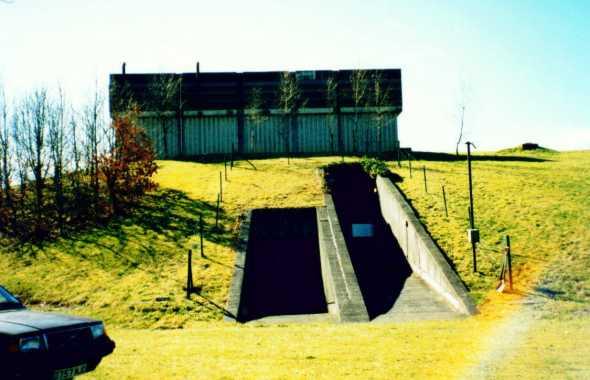
Chilmark main entrance (right) with air galleries above
The bunker is 2 miles from the picturesque Wiltshire village of Chilmark and occupies a small part of the RAF Chilmark. This was a major underground bomb store dating back to before the last war. The new bunker was however built on the surface opposite the railhead for the bomb dump and was referred to publicly as “RAF Chilmark Site F” or more usually as “Crown Building Chilmark”.
The bunker site covered 3.5 acres surrounded by a basic wire fence with was a single vehicle access gate. As usual, there were no signs to indicate the purpose or ownership of the site. The bunker was in the southern part of the site most of which was planted with grass and trees. There was a large area of “grasscrete” hard standing for parking.
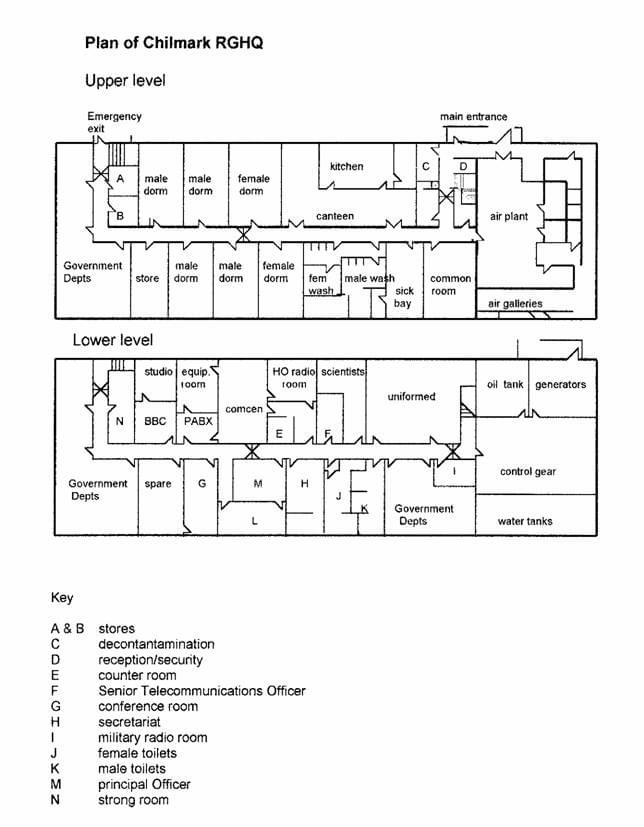
RGHQs, like their predecessors, were not expected to be proof against the blast of an H-bomb and the entrances and air-vents were particularly vulnerable. A frequently quoted figure is that they were expected to withstand an overpressure of 1.5 pounds per square inch, which, according to Home Office figures would be experienced up to 5 miles from a 500-kiloton ground burst. The RGHQ building was however designed to give a good level of protection against fall-out. A protection factor or PF of 400 is sometimes quoted. This figure has been in use since at least 1964 and means that the level of radiation inside the building would be 400 times lower than outside. This is roughly comparable with a well-prepared cellar under a strongly built house with no openings. By contrast, a normal house would have a PF of only about 20 even with its doors and windows sealed. Ignoring the problems caused by entrances and ventilation openings a PF of 400 could be achieved with two feet of concrete covered by an equal thickness of soil. The RGHQ was nominally provisioned for 30 days. It was not expected that the staff would stay inside for all this time, only when fall-out levels made it unsafe to go outside. In time, its functions would be transferred to a convenient surface building that would allow more staff to be recruited but given its pivotal role as a communications centre the RGHQ would likely be used for many months at least.
The RGHQ was built on the surface, and then covered by earth and grassed over. The concrete roof was 0.5 metres thick and the walls 0.3 metres thick. The air intakes and outlets were mounted on the roof where not only were they a vulnerable point for blast damage but the intakes would also draw in and concentrate fall-out. All RGHQs had a main and an emergency entrance. At Chilmark, they, perhaps surprisingly, both opened from the northern side of the bunker and were only a few feet apart. Both entrances give access to the upper level of the bunker. The main entrance was protected by a right-angled covered entrance “porch” giving access to another blast door. Alongside this was a removable panel giving equipment access to the upper plant room. The emergency entrance was via a simple ramp to a blast door. Whilst the bunker was fitted with an extensive fire and intruder alarm system, there were no external security facilities. The RGHQs would possibly have been designated as Key Points meriting a small police or military guard but otherwise the staff would have had to look to their own protection. If disaffected survivors attacked the bunker the staff could only close the doors and call for help.
Internally the operational part of the bunker was some 160 feet long by 70 feet wide with a central corridor on the long axis of both levels and a staircase next to each entrance. At the eastern end, and integral with the bunker were the plant rooms that added another 40 feet to its length. The internal walls were mostly of simple white painted breezeblocks and all the operational rooms had large pin boards on the walls. Most rooms had ducting for the air circulation system hanging from the ceiling. There were numerous telephone extension points, particularly in the open plan office areas allocated to “government departments” or “uniformed services” ie police, fire service and the military. There were relatively few power points indicating the general lack of office or domestic equipment. There were no computers, word processors or photocopiers in RGHQs and no maps or stationary were stored there. In theory, at least these would have been supplied on manning up by the Stationary Office under dormant contract arrangements or the staffs would have brought their own. In the days of the RSGs some government departments maintained packs of maps, reference books, etc ready for use.
The first floor was largely given over to domestic accommodation. The main entrance area contained the decontamination unit. This consisted of a basic shower, without a curtain, and a bin to hold contaminated clothes. Anyone who had been outside and exposed to fall-out would shower off the contaminated dust and then remove their clothing to be stored in the bin. No stocks of spare clothing were held. The first floor had 6 dormitories, nominally 4 male and 2 female, although the sex distribution of the staff would not be an influencing factor. Dormitories were equipped with 2 tier metal bunks each of which was provided with a blanket pack and a small personal locker. Bunks and other equipment were supplied for a nominal staff of 150. Only the Regional Commissioner and Principal Officer had the privacy of beds in their own offices. Exercise Bright Fire, held in 1988 showed that this type of domestic accommodation could cause problems particularly if people were coming and going at all hours and the only lights would be the main neon strip lights which were common throughout the bunker. Sleeping may well have been difficult. The communications team would have worked on a two-shift basis to give continual manning but the rest of the RGHQ’s staff would have worked as necessary. Although there was a Common Room with a few armchairs there were no recreational facilities. There were male and female toilets on both levels with showers in the upper one. The ladies' toilet was equipped with a gas detector.
A small sick bay was provided with a large first aid kit. The Community Physician from the DHSS would have provided medical assistance. Male and female toilets were provided together with sinks and showers for washing and instantaneous electric water heaters were fitted. Staff would be expected to bring clothing and personal kit for 30 days but there were no facilities to wash or dry clothes in most RGHQs although the Scottish site at Cultybraggen may have had both a washing machine and a dishwasher.
The canteen area occupied a large part of the first floor. The dining areas were equipped with basic tables and chairs although the Crowborough RGHQ’s canteen would not have been out of place in a modern fast-food restaurant. Crockery and cutlery were kept on site. The kitchen was well equipped with stainless steel ovens, sinks, two large fridge-freezers, a meat slicing machine and a bain marie servery. Food stocks were not permanently kept at the RGHQs. In the manning stage, some fresh food might be sought locally possibly under the direction of the Civil Service Catering Organisation but the main food source would be “compo” rations supplied by the army. A basic 30-day supply would be held together with a 15-day reserve. Once the basic 30-day supply had been used, further supplies would have been sought via MAFF or the local authorities. The draft Standard Operating Procedures copied sections from RSG instructions which suggested that toilet requisites, sweets, cigarettes and possibly even canned beer might be available but given the reality of the times, it seems unlikely that such items would have been available. There would be a restricted amount of cleaning materials available, but probably only what the peacetime Custodian kept.
The Regional Commissioner and Principal Officer had their own offices. Nearby were offices for the Secretariat, which would be the administrative hub of the RGHQ and the focal centre for handling all the major problems confronting the Regional Commissioner. Its basic function was to co-ordinate the assessment and consideration of problems with a view to ensuring that all the major decisions emanating from the RGHQ had been considered by all those concerned. This would involve, amongst other things, co-ordinating all activities within the RGHQ, issuing instructions on behalf of the Regional Commissioner either within the RGHQ or to local authority Controllers and other outside bodies, drafting scripts for regional broadcasts and preparing situation reports for the other RGHQ in the region, neighbouring RGHQs and central government43. The Secretariat would also maintain the Information Room that would plot the strategic position of the region mainly on maps. As most problems facing the RGHQ would involve more than one department or service the usual method of operation would be by committee. These would either be standing committees meeting twice a day or ad hoc committees established for specific purposes. A Conference Room was available for meetings.
Although not provided at Chilmark, other RGHQs had a room for Common Services, which would really be a store for stationary items, and a Typists Room. Other rooms, if available, were designated as stores. Chilmark, like most RGHQs had a Strong Room. This was a relatively small room with a security door. Its intended use is not obvious given that none of the RGHQ’s work would be secret and no high-value or secret documents would be kept. In peacetime, the Strong Room was often used to keep general equipment safe from the many maintenance workers who passed through the bunker.
The majority of the space on the lower floor was given over to communications. There was a BBC office together with a complete sound studio from which the Regional Commissioner could broadcast via local radio transmitter sites. Next to the BBC suite was the communications centre or Comcen. The main room here was the Counter Room (sometimes called the Comcen Registry) where outgoing messages were checked and prepared for transmission and incoming messages directed to the correct recipient. There were three main message systems. The RGHQ was connected to the normal public switched telephone system but this would quickly fail in wartime and be replaced by the skeleton Emergency Manual Switching System or EMSS. This would allow connection to a couple of trunk circuits which could connect the headquarters to various agencies such as ports, airfields and public utility headquarters which were not on the Emergency Communications Network or ECN. The ECN provided the main dedicated links to neighbouring RGHQs, the county council main and standby emergency centres and the county police headquarters within the sub-region and the nearest Royal Observer Corps Group Control. These “line” systems were backed up by radio and there was a Home Office Radio Room and a Military Radio Room.
All the RGHQs were connected to the normal electricity supply but this was expected to be lost in war and they were provided with two, occasionally one, diesel generators. At Chilmark, in a sound proofed area in the lower plant room were two 147 KW diesel generators which would supply electrical power once the mains supply had failed. The generators were supplied with diesel via a small daily service tank by a 48000 litre main tank. The lower plant room also contained the generator control panels, the main electrical switchboard and the heating and ventilation system control panel. One generator would automatically start 30 seconds after the external power supply failed. The bunker’s power needs were divided between essential and non-essential loads. Normally one generator would supply each, but if one generator failed the other could supply the essential load to provide basic communications, lighting and a minimum of air conditioning and cooking. In most RGHQs, the generators were sited outside or at least apart from the main part of the building probably because of the noise they produced and their need for an air supply. If the air did not first go through the filters, it would result in the generators building up potentially high levels of radiation.
The upper plant room contained the complex air supply system. Under fall-out conditions, air would be drawn into the bunker through large vents in the air intake gallery on the bunker roof. This would then be passed through a series of filters, including High Efficiency Particulate Air filters to remove the contaminated dust. It would then be heated or cooled to maintain a working temperature of 20 degrees centigrade. During peacetime operations, the filters could be by-passed. The system could also operate in a completely shutdown mode re-circulating the internal air. Air circulated around the bunker in metal ductwork at ceiling height. When unoccupied the ventilation system maintained the internal temperature at 14 degrees. It was important to keep the air conditioning running even when the bunker was unoccupied to avoid stop the humidity rising which would damage the electrical and communications equipment and lead to the growth of mould. The air would also have to be chilled and dried because when fully manned the staff would give off at lot of heat and moisture.
The Chilmark bunker shows that an RGHQ could provide essential office accommodation for the Regional Commissioner and his staff together with the necessary communications systems. But it also shows that the bunker, assuming it was properly provisioned, could be self-sufficient providing not only reasonably good working conditions but also all the necessary domestic facilities for the staff for around 30 days should the outside conditions require it.
The RGHQ sites
Many of the 1980s RGHQs used buildings which had been used as RSGs or SRCs in the 1960s although most were refitted in the 1970s or 1980s. There were also several complete refurbishments of other bunkers and for the first time since the early 1950s completely new bunkers were built. In fact, the mid-1980s saw the biggest boom in bunker construction since the early 1950s. As well as new RGHQs, hardened facilities were built for army headquarters, communications facilities, fuel supply points, water companies, etc during the decade.

The SRHQs/RGHQs for each region were -
Region 1 Scotland
In the 1960s, Scotland was divided into 3 zones - North, East and West with controls at Anstruther in Fife, Kirknewton in Lothian and Torrance House in East Kilbride. These reported to a Scottish Central Control at Barnton Quarry in Edinburgh although it is possible that by the mid-1960s the extended control at Kirknewton had resumed its original role as Scottish central. This arrangement continued throughout the 1970s. The Zone controls were equivalent to the SRHQs in England and Wales but unlike in those countries the Central Control equivalent to a 1960s RSG would have been established pre-attack after its English and Welsh equivalents were abandoned in 1965.
The Barnton Quarry site built as one of four R4 Sector Operations Centres in the mid-1950s as part of the ROTOR air defence scheme. Built entirely underground on three levels the bunker had internal dimensions of about 37 metres by 18 metres. The roof and walls were 10 feet thick and the entrance was through a long tunnel. The original RAF building appears to have been little altered during its civil defence usage until it was disposed of in 1984.
Torrance House was a former army Anti Aircraft Operations Room that had been built during the early 1950s. It was had two floors, the lower one being below ground level. The Anstruther Zone Control was originally built under the ROTOR scheme as an R3 two-level, fully underground Ground Control Intercept station. It was adopted in 1964 as the North Zone Headquarters, the equivalent of an SRHQ. Internally, it was little altered from its ROTOR days and still contained much of the original plant. By the late 1980s it was costing some £90000 a year to maintain. It was sold and opened in 1994 as “Scotland’s Secret Bunker”, the first of the RGHQs to become a museum to the Cold War. The Kirknewton headquarters was constructed in the mid 1950s as a Regional War Room to the standard design of a 2-storey surface built blockhouse with walls 5 feet thick. It was considerably extended in the 1960s.
This arrangement continued until 1983 when the East and West zones were merged to form the new South Zone and Scotland was designated as 1 Region. The Zone Headquarters at Kirknewton would now act as the Scottish Central Headquarters and house the Scottish Commissioner (the peacetime Secretary of State for Scotland). The Anstruther ZHQ became the Deputy Scottish Central Headquarters. In 1990, it was replaced by a new purpose built bunker at an army camp at Cultybraggen near Stirling. This was similar in basic design to the Chilmark bunker on two levels, with the top one mounded over. A mid-1980s plan to replace Anstruther was not completed.
Region 2 North East
This region was formed in 1983 by combining two English regions - North and North East, neither of which, unlike most regions had been divided sub-regions. In the 1960s, North Region would have had its RSG at the army camp in Catterick, but the region never had an SRHQ in the 1970s although by late in the decade work was starting to convert a former World War Two food cold store at Hexham in Northumberland to become RGHQ 2.2. The building, a massive rectangular windowless brick structure, was converted to give a net internal working area of 23,430 sq ft on two floors. Internally, the walls were thickened by an extra two feet to increase the protection factor and a standard aerial mast was placed on the roof. The building occupied a prime 1.37-hectare site on an industrial estate close to the railway station. It was sold in 1994 for £1.2 million.
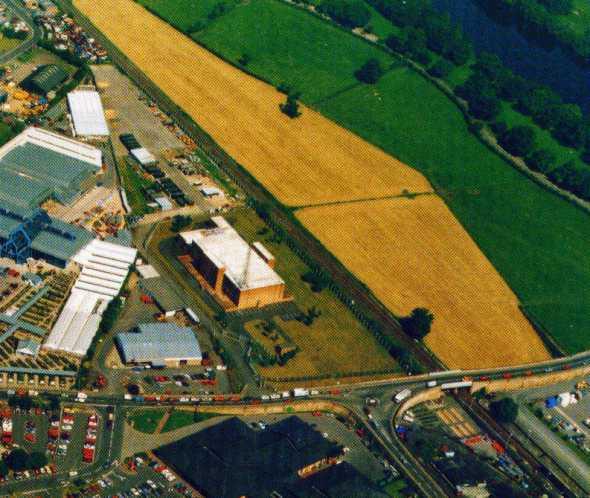
Hexham RGHQ - mid-1990s
The SRHQ for the North East region was at Shipton to the north of York. Like Barnton Quarry it began life as a 3 level ROTOR SOC and was taken over as an RSG in 1963. In the late 1970s, it was given a major refit that lasted several years. The guardroom bungalow was heavily reinforced internally and the windows filled in. A fourth floor, originally suggested in the 1960s, was added to the top of the bunker and earthed over. This new floor contained water tanks and dormitories. Whilst the original roof was 10 feet thick, the new one was only 1 foot with a few inches of earth on top.
Region 3 North Midland
The SRHQs for 3 Region were at Skendelby in Lincolnshire and Loughborough in Leicestershire and both were redesignated as RGHQs. RGHQ 3.1 at Skendelby was another underground ROTOR bunker, which had been adopted as a civil defence control in the mid-1960s, but unlike its sister at Anstruther, it was radically rebuilt in the early 1980s. By using a large under floor void originally used for cable runs in ROTOR days it was possible to fit a new lower floor into the existing bunker. A new fourth floor containing the tanks, generators and ventilation plant was then added on top and mounded over. It was then topped by 4 distinctive air towers. The bunker occupied part an exposed 6.75 acre site that was sold in 1995 for £150000.
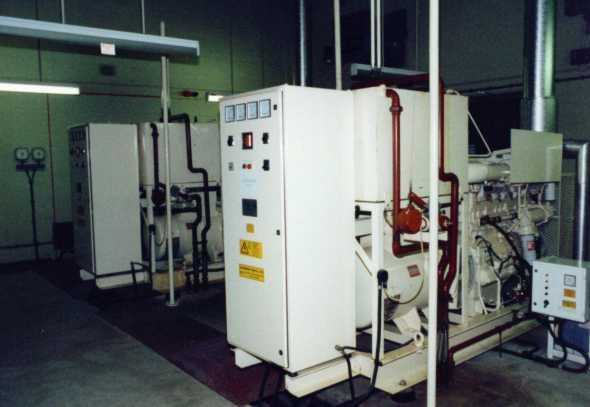
Generators at Skendelby
RGHQ 3.2 at Loughborough was another former cold store like Hexham which was taken over in 1973 for conversion into an SRHQ. The local council bought it when it was decommissioned and it was demolished at a reported cost of £200000.
Region 4 East
East Region was rather spoilt for choice when it came to protected accommodation. In the 1960s, the Regional War Room at Cambridge was extended to become the RSG for the region. With the end of the RSG system this building remained unused although in the 1980s it was refitted to accommodate the Easten Branch of the Nato Wartime Oil Organisation, the Nato Defence Shipping Agency and latterly the Eastern Region AFHQ when it moved from the old Rotor bunker at Bawdsey.
In the 1960s, the region had been divided into 3 sub-regions with SRHQs at Bawburgh near Norwich, Hertford and Kelvedon Hatch near Brentwood. When London was redesignated as a wartime region in 1971 it gained control of Kelvedon Hatch. This left 4 Region with Bawbugh as SRHQ 4.1 and Hertford as SRHQ 4.2 both of which were redesignated as RGHQs.
Bawburgh was another underground R4 ROTOR bunker. Like Shipton a fourth floor was added which was used for tanks and dormitories. The bunker was in poor condition and was being refurbished at the time when all work was stopped on civil defence projects in 1990. The main weakness of Bawburgh was its reliance on a single generator, which at the time the site was sold in 1994 was not in working order.
The diagram below shows a cross-section through the Bawburgh R4 Rotor Sector Operations Control with the new floor added to increase the available accommodation. It graphically shows the thickness of the reinforced concrete used in these buildings.
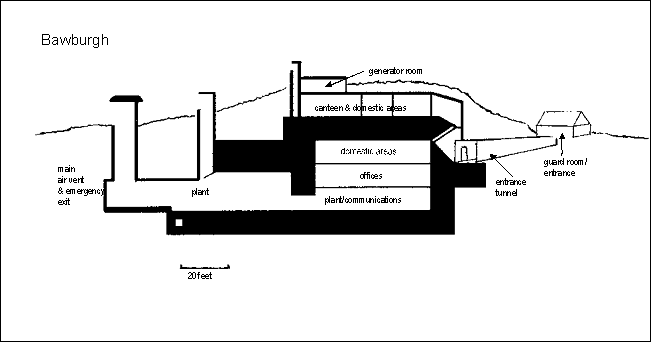
The Hertford bunker owed its origins to a mid-1960s plan to incorporate SRHQs into new government buildings. This resulted in a single storey bunker being built under a multi-story office block and its car park in the centre of Hertford. The main entrance was through the office building that had an aerial tower on its roof. The bunker was effectively abandoned by the Home Office on decommissioning and is used as a store by the government departments in the office block.
When the Royal Observer Corps was stood down in 1991 its parent government department, the Home Office, which was also responsible for the RGHQs found itself with several surplus ROC Group Controls. These had been built in the mid-1950s to a standard design with a large two level operations room surrounded at first floor level by an open gallery. They also contained a small amount of office and dormitory space. More importantly, they were equipped with the same communications equipment as the RGHQs and were all connected to the Emergency Communications Network. They had also been regularly used and maintained. They were therefore ideal to be taken over as RGHQs except for their size, having been designed for a staff of around 60, about half the complement of an RGHQ. Nevertheless, the opportunity was taken to replace the unsatisfactory Hertford bunker with the former Group Control on the outskirts of Bedford. The “well” which allowed people on the first floor to look down onto the ground floor was covered over to give additional working space but little else was done to alter the former Group Control before the RGHQs were themselves stood down.
Region 5 London
During most of the 1960s, the London region would have been divided in wartime between East, South and South East Home Defence Regions. But when it was established as a full region encompassing the Greater London area, it was not sub-divided into sub-regions and therefore only needed one SRHQ. The SRHQ, later RGHQ 5.1, for London was at Kelvedon Hatch near Brentwood, which is actually several miles outside the region’s boundary. It was sited in the fourth of the ROTOR R4 SOCs that originally controlled the RAF’s Metropolitan sector. This was taken over for civil defence purposes in the early 1960s as a Sub Regional Control and then a SRHQ. In this early period, it was also still used like the other former SOCs as a Sector Control for the ROC before these were relocated to ROC Group Controls in the early 1970s.
At one stage it was planned to put a fourth floor onto the bunker but this was never built. Instead, it was refitted in the mid-1970s when new tanks were installed on the roof (and then earthed over), new generators installed and the communications facilities upgraded. The bunker is entered via the standard ROTOR guardroom “bungalow” through a tunnel that unusually, because the bunker is built into the side of the hill, enters at the lower floor level rather than at the top as in other R4s. At the time of stand down the bunker was scheduled for a much needed major refurbishment. In 1994, the farming family from whom it was compulsorily purchased in 1953 for £2410 bought the site in the sealed bid auction for £150001and it was subsequently opened as a museum.
Region 6 Southern
In the 1960s the south eastern corner of England was still divided as it had been during World War 2 between 12 Region in the east with its RSG at Dover Castle and 6 Region in the west with its RSG operating from Warren Row which used thee old Regional War Room at Reading as its communications centre. When the two regions were merged they were each redesignated as sub-regions with their SRHQs at Dover and Basingstoke.
RSG12 was housed in the tunnels under Dover Castle which dated back to Napoleonic times although the operational heart of the RSG was in the lowest level of tunnels named “Dumpy”. This area consisted of a series of high rooms dug out of the chalk connected by a series of narrow communications tunnels. The main conversion work for the RSG was completed in 1964 and some remedial work was done in the 1970s but overall the accommodation and facilities in the tunnels were poor. Plans were made in 1982 to rebuild the SRHQ and to move the canteen and dormitories to the Dumpy level. The cost was however prohibitive and the plan was abandoned. In 1984, the Home Office gave up the site to English Heritage, which owns the Castle, and the upper two levels of tunnels were subsequently restored to their World War 2 condition and opened to the public.
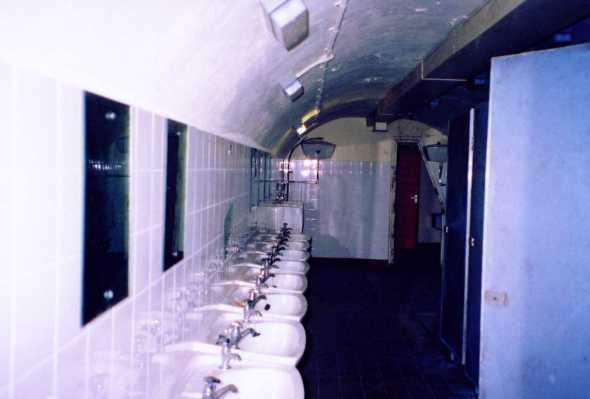
Domestic facilities at Dover
The closure of Dover left what was now Region 6 covering the whole of southern England with only one RGHQ. This became apparent for Exercise Vireg when the counties previously attached to Dover found that they had no way of accessing the Emergency Communication Network. This lead to them hurriedly being patched into the remaining RGHQ at Basingstoke. Plans were however in hand. In 1988 the Home Secretary replied to a question in Parliament that asked about “the alterations to the radio station at Kings Standing” by saying “…part of this site is being developed as an administrative centre for use in a possible emergency. It is not the practice to give detailed information about facilities of this kind. The building is not intended for use by the general public.” This was the first public announcement of what was to become the flagship of the RGHQs. It occupied a historically interesting site on high ground in Ashdown Forest near Crowborough in Kent. During the last war the site had been used to broadcast “black propaganda” into occupied Europe and two massive bunkers - one to house the studio and transmitting facilities and the other the power plant were built under the code name Aspidistra. After the war, the BBC and the Diplomatic Wireless Service used the transmitters until 1982.
The original main bunker was completely rebuilt to become the new RGHQ 6.1. When it was completed in 1987 its three floors were impressively equipped. Some of the furniture would not look out of place in a city boardroom, there were pictures on the walls and plastic pot plants and the canteen resembled something from a fast-food restaurant. The bunker occupied only a small part of the site, most of which was used by the police for training. After stand down the bunker was eventually also acquired by the police for training.
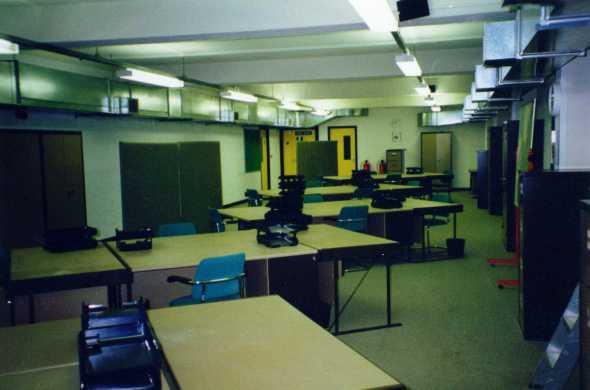
Crowborough RGHQ - Government Department’s room
The second RGHQ in the region was at Basingstoke, and like Hertford, was built under a 1960s government office block. The bunker was on two floors under the car park but it always suffered badly from water ingress. After stand down it was initially used as a nightclub before being demolished along with the building above it.
Region 7 South West
South West region had its RSG at another former ROTOR site at Bolt Head near Kingsbridge in south Devon. This was a two-story Ground Control Intercept station but unlike the Anstruther bunker this one was built completely above ground. Some conversion work was done in the 1960s but most of the domestic accommodation was in a nearby building. This was demolished in the mid-1980s and some of the upper rooms of the bunker were converted into dormitories. However, the space would have been extremely crowded. Whilst the bunker had been rewired and new communications and telephone points had been put in the washing and canteen arrangements were not updated from the original ROTOR days and were totally inadequate. Much of the air conditioning plant dated from the early 1950s and was still painted in the original drab green standard ROTOR colour scheme. The site was sold in 2000 for £200000 to a communications company who were interested in using the site’s tall aerial mast and left the bunker to decay.
Bolt Head’s companion SRHQ was at Ullenwood to the south of Cheltenham. This began life, like the Kirknewton Zone Headquarters, in the early 1950s as an Anti Aircraft Operations Room. In the 1960s, it was used by the Civil Defence Corps before becoming an SRHQ. As SRHQ 7.1 Ullenwood would have been very small for its role and was replaced by the purpose built RGHQ at Chilmark.
Region 8 Wales
Under the SRHQ scheme there was never a headquarters for the northern Wales sub-region. A 1970s plan to install a control in the basement of a government building being built in Ruthin fell through and in 1985, a site was found at Llandudno Junction at another former World War ll cold store like those used at Hexham and Loughborough. But in December 1986 it was announced that construction on what was termed “…this type of administrative centre” was unlikely to start within the next two years and in the interim temporary accommodation was sought to install the MSX message switch that were being installed in the RGHQs to link their subordinate county council emergency centres to the Emergency Communication Network. In practice, it was found that the cold store site needed too much work and the plan was abandoned. North Wales eventually acquired an RGHQ when the Royal Observer Group Control at Wrexham became available after the Corps was stood down. This was of the standard two-storey construction with both levels above ground providing some 2700 sq feet of internal space. The site was on the edge of a housing development and was sold in 1994 for £42000. The absence of a site for RGHQ 8.1 left the old tunnels at Brackla to cover the whole country as RGHQ 8.2.
Region 9 West Midland
The RSG for the Midlands region was sited in an underground factory at Drakelow near Kiddiminster. The factory consisted of a series of tunnels dug into the sandstone hillside in a gridiron pattern. When the RSGs were abandoned Drakelow was redesignated as an SRHQ and later an RGHQ before being sold in 1993. The bunker was refitted in the early 1980s with new generators, canteen, etc but its levels of habitability were always poor. In 1990, a feasibility study was made into building a new surface blockhouse on the extensive site but this plan came to nothing. Instead, in 1992 another former Royal Observer Corps Group Control at Lawford Heath near Rugby replaced Drakelow.
Drakelow’s companion SRHQ was another example of civil defence planners modifying existing accommodation to meet their purposes. RGHQ 9.1 occupied part of an army training area at Swynnerton near Stafford. The site was formerly a Royal Ordnance Factory one of its magazines had originally been converted in the 1960s as a civil defence Group Control. When it became an SRHQ an adjacent magazine was converted and the two linked by a tunnel some 200 feet long. One bunker contained the operational and communications areas and the other the domestic accommodation. The magazines were single storey structures that were earthed over providing a total of 2500 sq feet of floor space. After the RGHQs were stood down the site was returned to the army.
Region 10 North Western
Region 10 was poorly supplied with suitable bunker accommodation. The RSG would have been sited at the barracks in Preston. In the late 1960s, accommodation for a large, single storey SRC was provided under a new government office block in Southport that became SRHQ 10.1. However, it suffered severely from flooding and was abandoned in the early 1980s.
RGHQ 10.2 at Hack Green in Cheshire used another former ROTOR bunker. The site was first considered in 1969 and had been acquired by 1971 but, probably due to lack of funding work did not begin until the early 1980s and then the extensive refurbishment took several years. The bunker was originally, like the one at Bolt Head, a two storey semi-sunk R6 Ground Control Intercept station. But when it was rebuilt, like Skendelby, extra space was found to accommodate a new lower floor and a new generator house was built onto the side of the bunker. The site was sold for £151000 and subsequently became a museum.
In theory the two RGHQs for the region were located at the Hack Green site although this only really applied to the provision of the communications links to the county emergency centres as there would not be enough room at Hack Green to accommodate two RGHQ teams. Eventually, the gap was filled when the Royal Observer Corps was stood down by redesignating the UK Warning and Monitoring Organisation’s wartime headquarters at Gossnargh near Preston as RGHQ 10.1. This large bunker was subsequently sold for £110010.
Region 11 Northern Ireland
It is not clear if Northern Ireland had an operational regional control in the 1970s and early 1980s although both Gough Barracks and the former Regional War Room in Belfast were available. However, in 1985, it was announced that 3 purpose built civil defence centres would be constructed in Northern Ireland. Each would accommodate two teams. Four teams, each operating under a senior civil servant, would cover one of the four civil defence areas that would be co-terminus with the health and social service areas. The main team would constitute the RGHQ staff under a government minister as the Northern Ireland Central Control with the sixth team forming a reserve. Work was due to start on the first centre at Ballymena, which was based on the Chilmark design in 1987 but was delayed until the following July. It was completed in November 1989 but it appears that the other two sites were never started.
Staffing at the regional level
In the 1970s, the Sub Regional Commissioners would have been senior civil servants but, possibly following the 1981 review this role would have been taken by “junior ministers”. The Regional Commissioner would still be a “senior minister”. When the RGHQs were introduced combining the sub-regional and regional tiers the Regional Commissioner would have been a “Government minister” with “another minister” as his deputy based in the second RGHQ in the region. Unfortunately, the term government minister covers a wide range of the governing hierarchy and need not be an elected Member of Parliament. Exercise Regenerate in 1981, which perhaps assumed a single-tier at regional level, had a Minister of State in the Foreign and Colonial Office (second in the department to the secretary of State) as the Commissioner with a Parliamentary Private Secretary at the Ministry of Agriculture, Fisheries and Food as his deputy44.
These ministers would have been appointed when necessary by the Prime Minister probably on the advice of the Cabinet Secretary with little advance warning of their role and no specific training. They would have taken up their posts when the crisis had reached a point where war was seen as possible, if not probable, although they would have no role until regional government was implemented after a nuclear attack. However, the absence from Whitehall of some 20 ministers and possibly some cabinet ministers would hardly go unnoticed by the media and would need to be carefully managed if it was not to be taken by the public as a warning that nuclear war was imminent.
As well as ministers, providing officials to staff the decision making posts and then junior staff for communications and domestic duties in the SRHQs and RGHQs was always a problem. During the 1960s and at least into the 1970s government departments maintained lists of designated staff although generally these people were not told that they had been earmarked for a war role. From the early 1970s the designated principal Officers who would head the SRHQs were told of their potential appointments and some communications staff were sought. Senior staff were designated by the Treasury whose responsibilities for civil service manning were later taken over by the Civil Service Department. But when this was abolished in 1981 it appears to have left a vacuum. It is possible that some of the lower level staff were designated in 1982 and informed of their roles and there are some suggestions in the literature that the Regional Emergency Committees should meet to appoint some RGHQ staff. In the late 1980s, an inter-departmental committee was set up to address the staffing issue but it was over-taken by events when the system was abandoned. Most of the staff would be appointed by individual departments or other bodies such as the BBC and British Telecom. The departments knew how many people and of what grades they would need to appoint. some But it is probable that most were never designated because it was announced in 1982 that 35% of SRHQ staff had been “identified” as opposed to only 5% 2 years before. The use of the word “identified” does not sound very positive and both figures are lower than the 50% or so who were designated by their departments in 1972.
The MAFF Civil Defence Manual, published in 1988, made passing mention of its RGHQ contingent although without indicating how they would be chosen. It said of them that “It is essential that staff for regional government should be those people likely to make the most useful contribution. In particular, people selected for these appointments should -
- Not be liable to recall in an emergency to the armed services or other duties of national importance;
- Not suffer from claustrophobia or require special diets and medications;
- Be able to stand up to working for long hours under heavy pressure.”
Deputy Principal Officers for the SRHQs had to be specially appointed for Exercise Scrum Half in 1978 but other staff were not needed for the exercise. In the early 1980s the Principal Officers, Deputy Principal Officers and Assistant Principal Officers were appointed for the 3 regional teams. In East Region, for example, they were all civil servants and came from the Department of Trade and Industry, the Department of Health and Social Security, the Building Societies Commission, Customs and Excise and HMSO.
Although, senior designated staff were sent on Exercise Regard the recruitment problem continued. In the late 1980s the College was actively looking for delegates but was told by the Department of Transport that it was difficult to find people who were interested. Some staff may however have been designated following earlier practice without being told as the College suggested that a letter nominating some one for the course would be a good way of telling them about their role.
Exercise Regard only gave delegates a general introduction to the role of regional government and the delegates did not role-play specific tasks. In 1986 F6, the Home Office Department responsible for civil defence issued a small booklet to designated staff called “Briefing Notes for Designated Regional Government Staff”. It was only 25 pages long and simply reproduced sections of the Emergency Planning Guidelines for Local Authorities. It gave no practical direction as to the roles of staff at the RGHQs although a rather pompous note from the Cabinet Office at the time stated “…in a real life situation the Zone HQ would be staffed by experts in their respective departments who would be expected to know exactly what information they needed, what they could realistically expect to get and its source.”. The booklet confirmed the hostilities-only nature of RGHQ staff saying that the role of the “designate officer” i.e. someone who had accepted designation as a member of staff for wartime regional government “…is very much a contingent one; apart from the need to assimilate the scope of civil defence arrangements… and to attend where called upon training courses and exercises, there will be no requirement for the officer to undertake any specific functions in time of peace.”. The “hands on” procedures explaining how an RGHQ might operate were not drafted until 1988 and were possibly never completed.
The largest contingent in the RGHQ would have been the “counter room staff” manning the communications equipment. In the 1960s the army would have largely provided the communications staffs but from the early 1970s each SRHQ and then RGHQ had a communications team of local junior civil servants who would attend at the RGHQ every 6 weeks to test and train on the communications equipment. In practice, not all the headquarters had such a team. The members were told they were testing the equipment but in reality they would be the first people called on had the communications systems been manned for real.
In the late 1960s, the nominal staff for a Sub Regional Control (later Sub Regional Headquarters) had been reduced to about 200 from an original 280 partly because of security reasons but mainly because of the abandonment of all their civil defence roles. When the staffing for RGHQs was considered the numbers were further reduced to 134 reflecting a reduction in the numbers of support staff considered necessary or available. Even so, they would need over 3300 people spread through the RGHQ and reserve teams in the 11 regions and this ignores the many civil service in central and regional offices of government departments and other organisations who would have designated wartime roles. The Regional Emergency Committees would also need to be staffed which would require say another 300+ people, although there have been some suggestions that the REC teams would be ideally placed to form the core of the regional reserve team. In total, some 4000 people would have to be quickly recruited, organised and despatched to places they had never been to before to prepare to perform a role that they were probably not physically or mentally prepared for. This is asking a lot for a system that according to EPGLA should be ready at 48 hours notice. An added difficulty would be that, as in previous eras, no provision would be made for families who would be left at home to fend for themselves. The RGHQ staff would have to be volunteers as there would be no realistic way of coercing people into such a role.
The expectation or hope was that those who were nominated, whether before or perhaps at the last moment, without being warned in advance would simply leave their families at very short notice and at a time of great tension for an unknown destination and an unknowable future.
Regional controls - staff complements
| SRC (1964) | SRHQ (1970s) | RGHQ (1980s) | RGHQ (reserve) | |
|---|---|---|---|---|
| A. Common Services Staff | ||||
| Commissioner (or Sub) | 1 | 1 | 1 | 1 |
| Commissioner’s Office45 | 16 | 10 | ||
| - Principal Officer | 1 | |||
| - Deputy Principal Officer | 1 | |||
| - Assistant Principal Officer | 1 | 1 | ||
| - Legal Adviser | 1 | |||
| - Finance Officer | 1 | |||
| - Secretariat | 7 | 6 | ||
| Scientists | 13 | 9 | 5 | 2 |
| Communications Staff | 70 | 40 | 29 | 4 |
| Housekeeping Staff | 28 | 17 | 11 | |
| Common Services Staff | 10 | 6 | ||
| B. Government Staff46 | ||||
| Central Office of Information | 2 | 2 | 2 | |
| Dept of Employment | 2 | 1 | 1 | 1 |
| Dept of Energy | 6 | 4 | ||
| Dept of Environment | 12 | 13 | 7 | 5 |
| DHSS | 8 | 7 | 3 | 3 |
| HMSO | 1 | |||
| Home Office | 3 | 3 | 3 | |
| Lord Chancellor’s dept | 2 | 1 | ||
| MAFF | 6 | 8 | 8 | 8 |
| Dept of Trade & Industry | 1 | 1 | 2 | 3 |
| Dept of Transport | 13 | 10 | 8 | 7 |
| Treasury | 2 | |||
| C. Non Government Staff | ||||
| Civil defence | 5 | 5 | ||
| Armed Services | 20 | 18 | 20 | 1 |
| BBC | 3 | 547 | 2 | |
| British Telecom | 2 | 3 | 4 | 1 |
| Fire Service | 33 | 21 | 2 | 1 |
| Police | 24 | 19 | 5 | 5 |
| Totals | 267 | 192 | 134 | 65 |
File 12: The Role of Local Authorities in War
Controllers - Regulations - plans - emergency centres
Since its inception civil defence in Britain has been a function of the local authorities on the basis that they have existing structures, staff and equipment on which to base and build a civil defence organisation. They know their area and its people and the people know the local authority. In the event of an attack they, or more correctly their staff, would be at the forefront of any response and from the early 1960s they would also have been involved in regional government.
The size of the task
Plans made for the 1970s paid little attention to the crisis period before a nuclear attack but the new strategy in the 1980s required it to be considered. The Emergency Planning Guidelines for Local Authorities said that in the crisis period the local authorities should concentrate their resources on tasks related to the protection and survival of the people and generally to the war effort. This meant that they should prepare to implement their plans for the post-attack period whilst coping with the additional problems arising during the crisis and any conventional attacks. In practice, the tasks needed to put the local authorities onto a war footing would be enormous. Details of the preparations and activities they would have been involved with are given later but a typical urban district of 150000 people would have to find, set up, staff and equip say 5 large shelters, 75 Community Support Centres, 75 emergency feeding centres and numerous information points. It would need to close its schools and issue ration documents. Patients discharged from hospital might need to be looked after, as would those made homeless by enemy action. In some areas, refugees might be a problem. They would need to organise a radiac reporting network and train staff to use the equipment. Volunteers from the public would need to be recruited, organised and trained as community advisers, Community Support Centre helpers, etc. The Emergency Centre would need to be established, manned, possibly on a 24-hour basis, its communications brought to readiness and tested frequently and daily reports made to the REC. And all this should be done whilst maintaining “business as usual”48. After a nuclear attack, they would have to put their post-attack plans into operation as best they could.
The Controller
It was expected that the chief officer of the county or district council would be appointed as the Controller and it seems probable that Controllers at both County and District levels would be appointed at some time during the crisis period and given additional powers and functions under emergency legislation. After regional government had been introduced they would be members of the regional government answerable to the Regional Commissioner and the normal functioning of the elected councils would cease. EPGLA implied that under emergency legislation all the powers and functions would be vested in an emergency committee of 3 council members but the role of this committee was rather ambiguous. EPGLA said of the relationship of the committee to the controllers that “for as long as circumstances permitted it to act the committee should be consulted on general policy in relation to the disposition of council resources and the discharge of those functions essential to the life of the community. The Controller…would from time to time report to the committee on the steps that he, as a regional government official, was taking. The committee would leave day to day operational decisions to the Controller, whose actions must necessarily embrace matters beyond the committee’s knowledge and responsibility”. The implication is clear. The Regional Controller is the legitimate authority in the region and the Controllers are responsible to him. They might tell the committee what was happening, but the committee has no power except possibly in relation to the council’s peacetime functions and responsibilities most of which will have ceased or become irrelevant in the face of a nuclear attack. The implication is also clear that the Controllers powers and functions would go beyond those applicable to the peacetime council.
Regulations issued throughout the Cold War under the 1948 Civil defence Act required county councils to prepare for civil defence. The plans that had to be drawn up were all essentially short term and local dealing with the initial results of an attack and what might be called the survival period. There was no mention of planning for the longer term although this would probably have been better left until the time came given the huge number of uncertainties in this area. When EPGLA spoke of the roles of the Controllers, and therefore by association the county or district organisations it did so in these short-term rather than strategic terms. In a virtual repeat of the 1973 circular on Machinery of Government in War EPGLA said the County Controller’s tasks would be -
- To determine priorities.
- To plan for the most effective use of surviving resources in the county.
- To co-ordinate activities of local essential services.
- To identify resources for future use.
These tasks would be achieved through the county’s chief officers, the District Controllers and representatives of services attached to the Controller.
The District Controller’s tasks would be -
- To assess the position of the district.
- To determine priorities.
- To identify and co-ordinate the deployment of resources.
- To exercise full functions of the district council and those additional functions which may be delegated to him by the County Controller.
These lists shows the differences between peacetime and wartime activities and confirm that the District Controller would be responsible to the County Controller as part of the regional government control chain. A situation that does not happen in peacetime local government where independencies are often closely guarded.
Regulations and plans
Local authorities had been required to prepare plans for civil defence under regulations dating from 1948 but in the early years they were left to the councils' civil defence departments. Throughout the 1960s, the direct roles of the council increased and in 1967 more formal regulations requiring them to make plans were introduced. In April 1974 the local government structure in England and Wales was radically changed. Previously civil defence had been centred on the county and county borough councils. Now the counties were re-organised and the district introduced as a new second tier. This required a new set of civil defence regulations to be issued under the authority of the Civil defence Act 1948. The new Civil Defence (Planning) Regulations 1974 (1975 in Scotland) however imposed the same requirements on the local authorities as the earlier 1967 ones. The new Regulations made it a function of every County Council and the Greater London Council to make plans for -
- Collecting and distributing information on an attack
- Controlling and co-ordinating action necessary as a result of an attack
- Advising the public on protective measures
- Organising a billeting service for those made homeless by an attack
- Prevention of disease
- Disposal of human remains
- Distributing, conserving and controlling food in the event of an attack including emergency feeding
- Repair, demolition, clearance, etc of buildings and roads
- Providing and maintaining any other vital services
- Training their staffs and those of the District and London Borough councils to put the plans into effect.
The District and London Borough Councils were required to assist in the making of the County’s plans and to carry them out. If a crisis occurred, counties, at the request of the “designated Minister” (in practice the Home Secretary) would have to take precautionary steps to implement the plans.
The key word continued to be plan. No physical preparations had to be made beyond writing the plans. But there was no direction as to what to include in the plans, how comprehensive they should be, how they should be structured and so on. Once a plan had been written there was no requirement to keep it up to date or do anything at all with it. They were to be drawn up by the newly introduced Emergency Planning Officers or EPOs although there was no requirement for the councils to recruit these planners. The EPOs were then largely left to their own devices. Each Home Defence Region had one county Chief Emergency Planning Officer who acted as a convenor of regular meetings of the EPOs in the region. Many also held meetings throughout the 1970s and 1980s with their opposite numbers in the armed forces and public utilities. The government departments continued to prepare circulars outlining their plans but there was very little guidance from the Home Office on the grounds that this was a local authority function and one in which central government should not interfere.
More regulations
As discussed earlier the failure of Exercise Hard Rock in 1982 focussed the government’s mind on the role and activities of the local authorities and the new Civil Defence (General Local Authority Functions) Regulations were introduced in 1983. As well as plans for the same activities as the 1974 Regulations the new ones required new ones to be drawn up for rescue services, the use existing buildings for public shelter and the increased role for volunteers.
More significantly, there were two new requirements in the Regulations. Local authorities would in future be required to take part in exercises and there was now a specific requirement to “keep under review and revise plans” once written. There was however still no guidance about what exactly a “plan” should be nor any timescale for completion. The Home Secretary did however warn in Parliament that if local authorities did not perform their functions powers existed under the 1948 Act whereby the Minister could take on the task and pass the cost onto the council.
Initially there was still to be no monitoring of the plan making activities but it was soon announced that progress reports would be required. This was to be in the form of a questionnaire, later sent out annually to all counties and the six Fire and Civil Defence Authorities. The latter were introduced in 1985 to organise the fire services and carry out the civil defence obligations in the areas covered before their abolition by the Greater London Council and the metropolitan counties. Using these progress reports, the Home Office, overseen by a newly appointed Civil Defence Adviser, the veteran civil defence worker Eric Alley would monitor the local authorities. The first questionnaire found that local authority’s response to the Regulations was “not impressive” and only a handful of authorities had completed plans. They were then instructed to complete them by the end of 1985.
The Home Office produced a brief report on the implementation of the 1983 Regulations as at 31 July 1986. The report said that some plans were based on the 1974 Regulations and 14 counties had to be chased for replies. Three counties (Avon, Mid Glamorgan and South Glamorgan) had not submitted plans and consideration was being given to withholding the civil defence grant from them. Significantly, the report said, “…in most cases they [the plans] needed further work to meet the requirements of the Regulations”.
The situation in Essex in 1986 illustrates what had and had not been done in one county. The county had produced an outline plan under the 1983 Regulations but no districts had any plans although 2 had ones from 1976. The county had both a main and a standby emergency centre but only 9 of the 14 districts had adequate centres and 5 of these needed further work. There was virtually no staff training. Most districts had appointed Scientific Advisers but they were not very active. Only 4 districts had any volunteer organisation.
The Home Office report on the implementation of the 1983 Regulations in 1988 said that the standard of plans was much better than in 1986 when “…many of the plans received were incomplete, failed to take account of the government’s planning assumptions, contained little or no operational detail and in a number of cases amounted to little more than a statements of intent.” In 1988, the plans were generally better but “the picture still varies from authority to authority and even the best plans clearly require further work”. This applied in particular to plans below county level.
Many supposedly complete plans had gaps, often quite serious ones and usually relating to operational detail such as communications procedures and standard operating procedures for the emergency centres. Local authorities prepared what they had to do and most EPOs did their best but a middle-ranking council official suddenly told, in a period of developing crisis to put into operation part of a plan lacking in practical detail which he or she was previously hardly aware of would have been hard pressed.
The Planned Programme of Implementation
In response to the failings highlighted by the 1986 report the government decided to take a direct role in monitoring the local authorities' activities. This would be coupled with a threat to withhold the civil defence grant, which by this time was also available to be used indirectly to support peacetime emergency planning. This resulted in the Planned Programme of Implementation or PPI. A draft version of the PPI had been sent to the local authority associations in July 1986 together with the report on progress in the implementation of the 1983 Regulations and draft guidance on preparation of plans. The PPI, as finally announced in 198649 was to be based on a “three year rolling programme, setting priorities and a time table for systematic monitoring by the Home Office”. Its main points were -
- Each county council and Fire and Civil Defence Authority would have a series of targets for the staged preparation of civil defence plans.
- The production of operational plans was to take place within 3 years based on the requirements of the 1983 Regulations. There was a rolling 6-month cycle to prepare plans under each of the operational areas. The Home Office laid down which plans were to be produced in each 6 monthly period.
- Plans had to be submitted to the Home Office, which would review progress each October.
- The approval mechanisms for the civil defence grant to local authorities would be linked to the satisfactory progress in making the plans.
The Nuclear Free Zones were opposed to the PPI but the comprehensive, and no doubt expensive, legal opinion they took advised that it would be unwise for the authorities not to make the required plans.
The plans written up to the mid-1980s varied considerably in length and quality. They tended to be based heavily on the emergency services circulars and tended to have little practical content. Some of the lengthier ones were heavily padded with instructions on how to work dosimeters to measure radiation, how to write messages, diagrams of emergency feeding equipment and so on. One even had a diagram of a helicopter-landing site. Such detailed information might be useful in the hands of someone who would be implementing a well-developed, comprehensive plan but not in what was meant to be an outline of strategy. The impression often given is that the aim was quantity rather than quality. In practice, the plans were written and distributed to the principal council officers and other bodies involved such as the army and the Red Cross, but the people who might be asked to do the work at the grass-roots if a crisis developed were not involved.
The lack of guidance on plan writing was one of the main complaints of the Nuclear Free Zone movement. In 1988, some guidance was given on it50 saying that the plan should give an understandable review of all activities and a framework for carrying them out. The plan should state the objectives, the organisation that would achieve them, the roles of the individuals, where resources would come from and what actions would be taken by individuals to carry them out. The plans drawn up under this guidance tended to read more like management textbooks than a simple practical guide for action in a crisis. Most were typically long lists of what had to be done with vague instructions such as “ensure food stocks are built up” and “identify sources of public concern”. The lists of tasks for individual officers were full of talk of assessing, co-ordinating, collecting, identifying and establishing. These can be called the “whats” or the aims of the plans. What was too often missing was the “hows” - how each task could be done. The plans would give lists of schools, etc which were to be set up as Community Support Centre even mentioning that they should have, following the circular on the subject, 8 staff and be equipped with food, first aid materials, etc. But the person tasked with actually setting up the centre on the day would look in vain for a plan of where in the school to set up various services, where to get the equipment, how to run it on a day-to-day basis, etc. The padding however tended now to be less but this did not stop one London borough filling its plan with 75 pages, one-third of its total length, of pictures of the outsides of the buildings intended for use as Community Support Centres. One Chief Emergency Planning Officer described his plan as nothing more than a wish list.
The subject of plans
The Regulations required local authorities to draw up plans for various civil defence purposes. These purposes had tended to stay the same throughout the Cold War although 1984 Regulations introduced some new ones. There was little guidance with drawing up each plan and certainly no “specimen” or standard on which to base them. Consequently, each local authority’s plans were different although there were some broad trends common to most of them. The following paragraphs look at the subject of the plans and the general response.
The collection and distribution of information about an attack
This largely related to the collection of information locally about fall-out. The local authority would issue Personal Dose Rate Meters for measuring fall-out to its staff at Community Support Centres, work parties, etc who would pass information back to the Scientific Advisors who in turn would work out when it was safe to leave shelter and for how long. There was also a general requirement to keep the REC and later RGHQ informed.
Control and co-ordination
This essentially meant establishing a group of senior officials under the Controller that would operate from the Emergency Centre to co-ordinate and direct the survival activities at the various levels of county, district and community.
Instructing and advising the public
This was mainly the task of central government via the Central Office of Information in the crisis period but districts would set up local information points to amplify the advice and give it a more local and practical basis for example on the levels of social security benefits payable and where to go for shelter.
After nuclear attack, there would be a desperate need for information but national television and radio would cease and there would be no newspapers or postal service. Districts would continue to provide local information points at say CSCs to distribute information about emergency feeding, volunteering, etc. Local controllers would be able to make limited radio broadcasts using the Wartime Broadcasting Service via the RGHQs. The problem would however not just be distributing information but of obtaining it. In reality, most communities would have little idea of what was happening outside their own immediate areas for many weeks.
Public shelters
There was no requirement for the local authorities to provide, or plan to provide, shelters before the 1984 Regulations. These now required local authorities to make plans for “utilising such buildings structures excavations and other features of land in their area as are suitable for the purpose of providing civil defence shelters for the public”. This implied that no shelters were to be specially built and also that they were to be shelters against the effects of fall-out and not blast.
In the crisis period, people would be advised by TV and radio broadcast, adverts in the press and up to mid-1980s the Protect and Survive booklet to reinforce their homes against fall-out and to build an inner refuge. But some homes such as flats and mobile homes could not provide sufficient protection hence the requirement to provide shelter space usually in basement of building or underground car parks which would need to be stocked with bedding, water, food, lighting, etc for the expected 14 days during which people might have to stay under cover
Behind the shelter policy was the idea of “stay put” which had replaced the policy of mass evacuation. The government message would be that no place in the country was safer than any other from fall-out. Some areas were obviously more likely to be attacked than others but this point was glossed over. This idea was also behind the plans to disperse for example bulk food stocks and hospital supplies. They were not necessarily to be moved from a potentially dangerous area to a less dangerous one. The idea was to spread these resources so that they were not concentrated in any one place.
Rescue services
Pictures of the civil defence forces at work during the last war invariably show rescue squads digging survivors from the ruins of their homes. This concept continued when civil defence was re-established and a key part of the Corps was its rescue teams. Initially these were equipped with heavy rescue equipment and some training grounds featured specially built “nuclear villages” where the squads could practice on suitably ruined buildings. However, as the scale of the damage from a hydrogen bomb attack became known it was realised that the number of survivors who were not trapped would swamp any aid that could be provided so there was little point in trying to plan for large scale rescue work. The rescue squads were therefore re-equipped with much lighter equipment and the idea of organised groups steadily working their way into the heart of a devastated city digging out survivors as they went was abandoned.
Rescue was largely forgotten after the Corps was abolished but the need for some rescue capability for the conventional period was recognised in the 1980s. The planning response was usually to delegate the task to the fire brigade supplemented by council works staffs and volunteers.
Temporary accommodation and maintenance of the homeless
In the 1950s large scale plans were drawn up based on those from the last war to evacuate “priority classes”, essentially women and children, from the cities that were expected to be targeted. They would be taken, usually by train, to reception areas where Corps member and other volunteers would arrange billeting with local families. As with most civil defence plans it was the easy things that were planned for. The real problem would come with the billeting of millions of people for an indefinite period and no one seems to have considered the effects of the men left at home without their families to keep the economy going while waiting to be bombed
The evacuation plans were gradually changed and when the precautionary period was reduced to only 2-3 days, a revised plan to move some 9½ million people from 19 conurbations only up to 50 miles was considered. It would still be totally impractical and it was quietly dropped in favour of the “stay put” policy in the mid-1960s although this was not formally announced until 1973. Evacuation was again considered in the early 1980s by a working party of the Home Defence Committee but nothing came of it.
The Protect and Survive booklet warned against moving away from home. It told readers that “…your own local authority will be best able to help you in war. If you move away - unless you have a place of your own to go to or intend to live with relatives - the authority in your new area will not help you with accommodation, or food, or other essentials.”. In practice, planners at all levels did not expect people to “stay put”. Although the Regulations required local authorities to plan only to accommodate local people made homeless by an attack, all the exercises assumed there would be floods of refugees or “self-evacuees” as they were called who would need to be fed and sheltered. The government feared that these refugees would clog up the transport system and Essential Service Routes were designated which would be kept free of them to allow for the movement of essential traffic. In reality, such a plan would not be practical and it was quietly dropped in the 1980s.
Even if people did “stay put”, and EPGLA said the policy was “only advisory” some people would still need temporary homes if theirs had been destroyed or if they were away from their own home at the time of the attack. The 1950s idea was for “Rest Centres” where those bombed out could find immediate assistance and shelter before being moved to more permanent accommodation. The idea of the rest centre was re-introduced in 197651. Now there should be one centre capable of taking 200 people for every 10000 of the population. Again, this would only provide temporary care pending billeting although unlike in 1950s there was to be no formal billeting scheme. Billeting would depend on circumstances at the time but if necessary householders would be ordered to take in the homeless. Billeting was potentially an emotive issue and the 1980s plans tended to play down its impact. EPGLA simply referred to “…a number of options loosely described as billeting” and “…placing families in suitable houses”.
The 1980s strategy saw more need for a focal point for the community in the crisis period and beyond and idea of the Community Support Centre or CSC was introduced. These would provide the same services as the earlier rest centres but also be a focal point for information, volunteering, etc. The expectation was that one CSC would be set up for each “community” of around 2000 people. (It can be noted that this was the same basis as the 1950s Wardens Post area). The CSC, which in some plans was called a rest centre, would be staffed by volunteers and be pre-stocked with bedding, food, sanitation, emergency lighting, etc. Most local authority plans provided long lists of proposed CSC sites but in reality these were just lists of schools, village halls and other publicly owned buildings which would have space. Little was done to plan for their preparation and equipping.
Prevention of disease and the spread of disease
This would not be a problem in the pre-nuclear attack period except in areas with large numbers of refugees who would be living rough. The real problem would come after the attack when many people would be living in unhealthy and crowded conditions in public shelters and CSCs. Those in their own homes would have no running water, sewage or refuse disposal facilities. Emergency Feeding Centres would be a potential source of major food poisoning, to which would be added the problems of sewage, unburied bodies and rotting refuse. The basic message in the plans was to be aware of the need for hygiene.
Burial of the dead
One aspect of the 1980s planning task was the wide range potential attacks to prepare for - everything from a few conventional bombs to a major nuclear attack. A conventional war might produce a few dozen extra deaths at a time but a full scale nuclear attack would result in more bodies than any organisation could cope with. The problems of removing bodies from the rubble would be worsened by the restrictions imposed by fall-out. Almost certainly any area with large numbers of bodies would simply be abandoned. Many survivors from an attack would die from their injuries and later many more would die from radiation and disease. EPGLA and many local authority plans glossed over the emotive issue of mass burial whilst others covered it in considerable detail suggesting for example the number of graves that could be dug with a JCB. One London borough plan listed 45 items necessary for the disposal of human remains ranging from shovels to nailbrushes to gas masks. It did not however mention where any of these would come from. EPGLA simply speaks of leaving the place and method of disposal to an ad hoc decision at the time. Some local authority plans simply repeated this but others talk of earmarking parks, etc for mass burials.
Provision for emergency feeding
This vital area is covered in depth in the next file.
Works services
Local authority plans usually covered the provision of emergency works services using their own labour forces to clear blocked roads, repair lightly damaged buildings and restore essential services wherever possible.
Provision and maintenance of services
This was a “catch all” requirement that EPGLA says would include welfare, education, transport, finance and legal, etc. It would have relevance in the transition to war phases when it would probably come under the general heading of “business as usual”. After a nuclear attack, such considerations would have little relevance. As the situation began to stabilise into the recovery period, thoughts could turn to providing these types of services but this would be under the direction of the Regional Commissioner.
Voluntary organisation
With the demise of the organised civil defence voluntary effort in 1968, civil defence lost its core of trained and organised “foot soldiers”. Consequently, all plans placed heavy reliance on the organised volunteer services such as The British Red Cross Society, the Salvation Army, the St John Ambulance and the WRVS although with little consideration of the numbers
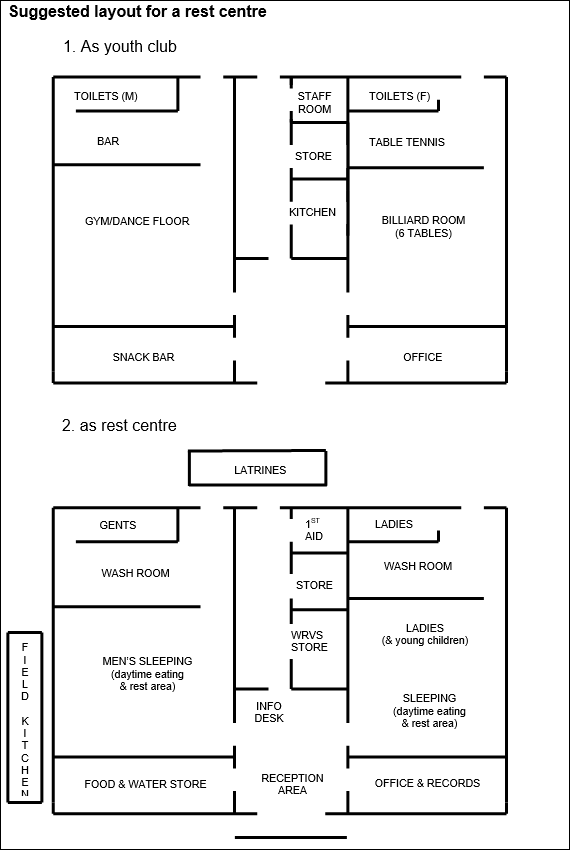
of people these organisations could make available. Another standard assumption was that people would present themselves in a crisis and would be given “crash training” to help run a first aid post, CSC, emergency feeding centre, etc. Who would do this training was rarely considered.
The 1980 home defence review emphasised the need to plan for community involvement and Circular ES2/81 enlarged on this saying that the principal objectives of community organisation in war are to help the community organise itself so as to improve its members survival prospects, to ensure that government information reached the people and to provide a means of assessing local conditions. The Co-ordinator of Voluntary Effort in Civil Defence drew up various papers and helped prepare a common training syllabus for “community advisers”. These people would be appointed in peacetime, hopefully on the basis of one for every 2000 people and receive a basic training consisting of a series of lectures on the background to civil defence. Keeping the volunteers interest after they had undertaken the initial training was a problem. Some counties organised further events and discussions on, for example, setting up support centres but they appear to have been in the minority.
The actual number of volunteers enrolled is unclear and the figures vary. The Home Office’s 1986 report said there were 15000 community-based volunteers and in the 1988 report it mentioned a figure of 25000. However, this latter figure probably included some 10000 members of the Royal Observer Corps and perhaps the 2000 or so Scientific Advisers. The Co-ordinator said in a 1989 letter that “the present scale and organisation of volunteer effort varies considerably” and urged local authorities to try to recruit more. Another 1989 paper mentions a figure of 19000 based on the annual returns the local authorities sent to the Home Office as part of the PPI process. The reality is perhaps best expressed in the Home Secretary’s reply to a Parliamentary Question in 1987. When asked if he was satisfied with the numbers of community advisers he said, “…much more undoubtedly needs to be done by most local authorities in accepting and training civil defence volunteers”. .
There were two groups of trained volunteers who were available to assist the local authorities - Scientific Advisers and members of RAYNET. The Scientific Advisers were originally called Scientific Intelligence Officers and they were recruited as part of the Civil defence Corps from local people with scientific knowledge to plot fall-out. From the early 1970s, the title Scientific Adviser was adopted as the emphasis moved from the immediate effects of an attack to considering the longer-term survival situation. Their role was enlarged to give more general scientific advice to the Controller for example on nutrition and morale but throughout their role was firmly anchored in the monitoring of fall out. They received training at local regional and national level but the establishment was variable across local authorities.
Each home defence region had a team of scientists often recruited from universities headed by a Chief Regional Scientific Officer. In peacetime, they advised the Home Office and oversaw the recruitment and training of the local Scientific Advisers. In war, they would form part of the regional staff to give advice to the Commissioner. The Home Office stopped funding Scientific Advisers in 1993 and most were stood down. The regional level scientists were also stood down receiving only a cursory letter of thanks for their unpaid service52.
The second group of volunteers came from the Radio Amateurs Emergency Network more commonly known as RAYNET. These enthusiasts would run most of the radio and teleprinter communications for the local authority emergency centres providing a vital core of expertise to supplement local authority staff. Most local authorities are still assisted by RAYNET volunteers who provide communications for peacetime emergencies.
Staffing
The use of volunteers leads to vital question of staffing. War appointments under the plans were made on the basis of peacetime roles so the County Education Officer was usually designated to become the County Food Officer (on the basis that the education department ran the school meals service), County Librarians became the County Information Officer, the County Surveyor the County Works Officer and so on. The jobholders would not necessarily know that they had been designated for a wartime role and such a responsibility could not be put into peacetime employment contracts. It was simply assumed that these people would turn up on the day although, as with RGHQ staff no special provision was made for the care of their families.
The College ran various courses to introduce local authority officers and other people designated to have war roles. The main course was for Chief Executives and Chief Officers and from 1977 it was based on a desktop exercise called Hot Seat. The aim of the course, which lasted three and a half days, was “to prepare chief officers of local government for their responsibilities in civil defence planning and operations”. In particular, it examined the statutory responsibilities of local authorities, the relationships with outside agencies, the need for co-ordination between staff, the roles and responsibilities of the officers and problems likely in the pre-and post-nuclear attack phases. The delegates would role play in small groups a series of problems “injected” by the directing staff covering the pre-attack period and then the situation after the first 3 days, then one month and then one year.
Whilst most county plans were written following the requirements of the Regulations, outlining in turn how each would be met the district and borough plans tended to look in turn at the individual departments of the council and the roles allocated to them. The following table shows how the 1990 plan for the London Borough of Ealing allocated wartime functions to its peacetime Departments and, by association, to their staffs -
| Department | Primary Function | Secondary Function |
|---|---|---|
| Chief Executive’s Office | Control & Co-ordination | Law & order |
| Press & Information | Rescue | |
| Information & advice | Food control | |
| Management Information | ||
| Technical Services | Communications | Homelessness |
| Essential Services | Burial | |
| Route & sewerage | Adaptations to premises | |
| Clearance & repairs | ||
| Demolition | ||
| Transport | ||
| Rescue | ||
| Public shelters | ||
| Education | Community Support Centres | |
| Emergency feeding | ||
| Housing | Homelessness | |
| Building repairs | ||
| Leisure Dept | Disposal of the dead | |
| Social Services | Voluntary organisations | Homelessness |
| Welfare | ||
| Environmental Health | Public Health | Homelessness |
| Radiac monitoring | Emergency feeding | |
| Disposal of the dead | ||
| Finance | Finance | |
| Planning & Economic | Building repairs (private sector) | |
| Development | Public shelter | |
| Libraries & Culture | Press & public information | |
| Personnel | Volunteers |
The Fire and Civil Defence Authorities had an unusual problem in that they had no staffs of their own and consequently would have to draw on their constituent authorities for staffing. The diagram below shows the nominal staffing for the London North West Group’s Control under its late 1980s plans. The 48 staff would come from among the Emergency Planners of the London FCDA and local borough staffs together with liaison officers from Maff, the army, etc. The Group Controller would have been the Chief Executive of the Borough of Kensington and Chelsea. The plan is theoretical because when it was drawn up the London North West Group did not have an Emergency Centre.
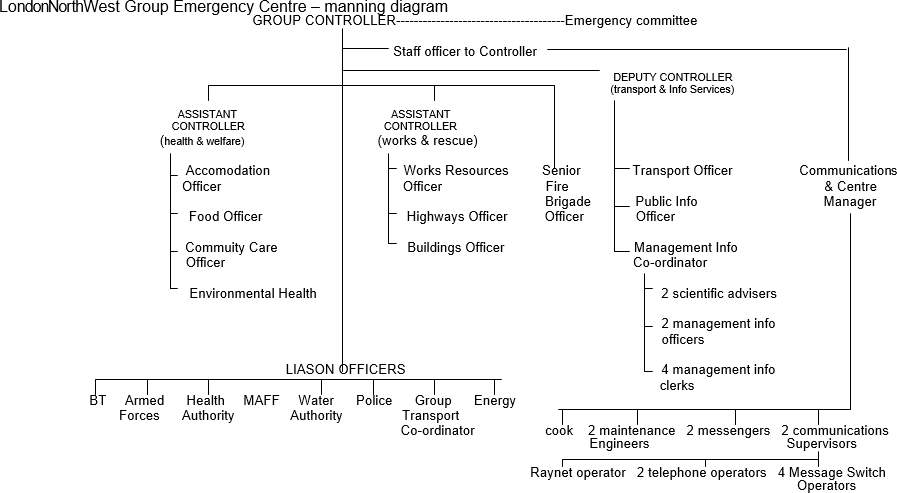
The diagram below shows the staffing structure planned for the London Borough of Croydon, part of the South East London Group in the mid-1980s. The centre, in the basement of the Old Town Hall, had a nominal staff of 37 including unusually 4 members of the Emergency Committee.
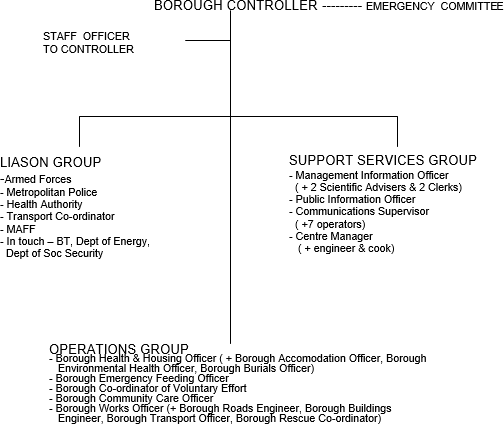
Essential to most plans was the use of large numbers of local authority staff both before and after a nuclear attack. It was therefore often assumed that teachers would help at schools designated as Community Support Centres, school meals staff would help with emergency feeding, library staff would man information points, the direct labour force would form work parties, etc. These people again were not consulted and would have even less idea that they were the backbone of the war plans than their departmental heads. A further problem developed as council services were privatised through the 1980s leaving the councils with fewer of their own staff to earmark for war duties. The assumptions about the roles that local authority staff were expected to take are shown in the list of responsibilities for a Community Support Centre given during the standard training course for Community Advisers -
| Task | Responsibility of |
|---|---|
| Movement | Police |
| Lighting & heating | } |
| Erecting signs | } School caretaker |
| Securing prohibited areas | } |
| General administration/Control | Headteacher/Principal |
| Information bulletins | School staff |
| Reception & registration | WRVS |
| Feeding | Education catering department |
| School staff & volunteers | |
| Social problems & rehabilitation | } |
| Bedding | } Social Services Dept |
| Supplies | } |
| Liaison with DHSS & Housing Dept. | } |
| Clothing - initial issue | WRVS |
| Longer term clothing issues | Social Services Dept |
The numbers of staff required to man the proposed control chain was enormous. The following chart of the control chain for Essex in the late 1970s shows the numbers of controls planned at each level of the control chain with the approximate total numbers of staff required in brackets -
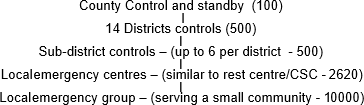
All plans were supposed to be capable of being implemented in 7 days but the limited exercises that the councils conducted such as Vireg and Ivy showed that they would need weeks, possibly months to train staff and then bring plans and facilities to actual readiness.
Emergency centres
In 1967, county authorities were advised to establish controls from which to co-ordinate the exercise of their civil defence functions and also those governmental functions that might be delegated to Controllers. Previous advice had been less specific about establishing what were then called control premises. Controls should be established near to the peacetime offices so that these could still be used and be capable of having a protective factor of 100 but no new building or expensive conversion work was anticipated. There was also no money for any controls below county level. The staff was expected to be up to 80 and the control should be self-sufficient for up to 21 days although no sleeping accommodation was to be included. Staff would sleep in nearby accommodation and only retreat to the control if fall-out conditions dictated. Under this scheme, some 300 controls were required although only 150 existed.
In 1972 the Circular53 which outlined the post care and maintenance structure of civil defence said that no central government money would be available to fund controls but that counties should select “one wartime headquarters normally co-located with the peacetime
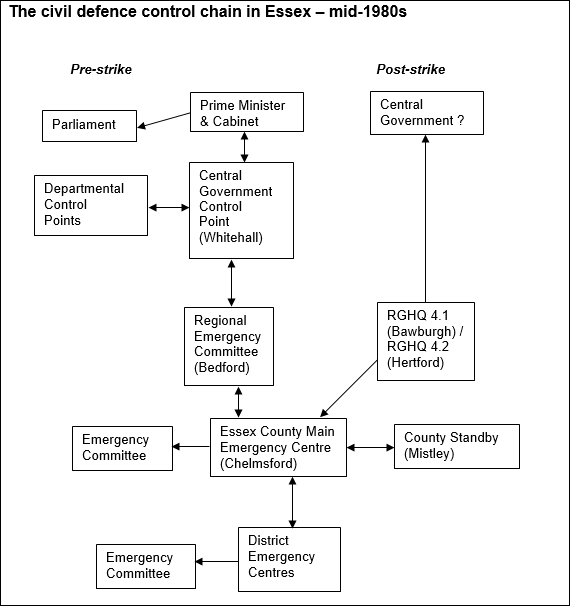
headquarters and one standby headquarters in a separate location…” so that the newly planned Government Communications Network could be installed. The 1974 Regulations imposed no requirements as to controls.
The 1983 Regulations did however require county authorities to provide and maintain what was now to be called an emergency centre, together with a standby. The Greater London Council was required to set up a group emergency centre for each of its 5 groups of boroughs. District councils and London boroughs had to provide one centre. An emergency centre was to be a “reasonably protected premises for emergency use with adequate communications” from which to “control and co-ordinate action” in the event of hostile attack or a threat of hostile attack. The centres were not expected to be proof against direct nuclear attack but should be capable of continuing operations “despite the effects of more distant attack”. The emergency centre was to be capable of accommodating and supporting the staff necessary to control and co-ordinate the action required by the local authority in the event of an attack or threat of attack. It should be capable of withstanding a static overpressure of 1.5 psi, provide a protective factor of 100 and be able to operate independently of mains services for 14 days. Suitable provision was to be made for domestic accommodation and equipment. Particular guidance was given on ventilation and filtration.
In practice, most county emergency centres were built in the basements of the county hall, sometimes in other council premises. In some places, the council was lucky enough to have some protected accommodation such as a redundant war room or an old civil defence centre from the 1950s or even the last war, which it could use although such places were usually remote from the main council offices. As planning developed through the 1980s, an increasing number of centres were established and often these were incorporated into new council buildings although not necessarily offices. The premises used by the district councils were typically in the basement of the town hall.
The Home Office’s report on the implementation of the 1983 Regulations as at 31 July 1984 said that “…almost all authorities had made some provision for emergency centres, but slightly over half needed to make further provision to accord with the 1983 regulations”. However, the next report on the position in October 1988 was more forthcoming. It said that in 1984 81 of the required 111 county level controls were operational but only 146 of the 402 required at district level. It added that many of these controls were found to be below standard so that the real position was now that only 53 of the required county controls were operational and sites had not even been identified for 23. At district, level only 142 were operational of the required 402 with no site identified for 156.
London provides an illuminating example of the level of preparedness. In 1972, it became a wartime region again in its own right. The old bunker at Kelvedon Hatch was adopted as the SRHQ and the boroughs continued to be divided into the long established 5 groups. Each group required a control but it would however take several years to establish these and the communications links to Kelvedon Hatch and as an interim measure it was planned to designate 5 borough controls as groups and continue the existing communications links to the outlying regional controls at Hertford, Warren Row/Reading and Guildford. The latter 2 would however not be needed after 1974. By this time the 1950s sub-regional war rooms at Mill Hill and Chiselhurst54 had been abandoned leaving only the other two at Wanstead Flats and Cheam operational. An underground Second World War civil defence control in Southall was adopted to serve as the Group Control for the North West Group but this was later abandoned by 1980 due to flooding. The South East Group took over a control built in the late 1960s for the Borough of Lambeth. This must have been one of the strangest “nuclear bunkers” ever built as it was constructed on two levels as part of the basement of a block of council flats in the middle of a large housing estate. In the early 1980s the Greater London Council was aleading member of the Nuclear Free Zones movement but when the Council was abolished and its civil defence functions taken over by the London Fire and Civil defence Authority planning began in earnest. Plans were drawn up for a major emergency centre to replace Southall in the long abandoned Brompton Road underground station. This would have also acted as the main peacetime emergency centre for London but the plans were overtaken by the changes in government policy at the end of the cold war.
Although no two emergency centres were the same, they were designed for the same basic functions. They were essentially places to provide some self-contained office space that afforded protection against fall out so that staffs could operate from them immediately after an attack. Typically, a county main emergency centre might have a staff, including the communications team of about 50 and a district or borough about 30. Whilst the communications team would be organised into 2 or possibly 3 shifts the rest of the staff would work as required taking rest as and when they could. Exercises such as Vireg suggested that the workload would be very high. Most had only a few rooms and they were usually surprisingly small particularly in the case of the district emergency centres. They all had some form of emergency generator and most had air filtration although in some older centres this might consist of an air pump powered by a converted bicycle. One of their main functions was as a communications centre providing contact with the other parts of the system such as the RGHQs, the utility services and UKWMO. During the crisis period, the designated staffs would mainly operate from their usual offices using normal communications but the emergency centre would be available to provide centralised facilities. It was only after the nuclear attack when fall-out protection was required and the Emergency Communications Network was activated that the emergency centres would be really needed and then they would only be occupied as necessary and for as long as necessary. The accommodation they provided was usually basic with few facilities for sleeping or providing meals.
The diagram below shows the 1980s room layout of the Kent Main Emergency Centre. This well designed and equipped centre was built under the canteen in a council complex in Maidstone. In peacetime, it could be used as a training centre but in war it provided self-contained protected accommodation for up to 50 staff for 14 days. There was a fan blown filtered air supply but the centre could be completely sealed for up to 12 hours if fall-out conditions were particularly bad. There were normal toilets as well self-contained ones if the sewage system failed. The tanks held 3000 gallons of water. A small kitchen was installed but whenever possible the canteen would be used. It had a few beds but nearby basements would be used for sleeping except under “shut down” conditions. Unusually, the centre plans envisaged the wartime staff working in shifts to allow staff to return to their families.
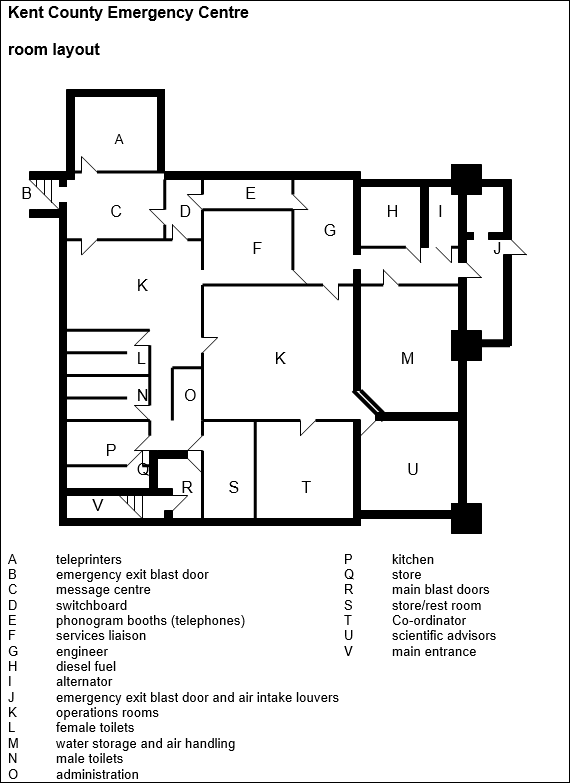
The Grass Roots
In the days of the Civil Defence Corps, the control chain extended down to the local Warden. He would have been the local people’s point of contact with the central organisation and could call for assistance as necessary. Alongside him would have been the support services organised mainly by the Corp’s Welfare Section and the WRVS. But with the end of the Corps, this grass roots organisation disappeared and little was done to address the gap in the 1970s.
Civil defence activity at the local level was determined by the Regulations and they concentrated on planning at the level of county and to a lesser extent the district. The implication was that the plans they required were to be for the benefit of the community although neither the Regulations nor the plans drawn up under them addressed this directly. The Emergency Planning Guidelines for Local Authorities mentioned the need for “organised community groups” and plans for “community wartime organisations” but without giving them any priority although the vital nature of these grass roots plans was clear from the statement that local communities “…might have to look after and support themselves unaided for days or even weeks…” Even in areas not directly affected by the nuclear attack, there would be no power, no food deliveries and poor communications together with a universal feeling of confusion and fear. For some days perhaps weeks there would be little guidance or assistance from the regional government organisation - assuming it was functioning. The need for local people to organise and help themselves is obvious, but little was done to prepare them.
The Emergency Planning Guidelines talks of planning at the “community level” based on local councils, community self-help and volunteers. The leaders would either be found from the existing elected bodies or from volunteers who would be “vested with some executive authority”. It stressed the need for leadership but also points out that these leaders who would inevitably have been appointed or self-selected would need to be accepted by the community.
The 1983 Regulations said that local authorities should “enable volunteers to serve” but there was no requirement to recruit them although most counties did so to some degree. Planners at various levels put a lot of emphasis on these local volunteers and to co-ordinate their efforts the Principal of the Easingwold College was appointed as Co-ordinator of Voluntary Effort in Civil defence. In reality, whilst it was hoped to have one trained volunteer for every 2000 people the numbers fell short throughout the 1980s. A 1989 report described activity in this area as “patchy” and in large towns and cities it was said to be virtually non-existent.
In 1984, a Working Party reported on its ideas for standardising the training of civil defence volunteers. It suggested a “community team” for the post-attack tasks made up of advisers on feeding, health, technical and welfare under the leadership of a “Civil defence Community Co-ordinator”. The volunteers might be involved in 15 distinct tasks in the pre-attack period to assist the local authority. These tasks ranged from selecting premises for civil defence purposes to setting up communications systems and reinforcing central government advice. This would have been a huge task for one person possibly covering a large geographical area with little support but the Report then listed 20 “post-attack tasks which might fall to civil defence volunteers”, possibly without outside assistance. This list is informative because it shows the huge range of tasks, resources and skills that would have been needed to help a community survive -
- Supplementing and/or initiating warnings.
- Marshalling people in shelters.
- Informing the public.
- Reconnoitring the area and assessing the situation.
- Monitoring, interpreting and reporting radiation levels.
- Communicating with other centres.
- Directing fire fighting.
- Directing available assistance to tasks.
- Rescuing the trapped.
- Administering first aid.
- Managing transport.
- Managing or manning rest centres.
- Managing and distributing food and water.
- Managing fuel.
- Managing or manning Feeding Centres.
- Billeting and rehousing from Rest Centres.
- Disposing of the dead.
- Clearing debris.
- Providing material to neighbouring areas.
- Advising on environmental health.
This list covers all the tasks given to the local authorities by the Regulations and goes beyond the roles expected of the entire Civil Defence Corps and associated organisations in the 1950s. As usual with such plans, the implicit assumption in the list is that the community suffers little direct damage, everyone is co-operative and there are no problems from outsiders. The Report was a public document and so perhaps had to adopt this approach but other people have suggested that the local community would need to set up vigilante groups to enforce the local arrangements for the good of the community and to defend it from unwanted outsiders.
To expect people to successfully perform all these tasks in the aftermath of a nuclear attack is surely asking too much. Nevertheless, the Report gave 92 areas of knowledge that would be needed by the volunteers ranging from operating RADIAC equipment, to sanitation, fire fighting, knots and lashings, first aid, organising drivers and repairing equipment. By the mid 1980s, a standard course had been written covering these areas and was given to volunteers by the local Emergency Planning Officers. The problem then became one of keeping the volunteers interested and their newly acquired knowledge up to date. The Civil Defence Corps had done this by being a properly constituted uniformed organisation that met regularly but except in a handful of counties the volunteers of the 1980s had no such support.
Few counties prepared any meaningful plans for this vital grass roots level. As an example, Essex prepared some plans in the early 1980s but they were little more than a plan for a hierarchy of various levels of control. It envisaged that below the district control would be a sub-district based on an area with between 10000 and 50000 people. Below this, based on an area of 2000 to 10000 people would be a “Local Emergency Centre”. This would be the main point of contact between the people and the emergency services. It would be based at a local school and run by the Head teacher supported by his teaching staff. The next level would be the “Local Emergency Group” supporting 600 to 1500 people in say a village or housing estate. It should be self-supporting and would be lead by “selected persons of standing”. The lowest level would be the Community Party with 60 to 150 people whose leaders would be selected by the Local Emergency Group leader. The size of the resulting organisation was huge requiring in the county some 2600 Local Emergency Groups and 26000 Community Parties. As was usual with such plans there was little or no information about how they would be translated into practical reality.
In 1987 The Institute of Civil Defence organised a conference at Easingwold to consider the grass roots response to war. Two papers gave some interesting insights on what might be done. The first came from Devon, one of the most active counties from the point of view of community involvement in civil defence. It suggested a “Parish Emergency Plan” should be compiled by a Parish Emergency Committee. This would be chaired by a Parish Warden who would administer the community area in time of war on behalf of the parish council thus giving at least a semblance of legitimacy or authority to the Committee. Interestingly its organisational structure did not follow the Working Party’s recommendations but envisaged a team under the Parish Warden with an Emergency Planning Adviser and an Agricultural Adviser and then Team Leaders for 5 teams concerned with control and communications, welfare, fire and rescue, first aid and engineering. A key task in the transition period would be to identify premises and identify and train people with the overall objective of improving the community’s self-reliance and self-sufficiency. The plan is notable for recognising the need to consider refugees. The paper suggested that 62% of parishes in Devon had these Committees with some 5000 volunteers.
A different and perhaps more practical approach was discussed by the speaker from Stansted in Essex. He drew on experience from the last war and suggested that grass roots survival would need grass roots planning but the local enthusiasts had received little or no support from the professional planners. In Stansted a local working party of parish councillors and co-opted members had been set up and had done some practical work such as talking to local farmers and testing wells. The plan said that in the crisis period “we” would start organising people and later they would, amongst other things, requisition buildings, ask people to take in neighbours and consider putting down domestic animals. Such practical planning would no doubt be very useful but would it be welcomed by both the “official” organisers and the local people? It also ignored the fact that as the site of one of the largest airports in the country Stansted was an obvious target.
If a major nuclear war had come, survival and recovery would have had to start from the grass roots, from small communities even groups of neighbours coming together for mutual support. The plans at county let alone regional level would not be effective for days possibly weeks and if by that time people had not started organising themselves there would be little chance of the Controllers at district and county level being able to impose some organisation. But this parochial level was practically ignored. The Regulations required plans to be made at county and then district level. There was no requirement for local level planning and few councils had the resources to spare for it.
File 13: The Ministries Prepare for War
Departmental plans - the War Book - health - transport - energy
Central Government Planning
Civil or home defence goes beyond responding to the immediate effects of an attack. It includes preparing all aspects of the nation state for war and ensuring that it can continue to function during and after it. Most government departments, local authorities and many other bodies such as the BBC were involved in these activities throughout the Cold War.
At the policy making level activities were co-ordinated and policy made by Cabinet Committees55. The principal one was the Home Defence Committee that was to “co-ordinate planning for the Machinery of Government in War”. At the height of the Cold War, it had sub-committees on public information in war, the machinery of government in war, war book and war legislation. Concerned with the more day-to-day aspects of civil defence was the Ministerial Committee on Civil Defence that met every few months under the chairmanship of the Home Secretary. It had sub-committees on civil defence planning, key points, port emergency planning, oil supplies and NATO civil preparations.
The Ministerial Committee was shadowed by an Official Committee on Civil Defence that acted on instructions from the Ministerial Committee and prepared reports, etc for it. It was composed of civil servants from departments such as the Treasury, Home Office, MAFF, the Scottish Office, the Cabinet Office, the Ministry of Housing and Local Government and the Chiefs of Staff
In addition, the military Chiefs of Staff had various committees responsible for their role in home defence. There were also various NATO committees to co-ordinate national plans both before and during a war.
The Government War Book
The key to home defence during the Cold War was the War Book. This has been maintained since 1911 and contains detailed instructions for co-ordinating the mobilisation of the civilian and service ministries on the outbreak of war. The War Book was a heavily classified publication and only available to a few senior people. Most ministries only had one copy and in 1964 only 96 copies existed. Even then there were even more heavily restricted parts relating to release procedures for nuclear weapons. The War Book, even the versions from 50 years ago are still not available to the public but the scope of its contents can be seen from the chapter headings of the 1966 edition -
- General
- Machinery of government
- Preparation of the armed forces
- Civil defence measures
- Internal security measures
- Control of manpower
- Control of information
- Food and agriculture
- Fuel, power, iron and steel industries
- Building and civil engineering
- Control of inland transport
- Shipping and ports
- Control of civil aviation
- Financial measures
- Treatment of enemy shipping and aircraft
- Diplomatic measures
- Appendix A NATO alert measures
- Appendix B NATO manning orders
- Appendix C Instructions for the control of radio transmission in time of war
- Appendix Z Relating to Chapter 1
- Minor Comments - Python planning and amendments resulting from Python.
The Government War Book gave a series of cryptic instructions as to what was to be done and by whom at various stages of a crisis, for example “warn telephone managers to activate the EMSS”, “Review police war instructions” and “Secretary of the Cabinet arranges for the Cabinet to consider if the selection of staff at the alternative government war headquarters should be finalised and staff informed”.
In addition, each government department and fighting service had its own local War Book but by the late 1950s some departments had not updated their War Books since the turn of the decade and some may have been using one from the last war. They were however updated several times during the Cold War and changed to meet differing circumstances and responses. During the 1960s War Book exercises were held in conjunction with the Fallex series of exercises. For example, “Exercise Felsted” was the central government War Book exercise, which preceded Fallex 62, and “Exercise Invaluable” preceded Fallex 6856. These exercises simulated cabinet meetings and decision-making processes relating to mobilising the country during the crisis, together with the use of various communications systems. They were held every two years and appear to have been far from popular with the civil servants who planned and took part in them. A cryptic hand written note in the margin of one briefing document for Exercise Invaluable refers to it as a “bi-annual horror”. Politicians and Ministers seem to have taken no part in these exercises. A lesson which appears to have been learned each time was that the communications and decision making procedures involving NATO, various ministries and the Cabinet Office Control Point (then codenamed “Cockpit57") were too slow and cumbersome for the increasingly rapid pace with which crises were developing. Exercise Invaluable seems to have virtually collapsed due to problems of communications both within Whitehall and between the Whitehall ministries and NATO centres. The Government War Book was also frequently found to be inflexible and inadequate.
In the 1970s NATO started a series of biannual “Wintex/Cimex” (winter exercise/civil-military exercise). The first, Wintex71(Exercise Good Heart) was paralleled by a small exercise called Exercise New Deal to test military home defence transition to war plans. New Deal was notable for having minimal civil involvement following the introduction of “care and maintenance”. For example, the new Armed Forces Headquarters were established but the Sub Regional Controls were not.
The Government War Book and Manual of Emergency Measures was rewritten between 1982 and 1984. It came into use in 1985 when it was said to “…present the decisions which need to be made by the Cabinet at time of heightened tension to place the nation on a war footing and respond to Nato requirements. It presents decisions as a series of Emergency Measures which are set out in the form of omnibus measures which enable the Cabinet to instruct Departments to take all measures to a specified stage and in the form of 50 measures set out under broad headings….Within each Emergency Measure are up to 7 chronological steps broadly described as -
- Step 1: Covert review and preparation
- Step 2: Overt low key preparations
- Step 3: Preparations for reinforcement, related civil action
- Step 4: Mobilisation and reinforcement, related civil action
- Step 5: Further measures, full emergency powers
- Step 6: Final measures to war readiness
- Step 7: Nato attacked, war”
The Home Office
At the central government level planning for the “machinery of government in war” is the responsibility of the Cabinet Office. Below this level of the control chain the lead department for civil defence was the Home Office. In the Cold War its main areas of responsibility were overseeing the preparation of plans by local authorities, monitoring the Civil Defence Grant paid by central government to local authorities, the regional level controls, the regional and local scientific advisers, the College at Easingwold and scientific research in relation to civil defence
Following the 1948 Act the Home Office’s Civil Defence Department was enlarged and organised into several divisions to oversee the Civil Defence Corps, the role of the local authorities, the regional organisation and so on. In the mid-1950s the regional organisation, which had existed since the last war, was expanded and Regional Directors were appointed. The Regional Offices monitored the civil defence activities in their region but more importantly, they were responsible for the regional level controls such as the RSGs and SRCs including organising exercises. In 1968, the regional organisation was scrapped leaving the Home Office without any direct local contact with the local authorities and no one to oversee the SRHQs, etc. This was a serious weakness in the ability of the Home Office to perform its role effectively.
In 1970 the rump of the civil defence activities previously performed by the large Home Office Civil Defence Department were taken over by the F6 Division supported by the Supply and Transport branch. Both were part of the Police Department no doubt because the only real remaining part of the civil defence system, the siren network, was the day-to-day responsibility of the police. In 1984, F6 was transferred into the newly formed Fire and Emergency Planning Department and in 1989 to reflect the changing nature of civil defence this was renamed The Emergency Planning Division58. In Scotland, civil defence was overseen by the Scottish Home and Health Department.
Other Government Departments
Many other government departments had civil defence responsibilities throughout the Cold War. As an illustration, the roles the responsibilities of individual ministries in planning and operational aspects of civil defence in the 1950s were as follows -
| Home Office | lead department for civil defence |
| public shelter and protection | |
| warning and monitoring | |
| control of law and order and machinery of justice | |
| Ministry of Agriculture, Fisheries & Food | protection of crops and livestock |
| Ministry of Defence | support to civil power by armed forces |
| protection of key points | |
| Ministry of Health | hospital and casualty services |
| public health measures | |
| Ministry of Pensions | war assistance payments |
| National Assistance Board | |
| Ministry of Housing & Local Government | care of the homeless and billeting |
| Ministry of Public Building & Works | control of building and civil engineering |
| Emergency Works Organisation | |
| Ministry of Labour | provision of manpower |
| Ministry of Transport | inland transport |
| ports and shipping | |
| Ministry of Power | control of electricity, gas, coal and oil |
| Board of Trade | control of private industry |
| Ministry of Aviation | control of civil aviation |
| Central Office of Information | information and instructions to the public |
| BBC | War Time Broadcasting Service |
| Treasury | monetary policy |
The department with the most vital role was the Ministry of Agriculture, Fisheries and Food and this will be covered in depth in the next File. The other main players were the departments dealing with health, energy and transport.
Health and medical services
One of the key roles for civil defence was the treatment of the casualties and preparations were made throughout the cold war to deal with them. These plans show graphically the changes between the massive efforts which, albeit often only in theory, would be directed towards civil defence after a nuclear attack in the 1950s and early 1960s and the much more limited aspirations of the plans of the 1970s and 1980s.
In the 1950s, the plans were based on atomic attack but by the mid-1950s the horror of the hydrogen bomb dominated planning. An attack would result in millions of casualties in a matter of hours. Plans envisaged that hospitals (or rather their staffs and as much of their equipment and supplies as possible) would be evacuated from the cities that were expected to be attacked. They would be re-established in the “hospital evacuation zone” some 15 miles from the target city centre as “acute hospitals” which nationally would provide up to 450000 beds. After the attack, “auxiliary hospitals” would be opened as necessary in shops, village halls and the like. They would provide up to 450000 additional beds but would be able to offer little medical care and their role would be to hold patients pending transfer to an acute hospital. All the hospitals would be assisted by volunteers, members of the voluntary aid societies such as the British Red Cross Society and the St John Ambulance together with the National Hospital Service Reserve.
As with all other 1950s plans the idea involved a rather rigid structure with many levels of organisation and would require huge numbers of people. Civil defence workers would initially take casualties to Ambulance Loading Points, which would be manned by the voluntary aid societies and first aid parties from the Corps. They would then be taken on to a Forward Medical Aid Unit staffed by general practitioners and nurses who would treat the lightly injured and give emergency treatment as necessary to those requiring transfer to a hospital. Movement of the casualties would be by organised ambulance units manned by the Corps using requisitioned vehicles.
These 1950s plans depended on many layers of quite complex organisation backed up by suitably trained and organised staff and ultimately needing vast amounts of drugs, dressings and so on. In reality, could such a structure have been put together in the chaos following a nuclear attack? At least the existence of the Corps and the National Hospital Service Reserve gave a foundation on which such a structure could possibly be built but these people were not available after 1968. However, the later plans tended to assume that the cities would not be targeted and the advent of more accurate delivery systems meant that smaller bombs would be used. This suggested that that the number of casualties would be lower, although a 1977 Circular59 still said “The number of casualties might be quite beyond the resources of existing health services” which is surely an understatement given that today’s health services are stretched to the limit when confronted with a few dozen casualties from a major train or air crash.
The Circular envisaged that as many patients as possible would be discharged from hospitals on the crisis period which would free up to 60% of available beds. It did not however say what would happen to those discharged patients who for whatever reason needed help or medical care. These discharges would allow equipment, and in particular trained staff, who were said to be the health service’s most valuable resource to be dispersed around the region. The health services would continue to be administered after attack by the peacetime Regional and District Health Authorities.
Casualties would now be treated initially at a first aid post manned by the voluntary aid societies before being transferred to a Casualty Clearing Centre staffed by general practitioners and nurses. These centres would sort and treat casualties before sending some onto hospital and returning others to the community to be cared for. The only hospital facilities would be those in the peacetime hospitals. The Circular said, “The number of casualties may be expected greatly to exceed surviving hospital resources and Directors [of Health] would have to impose strict admission policies”. In particular, radiation casualties would not be admitted because there would be no effective treatment for them and furthermore hospitals “…should initially accept only those casualties who after limited surgical procedures would be likely to be alive after 7 days with a fair chance of eventual recovery”. There was no indication about the fate of those who did not appear to have such a fair chance. The regional training course Exercise Regard was blunter in its expectation as were most civil defence plans that were not for public consumption. Part of the post-attack briefing for delegates said “the devastation and mass casualty situation in Nottingham is horrific” and that there was “an appalling and continuing burial problem”. Medical staff would quickly become overwhelmed by the task but they would also rapidly run out of supplies and the briefings for Exercise Hard Rock envisaged that there would not even be enough supplies of dressings and other basic first aid supplies to set up the planned first aid posts. Some experiments were made in the mid-1980s to pre-stock supplies but in reality, little would have been available60.
In 1988, a further health service circular was issued which originally should have been produced as part of the EPGLA in 1985. It repeated the same basic message as its predecessor but toned down slightly the casualty prediction. The wartime casualty treatment structure was however simplified. As before, as many patients as possible would be discharged and medical staff and supplies dispersed but now the initial treatment would be provided at an Emergency Medical Centre staffed by general practitioners and nurses who would carry out basic first aid and simple surgery. There were however still hints that the system would not be able to cope and that there would be a need to switch from “highly sophisticated methods…to more basic approaches to care” and “the treatment of burns and blast injuries might have to be selective”. There was no guide as to who would do the selecting and on what basis.
Energy
Modern society is totally dependent on power supplies - coal, oil, gas and in particular electricity. We experience the occasional power cuts which are amusing for a few hours but soon become a problem when there is no lighting, heating, entertainment, hot water or cooking. And this is just the impact on the average home without considering the wider effects on the economy and society as a whole. All the war plans assumed that in the vast majority of the country would have no power at all for weeks after a nuclear attack and possibly for much longer.
In the 1950s production of coal, gas and electricity was much more localised than today. It was also the responsibility of nationalised industries and therefore came under direct government control. Some of the industries developed limited war plans including the provision of emergency headquarters and stocking of spares and parts.
Even after an H-bomb attack it was thought that enough electricity generating capacity would remain for the expected much reduced national needs. In 1976, a Circular61 said, perhaps surprisingly, that electricity and gas were not essential to survival and pointed out that whilst all the power producers were interdependent with for example coalmines needing electricity and gas producers needing coal much of the normal peacetime demand would cease after attack. Some production facilities might be directly affected by the attack but the electro-magnetic pulse would do more damage particularly to the grid distribution system. After the attack there would be little coal or gas available although some power stations might be restarted. However, this may have been more problematic than the circular implies because as well as fuel power stations require supplies of various chemicals and other consumables and most require large amounts of air and water. If the plants were run in conditions of even low level fall out the volume of air and water used would concentrate the fall out inside the plants.
The diagram below shows the expected impact of a nuclear attack on both the demand for and supply of electricity.
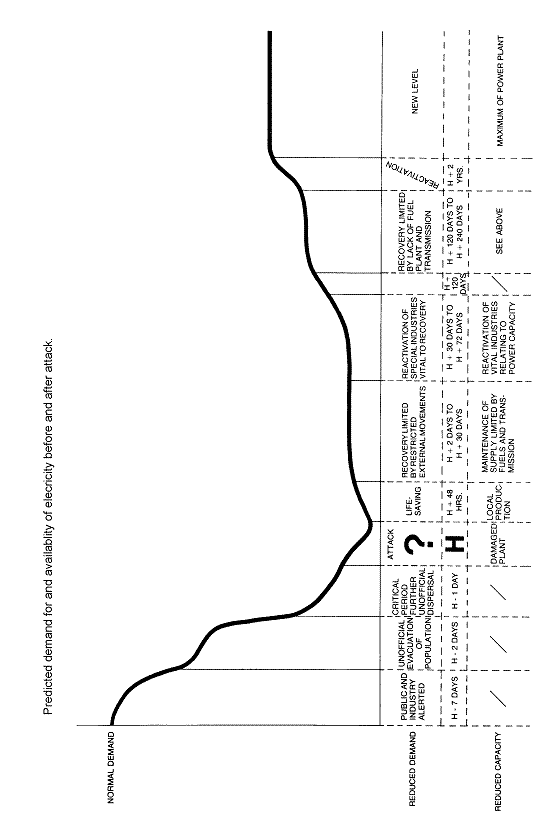
Oil, and in particular supplies of petrol and diesel fuel have always been considered important for national survival. At the national level, the main oil companies assisted the Department of Energy on the National Oil Board and in a war the companies would pool their resources, co-ordinated by the UK Oil Mobilisation Control, and aim to give priority to defence and other essential services. At regional level Regional Oil Committees would be set up mainly with staff from the oil companies with representatives at the regional and county controls. Throughout most of the Cold War the bulk of petrol and oil products were imported but there was a lot of emergency storage capacity left over from the war. In the 1950s an underground storage facility was built in Cheshire in converted salt mines to hold bulk supplies of oil products for both government agencies and private companies. Additional pipeline facilities were also constructed together with other storage facilities which were leased to commercial concerns and some emergency anchorages. The importance of these facilities and the fact that because they were leased to commercial companies they were self-financing meant that they were largely untouched by the various cost cutting measures affecting other areas of home defence.
In the crisis period production would be maximised and a 1984 report said that there was usually 76 days supply of oil products in the country although the problem, post-attack might be getting at it and it suggested that bulk stocks should be dispersed to the tanks of users where ever possible. If an attack seemed imminent, certain local petrol stations would be “frozen” by the police for use later by the simple expedient of taking the keys from the owners and removing the fuses from all electricity circuits for the pumps although some more realistic planners in the oil industry have dismissed this idea. From the mid-1970s, plans to introduce a general scheme of petrol rationing in wartime were abandoned.
EPGLA covered the power industries in the transition to war/conventional war phases pointing out that demand would rise and restrictions might have to be introduced. The panic buying and general shortages, which were seen during the restrictions which followed the fuel protests in 2000 showed that this would be an understatement. The Guidelines emphasised that gas supplies would be vulnerable. If production facilities were lost in the transition to war then the supply would cease but the national pipeline distribution system was itself vulnerable to interruptions and might have to be shut down at an early stage. Despite this, many Emergency Planning Officers made plans on the basis that gas supplies would not be interrupted and many of those plans listed potential Community Support Centres and feeding centres where cooking would be done with gas. It consequently came as a significant shock to the players in Exercise Vireg when gas supplies were cut off quite early in the crisis. Post-exercise discussions with the Department of Energy showed that the, now privatised, power industries were responsible for preparing their own emergency plans independently of the Department and there were no national or regional plans. Whether or not gas would be cut off and when would depend on the circumstances but planners were advised to assume that there would be no domestic gas supplies in the transition to war period.
Transport
Transport was another area where grandiose plans were made in the 1950s and then whittled down over the next 30 years. In the 1950s and 1960s plans Regional Transport Controllers would be responsible to the Regional Commissioner for all buses, coaches and goods vehicles in the region. All lorries and vans except those used by the emergency services would be requisitioned into Goods Vehicle Units of 500 - 1000 vehicles. Buses and coaches would be similarly grouped into Bus Fleets. Who would drive these vehicles was not mentioned but presumably it was expected that the peacetime drivers would either volunteer or would be directed under the emergency powers. Any significant road movements would be organised by the Convoy Co-ordinating Officer at county level under the direction of the RSG. Certain major roads would be designated as Essential Service Routes to be kept clear in the crisis period and beyond for civil defence and other official traffic. This idea dates from the 1950s. Although the scheme was modified in 1973 to take motorways into account it was quietly dropped in the early 1980s no doubt in recognition of the simple fact that there would be no spare police or military forces to keep the routes clear of civilians and also that in the absence of organised civil defence there would be few official vehicles about.
The railways would have been important during wartime particularly up to the mid-1960s when the network was much bigger than today. Most of the transport for mobilisation and moving bulk stores and people would have been by rail. The evacuation schemes were particularly dependent on railways. In the early 1950s, the British Railways planned to build 37 purpose built hardened controls with walls five feet thick as part of their “due functioning” preparations.. In practice, money was short and only one was actually completed. By the early 1960s, the idea had been abandoned in favour of using the peacetime control system with railway liaison officers at regional and county controls supplemented by Mobile Emergency Controls to take over if the peacetime Divisional controls could not function. Two such emergency controls each consisting of 4 coaches were proposed for each British Railways region. Detailed planning started in 1961 but in the tradition of civil defence work they were not operational until 1967. They were all scrapped by 1980 having largely been forgotten for many years. One perhaps apocryphal story tells of one such set of coaches marooned inside its sealed shed for many years after the track connecting it to the main line had been taken up62. As with many plans for many organisations the railways also ran into problems with emergency communications, notably how they would be paid for.
In 1977, a circular on Inland Transport in War63 suggested that in a crisis the local Traffic Commissioners, who in peacetime look after such things as the licensing of bus and goods vehicle operators would co-ordinate transport resources if necessary but generally, it was expected that the normal peacetime mechanisms would cope. After attack, Department of Transport staff at region and county controls would organise transport again using peacetime organisations supplemented if necessary by requisitioning.
EPGLA continued the same basic line but recognised the need for more active co-ordination and planning in the transition to war period and envisaged a Surface Transport and Shipping Co-ordinating Centre being set up. This would be established in the basement of the Marsham Street complex, better known as The Rotunda and site in the 1950s the old Central Government War Room where it would share accommodation with the National Shipping Agency and the Department of Transport Control Point. It would be staffed by officers from the Department of Transport to monitor all transport needs and usage and if necessary allocate priorities. At the regional level, the Traffic Commissioners would again be called on although they would be called Regional Transport Commissioners and become members of the Regional Emergency Committee if it were set up. After attack, all central control of transport would cease and the Regional Transport Commissioner would become part of the Regional Commissioner’s team to assess, co-ordinate and control resources. At county level County Transport Controllers would be appointed from council staff but they would be responsible to the Regional Transport Commissioner rather than the County Controller.
An interesting device often mentioned in plans, even those from the Department of Transport is the “dormant contract”. The idea was that in peacetime a local transport company would be approached to sign what amounted to little more than a gentleman’s agreement that they would supply an agreed number of vehicles (and possibly, but at least as important, drivers) in a crisis. However such was the sense of muddle in civil defence planning that whilst one part of the Department was advocating the use of such dormant contracts another was saying that in reality they did not exist and that if necessary requisitioning could be used if normal contractual arrangements proved inadequate.
The early 1950s “due functioning” plans expected the major ports to be damaged if not destroyed. But ships would still reach the country from overseas during the lengthy war so plans were made to use the smaller ports and to establish emergency anchorages at some 20 sites for 140 ships. Equipment such as moorings, cranes and grain elevators were purchased and often then rented to the port authorities. This equipment appears to have been retained into the 1980s and extensive plans were again made in those years to set up a wartime port and shipping organisation for a “due functioning” role during the expected conventional war. In a crisis the navy would have been given emergency powers to requisition British shipping. This would be achieved by the activation of the Naval Control and Shipping Organisation working in conjunction with the civilian Central Port and Shipping HQ and members of the Royal Naval Auxiliary Service
File 14: Feeding the Survivors
Rationing - stockpiles - emergency cooking
After a major nuclear attack, the future for the survivors would be grim. Theirs would indeed be a struggle for survival and their biggest problem would be getting food. Plans and exercises from the mid-1950s predicted that the loss of raw materials, power and water together with physical damage and loss of workers would seriously reduce if not completely stop all food manufacturing and processing. There would also be no imports of food for months, and this would probably include importing food from another home defence region. Furthermore, the breakdown in transportation systems, communications and the economy in general would stop food moving to the shops. If food was available to the public they could not cook it at home without electricity, gas or water. If the survivors could not be fed even in the short term there would be mass starvation and probably complete anarchy. The plans to feed the survivors were undoubtedly the key to survival and this File looks in detail at this area and in particular, the plans for emergency feeding made in the 1980s.
The 1984 Regulations required local authorities to draw up plans for “Providing and maintaining a service in their area for the distribution, conservation and control of food in the event of hostile attack, including emergency feeding services and equipment”. The resulting plans at all levels were unfortunately utterly impractical.
The role of MAFF
The responsibility for food in wartime throughout the Cold War lay with the Ministry of Agriculture Fisheries and Food (MAFF). In a period of crisis, MAFF would monitor the availability of food through its local Regional and Divisional Offices and it would liaise with the REC if it was activated. As the crisis deepened it would aim to ensure the continuity of supply of food throughout the country64. It would encourage manufacturers to increase output, increase its buffer stockpile, disperse bulk food stocks, set up its post-attack structure and possibly introduce the rationing system. Its aim at this stage would be to ensure continuity of supply. Day-to-day responsibility for food would lie with the county and district controllers although their role pre-strike would be limited. Their main function at this time would be to issue of ration documents and run the rationing scheme.
Rationing
A rationing system had been considered in the 1950s but only for the post-attack survival period and by 1963 millions of rations document had been printed. A scheme was however introduced in the 1980s to cope with the new problems expected in the transition to war/conventional war phase when the normal food distribution system might be disrupted. It was devised by the Food Distribution Working Party which had been set up in 1981 to consider the problem. It reported in 1983 but the proposed scheme came as a surprise to the local authority planners when MAFF first introduced it into Exercise Vireg three years later.
The new rationing system was relatively simple. The ration would cover long-life products such as tinned and bottled goods and would be expressed in terms of price rather than quantities. People would be issued with ration documents that could be used in one nominated shop. The retailer would then re-order based on the number of people registered with him. The scheme was however riddled with potential problems. An immediate one was how to issue the ration documents, or rather to whom to issue them. The plan was to base the issue on the electoral roll but many people would not have been on it and consequently would not qualify. Another problem was that the scheme was expected to take 7 days to fully implement and during this time the rationed goods would not be available for sale. As well as presenting a problem in itself, this period would clash head on with the expected government advice for people to stock up with 14 days supply of the very foods that would be rationed.
A constant problem envisaged in exercises although not in most plans was that of refugees, many of who would have fled from their homes in the crisis period. A 1979 circular65 simply said “…there would be no question of implementing emergency feeding arrangements during the pre-attack period for those persons who chose to ignore the government’s advice to stay in their own homes”. The 1980s exercises recognised the potential problem and the need to feed the refugees before they took matters into their own hands but beyond the suggestion to open emergency feeding centres, little practical guidance was given. The situation was summed up in a phrase used during Exercise Vireg when it was said, in the face of 70000 refugees living rough in the New Forest that “food was almost impossible to obtain especially after the New Forest ponies had been consumed”.
The strategic stockpile
The plans assumed that MAFF would take over all bulk food stocks in the crisis period although it has not been publicly stated how this would be done. After regional government had been introduced, the supply of food would be controlled by the RGHQ although local Controllers might have emergency powers to requisition stocks held locally in shops. The RGHQ would release food from bulk stocks held by warehouses, food producers and farms although the supply might be restricted and “demands for food to meet the needs of the surviving population in the immediate post-attack period would have to be balanced against the need for greater agricultural production later”.66
The RGHQ would also have access to the “strategic food stockpile” maintained by MAFF since the 1950s in a series of buffer depots throughout the country of which there were 136 in 1966. The idea of such reserve stocks dates back to the last war and in 1943 there were some 6.5 millions tons of food held in bulk stores. Food stocks were held throughout the Cold War and MAFF were very vocal in their defence although their views were rarely held by other government departments. The stocks held were however much lower than held during the last war and peaked in 1956 at some 750000 tons held in various depots including 43 massive government owned cold stores.
In 1960 the reserve stood at 582500 tons, made up of -
| Corned beef (in 12oz and 6lb tins) | 75000 tons |
| Flour (in 140 lb sacks) | 196000 tons |
| Sugar (raw) | 252500 tons |
| Raw materials for processing (mainly oils and fats) | 36000 tons |
From 1961 the idea of an immediate “survival element” of biscuits and boiled sweets was introduced but the corned beef was all sold by 1967. In practice, the storage costs were covered by selling off the stocks and by 1971 only 402000 tons remained. This was considered to be totally inadequate. In the 1960s it was assumed there would be some 40 million survivors who would need feeding for 3 months until food imports could be resumed (although it was accepted that, unlike during World War 2 no plans had been made to buy food from abroad after the attack). It was thought that normal commercial stocks could provide food for 33 days but the strategic stockpile would only provide for another 23. There were frequent calls from MAFF to increase the stocks by up to a million tons to cover the shortfall and for example in 1969 a MAFF report advised that “…current arrangements for food supplies in the UK in the aftermath of nuclear war are inadequate to prevent widespread starvation” but with the continual absence of money for civil defence measures these concerns fell on deaf ears.
When the decision was made in 1991 to finally dispose of the stockpile there were probably around 200000 tons of food in store. According to a MAFF brochure “the stockpile along with commercial wholesale and retail stocks was intended to provide a reserve to feed up to 40 million survivors sufficient to cover a 60 day recovery period following a nuclear attack”. The hope would be to increase the amounts of food held in these reserves during the crisis period and Exercise Hard Rock envisaged doubling the number of buffer depots to 250 in the pre-strike period.
EPGLA said the foods in the stockpile “have been chosen for their value as sources of energy and nutrition : they do not constitute a balanced diet nor are the quantities related to the needs of the population in a particular area”. In practice the stockpile in the 1980s consisted of -
- Flour - this was a special high protein, low moisture content flour that was turned over every 4 or 5 years.
- Yeast - packed in tins with an expected life of 10 years.
- Sugar - held in 56-pound sacks and turned over if it started to deteriorate.
- Fat - known as “Ministry marge” with an expected shelf life of 20 years.
- Biscuits - sweet biscuits in large tins apparently made in the 1960s
During the 1960s tinned meat and cake mix was held but at is peak during the last war the stockpiles held large amounts of frozen and tinned meat and other products including beef hash, baked beans, tinned rice pudding and “ministry soup”. By coincidence, some of the corned beef, margarine and yeast were held at the government owned cold stores in Hexham and Loughborough that later became RGHQs.
Up until the mid-1980s government advice to the public in a crisis period would probably have been to stock up with 14 days supply of food and water. The idea of advising people to stock up with food dates from the 1950s and originally people would have been told to stock up for only 7 days although even then there were doubts that most people could afford to do this even assuming the shops could provide it. This advice appears in the Protect and Survive booklet although neither EPGLA nor any of the 1980s exercises material mentions it and it is possible that the idea may have been dropped along with the booklet in the early 1980s. EPGLA however does say that emergency feeding might not start until up to 21 days after nuclear attack in the worst cases and 7 days in the best.
Protect and Survive gave some general advice on what foods to stock but oddly it was the guide on domestic nuclear shelters that suggested a list of food sufficient for 2 weeks as follows -
| Biscuits, crackers, breakfast cereals, etc | 2750g |
| Tinned meat or fish (eg tinned beef, luncheon meat, stewed steak, pilchards) | 2000g |
| Tinned vegetables (eg baked beans, carrots) | 1800g |
| Tinned margarine or butter, or peanut butter | 500g |
| Jam, marmalade, honey or spread | 500g |
| Tinned soup | 6 tins |
| Sugar | 700g |
| Tea or coffee (instant) | 250g |
| Boiled sweets or other sweets | 450g |
| Tinned fruit, fruit juices, drinking chocolate | if sufficient storage available |
This list has its origins in some 1950s advice and was frequently repeated in local authority food plans apparently oblivious to the problems of millions of people trying to obtain vast amounts of, for example, evaporated milk or of finding any “tinned butter” at all. In practice most exercises assumed that many people would not have a 14-day supply of food but they had little answer to what to do about the resulting shortage. The 1960s booklet “Advising the Householder on Protection against Nuclear Attack” did not give a list of suggested foods but it did remind the householder “do not forget your pets”.
Requisitioning
After attack, the Controllers would organise emergency feeding but they had no responsibility for providing the food. This would be the task of the MAFF Regional and Divisional Offices, or rather their staffs who were assumed to have survived and turned up for work, operating under the direction of the RGHQ. Food would have to be requisitioned under emergency powers from wholesalers and farms although there is no mention in the MAFF Civil Defence Manual published in 1988 or the small booklet Civil Defence and the Farmer issued 3 years earlier of requisitioning or how it would be done or if for example the food taken would be paid for. Once requisitioned, the County Food Officer to relate the food released by the RGHQ to the needs of the districts. It was then the responsibility of the district food officers to collect and distribute it to the emergency feeding centres.
Emergency cooking
In the early 1950s, the expectation was that any problems would be short lived. The local civil defence resources notably the Welfare Section of the Corps supported if necessary by Food Flying Squads would feed the survivors until they could be re-housed or normal conditions were restored. But with the advent of the H-bomb, the plans had to change. In the absence of publicly available food or any means of cooking it the whole population would have been fed under emergency arrangements from a few days after a nuclear attack until a normal food distribution system and domestic power could be restored. This was expected to take months in most areas. Some plans recognised that there would be additional refugees to feed but the 1980s Essex plan said that it would be impractical to feed the whole population of the county and proposed only to feed 25%. This figure dates back to at least the days of the Corps but there was no indication about how the remaining 75% would be fed or chosen.
It is at the level of emergency feeding that the plans become little more than ill-conceived fantasies. As with so many plans they normally became less detailed as they moved down the control chain. Emergency feeding would have had to be run at the basic grass roots community level but rarely were there any practical plans for this level.
The standard county food plan in the 1980s plan mirrored the Emergency Services circulars, EGPLA and the “Emergency Planning Guidelines Handbook 3 Emergency Feeding Guide” (EPG3) published by MAFF in 1986. This replaced, but was still largely based on, the earlier Civil Defence Corps Handbook last published in 1960. EPG3 gave vast amounts of often impractical advice about sitting emergency feeding centres, emergency cooking arrangements, sanitation, etc. It suggested that an Emergency Feeding Centre (or EFC) would be set up some time after nuclear attack probably at a school to serve a community of say 2000 people. It would operate a system of 3 8-hour shifts aiming to give each person “half a pint of stew” per day with a calorific content of 1200 calories. “Half a pint of stew” was almost a mantra in civil defence plans and quoted constantly although according to one county plan this 1200-calorie figure “…is below the normal basal metabolic requirement…the persons on such a diet would be lethargic, depressed and unable to carry on much activity”.
The official assumption was that the stew would consist of meat and barley. Meat would be readily available, as many animals would be slaughtered to save feeding them although butchering would be a problem. Barley is the commonest grain grown in the country but it would need milling before it could be used; a factor rarely taken into account.
EPG3 gave the following recipe for 120 portions of the stew to be cooked in a Soyer Boiler -
| Fresh meat | 16 lbs |
| Crushed barley | 8 lbs |
| Water | 7 gallons |
| Seasoning | (if available) |
The method of cooking was essentially to boil for 3 to 3 1/2 hours, stirring continuously and skimming off as many barley husks as possible. This recipe would give each serving less than 4 ounces of solid food and nowhere near the supposed 1200 calories.
EPGLA said little about food except that it would be “scarce, lacking in variety and unevenly distributed”. This is a far cry from Civil Defence Corps days when the food-training manual gave a detailed suggested weekly diet for sometime after an attack “when a wider range of foodstuffs became available”. One day’s menu was -
| Breakfast | porridge, bread/biscuits, jam, marmalade, tea. |
| Mid-day | roast meat, Yorkshire pudding, carrots or cabbage, boiled potatoes, milk pudding and stewed figs, bread, tea or coffee. |
| Evening | bread, cheese, margarine, tea or cocoa. |
All this would be cooked and served under emergency conditions. These proposals would probably give most people a better diet than they would have had in peacetime and were of course ridiculous in their expectations.
Local plans however rarely accepted the meagre “half a pint of stew” regime. The London General Training Course for community advisers written in the late 1980s talks of a “typical emergency meal” consisting of 11 different food items totalling 2000 calories but there was no consideration as to where the food itself would come from or how it would be cooked or served.
Until domestic power and water supplies could be resumed to homes, or at least to establishments with bulk cooking facilities such as factory or school canteens the food would have had to be cooked in public emergency feeding centres. Local authority plans invariably listed potential emergency feeding sites, mentioning that MAFF will provide emergency equipment and how many staff will be needed. There was little practical advice on for example who would build the cooking facilities, how the food would get to the emergency feeding centre, who would run it, where the fuel would come from, etc.
Much mention was made in EPG3 and all plans of the “manufactured cooking equipment” which MAFF held in store ready to be distributed in an emergency. The main items held were Soyer Boilers and No4 Field Cookers.
The Soyer Boiler was invented during the Crimean War but it was simple and robust and could boil up to 10 gallons of liquid eg a stew to give say 125 servings. The larger No4 Field Cookers could also boil but had an oven and hotplates. Other equipment was also held such as milk churns, baking trays, camp kettle and a large number of half-pint plastic bowls. These resembled a flower pot (without the hole) and look very impractical for holding boiling liquid.
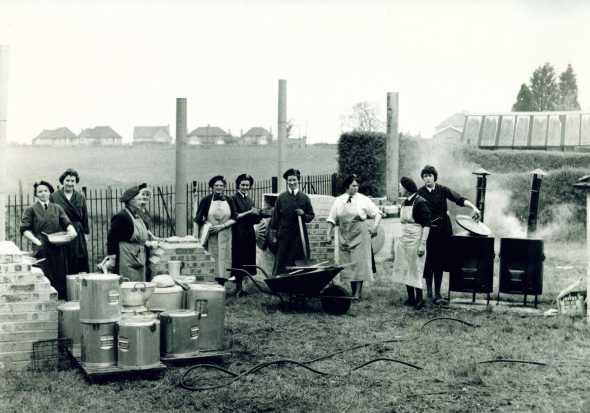
Corps cooking exercise in the mid-1960s using Soyer boilers and improvised ovens
The amount of the equipment available was acknowledged to be inadequate. Essex, with a population of 1.5 million would receive as part of its allocation, 600 Soyer Boilers, 900 camp kettles and 38300 plastic spoons67. Chelmsford’s allocation would feed at best about 30000 of its 140000 population. The London Borough of Ealing’s 1980s plan proposed to use 30 Soyer Boilers to provide meals for 1000 people even though the total issue for the whole borough was only 97.
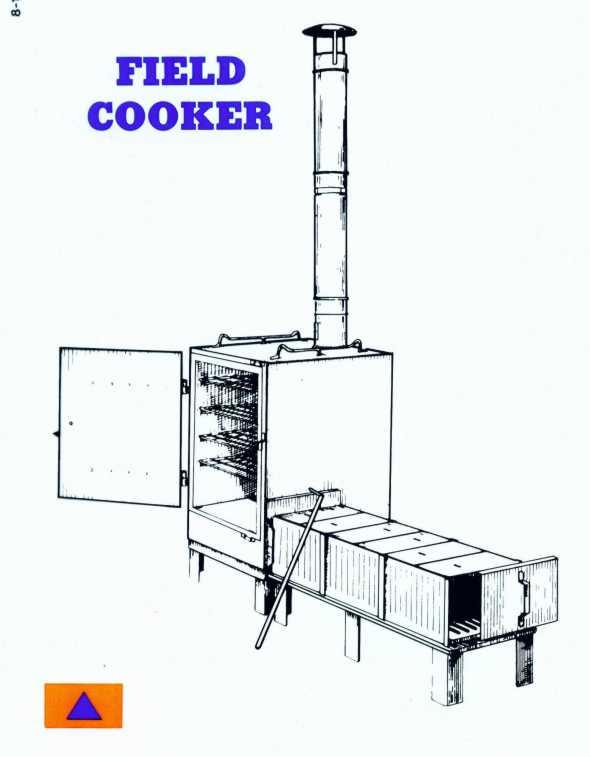
No 4 Field Cooker
If there was insufficient manufactured equipment EPG3 said “…it will be necessary to improvise”. Numerous diagrams were included for emergency cooking equipment ranging from converted oil drums to the massive emergency feeding centre shown in the diagram below. The diagram actually comes from the 1960 Corps manual but it was redrawn for EPG3. It is a substantial work of civil engineering but there was little guidance on how it might be built although EPG3 said it it would require 3500 bricks. There is no provision for a water supply in this diagram but this was solved in the EPG3 version by adding a drawing of a tap. In theory, such a centre could cook and serve 1000 meals at a sitting. Three sittings a day were expected on an 8 hours cycle. To feed a hypothetical town of 150000 people 50 such centres would be needed requiring, according to EPG3, 75 tons of food a day. These centres would be completely outdoors situated for example on a school playing field and would have to operate continually day and night in all weathers perhaps for months. But the plans made no allowances for darkness or bad weather. Cooking equipment, crockery, cutlery and where people would actually eat was also rarely considered.
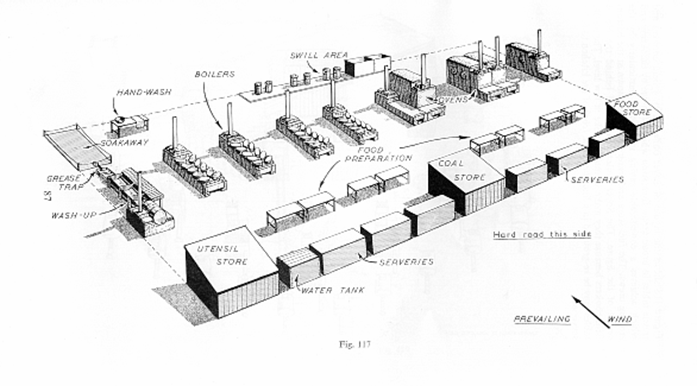
EPG3 says that 11 people under emergency conditions could feed 1000 people and many local plans repeat this figure without question. This feeding would include food preparation, stoking fires, cooking (the recipe for emergency stew said it had to be stirred constantly), washing up and serving. This sounds a lot for 11 people. A College emergency feeding exercise said 60 people would be needed for the task but even on the EPG3 figure London plans said they would need 50000 people to run its expected 3000 emergency feeding centres. This figure itself appears to be a gross under estimate as it only allows 18 people per centre, which would be operating 24 hours a day, every day for an indefinite period until electricity or gas supplies became available. The centres would also require vast amounts of water and fuel. In the early decades of the Cold War, supplies of coal would have been readily available but in later years wood would have had to be used. The emergency feeding centres would consume huge amounts and re-supply would have become increasingly difficult. In the absence of a piped water supply, the plan was for the fire service to deliver potable water to the feeding centres although the source of this water is not obvious.
The sheer logistical and organisational problems of feeding the survivors for weeks, possibly months under these emergency conditions in the absence of electricity, lighting, heating, water supply, sewage and refuse disposal, adequate communications and the constant threat, according to many exercises of thefts of food would be immense. It is difficult to believe that any of the plans would have worked except under the most favourable of conditions for example in an isolated rural community with local sources of food and an organised, self-sufficient and motivated community.
File 15: The Uniformed Services
Armed forces - fire service - police
In the language of civil defence the armed forces, police and fire services are often collectively called “the uniformed services” to distinguish them from the government officials and volunteers involved in civil defence work. As well as being organised, trained and equipped for a peacetime role which would readily transfer to a civil defence one these services would also provide bodies of disciplined people used to accepting responsibility and which the public would readily look to in a crisis. To a limited degree, but one much greater than the public in general these services would also be trained and psychologically prepared for the problems caused by war. The same could also be said of the Royal Observer Corps and in the 1950s and 1960s the Civil Defence Corps.
The Armed Forces
Following the Strath Report the armed forces were given the role of assisting the civil defence services in the survival period. In the 1950s the forces, and the army in particular, was much larger than today in part due to national service and in wartime it would call on the extensive reserve and territorial forces. Some major army units were directly allocated to the Home Defence Regions but of particular significance to civil defence was the Mobile Defence Corps. This was formed in 1955 specifically for civil defence. It was to consist of 48 battalions each with a minimum of 600 personnel, which would come under direct Army or RAF command. The personnel would be trained in rescue, fire fighting and first aid during their active service with the Army or RAF. They would then have a duty to train with and if necessary serve in one of the battalions as part of their reserve obligations. In practice, most of the men came from units of the recently disbanded Anti-Aircraft Command. The end of national service meant that there would no longer be enough reservists for the Corps and it was disbanded in 1959.
As national service came to an end and the armed forces were generally reduced in size in the 1960s there were fewer and fewer troops available generally for home or civil defence duties. Following the 1965 Home Defence Review an attempt was made to recruit 28000 volunteers to form the Home Defence Force (usually known as TAVR lll) who were specifically intended for law and order duties post-nuclear attack. As with other such organisations the units were rarely at full strength or properly equipped.68 They were unpopular with the civil servants who oversaw the civil defence budgets who believed, that like the Civil Defence Corps, they would be of no real value but they were popular with what might be called “the retired colonels” lobby. However, after a considerable debate, which paralleled that which finally saw the end of the Corps the TAVR lll was scrapped in 1969.
At this time, the UK Commanders in Chief Committee (Home) was responsible for the military aspects of home defence. It consisted of the Commander-in-Chief Naval Home Command, the Air Commander Home Defence Forces and the Commander-in-Chief UK Land Forces who acted as Chairman. During a period of tension, this committee would oversee such matters as mobilisation and the protection of the UK home base. As the crisis escalated, they would disperse to their individual wartime headquarters keeping in contact via the CONRAD radio net. Their operational orders then told them that, after a nuclear attack, “if you survive”, they, together with their staffs should report to the Chief of the Defence Staff of the surviving “central government authority
The continued run down of the armed forces manpower meant there would be few troops available for home defence duties both before and after an attack. In 1970 the Chiefs of Staff had estimated that there would be some 30000 military personnel available post-strike against a potential requirement of 196000 and in 1974 it was publicly admitted69 that the forces would have little manpower or equipment for purely civil defence work. The military planners in particular expected a massive need for armed troops to support the police in maintaining law and order but army manuals and College briefings showed that the role of the armed forces would extend beyond this to include
- Assistance in the preservation of law and order, invariably in support of the police.
- Guarding key points.
- Providing regional communications
- Explosive ordnance disposal
- Advising the civil authorities
- Other assistance to the civil authorities which could include -
- Restoration of essential services
- Route clearance and control
- Control of public movement
- Reconnaissance and radiac survey
The Ministry of Defence War Book in the mid-1960s also assigned four battalions for “special Government War Book measures -
- Special duties towards the Royal Family.
- Special duties for central government
- Security of gold reserves and art treasures.
- Aid to HM Customs and the police in seizing enemy ships and aircraft.”
In the early 1960s, the RAF expected to form regional air squadrons each with 24 RAF training and transport aircraft for reconnaissance and communications in the region. It also planned to set up a Central Government Squadron with 16 aircraft for national communications. By the 1980s, it was still expected that regional squadrons would be formed but these would be on an ad hoc basis and would now use civilian aircraft.
From the 1970s some Territorial Army units were designated for “home defence” and some “composite companies” would have been formed from military personnel in administration, training and other units who did not have a designated war role. A 1984 briefing from the College suggests that there would be 110000 members of the armed forces in the UK at the time of an attack but this seems a very high figure. Other documents suggest that it was planned to have a contingency reserve in each region of “at least one battalion of 400 men” or that there would be up to two battalions assigned to each region, although these would also have to guard key points.
The Strath Report resulted in the need for military and civilian forces to work more closely together in the survival period and this was one of the key elements in the joint civil-military headquarters plan in the mid-1950s. The Home Defence regions and the army districts would have the same boundaries and the Regional Military Commander would be located with his wartime District HQ in the civil-military headquarters and later the RSG. When the RSG was scrapped as an operating control for the survival period the concept of the Armed Forces Headquarters or AFHQ was developed although military teams continued to be allocated to the SRCs and their successors. The armed forces would however still be organised on a regional basis and commanded by the Regional Military Commander who would be on the staff of the Regional Commissioner. In the 1970s and 1980s some protected AFHQs were developed for example at the barracks in York and in a small complex of tunnels near Henley on Thames. In addition to the teams at regional headquarters, there would be small military attachments at county controls and each county would be designated as a “tactical area of responsibility”. The first task of the armed forces post-strike would be to continue to defend the United Kingdom. Thereafter, any surviving forces would be available to assist with rescue and survival operations, but generally in exercises, the role of the armed forces was, from the 1970s very limited.
Under the 1980s plans large numbers of troops would be involved in guarding “key points”. These were places considered vital to the continued effectiveness of the fighting services or for survival post-strike. They included places such as military sites, key communications centres and major road bridges. Some exercises envisaged the armed forces guarding food stocks in the survival period but many places, which might merit guarding, would not be due to shortages of personnel. As well as some designated Territorial Army units an attempt was made in 1982 to boost the numbers of soldiers available for home defence duties, particularly guarding key points with the establishment of the Home Service Force. This was made up of lightly armed former members of the armed forces. The intention was that the force would be 5000 strong by 1990 but in 1986 it had only 3133 members. It was disbanded in 1993.
In exercises, local authority emergency centres were often targeted by protest or other disaffected groups both pre- and post-strike but there were no military guards available to help and frequently no police. Suggestions were made that the local authority staffs should organise their own protection. Similar suggestions were made for areas such as food stores and emergency feeding centres. Some locally based plans included forming vigilante groups to protect the locals from disorderly elements both from within and without.
The military radio network called CONRAD continued to be used into the 1980s. CONRAD was controlled by 2 (National Communications) Signal Brigade and its predecessors whose operational units were then and still are largely Territorial Army ones. The Brigade is still tasked with providing communications support to the machinery of government in war based on the National Communications Radio System, a nationwide radio network that appears to have replaced CONRAD. It is also notable that the 1980s saw a large increase in military communications systems for home defence purposes some of which are known to be mobile using satellite links.
The Fire Service
As with many other plans those for the fire service in the 1950s were grandiose but with little basis in reality. In a war, all the local authority brigades would become part of a national fire service augmented by the volunteers of the Auxiliary Fire Service70 and military reservists and commanded by a Regional Fire Commander. A key element was to be the 40 Mobile Fire Columns manned by RAF reservists supported by some regular fire crews. These would be formed into self-sufficient columns each with 700 personnel and 30 emergency pumps together with other vehicles and specialist equipment. In the precautionary period, the columns would be formed and then dispersed to unused RAF airfields to await the attack. In reality, they could have made little impact on and area devastated by a hydrogen bomb and if they were sent in they would have very quickly used up their allowed “war emergency dose” of radiation from the fall-out. In practice, their equipment was limited and although the columns nominally existed until 1968 the decline in the number of RAF reservists meant that there were insufficient personnel available.
These problems together with the fact that fire fighting was simply not a practical reality in the face of the hydrogen bomb was reflected in a 1969 review which recommended that, in war, the fire service would use only its peacetime manpower, it should not undertake fire fighting and the emphasis should be on the preservation of the service for vital tasks in the survival period such as moving water and decontamination. This lead to a simpler structure being introduced in 1974. The peacetime command structure would now be retained in war but overall control would be in the hands of the Sub Regional Fire Commander at the SRHQ. The concept of the mobile column had been abandoned but use of existing fire service manpower would be maximised and volunteers sought so that use could be made of the former Auxiliary Fire Service equipment which was still held in store by the Home Office. This included 1079 emergency pumps (commonly known as Green Goddesses) together with Land Rovers, inflatable dams (to hold water), hoses, etc. Nominally, Green Goddesses would be issued on the basis of one per 50000 people so that in the 1980s London would receive 153 to supplement its 200 red engines. Up to 50% of the regular fire service men and equipment would be withdrawn from their normal stations in the crisis period and dispersed. After nuclear attack, fires would only be tackled when this would be worthwhile although the main consideration would be to preserve the service for the survival period and beyond. In practice, the main role of the fire service would probably have been to transport drinking water to emergency feeding sites. This basic structure was continued into the 1980s although Fire Service Circular FS6/84 introduced the need to plan for conventional attacks and it was expected that the “small but widespread” attacks would be tackled using the existing brigade resources.
The Police
In a period of crisis or conventional war, the police would be expected to continue their normal operations although their resources would come under much greater pressure. In addition, early plans envisaged a much wider role even before a nuclear attack. The 1965 Essex Civil Defence Corps Group War Plan listed their tasks as -
- Taking special measures to maintain internal security with particular reference to the detention or restriction of movements of potentially subversive people (by the 1970s briefings this task had been toned down to “…with particular emphasis on preventing sabotage and subversion”).
- The guarding of key points, protected and prohibited areas and restricting generally, for security purposes the movement of the public.
- Assisting in the dispersal of the people in the priority classes if the government decides to put the dispersal scheme into operation.
- Reconnaissance immediately after an attack to determine the extent of damage and radiation.
- Assisting in the marshalling and direction of the homeless.
- Control of essential service routes71
- Assisting in the clearance of the Z-zones and in the operation and control of the public in other fall out zones
In 1964 the civil defence organisation was at its most complex when the regional organisation included RSGs, SRHQs and various levels of local control and the Home Office’s Police War Committee suggested a wartime policing structure to fit it. The Regional Commissioner would appoint a Regional Police Commander who, based at the RSG, would direct all strategic aspects of police operations and resources, including the Mobile Columns, under the Commissioner’s authority. The appointment would however cause practical problems as the Regional Commissioners would have no powers until after an attack.
The operational aspects of policing would be handled by the Sub Regional Police Commander and his team of 24 based at the SRHQ. At the local level the Chief Constable would still be responsible for the maintenance of law and order. In 1964 the Treasury approved expenditure for equip new force and divisional police headquarters with protected control rooms but nothing seems to have come of this as in 1967 the War Duties Committee suggested using prefabricated concrete blocks, as used to protect GPO switchboards, to protect police stations.
Whether or not to arm the police appears to have been a difficult decision and one which was repeatedly fudged. In the mid-1960s it was suggested that 34700 rifles and 93000 pistols would be needed. But problems such as the cost of buying pistols from the Ministry of defence, provision of ammunition for training and the need for a cover story for such a sensitive matter delayed matters and by 1967 it was said that the only weapons available would be the rifles used by the Army Cadet Corps.
The police would have had a major role in keeping the Essential Service Routes clear. These were originally designated in the 1950s to keep major routes open for the life saving forces to reach the bombed cities. By 1967 the plan had been overtaken by events and there would be insufficient forces available. It was therefore redrawn with fewer routes mainly to be kept clear for military mobilisation in the Precautionary Period.
The police kept their own War Books and the Home Office would issue “polwins” or “police war instructions”. One such instruction from the mid-1960s covered the detention of suspected persons. The legal authority for this would come from the emergency powers regulations and a master list of political detainees known as the Everest List was kept centrally for the purpose.
Another instruction was aimed at preserving fuel by sealing certain petrol stations. In an emergency the police would visit, without prior notice, certain petrol stations where they would obtain all the keys, lock the pumps and buildings, remove all fuses and put up a “closed” sign.
The late 1950s plans envisaged that all available manpower would be mobilised and a proportion organised into up to 167 self-supporting mobile police columns with 135 men in each. South West Region for example planned to raise 10 such columns. These would be dispersed away from the areas which were expected to be attacked possibly to former airfields. Some Metropolitan Police columns would be based for example in rural Essex ready to move back into the capital after the nuclear attack. However, equipment was always short and in 1967 there was only enough to equip 34 columns. The concept was abandoned and replaced in 1972 with the idea of forming 20% of each force’s strength into smaller, more mobile Police Support Units each of 35 men. Plans existed to maximise police strength and in 1964 it was suggested that Traffic Wardens might be employed in war. This was however apparently not reconsidered again until 1967 when the plan was seen as impractical because emergency powers would probably be ineffective in of directing labour.
In the 1980s, the police’s role in the transition to war phase was emphasised with additional roles in managing traffic, manning the warning system and assisting with the effects of conventional attack. Manpower would be maximised by using Special Constables and Traffic Wardens were again mentioned72, encouraging volunteers from the public, restricting training and administration and introducing longer shifts. However, no mention was made in the EPGLA of the massive law and order problems, which were anticipated in all exercises, nor was mention made of arming the police, which was actively considered in the 1960s.
File 16: Civil Defence Communications and Warning
Wartime broadcasting - emergency communications - attack warning - Royal Observer Corps
British governments have recognised the importance of mass communication to both put over its own message and to boost morale since at least the time of the general Strike in 1926. During the last war efforts were made to ensure the “due functioning” of both the national press and the BBC and this continued throughout the Cold War. Although plans for censorship in wartime were abandoned in the late 1950s, to ensure it was giving the official message the media would have been managed at national level by a 2 tier structure originally established in the early 1960s if not before -
- The Standing Committee on Information Policy with a Cabinet Minister as chairman. This would co-ordinate all official information and instructions to the public, maintain constant contacts with the media and generally oversee information policy. It would also direct -
- The Media Working Party chaired by the Prime Minister’s Press Secretary, which would co-ordinate, the issue of press notices and other official announcements.
The War Time Broadcasting Service
The importance of broadcasting as a means of disseminating information and maintaining morale in an emergency had been recognised since the 1930s. During the Second World War the BBC had implemented detailed plans to ensure national broadcasting continued and these formed the basis of the post-war Wartime Broadcasting Service or WTBS.
The principal broadcasting centre for the WTBS during the Cold War would would have been “The Stronghold”. This protected studio and office suite was built alongside the BBC’s headquarters at Broadcasting House during the war and was later absorbed into an extension of it. The Stronghold allowed the government to make nation wide broadcasts until the nuclear attack or until the seat of government left London and also acted as the “primary injection point” for broadcasting attack warnings to the public. There was also a studio in the CGWR code named SCOUT that would allow Ministers access to broadcasting facilities.
During the Second World War, part of the BBC had been dispersed to a site a Wood Norton near Evesham and in the 1950s it was developed as the reserve headquarters for the WTBS. In the 1960s, a large bunker was built there to provide 4 radio studios and accommodation for 100 staff. However, its usefulness would have been limited by the difficulties in getting information to Wood Norton in the first place and then the relevance of national news to the survivors. A studio was also installed at the Corsham war headquarters in the late 1950s connected to Wood Norton
The initial ideas for a WTBS were sketchy but by the mid-1950s there were plans to provide a national radio service with two medium wave programmes. The BBC’s main high-powered transmitters could not be used because it was thought enemy aircraft would use them for navigation so 54 low-powered medium wave transmitters were installed around the country.
The BBC revised its plans for the H-bomb era in 1957. The object of broadcasting in war would now be “to provide instruction, information and encouragement as far as practical by means of guidance, news and diversion to relieve stress and strain”. The last phrase appears to mean entertainment, which would have been provided by pre-recorded programmes and records. The idea was to provide a national radio service possibly broadcasting 24 hours a day although it was acknowledged that if the national electricity supply failed few people in the pre-battery radio era would have been able to hear it.
By the early 1960s, aircraft were no longer considered a major threat and the main transmitters, particularly those at Droitwich could now be used. At some time the main cable carrying the long wave (now Radio 4) service from London to Droitwich was diverted through the reserve site at Wood Norton giving it access to these transmitters. The plan from the late 1960s envisaged high powered medium wave transmitters being used at local transmitter sites which were provided with emergency generators and some fall-out protection. The decision to start the WTBS would be made at Cabinet level at a late stage in the pre-war crisis. At that point all broadcasting facilities, including BBC and ITV television would stop normal programmes and start broadcasting the frequencies for the WTBS. After an hour the WTBS would take over broadcasting one national programme originating from Wood Norton. This would carry government announcements and information interspersed with what was called “sustaining material”. Local transmitters would be used and after the attack these would allow for a regional system of broadcasts. Central government could then broadcast using this regional network. The Droitwich long wave transmitters would be held as a national reserve. Television would not be used as it was thought that it would divert people away from the vital national message to be carried by radio and would not be available after the attack.
The 1980s plans expected that the WTBS would not start until after a nuclear attack unless the broadcasting facilities nationally were severely damaged. It would provide a sound only service for a few minutes each hour restricted mainly by the need to preserve the batteries in people’s radios. There would be no entertainment content.
Alongside the national service, it was always planned to provide a regional one. Studio facilities were planned for the 1950s joint civil-military HQs. In the long term transmitters would be installed but until that time local transmitter sites would have been used and many BBC staff would have dispersed from London to these sites. The RSGs had small BBC studios for regional broadcasting linked to local transmitters as did the SRHQs and RGHQs that succeeded them. So from the 1960s the main user of the WTBS would be the Regional Commissioner who would try to reassure the survivors that some form of government was still in control and to issue advice and instructions about such matters as fall-out and emergency feeding. The local authority Controllers would be able to use the regional facilities to give out local messages. However, although broadcasting was seen as a vital service the money was not made available for these regional facilities and as late as 1970 it was reported that it would take several years to set up a completely effective regional network.
At various times during the Cold War thought was given the continued operation of the BBC’s External Services but the plans seem to have been very confused. During the 1950s suggestions were made that 5 country houses used for the purpose during the Second World War should be refurbished but these ideas were generally not pursued and by the end of the decade the idea of a post-war external service had been abandoned. There was however a suggestion in the late 1960s that the former site of the wartime Aspidistra secret transmitters should be used for the purpose. The idea does not appear to have been implemented but it is interesting as the site would later be used in the 1980s for the new Crowborough RGHQ.
Telephones
Most communications pre-nuclear attack would be via the normal public telephone or telegraph circuits. Although the latter was largely replaced by fax by the 1980s, it formed the core of civil defence communications throughout the Cold War.
At central government level the various ministries and departments had been linked since the 1950s by an extended Whitehall Teleprinter Network supplemented by a dedicated private telephone network switched through the private Federal exchange. In the early 1950s when plans were made for “due functioning” during a lengthy war two schemes were implemented to increase both the capacity and survivability of the line circuits used for telephone and telegraph. The first involved six massive underground exchanges in London, Birmingham, Manchester, Liverpool, Glasgow and Leeds although as mentioned in File 3 only the first 3 were actually built as mentioned earlier. These were supported by new strategic cable runs which included a series of massive blockhouses built to protect the repeater equipment.
The second system was publicly revealed in the 1955 Defence White Paper which announced “The Post Office…are planning to build up a special network, both by cable and radio designed to maintain long distance communication in the event of an attack”. This network, generally known as Backbone provided some additional trunk cable routes and protected switching centres but the most visible part of the system was to be a chain of microwave relay towers. The original scheme provided for 11 towers literally forming a backbone running from the south of England where the key tower at Stokenchurch is now passed daily by thousands of motorists using the M40, up the centre of the country and into Scotland. In the 1960s additional links were added in southern England from Fairseat in Kent via Kelvedon Hatch and Stokenchurch to the Fiveways Tower which virtually sits on top of the Corsham war headquarters site. Ordinary cable circuits would be connected into the Backbone towers to allow additional capacity for use in wartime. Although planning started in 1954, the scheme ran into major delays involving money and equipment design, and more surprisingly given the strategic need for the system it was constantly held up by problems with planning permission. It did not become properly operational until the early 1960s by which time its original wartime role had been largely overtaken by the need to provide additional peacetime circuits for telephone and TV transmission and the original 11 tower scheme, together with the extensions had been absorbed into the nationwide network of towers seen throughout the country today.
During the pre-war crisis period, the public would put an increasing strain on the public networks, which might prevent official users from making calls. To counter this the Telephone Preference Scheme would be used. This was first introduced in 1962 although a similar system had existed for some years before. It divided all public lines into one of 3 categories. By making some simple adjustments at the exchanges, some 90% of ordinary subscribers could be prevented from making outgoing calls. This would leave the network free for the top two categories. The second category, with some 8% of lines, included schools, newspapers, foreign embassies, etc considered necessary to maintain the life of the community during a peacetime emergency. If necessary these lines could also be cut off leaving active only some 2% at places such as transport authorities and warning broadcast points considered vital to the prosecution of the war and national survival. Cutting off the public phone network would have been a blow to public morale and it was noticeably not introduced during the 1980s exercises.
The Emergency Communications Network
Without reliable and effective communications the civil defence control chain could neither receive information nor give instructions. The staff in the controls would be deaf, dumb and blind. The planners recognised this throughout the Cold War, and the vital communications systems were generally available for the higher levels of the control chain although they were totally dependent on the physical existence of the control buildings. If these did not exist, as was often the case, the communications systems were not installed.
A nuclear attack would destroy much of the infrastructure of the telephone and telegraph system and what survived would soon fail with the absence of mains electricity. A dedicated communications system was therefore established to link the civil defence controls. In the early 1970s, this Government Control Network was extended to link local authority controls to the regional ones. It was renamed the Emergency Communications Network (or ECN) in 1979 although it was strictly for wartime use. The aim of the ECN was explained in “The Emergency Planning Guidelines Handbook No 4 - Communications” published in 1989. It said “…the overall aim of the government’s civil defence communications programme is to provide emergency wartime communications to supplement surviving elements of peacetime systems for the control and co-ordination of action in war, particularly after a nuclear strike; and to support the operation of Regional Government in war including the wartime responsibilities of local authorities for survival operations…”
The ECN was based on “private wires” which are dedicated telephone lines independent of the public network connecting the main parts of the regional government system. As can be seen from the diagram below the RGHQs (and before them the SRHQs) were the hubs of the system. They were connected to neighbouring RGHQs, the main and standby County Emergency Centres and a few other key places in their sub-region. The County centres were in turn linked to the districts and some other places vital to them.
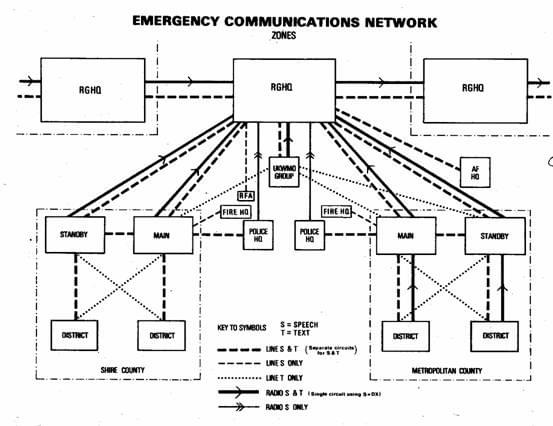
In the 1970s, the telephone systems in the ECN were based on small manual plug-board exchanges and the equipment took up a considerable amount of space. The equipment was usually old and in the local authority centres normally obsolete and inadequate. In the late 1980s, the manual switchboards were replaced by modern equipment. The RGHQs were each given two SX2000 units (plus one for testing) and the county controls one.
Although in later years the RGHQs and most county centres had extensive internal telephone extensions, much use was used in the earlier days particularly at local authority centres of “phonograms”. These consisted of an extension from the main switchboard in the control to a phonogram booth where an operator would write down each incoming message and then physically pass it to the recipient. Outgoing messages were handled in a similar fashion. The Kelvedon Hatch SRHQ for example had 3 phonogram booths prior to its 1976 refit.
The most common civil defence line based system was however not telephone but telegraph using teleprinters. These teleprinters allowed a message to be printed out at the receiving control. The system used was however a point-to-point one relying on a few central hubs. If one county control sent a message to a neighbouring one it would first go to the regional headquarters where it would be received as a punched (or “chadded”) paper tape. This tape would then be fed into the transmitting teleprinter at the headquarters connected to the receiving control. Alternatively, if the message were to be passed through several intermediate points it would pass through the Tape Relay Centre at the headquarters. The telegraph system used electro-mechanical equipment that had been designed in the 1930s. Kelvedon Hatch for example had 9 Model 7B machines although many controls used the later Model 15s. It was robust but demanding in manpower. More importantly, it was very slow and consequently the length of messages had to be restricted and there was obviously no way of holding a discussion via telegraph.
Typical 1950s vintage teleprinter with paper tape reader
Tape Relay Centre at Brackla (Ben Soffa)
Message Switching
The deficiencies in the telegraph systems lead to the introduction in the 1980s of modern message switching equipment known as MSX. This was initially installed at Royal Observer Corps Group Controls and then at the RGHQs. By the mid-1980s, most county emergency centres had it although as late as 1990 some district emergency centres were still using the old equipment. MSX allowed much more flexibility in sending text messages, for example, the messages could be automatically switched between any site on the network doing away with the old Tape Relay Centres. Transmission was also faster and messages could be longer.
Emergency Manual Switching System
Some places that the regional level controls might wish to contact such as ports and power stations were not on the ECN or before it the GCN and the public telephone system would have to be used to contact them. After an attack it was assumed that even the restricted service available from the Telephone Preference Scheme would fail and reliance would be put on a last ditch rump of the service called the Emergency Manual Switching System or EMSS. This consisted of a few trunk lines some of which were permanently connected while others would be connected in the crisis period. They terminated at small manual switchboards known as Terminal Group Centres housed in ad hoc protected accommodation in the basements of some 250 of the larger telephone exchanges. The centres were connected to one of 31 Emergency Zone Centres and through them to 6 Emergency Trunk Switching Centres. This would give access to a very restricted service at regional and possibly national level. RGHQs had two permanent EMSS lines as well as around 15 lines connected to the public system to back up the dedicated circuits in the ECN.
Radio
Radio was seen as a back up to line based systems. It was frequently referred to for use by all levels of the control chain from the 1950s and it would have been vital in establishing communications where the regional or sub regional control was established in ad hoc premises. In the 1960s, a lot of thought was given to the provision of radio to link the various controls and some sets were stockpiled but in many cases the radio equipment or the controls to install it in did not actually exist. It was however usually installed in the permanent regional level headquarters to be used if the line circuits failed. Most of the line circuits were effectively duplicated in this way and the equipment at the RGHQ or County centre could automatically send the message by radio if the line was not available. The radio transmitters used the “hill top” radio stations operated by the Home Office that were normally used by the emergency services.
The army had its own dedicated teleprinter circuits known as TASS (teleprinter automatic switching system) with a terminal at each regional headquarters. It would also make extensive use of radio. As well as the CONRAD system home defence units were equipped with a basic short-range radio system from the mid-1970s known as Mould.
Message procedures
The communications areas in the RGHQs and their predecessors followed a common design that dates back to earlier Civil Defence Corps and military practice. Messages, which had to be kept short because of the limited capacity of the systems, were passed to a Counter Room (sometimes called the Registry) in the Communications Centre or “comcen”. Here they were prepared for dispatch before being passed to a teleprinter (or later a VDU operator) to input the message. Incoming messages were handled in a similar way prior to being passed to the addressee. Messages on the ECN could be classified in order of priority as flash, immediate, priority or routine. There were no facilities to encrypt messages over the civilian circuits. In the late 1980s, the Home Office published a guide for users of the ECN and another on message handling and writing to help the communications teams in the RGHQs and local authority emergency centres most of who would have received little prior training.
Message handling at the emergency centres was supposed to follow the same lines as for the RGHQs but their comcens were both smaller and simpler. The diagram below shows a specimen district comcen as suggested in the “EPG Handbook 4 Communications”.
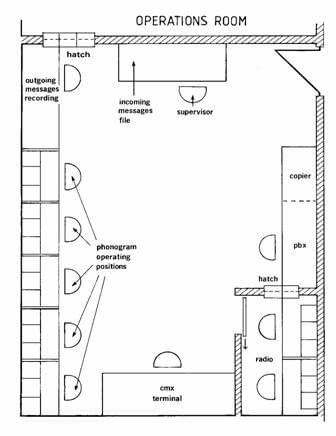
The Attack Warning System
When civil defence was re-introduced, the attack warning system based on sirens that had worked well during World War Two was refurbished but it was essentially one designed to cope with slow moving aircraft and give local warnings. It could not really deal with jet aircraft and then ballistic missiles so the system needed to be modernised. By the early 1960s, the Fylingdales missile warning radar was operational and could give a seven-minute warning of a missile attack. The decision would then have to be made to set off the attack warning sirens for the whole country. This initially caused a debate between the RAF in charge of the radars and the Home Office, which was in charge of the warning system as to who would take the final decision. This was not for any practical reasons but because they were both concerned more about the repercussions of sounding a false alarm.
A film from the 1950s shows a man at the BBC receiving the warning by telephone and then opening a locked cupboard and removing a gramophone record that he placed on a turntable. This presumably had a pre-recorded attack warning on it to be broadcast nationally but it was obviously not intended for the missile age. By the 1980s, the decision to trigger the warning system would have been made by a Home Office Warning Officer based at the “principal warning injection point” at the RAF’s Primary War Headquarters near High Wycombe or, alternately, from the back up at the United Kingdom Warning and Monitoring Organisation’s war headquarters housed in a large bunker near Preston. They were both linked to Broadcasting House and the reserve broadcasting facility at Wood Norton, but the attack warning could only be injected into TV and radio broadcasts from Broadcasting House.
The Home Office staff, as well as alerting the BBC would trigger the national siren system by alerting 255 Carrier Control Points located at main police stations around the country. On receiving the “national attack warning red” the control point operator would activate the large electro-mechanical sirens in his area. They would then alert volunteers at local Warning Points via small “carrier warning receivers”. These volunteers, mostly in rural areas would then sound hand-operated sirens. When the system was stood down there were 9760 hand operated sirens mostly dating from the 1950s and about 7000 power sirens in use. In addition, warning messages would be broadcast by the BBC over all available radio and TV channels. It was hoped that the message could be passed through the system to give the general population the famous “4 minute warning” of nuclear attack.
The power sirens were usually mounted on public buildings where they were vulnerable to attack from the weather and birds. Maintenance of the sirens was the responsibility of the local police and as one report by the Home Office’s Emergency Planning Research Group diplomatically put it “…there was strong evidence that this task had been carried out more conscientiously in some areas than in others”. Also, over the years, the level of background noise has increased in towns, as has the tendency to sound proof house. Tests in the late 1980s showed that the manufacturer’s claims for audibility had been greatly exaggerated and the system was only between 3% and 10% effective. And this assumed the sirens worked. Regular testing had been stopped in the 1960s and a test of 5 sirens in 1985 found that only one worked properly and 2 did not work at all. A review of UKWMO recommended in 1989 that the siren system should be replaced. But before any action could be taken, the system was effectively put out of action when BT withdrew the “speaking clock” telephone service that had been used to carry the activating signal to the carrier control points. Alternatives were considered but the end of the cold war overtook them and apart from a few kept to warn of coastal flooding the siren system was dismantled by 1993.
The warning signal would be the same rising and falling note from the last war. Information films advised people to go indoors or lie down in a ditch or depression. If driving a vehicle they should “park off the road if possible; otherwise alongside the kerb, but not near crossroads, or in a narrow street where it could obstruct fire engines or civil defence vehicles”.
The system could also announce an all clear meaning that there was no further danger of attack or as the Protect and Survive films reassuringly put it, “when the immediate danger of air attack or fall out has passed the siren will sound a steady note.” On hearing this, survivors could “…leave your cover…” In an area directly affected by a hydrogen bomb this would, of course, be of academic interest only. After attack, the arrival of fall out in an area could be announced locally by firing maroons from some 12000 “maroon points”, 9000 of which were collocated with hand siren sites. The spread of fall out would be monitored mainly by the monitoring posts manned by the Royal Observer Corps and plotted by their Group Controls from where the information would be fed to carrier control points, local authority controls and the RGHQs via the ECN - assuming it survived. Additionally, local authorities would establish local monitoring nets to give a more detailed view of local conditions.
The attack warning system was not designed to give local warnings of conventional air attack and could only really cope with one national warning of a missile attack, warning people to take cover. There were no public air raid shelters73 throughout the Cold War but many injuries and deaths would have been prevented by warning people simply to take what cover they could thereby avoiding the dangers from heat flash and flying glass. The actual effectiveness of the system was however unknown and this illustrates many of the problems inherent in civil defence throughout the Cold War in that the system was not properly maintained and its effectiveness not seriously challenged or tested. It existed and that apparently was all that mattered.
The Royal Observer Corps
The Royal Observer Corps was the field force of the United Kingdom Warning and Monitoring Organisation, which was usually known as UKWMO. UKWMO was responsible for -
- Originating warnings of the threat of air attack.
- Providing confirmation of nuclear attack.
- Provision of a meteorological service for fallout prediction.
- Originating warnings of the approach of fallout.
- Providing regional government HQs, local authority emergency centres, armed forces HQs, and nuclear reporting cells of the armed services in the UK, neighbouring countries and offshore islands with details of nuclear bursts and with a scientific appreciation of the path and intensity of fallout.
The Royal Observer Corps had given up its original role of spotting enemy aircraft by the mid-1950s and had taken on the task of monitoring the nuclear bursts and then the spread of fall out.. By the late 1950s, they were equipped with some 1550 underground 3-man monitoring posts designed to withstand a blast pressure of 10 psi. The effectiveness of these posts was however questionable as most were dependent on overhead telephone lines and it was estimated in 1967 that 42% of them would lose their line in the “standard attack”. About half the posts were closed in 1968 following “care and maintenance” and the remaining 873 were closed in 1992 when the Corps was unceremoniously stood down. The posts would have been able to plot the direction of a burst, its approximate size and then the passage of fall-out. The post would then report this information at regular intervals to one of 24 Group Controls spread throughout the UK. These were further organised into sectors with “blisters” for the Sector Controls attached to the Group Controls at Horsham (Metropolitan Sector), Fiskerton (Midlands), Bath (Southern), Preston (Western and national war headquarters for UKWMO) and Dundee (Caledonian). Throughout its life, the Corp’s volunteers were keen and well trained and, like the other volunteer organisations would no doubt have done their duty on the day. They were however always under strength.
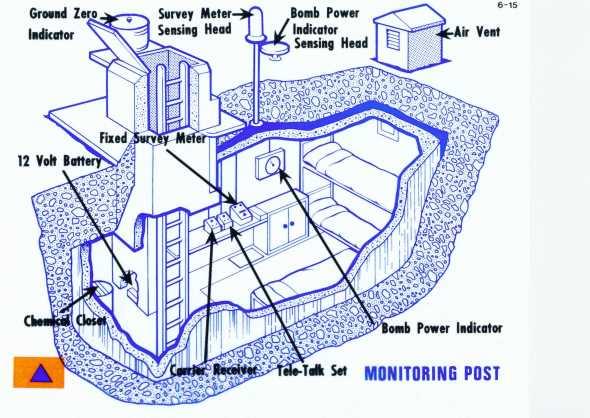
Royal Observer Corps monitoring post
File 17: The Road to War
Countdown to the attack - the aftermath
To make civil defence exercises more realistic detailed scenarios were prepared to set the scene for the players and to introduce the problems they would be faced with. The scenarios usually consisted of a background to the crisis, detailed lead-in scenarios covering events in recent days and then the situation at “startex” covering the various services, departments and so on involved. They show the depth of the problems the few, largely untrained and ill prepared people in central and local government might have faced in preparing the country for war in the 1980s.
The scenarios followed current civil defence policy and guidelines. All the plans were assumed to have been completed in time, everyone did what they were expected to do and all resources needed were available. The scenarios rolled forward along an orderly timescale with each stage of preparation being completed fully and on time so that hostilities broke out when everything was ready but not before problems of holding the country in a state of tension began to cause problems.
This File is based on scenarios from several exercises run during the 1980s and shows how a war might have developed in 1986 and the home defence response.
9 October
Following the seizure of power last month in the Soviet Union by an extreme nationalistic group relations between the Soviet Block and the West continue to worsen. There are indications that Warsaw Pact forces are preparing for full mobilisation and the Soviet Union has demanded the demilitarisation of West Germany. In Britain, Government attempts to play down the situation have been largely unsuccessful. There is growing concern in the media and organised demonstrations by peace groups become a daily occurrence. Public concern is reflected in a run on long-life food. The Government orders all departments to 24 hour manning. Local authorities are instructed to make limited preparatory actions to implement their war plans under Stage 2 including 24 hour manning of Main Emergency Centres. Several Nuclear Free Zone aligned councils refuse causing the tabloid press to call for a firm response from and support for the Government.
10 October
The Prime Minister announces that as a precaution the reinforcement of Europe by NATO forces would be increased. The first two Emergency Powers Acts are passed through Parliament in 36 hours and under pre-prepared Regulations the Government takes extra powers to requisition transport and equipment to help military preparations and in particular the movement of US forces through Britain. In the evening, the first squadron of F-111 bombers arrives at RAF Thurleigh from the United States.
The Home Office instructs local authorities to collect RADIAC equipment from stores and begin crash training in its use. They are also told to begin training the many people volunteering for civil defence duties.
The Property Service Agency is ordered to prepare the Regional Government Headquarters. Senior staff are designated and told to prepare to take up their posts.
The BBC is instructed to bring the Wartime Broadcasting Service to readiness. Staff are dispatched to the emergency facility at Wood Norton near Evesham and the emergency cell in Broadcasting House is manned and its facilities to receive and broadcast attack warnings checked. Transmitter sites earmarked for WTBS use are stocked with fuel and food.
UKWMO is put on a war alert and Royal Observer Corps members warned to be prepared to man their monitoring posts. The army begin to prepare Armed Forces Headquarters.
At 6pm, the Ministry of Agriculture announces that rationing of long-life food products would be introduced and that such items would not be available for sale from midnight. There is panic buying at those shops still open.
11 October
The Warsaw Pact announces that in response to the warlike actions of the imperialist NATO governments it would supply arms and advisers to any country or group that might look to it for protection. There are major troop movements in the Middle East, Africa and Asia as traditional enemies begin to reinforce their borders. There is a worldwide breakdown in diplomatic relations and the United Nations is paralysed by disagreement.
The Queen’s Order is signed calling up certain reserve and Territorial Army units. An umbrella organisation calling itself the Combined Peace Movement openly organises demonstrations against Government policy and military activities. MI5 leaks information about Russian support and financing of the CPM to the tabloid press, which responds as predicted.
The police report heavier than normal traffic on roads to the West Country and North Wales. Queues are becoming common at petrol stations as large amounts of fuel are diverted to military use and to official stockpiles.
12 October
US forces begin to pass through Britain in ever increasing numbers. Under emergency powers, protection areas are declared around all airfields and guarded by armed troops. In the evening demonstrators organised by the CPM break through the wire fence at RAF Greenham Common and threaten to attack a cruise missile convoy which is preparing to leave. US troops fire on the demonstrators causing several casualties.
During the day, banks and building societies report increasing withdrawals of cash. Ugly scenes develop as some branches run out of cash. Claimants demanding emergency payments to stock up with food inundate Department of Social Security offices74.
All Special Constables and Traffic Wardens are requested to report for full time duty. Police leave is cancelled and many forces adopt 12 hours shifts to increase available manpower.
13 October
A Russian destroyer shoots down a US reconnaissance aircraft in the Mediterranean. The US orders its forces worldwide to a higher state of alert. TV broadcasts show large scale troop movements throughout NATO countries but all western journalists are expelled from Warsaw Pact countries. Member countries of the two alliances break off diplomatic relations but behind the scenes attempts continue to diffuse the crisis.
Overseas travel facilities are thrown into increasing chaos. The requisitioning of aircraft for military use leaves many British citizens stranded abroad. Thousands of service families return from Germany adding to transport and accommodation problems, while many dependents of UK based US forces fly home. Heathrow and Gatwick airports are closed to civilian flights adding to the problems. Many ferries are requisitioned leaving lorry drivers stranded on both sides of the Channel. In Britain lorry and train drivers are increasingly reluctant to undertake long journeys.
The Government covertly requests manufacturers of food and medical supplies to increase production.
ROC controls and posts are ordered to 24 hour manning. Central government and local authority Scientific Advisers are asked to report to RGHQs and Emergency Centres.
The Ministry of Agriculture announces the requisition of all remaining bulk food stocks held by producers and wholesalers. The movement off-farm of all produce except perishable items is stopped and farm wardens are appointed. MAFF Regional Offices begin to organise additional Buffer Food Depots. Local authorities are told to start issuing ration documents.
14 October
Behind the scenes diplomatic activities continue but without any sign of compromise. Soviet aircraft buzz oil and gas installations in the North Sea. Many petrol stations have run out of petrol and there is increasing panic buying of unrationed food. There is a severe shortage of batteries for RADIAC equipment, torches and transistor radios.
Local authorities are ordered to take steps to implement Stage 3 measures. The third Emergency Powers Act is passed and the media briefed about plans for regional government in war. The Queen appoints Regional Commissioners but they do not take up their posts. The RGHQs and AFHQs are fully manned and Regional Emergency Committees (RECs) are set up. Prince Charles leaves London for an unannounced holiday in Scotland. Major art galleries and museums in London are closed and their Administrators told to evacuate a limited number of national art treasures. The media increasingly speculates that war is fast approaching.
The national siren system is tested and found to be far from effective. People are told to listen to Radio 4 for public announcements and information is released about the WTBS frequencies. Daily checks of the Emergency Communications Network are started.
15 November
The Warsaw Pact steps up its exercises with live firing in the North Sea, which it declares to be a “maritime danger area” informing NATO that its ships enter the area at their peril. CPM sponsored demonstrations are increasingly violent with numerous bombing and arson attacks. The police are hard pressed to control clashes between CPM supporters and growing nationalist groups.
The movement of people to the West Country, Wales and Scotland continues. The South West REC reports that 100000 people a day are arriving in the West Country. All available accommodation is full and police and local authorities are facing demands for food and shelter.
The rationing system is introduced. Local authorities are instructed to collect emergency feeding equipment, update their plans for emergency feeding and to train volunteers to man them.
Absenteeism grows as people decide to stay away from work, have left the area or are prevented from reaching work by transport difficulties. The Government repeats its message to “stay put” and for “business as usual” but the public is becoming increasingly alarmed.
In the face of growing media complaints about the lack of information on civil defence the Government steps up its information campaign. National papers are given Protect and Survive inserts covering basic civil defence measures and local authorities are asked to ensure that they have set up adequate information points. Local authorities are asked to step up civil defence training for as many volunteers as possible. The voluntary aid societies such as the Red Cross and WRVS are asked to assist.
Fire brigades are instructed to collect Green Goddess fire engines and other emergency stores and to take measures to increase their operational manpower. Military liaison officers are appointed to County Halls. The Surface Transport and Shipping Control Centre is activated and its Inland Transport Cell permanently manned.
The Government announces restrictions on the use of electricity for advertising and display lighting.
16 October
Localised, well-organised demonstrations continue, mainly directed against military facilities and personnel resulting in many pitched battles. CS gas and rubber bullets are used to disperse rioters.
The exodus of people from perceived danger areas around military bases and major cities continues. Accidents or vehicles that have run out of fuel are blocking many motorways and main roads to the West, Wales and Scotland. The refugees are causing intense strain on local resources. People living rough are causing health and public order problems. In some areas vigilante groups are being formed in response to the “invasion”. Local authorities are given powers to requisition warehouses and other large buildings to house refugees and some start emergency feeding centres drawing supplies from reserve stocks despite protests from MAFF.
All newspapers again carry Protect and Survive instructions. There is a run on building materials as people try to build shelters. RECs announce that key construction materials such as bricks and cement are to be placed under government control so that they can be used where there is greatest need.
Levels of absenteeism are averaging 25%. The Department of Trade reports its concerns about falling industrial production and considers the need to control industry under emergency powers. The RECs ask local authorities for information and suggestions. The Department of Employment announces it has taken power to control manpower to meet essential needs but has no practical way of enforcing its policies.
Pirate radio stations from Eastern Europe begin broadcasting Soviet propaganda.
The Government announces the closure of all schools and universities.
A British Airways Boeing 747 carrying families from Germany is shot down by a hand held missile as it approaches Luton Airport. The plane crashes onto the town centre. The resulting deaths, injuries, fires and damage overwhelm the emergency services.
17 October
MAFF implements its food dispersal plan for stocks held at ports. Hospitals are instructed to accelerate the discharge of patients and to restrict admissions. Most prisoners are released from gaols but many people considered potentially subversive are detained under the emergency powers. BT report the public telephone system is at breaking point and asks customers to limit their calls. The Government instructs BT to prepare to implement the Telephone Preference scheme. RADIAC instruments are issued to local authority and other workers designated to man monitoring positions.
Several gas distribution facilities are damaged by sabotage and it is announced that the public supply will be terminated from midnight causing alarm from those who cook and heat with gas. The public electricity supply is under increasing strain and rota cuts are started.
18 October
At dawn, Warsaw Pact ground forces attack West Germany, Denmark and Norway. There are widespread, small air attacks on the UK mainly against airfields. At mid-day the Prime Minister announces that a state of war exists.
There is a further surge of refugees. Over a million people have left London. Southern and Eastern ports see ever increasing numbers of small boats bringing refugees from the Continent, causing concerns about possible Warsaw Pact special forces units infiltrating the country under cover of them.
Local authority powers are vested in Emergency Committees and Controllers are appointed to all County and District authorities.
Local authorities open many first line Community Support Centres and public shelters. Attempts to set up Casualty Clearing Centres are hampered by the lack of basic first aid supplies and the absence of many National Health Service personnel serving with the reserve forces. In the areas directly affected by air raids, the emergency services are put under severe pressure.
The Telephone Preference Scheme is introduced cutting off some 90% of subscribers from the network. Further electricity cuts are introduced and main water supply reservoirs are valved off.
19 October
Air attacks on Britain continue and over 50 targets are attacked during the day. In some areas, the resulting fires and injuries overwhelm the emergency services. The cross-channel ferry Herald of Freedom, carrying US troops to France hits a mine off Dover and sinks with heavy loss of life. Large scale fighting is reported on all fronts in Europe but the situation is unclear. Normal life in the country comes to a halt.
There are unconfirmed TV reports that tactical nuclear weapons have been used in West Germany.
20 October
At 1am, Air Defence Operations Centre reports a large-scale missile launch from Soviet territory. Ten minutes later, a 150-kiloton hydrogen bomb detonates over RAF Scampton…
Afterwards
The results of a nuclear attack would depend on many factors. The immediate effects would depend on the scale of the attack, size of weapons used, the targets, weather conditions, and so on. The effects on the country would depend on what factors such as what preparations had been made and how people reacted but whatever the circumstances a single hydrogen bomb exploding over a British city would be the greatest disaster this country, perhaps the world has ever experienced. But the military planners envisaged up to 200 such bombs exploding in just 2 or 3 days with possibly thousands more exploding throughout Europe, North America, the Soviet Union and perhaps beyond. During the last war cities like Dresden and Hiroshima suffered massive damage and loss of life but they were able to draw support from organised civil defence agencies from outside where government, power, society, the economy and so on were more or less unaffected. Moreover, rescue workers could operate free from fall-out problems. In World War 3 there would be no such help - everywhere would be affected.
In the 1950s and 1960s, those who were directly affected might have received some help from the civil defence forces but even then, many would be on their own. From the mid-1960s, there would be no squads of rescue workers digging for survivors, no first aid squads, no fire fighting, no ladies bringing tea and sympathy. At best, there might be some localised efforts on a self-help basis at the fringes of the damaged area.
There is little hope for those directly affected by the blast and the heat of the explosion. But only a very small proportion of the country’s area would affected like this. Of more concern to the planners were the indirect effects of the nuclear electro-magnetic pulse75 and fallout, which would extend far beyond the area of damage and last for days and possibly weeks or months. Local effects would have widespread repercussions in today’s interdependent society. The loss of part of the national grid would mean widespread power failures, the loss of some raw materials would cripple a whole industry, the loss of key workers close a factory and so on. These effects would combine to paralyse the country and throw localities back on self-sufficiency on a scale not known for centuries. Gradually, people would begin to organise themselves but even in favourable conditions, it would take weeks or months for something resembling an organised lifestyle to evolve in most of the country. Even then, it would be on a primitive, self-sufficiency basis.
Exercise Hard Rock would have considered the situation 28 days after a major nuclear attack, or, in military jargon, at D+28. This and other exercises tended to be optimistic and assume that everything would work according to plan but even so the situation would be grim. The war was assumed to have stopped following the nuclear exchange, as both sides would have nothing to fight with, or perhaps for. The UK’s armed forces, which would have been mainly sent to mainland Europe, are assumed to have been wiped out.
The control system would have to develop from the grass roots. Initially, it would be hoped or assumed that communities would organise themselves lead by trained volunteers. These groups would have to organise initial emergency feeding and casualty care but while this level would probably be the key to the future, it was the one that was least organised and planned for. Local authority plans assumed that all the staff nominated for the control apparatus would turn up on the day, although surveys suggested that this would not be the case. They also assumed that all the plans for example involving the pivotal emergency feeding programmes would work which is very unrealistic. Furthermore, they supposed that all the controls in the regional government control chain would survive the attack, their occupants be unaffected by radiation and that the traumatised survivors allowed them to function. Such assumptions seem unrealistic.
Oil refining and bulk distribution will be non-existent. Oil products would be at low levels, although few people or goods would be moving so demand would be limited. The main use would come later for agriculture. Gas supplies would have been cut off pre-attack and would not be restored in the immediate future. Coal production would be affected by the lack of electricity but some open cast mining might be restored by D+28.
The road and rail infrastructure would be largely intact although hampered by a lack of fuel, electricity and labour but the biggest loss would be the electricity supply. Modern society is totally dependent on electricity but the planners always assumed that a nuclear attack would result in the total loss of the domestic electricity supply due to direct damage to the generating and distribution systems and the effects of nuclear electro magnetic pulse. By D+28 some local supplies might be available direct from power stations but this would be very restricted as they would be dependent on various outside supplies and their air intakes would draw in large amounts of fallout. With no heating or lighting, little food, few medical supplies and no water or sewage systems the survivors would face a desperate future, even without the effects of a possible “nuclear winter”.
Medical services would be badly affected. Modern hospitals are very vulnerable to blast damage and have little fallout protection. Many would be full of military casualties before any casualties from the nuclear attack began to arrive. Most would be affected by the loss of power for heating, lighting and cooking and the lack of water. Injured survivors would quickly overwhelm any medical facilities close to an attacked area. By D+28, those receiving casualties would have run out of drugs, dressings and other supplies and the staffs would be exhausted. By D+28, radiation poisoning would begin to show in many survivors. There would be no effective treatment so that even in areas away from the ground zeros rising death rates would cause burial and disease control problems.
A month after the attack most people will have run out of food and be dependent on public feeding centres. Most plans expected that overall there would be sufficient food available for the immediate future but they assumed that the emergency feeding centres could be built, staffed, organised and then supplied day after day with food and fuel perhaps in the autumn when the hours of daylight would be decreasing and the weather worsening.
Overall, even in the least affected areas the condition of the survivors at D+28 would be desperate. They would exist on, at the best, subsistence rations in a community possibly teetering on the brink of anarchy. Their homes would be cold and dark. Many refugees would be in inadequate accommodation or billeted with unwilling hosts. They would have little knowledge of what had happened to loved ones outside their immediate area. They would mostly have no work, except possibly hard manual work in the fields. The psychological strain would be immense. Even assuming they survived the winter, they would have no future to look forward to. Areas that failed to organise themselves would be lucky to survive. Those suffering from illness, including the affects of radiation, the weak and the old would have little hope.
This is what the civil defence planners throughout the cold war expected. The situation, had it ever occurred may have been very different but as the Principal of the Home Defence College at Easingwold, Air Vice Marshall Sir Leslie Mavor told delegates on civil defence courses “…if there is one thing that is as near as dammit certain it is that after a nuclear war we will never pass this way again…” Even on the most optimistic assumptions, life after a nuclear attack would have been a struggle for survival.
Appendices
- A Note on Sources
- An outline of the Dispersal Scheme
- Targets for conventional air attack
- Local authority tasks for Exercise Hard Rock
- Nuclear targets in Britain
- Precautionary measure to be taken
- RSG staff list
- Situation reports
- War Cabinet organisation
1. A Note on Sources
The sources for the story of home defence in the Cold War fall, rather like the story itself, into two parts. For the pre-1970 period most of the information comes from government files held at the Public Record Office, part of the National Archives. The staff there have found over 800 files for me and the service they give is a model for any public organisation. Most of the files referred to originate from the Home Office, the Treasury and the defence ministries but some useful information has turned up in surprising places such as files from the Charities Commission and the Ministry of Health. Unfortunately, there is still a cloak of secrecy surrounding many aspects of the subject particularly relating to preparations for the continuity of central government and information relating to many operational matters has not been kept. Apart from the Public Record Office files, the instruction manuals and circulars prepared for the Civil Defence Corps have been useful although there is a constant problem in distinguishing between what was officially announced or planned and what actually happened.
Public records are rarely released until 30 years after the file was closed so there is little information in the Public Record Office relating to events particularly at the central government level after 1970. I have used many Emergency Services Circulars and manuals issued by the Home Office for this period together with war plans from county and district authorities that have been made available by their Emergency Planning Officers. Again, there is a problem in distinguishing plans from reality and discussions with the people concerned at the Home Office, the Emergency Planning College and many local authorities have been very useful. The availability of information has meant that the story of the 1950s and 1960s is weighted towards central government whilst that of the 1970s and 1980s towards local activities, although this also mirrors what happened in reality.
The owners of the former controls at Kelvedon Hatch, Hack Green, Dover and Mistley who have given me free access to the papers left behind by the former owners of the bunkers and information that they have subsequently obtained have also helped greatly. I have also drawn on the findings from many members of the Cold War Research and Study Group, which is part of Subterranea Britannica. The group’s superb web site at www.subbrit.org.uk is the definitive source for information on and pictures of British Cold War civil defence architecture.
Few books have been previously published on home and civil defence and some are very inaccurate and politically biased. However, Duncan Campbell’s “War Plan UK” published in 1982 still makes interesting reading, as does the “Greater London Area War Risk Study”. “Civil Defence”, T H O’Brien’s official history of civil defence during the last war shows how much of the practices adopted in the Cold War mirrored those from World War ll.
2. An Outline of the Government Dispersal Scheme for the South West Region in 1963
Evacuation from the likely target areas had been in the minds of the planners since the first days of civil defence. It was seen as vital by the Strath Report who supported the idea of evacuating some 11½ women and children from the cities but with the proviso that working men must stay to keep the economy going.
In typically impractical fashion it was thought that these people could be moved considerable distance in a few days with 6.75 million going by train, 2.7 million by bus and 1.85 million by private transport. These figures were said to be possible because for example 3 million people travelled every day on the trains and the capacity of all the buses in the country was some 3 million.
By 1959 this idea had been abandoned in favour of a more restricted scheme to evacuate some 6 million people from the major conurbations to reception areas. Plans were worked out to move people and in 1962 considerable publicity was given to an evacuation exercise called Operation Bluebell which involved moving 4000 people using the Bluebell Railway and 36 rest centres. This exercise however had taken months of planning and required large numbers of volunteers. It would have been a different matter to move millions of unprepared people at a few days notice. And whilst the movement plans were worked out no thought was given to the long term billeting of the evacuees. The plan was always considered doubtful and it was thought that it might not be practical and might simply add to the general confusion. However, the existence of a plan was seen to give the government at least the option of putting it into effect. By 1966 the impracticality of moving the evacuees possibly hundreds of miles to supposedly safe areas had been abandoned in favour of one where they would be moved a maximum of 50 miles.
The early 1960s official evacuation scheme envisaged moving certain people in the “priority classes” from the more densely populated areas known as Dispersal Areas to the more lightly populated areas known as Reception Areas. Certain areas called Neutral Areas would neither gain nor lose people.
The main classes of people to be dispersed were -
- Children under 18. Those under 15 would be accompanied by their mothers. Children at boarding schools and similar establishments would travel in organised parties.
- Expectant mothers.
- The blind, crippled, etc who are dependent on the care of mothers being dispersed with their children.
The Dispersal Areas in the South West were Bristol and Plymouth and the surrounding areas. The Neutral Areas were Bath, Swindon, the Scilly Isles, most of Wiltshire, parts of Somerset and Gloucestershire near Bristol and parts of Cornwall and Devon near Plymouth. The rest of the region was considered to be Reception Areas.
Some 339000 people would be moved from the Dispersal Areas leaving 450000 behind. At the same time the Region would receive some 1½ million people from other Regions to increase the total population by nearly 50% to 4 ¾ million. The population of Somerset would double.
3. Conventional air attacks
This is a list of military targets “attacked” during a 2 ½ day period in the conventional war phase of Exercise Hard Rock:
| Abingdon | Clyde | Lakenheath | St Mawgan |
| Alconbury | Colchester | Leeming | Saxa Vord |
| Aldershot | Coltishall | Leuchars | Scampton |
| Conningsby | Lindholme | Sculthorpe | |
| Beaconsfield | Cromarty Firth | Loch Ewe | Sealand |
| Bawdsey | Lossiemouth | Stafford | |
| Bawtry | Donnington (COD) | Lyneham | Stanmore Park |
| Benson | Dover | Staxton Wold | |
| Bentley Priory | Fairford | Machrihanish | |
| Bentwaters | Farnborough | Marham | Turnhouse |
| Binbrook | Faroes | Mildenhall | |
| Bishops Court | Finningley | Mountwise | Upper Heyford |
| Boscomber Down | Forth | ||
| Boulmer | Fylingdales | Neatishead | Waddington |
| Bracknell | North Coates | Wattisham | |
| Brampton | Gatwick | Northolt | West Drayton |
| Brawdy | Northwood | West Raynham | |
| Brize Norton | Hendon | Newbury | Wilton |
| Buchan | High Wycombe | Wittering | |
| Burton Wood | Holy Loch | Odiham | Woodbridge |
| Honington | Wyton | ||
| Catterick | Pitreavrie | ||
| Chelveston | Immingham | Portlant | |
| Chatham | Invergordon | Portreath | |
| Chilmark | Portsmouth Dockyard | ||
| Kinloss | |||
| Chivenor | Lirkliston | Rosyth |
4. Additional tasks for the local authority in war
The following is a list drawn up for Exercise Hard Rock in 1982 showing the additional services which the local authorities would be called on to provide in the conventional war phase and the constraints on them:
| New Services | Normal services made more difficult or arduous |
|---|---|
| Local warnings | fire fighting |
| Information and advice to public | ambulance |
| Rationing | highways |
| Shelter | housing |
| Billetting | social services |
| Rest centres | mortuary services |
| Rescue | transport |
| Treatment of casualties | education |
| Demolition | traffic control |
| Repair | policing/protection |
| Communal feeding | courts |
| Assessment of consequences of attack | supplies of water etc |
| Emergency transport | |
| Emergency supplies | |
| Emergency deployment of staffs and volunteers | |
| Emergency training | |
| Allocation of supplies | |
| Emergency communications | |
| Aid to other authorities |
| Constraints | |
|---|---|
| Resources | cash/credit |
| labour | |
| skills/knowledge | |
| equipment | |
| communications | |
| services | |
| Reduced efficiency | overwork |
| worry | |
| obstructiveness |
5. Nuclear Targets in the UK
The following list of 81 probable targets for nuclear attack was prepared by the Joint Intelligence Committee for the Machinery of Government in War Sub-Committee of the Home Defence Committee in 1967.
Most targets were expected to be attacked by both missiles and aircraft, usually with 4 x 500-kiloton airburst weapons. London was expected to be targeted with 10 weapons totalling 9 megatons.
Control centres
Government (central) - London, Cheltenham.
Government (regional) - The 12 former RSG sites were considered as possible targets.
Military - Northwood, Plymouth, Pitreavie, Fort Southwick, High Wycombe, Ruislip, Bawtry.
Bomber bases
Scampton, Wittering, Waddington, Honiton, Cottesmore, Marham, Coningsby, St Mawgan, Lossiemouth, Macrihanish, Leeming, Gaydon, Finningley, Valley, Bedford, Brawdy, Yeovilton, Lynham, Wyton, Pershore, Boscombe Down, Kinloss, Manston, Ballykelly, Filton, Leconfield, Alconbury, Bentwaters, Woodbridge, Wethersfield, Lakenheath, Upper Heyford.
Seaborne Nuclear Strike Bases
Bases - Garelock(Clyde), Holy Loch, Rosyth, Portsmouth, Devonport.
Communications - Rigby, Criggion, Anthorn, Inskip, New Waltham, Londonderry, Thurso.
Major Cities
Glasgow, Birmingham, Liverpool, Cardiff, Manchester, Southampton, Leeds, Newcastle, Bristol, Sheffield, Swansea, Hull, Middlesborough, Coventry, Wolverhampton, Leicester, Stoke-on-Trent, Belfast, Edinburgh, Nottingham
Air Defence
Control centres - Bentley Priory, West Drayton.
Fighter bases - Coltishall, Leuchars, Wattisham, Binbrook.
Surface-to-air missile sites - Woodhall Spa, North Coates, West Raynham.
Radar sites - Fylingdales, Boulmer, Patrington, Bawdsey, Neatishead, Buchan, Saxa Vord, Staxton Wold, Feltwell.
6. Measures to be taken in the Precautionary Period
The following list comes from a 1957 Admiralty report on the meeting of the Global War Planning Panel.
“Measures proposed to be put into effect automatically on declaration of a precautionary period
- All departments will review the state of their war preparedness, appoint duty officers and where necessary provide departmental arrangements for rapid execution of precautionary measures as appropriate.
- Personal and Top Secret warning telegrams will be sent to authorities overseas.
- Press and broadcasting censorship concerning the emergency under the D Notice Scheme.
- The Main Government War HQ will be partially (virtually completely (?)) manned.
- The Reserve Government War HQ will be fully manned.
- Regional Commissioners will take post.
- Regional joint civil/military HQs will be manned.
- Regional and Local Government staff will be strengthened.
- The Strategic Bomber Force will be alerted without recall of reservists.
- The Air Defence of UK will be alerted without recalling reservists.
- The Active Fleet will be deployed for operations without recalling reservists.
- The following measures are also possible -
- alerting the Control of Radio Transmission Organisation.
- Protection of Key Points against sabotage
- Confidential advice to the British Transport Commission, Airways Corporations, Shipowners, Oil Companies and Public Utility Undertakings on impending requirements.
- Confidential advice to owners of merchant vessels concerning routing.
- Unobtrusive preparations for ships to leave UK ports
- A measure of redistribution of hospital patients and staff
- Reduction of stocks of medical supplies, food, oil, coal and repair materials in high density areas.”
7. The proposed war establishment of an RSG in 1963
| Regional Commissioner’s Private Office | Regional Commissioner | 1 |
| Deputy Regional Commissioner | 1 | |
| Private Secretary | 1 | |
| Assistant Private Secretaries | 2 | |
| Clerical Officers/Secretaries | 3 | |
| Secretariat | Principal Officer | 1 |
| Assistant Secretary | 1 | |
| Principals | 3 | |
| Higher Executive Officers | 2 | |
| Clerical Officers/Secretaries | 2 | |
| Information Unit | Assistant Secretary | 1 |
| Principal/Senior Executive Officer | 3 | |
| Higher Executive Officer | 2 | |
| Clerical Officers/Secretaries | 1 | |
| Combined Operations | Chief Executive Officer (staff off) | 2 |
| Higher Executive Officer | 2 | |
| Scientific Team | Regional Scientific Adviser | 1 |
| - Other scientists | Operations | 1 |
| Questions | 1 | |
| Plotting | 2 | |
| Relief | 1 | |
| - Other staff | Executive Officer | 2 |
| Clerks | 2 | |
| Plotters | 3 | |
| Telephonists | 3 | |
| Common Services - Clerical and Registry | Higher Executive Officer (Chief Clerk) | 1 |
| Executive Officer | 3 | |
| Clerical Officers/shorthand typist | 12 | |
| Duplicating Supervisor | 1 | |
| Photocopier/duplicator oprs. | 10 | |
| Draughtsmen/illustrators | 2 | |
| Signals Office | Regional Comms Officer | 1 |
| Signal Master | 2 | |
| Signals Officer | 2 | |
| PBX Operators | 15 | |
| Teleprinter staff | 28 | |
| WT/phonogram staff | 10 | |
| Counter Room | 10 | |
| Clerical Officer/Sec | 1 | |
| Cypher clerks | 6 | |
| Maintenance | 4 | |
| Camp Commandant | Camp Commandant | 1 |
| Clerk | 1 | |
| Medical Orderly | 1 | |
| Canteen staff | 14 | |
| Despatch riders | 6 | |
| Maintenance staff (MoW) | 16 | |
| Messengers | 20 | |
| Home Office | Clerical Officers/Secretaries | 2 |
| - General Duties | Administrative Officer | 1 |
| Assistant Admin. Officer | 1 | |
| - Civil Defence | Regional Director | 1 |
| Asst Regional Director | 1 | |
| Others | 5 | |
| - Police | Regional Police Comndr | 1 |
| Deputy Reg Pol Comndr | 1 | |
| Others | 8 | |
| - Fire | Regional Fire Comndr | 1 |
| Deputy Reg Fire Comndr | 1 | |
| Others | 8 | |
| Treasury | 3 | |
| Security Services | 3 | |
| Admiralty | Regional Controller | 1 |
| Support Staff | 11 | |
| MAFF | Controller | 1 |
| Regional Officers | 3 | |
| Trade Officers | 7 | |
| Clerical/Executive Offcrs | 14 | |
| Air Ministry | Air Vice Marshall | 1 |
| Support | 7 | |
| Ministry of Aviation | Director General | 1 |
| Product Engineers | 3 | |
| Clerical Offcrs/Secs | 1 | |
| Board of Trade | Assistant Secretary | 1 |
| Senior Executive Offcr | 1 | |
| Clerical Officers/Sec | 1 | |
| BBC | In charge | 1 |
| Senr Ops Engineer | 1 | |
| Operations Engrs | 6 | |
| Operational output | 5 | |
| Central Office of Information | Chief Regional Officer | 1 |
| Press Officers | 2 | |
| Clerks | 2 | |
| Colonial Office | 0 | |
| Commonwealth Relations | 0 | |
| Customs & Excise | 0 | |
| GPO | Regional Director | 1 |
| Senior Admin & Specialist Staff | 6 | |
| Other Specialists | 2 | |
| Ministry of Health | Assistant Secretary | 1 |
| Principal Medical Offcr | 1 | |
| Medical Officer | 1 | |
| Ambulance Officer | 1 | |
| Clerical Officers/Secs | 2 | |
| Ministry of Housing & Local Government | Administration | 12 |
| Professional Staff | 4 | |
| Cartographers, Clerks | 8 | |
| Ministry of Labour | Assistant Secretary | 1 |
| Chief Executive Officer | 2 | |
| Clerical | 1 | |
| National Assistance Board | Regional Controller | 1 |
| Senior Executive Offcr | 1 | |
| Executive Officer | 1 | |
| Ministry of Pensions & National Insr | Regional Controller | 1 |
| HMSO | Printing Technical Officer | 1 |
| Ministry of Power | Deputy Secretary | 1 |
| Coal - Admin Ofcr | 1 | |
| Industry | 1 | |
| Gas and Electricity - Admin Offcrs | 1 | |
| Ex gas industry | 1 | |
| Ex electricity industry | 2 | |
| Petroleum - Admin Offcrs | 2 | |
| Ex industry | 2 | |
| Clerical Officers/typists | 4 | |
| Ministry of Transport | Inland Transport - Admin | 2 |
| Specialists | 10 | |
| Executive/Clerical Offcrs | 9 | |
| Shipping - Admin | 1 | |
| Clerical | 1 | |
| UK Armed Forces | District Commander | 1 |
| Others | 24 | |
| Ministry of Works | Regional Director | 1 |
| Maintenance Surveyor | 1 | |
| CEO | 1 | |
| Engineer | 1 | |
| Supplies Officer | 1 | |
| Clerk | 1 |
8. Situation reports
To ensure that information sent between headquarters was both concise and comprehensive standard formats for “situation reports” were devised. Two are given here. The first is from the 1960s and shows the headings to be used in a “sitrep” from the RSGs to the Central Government War HQ. The second is a draft from the Standard Operating Instructions for RGHQs drawn up in 1988. It is interesting to see how the 1960s version drawn up based on experience differs from that of the 1988.
Situation report code - Regional Seats of Government to the Central Government
| Code letter | Heading |
|---|---|
| A | Broad description of scale of attack, damage and fire situation |
| B | Broad description of fall-out situation and public control measures |
| C | Casualties and homeless |
| D | Morale |
| E | Control organisation and communications |
| F | Life saving and other major “operations” |
| G | Reinforcements, special equipment or supplies required |
| H | Essential Service Routes |
| J | Armed Forces |
| K | Transport |
| L | Food |
| M | Health |
| N | Water |
| P | Electricity |
| R | Other Public Utilities |
| S | Industry |
| T | Spare |
| U | Spare |
| V | Spare |
| W | Spare |
| Y | Spare |
| Z | Regional Commissioner’s Comments |
Situation Report Code to Regional/Zone Headquarters and Onwards
| Part I - Immediate Attack Situation | |
| A.1 | Details of the attack - scale, location of ground estimated weapon sizes,other forms of attack. |
| A.2 | Damage and fire situation- damage to towns, essential service routes,essential and service installations. |
| A.3 | Extent and effectiveness of life-saving measures |
| A.4 | Fallout situation - broad description of public control zones. Extent and effectiveness of any clearance operations undertaken. |
| A.5 | Areas abandoned. |
| B.1 | Population statistics Apparently able bodied survivors in (a) fallout free and (b) under fallout. |
| B.2 | Homeless in (a) fallout free areas and (b) under fallout. |
| B.3 | Casualties (a) acute injured; (b) radiation sick; and (c) numbers expected to die. |
| B.4 | Dead |
| Part II - Control and Communication | |
| C | Machinery of government. Extent of damage to Control Organisation and subsequent restoration, re-adjustments to boundaries, responsibilities, etc. Functioning of organisations below regional level. |
| D.1 | Communications. Line and radio communications. |
| D.2 | Postal and courier services. |
| D.3 | Broadcasting |
| D.4 | Press and local information arrangements, |
| E.1 | Public Order. Law and order (to include matters pertaining to the police). |
| E.2 | Administration of justice. |
| E.3 | Morale |
| F | Monetary Situation |
| Part III - General Welfare of Survivors | |
| G.1 | Distribution of Surviving population. Movements of population, both unofficial and organised. Registration. |
| G.2 | Housing and billeting matters. |
| H | Water Supplies |
| J.1 | Food. Stocks, ration scales. |
| J.2 | Distribution and feeding arrangements. |
| K.1 | Health. Hospital services. |
| K.2 | Medical supplies, stocks, manufacture, improvisation. |
| K.3 | Public health |
| L | Essential consumer supplies |
| Part IV - Production, Supplies and Transport | |
| M.1 | Transport. Road transport (including road and bridge repairs) |
| M.2 | Railways. |
| M.3 | Ports and shipping. |
| M.4 | Inland waterways. |
| M.5 | Aviation. |
| N.1 | Energy. Petrol, oil and lubricants. |
| N.2 | Electricity production and distribution. |
| N.3 | Gas production and distribution. |
| N.4 | Coal production, stocks and distribution. |
| P.1 | Industry. Essential stocks and manufacturing plant surviving. |
| P.2 | Manpower and allied problems. |
| P.3 | Problems of and priorities for industrial production. |
| Q | Agriculture. |
| R | Building works, repairs and construction. |
| Part V - Armed Forces | |
| S.1 | Royal Navy |
| S.2 | Army |
| S.3 | Royal Air Force |
| S.4 | In support of civil power. |
| Part VI - General | |
| T | Spare |
| U | Spare |
| V | Spare |
| W | Spare |
| X | Spare |
| Y | General situation and special requirements. |
| Z | Any special comments (by the Commissioner) |
9. TURNSTILE war cabinet organisation
| Prime Minister & War Cabinet | Prime Minister | 1 |
| Private Secretaries/executive officers | 2 | |
| Clerical officers/typists | 4 | |
| Other Ministers of War Cabinet Rank | 5 | |
| Personal staff | 10 | |
| Chief of Defence Staff & Staff | Chief of the defence Staff | 1 |
| Deputy Chief of the Defence Staff | 1 | |
| Staff Officers | 6 | |
| Clerical officers/typists | 4 | |
| Civil Secretariat | Secretary to Cabinet | 1 |
| Private Secretary, Assistant Secretary, etc | 4 | |
| Clerical staff | 3 | |
| Military Secretariat | Staff Officers | 8 |
| Clerical staff | 5 | |
| Ministry of Defence | 23 | |
| Joint Planning Staff | 9 | |
| Joint Intelligence Committee | Secretariat | 6 |
| Senior representative (MI5, etc) | 8 | |
| Intelligence staff | 39 | |
| Combined Registry & Committee & Distributions Sections | Clerical staff | 15 |
| War Cabinet Signal Registry | Clerical Staff | 5 |
| Typing Pools | 15 | |
| Prime Minister’s Map Room | 32 | |
| Grand total | 210 |
-
Emergency Services Circular ES3/1973 ↩︎
-
Code names were invariably written in capitals in official documents. ↩︎
-
The Act did not apply in Northern Ireland where civil defence was based on the 1939 Civil Defence Act. The Isle of Man and the Channel Islands also had their own independent civil defence organisations. ↩︎
-
At the start of the Second World War the government encouraged people to leave the cities and by September 1939 about 2 million had done so. They were soon followed by 1500000 official evacuees, mainly women and children. ↩︎
-
Details of the dispersal scheme for the South West are given in the Appendix. ↩︎
-
A kiloton is equivalent to one thousand tons of conventional explosive. ↩︎
-
The War Room was built in the grounds of the Geological Museum and later absorbed into it. ↩︎
-
The information was very limited and much British planning was done in isolation. ↩︎
-
In the early years of the last war, eight of these massive shelters were built in London at the sites of existing underground stations. Each could accommodate 8000 people. ↩︎
-
A megaton is equivalent to one million tons of conventional explosive. ↩︎
-
This phrase had been used in the 1930s when considering the first evacuation plans although, perhaps reflecting the civil service of the day the “useless mouths” were termed “les bouches inutiles”. ↩︎
-
The Chiefs of Staff argued that they would still need conventional forces for localised conventional wars, particularly in the Far East ↩︎
-
CDC 28/56 ↩︎
-
The separate military alert process started with the declaration of a state of military vigilance and then proceeded to the precautionary stage with a simple and then a reinforced alert ending with a general alert when hostilities started. ↩︎
-
A list of the actions to be taken by the military during the precautionary period is given in the appendix. ↩︎
-
By this time the RAF’s V-bombers formed a potent attack force armed with H-bombs and supplemented by 60 intermediate range Thor missiles armed with 1-megaton warheads. ↩︎
-
In the early 1950s over 20 anti-aircraft operations rooms were built to control anti-aircraft guns in Gun Defended Areas throughout the country. They were similar in size and appearance to the Regional War Rooms ↩︎
-
Unilateralists believed in unilateral nuclear disarmament. ↩︎
-
CDC17/63 ↩︎
-
A list of probable nuclear targets in the UK is given in the appendix. ↩︎
-
The Shipton bunker was technically in North East region but it was designated as an SRC for North region because of its communication links. ↩︎
-
In the 1960s the US government maintained a ship as an “Emergency National Command Post Afloat”. ↩︎
-
CDC1/67 ↩︎
-
This means that the radiation level inside would be about 100 times lower than outside. A PF of 100 is about the same as that given by a cellar. A prepared fall-out room in a traditionally built terraced house would by contrast give a PF of about 25 whilst, according to Home Office figures a more modern detached house would give a PF of 7. ↩︎
-
CDC2/68 ↩︎
-
CDC2/1969 ↩︎
-
ES3/1973 ↩︎
-
ES4/1974, ES4/1975, ES2/1975. ↩︎
-
ES6/1977 ↩︎
-
ES1/1984 ↩︎
-
There was also a series of exercises called Torchlight examining military “aid to the civil power” during peacetime crises. ↩︎
-
A list of military targets to be attacked in this phase is given at Appendix 3. These attacks would require responses from local authorities and would put additional strains on them. ↩︎
-
Vireg is made up from the Roman numeral for 6 + Region. ↩︎
-
ES7/1973 ↩︎
-
ES7/1976 ↩︎
-
ES2/1984 ↩︎
-
The draft procedures were considered during the two-day Exercise Regex held at Easingwold and the Shipton RGHQ in 1988 but it appears that they were never completed before the system was stood down. ↩︎
-
The role of this committee was “To advise Ministers, as required, on the implementation of the Government War Book and to co-ordinate Departmental action in a national emergency”. ↩︎
-
RAdioactivity Detection Identification And Computation equipment were hand held devices to monitor fallout. They would have been issued in large numbers to Royal Observer Corps personnel, the police and local authority staff. ↩︎
-
A Bill becomes an Act when it has passed through Parliament and becomes law. ↩︎
-
Exercise Hard Rock assumed that all but 1000 prisoners would be released on parole. ↩︎
-
This would formalise a long existing agreement between the government and the BBC backed up by its Charter and statute under which the Secretary of State can at any time take control of broadcasting if in his opinion an emergency has arisen. ↩︎
-
2 examples of situation reports are shown in the appendix. ↩︎
-
A Parliamentary Private Secretary is an unpaid assistant to a minister chosen from the Parliamentary backbenches. Most of these junior ministers would be unknown to the survivors who they would claim authority over. ↩︎
-
Breakdown not available for SRC and SRHQ. ↩︎
-
Using approximate 1980s equivalent Departments. ↩︎
-
Excludes 23-33 staff at transmitter sites. ↩︎
-
A list of additional tasks local authorities would need to undertake during a conventional war phase prepared for Exercise Hard Rock is given in the appendix. ↩︎
-
ES1/1986 ↩︎
-
ES1/1988 ↩︎
-
ES7/76 ↩︎
-
The Scientific Advisers had their own magazine called Fission Fragments, which in the 1960s ran “spot the bomb” competitions based on patterns of fall-out. ↩︎
-
ES1/72 ↩︎
-
In 2000, this massive blockhouse with 5 feet thick walls was converted into a unique “house” complete with indoor swimming pool. ↩︎
-
This section is based on the 1950s and 1960s. Planning at this level is usually done in secret and information is not available about the practices after 1970 although it is probable that something at least very similar was used. Certainly, the Home Defence Committee continued into the 1980s when it was supported by the Civil Contingencies Committee. ↩︎
-
In the late 1960s and 1970s the Nato-wide Fallex exercises were replaced by the Hilex (“high level exercise”) series exercising Nato political consultation and decision making. ↩︎
-
The Cabinet Office building occupies the site of the cock-fighting pit of the Whitehall Palace. ↩︎
-
In 2001, the emergency planning functions of the Home Office were transferred to the Cabinet Office. ↩︎
-
ES1/1977 ↩︎
-
In 1961, the Ministry of Health suddenly asked the Treasury for money to convert 44 tons of opium into 125 million doses of morphine. This stock had been bought in 1949 and had apparently been forgotten. Unfortunately, there were no facilities to make the morphine and the stocks were disposed of although this was not completed until 1969. ↩︎
-
ES5/1976 ↩︎
-
There are many urban myths surrounding home defence. One of the most persistent is the supposed existence of a strategic reserve of steam engines secreted away in some unknown tunnel. Unfortunately, like a supposed tunnel from London to the Corsham complex or the 32 storey deep bunker under Whitehall it has no basis in fact. ↩︎
-
ES2/1977 ↩︎
-
A lot of thought was given to this idea in the 1950s when the plans gave priority to what were called “normal dietary habits”. These habits included tea, and throughout the 1960s MAFF designated “Regional Tea Officers” to be responsible for its supply in wartime. ↩︎
-
ES1/1979 ↩︎
-
EPGLA ↩︎
-
In 1968, the national stocks included some 25000 Soyer boilers, 45500 camp kettles and 1,420,125 plastic spoons. ↩︎
-
At this time, the preservation of law and order was expected to be a major problem so much so that one report proposed that light aircraft could be used “to deliver CS agents to assist the police pre- and post-attack”. A mass arming of the police was also contemplated using surplus army small arms and those held by cadet forces. ↩︎
-
ES11/1974 ↩︎
-
Numbering some 13000 in the mid-1960s. ↩︎
-
Essential service routes were major roads designated for use official vehicles and which would be kept clear of refugees, etc. ↩︎
-
Powers would have existed under the emergency legislation to direct labour to where ever place and to do whatever job was needed. ↩︎
-
One odd exception to this rule was the provision of floodgates for the London underground. During the last war, 21 floodgates had been installed to isolate parts of the tunnel network to prevent flooding if nearby rivers or sewers were breached. From 1953-1958, a second ring of 18 gates was built in case an A-bomb breached the Thames. When the Victoria line was planned it was again decided that the tubes would be used as shelters albeit unofficially and the floodgate system was expanded during 1965-1968 to cover the line north of the Thames at a time when most other civil defence projects were being delayed by lack of money. The later section of the Victoria line south of the Thames was not however given floodgate protection. Although use of the tube system and the former Deep Shelters built in London during the last war as air raid shelters was sanctioned in 1952 the idea drifted and a working party finally concluded in 1967 that it would be impractical to equip them to the required standard and their proposed use was abandoned. ↩︎
-
Plans existed for a “war emergency scheme” for social security payments. ↩︎
-
An exploding H-bomb would produce a nuclear electro-magnetic pulse that destroys electrical circuits. It would damage electrical control apparatus and in particular communications systems. ↩︎