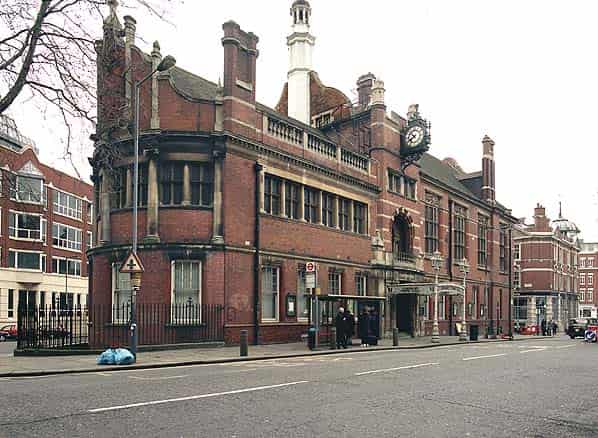
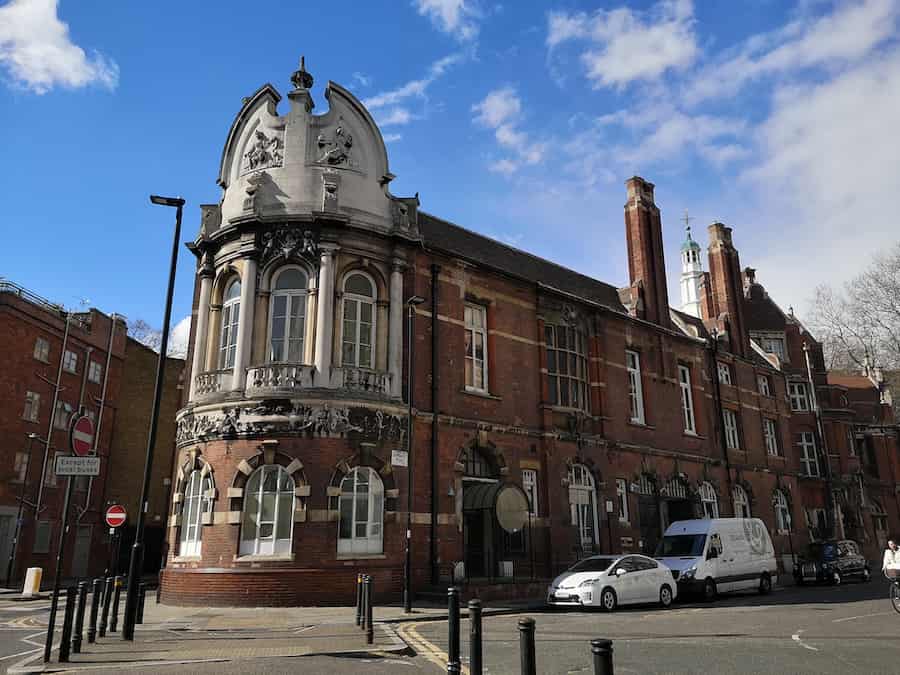
Finsbury Town Hall was built in 1895 to serve the Metropolitan Borough of Finsbury which was established in 1888. It is located in Rosebery Avenue, London, EC1 at its junction with Garnault Place.
In 1939-1940 a temporary civil defence reporting centre was set up in the basement of the town hall while a permanent two level control centre was excavated by ‘cut and cover’ beneath Garnault Place. There had been some objections from the Ministry of Home Security about the cost of the new control to a small borough like Finsbury but with several key targets in the area, notably the Metropolitan Water Board HQ on the opposite side of Rosebery Avenue, the construction was authorised.
Finsbury Borough Control was opened in late 1940 and was considered to be one of the best reporting centres in the London County Council area.
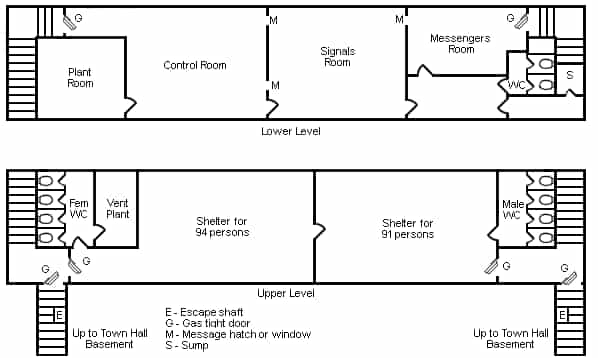
The two level bunker was accessed down steps from the basement of the town hall. The upper floor was designed as a two room air raid shelter for town hall staff (one room for 94 persons and the other for 91) with the control centre located on the lower floor. External walls were 6' 6" thick
The borough control was closed after the war and used for storage but with the threat of nuclear attack in the early 1950’s it was reactivated in 1952. In about 1959 it was designated a sub area control to the area control housed in Islington Town Hall’s old WW2 control centre.
In 1965 the Metropolitan Borough of Finsbury was amalgamated with the Metropolitan Borough of Islington to form the new London Borough of Islington. At this time the area and sub-area scheme was abandoned. The new borough control was established at Islington Town Hall while the Finsbury control was downgraded to a sector post located in the lower level with the upper level being used as a civil defence training centre. With the disbanding of the Civil Defence Corps in 1968 the sector post and training centre were shutdown and the bunker placed in care and maintenance.
In 1972 plans, the town hall was designated as a sector control, but this probably just involved use of the main building. At this time, plans were only on paper and were not put into practice. During the 1980’s the London Borough of Islington was politically to the far left and only used one room of its large two storey control centre in the town hall.
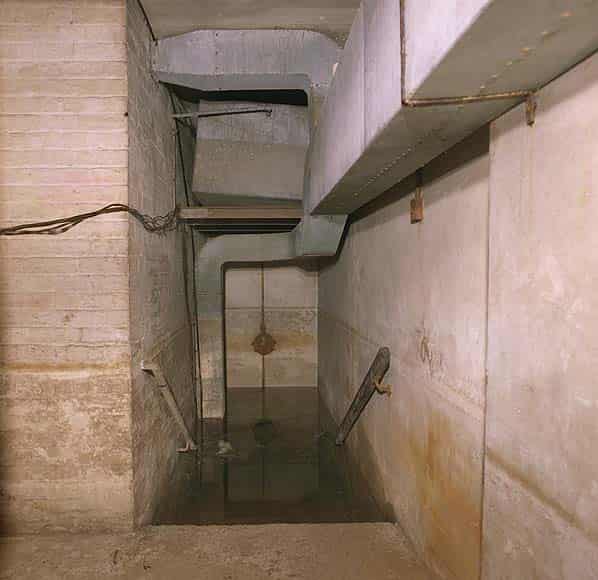
Finsbury’s bunker remained in use as a store but in recent years the lower floor has been completely flooded. The water level has fluctuated and at times also flooded the upper level up to a depth of about one foot.
In the 1990 London Fire & Civil Defence Authority borough war plan the bunker was not considered of any use and the local housing office at rear of Finsbury Town Hall was designated as an Area Support Centre (successor to sector controls). All of Islington’s area support centres were located in local housing and neighbourhood offices.
In late 2002, Islington Council proposed selling the Grade II listed building to Berkeley Homes, for conversion into luxury private flats. There were numerous objections and the sale fell through but in 2004 the council were in negotiations with the Urdang Dance Company and it now seems likely that the town hall will soon be in private ownership.
It is unclear what will happen to the bunker. It was pumped dry in March 2004 for a visit by members of Subterranea Britannica but within days it was filling up again and unless the reason for the water ingress can be easily found and remedied the bunker will be allowed to flood making both levels unusable. It will then be up to the new owner to find the reason for the water ingress.
SITE DESCRIBED
The bunker is entered from the basement of the town hall where two flights of stairs give access to either end of the upper level. Although the bunker is beneath Garnault Place rather than beneath the town hall building itself, the upper level could be described as a sub basement to the town hall and the lower level a sub-sub basement; it is unusually deep for a borough control.
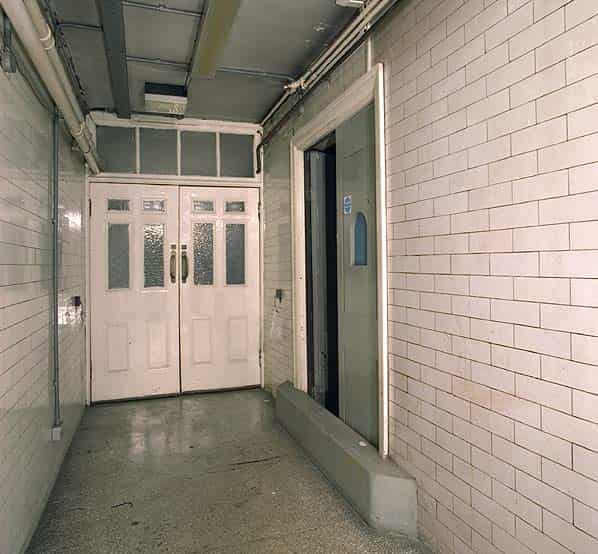
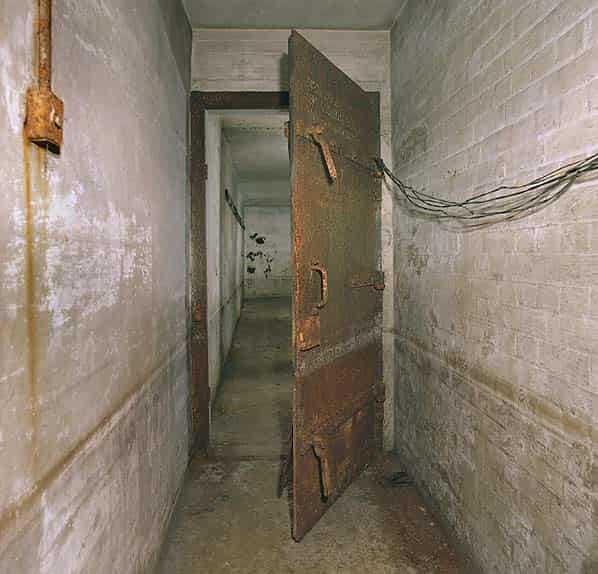
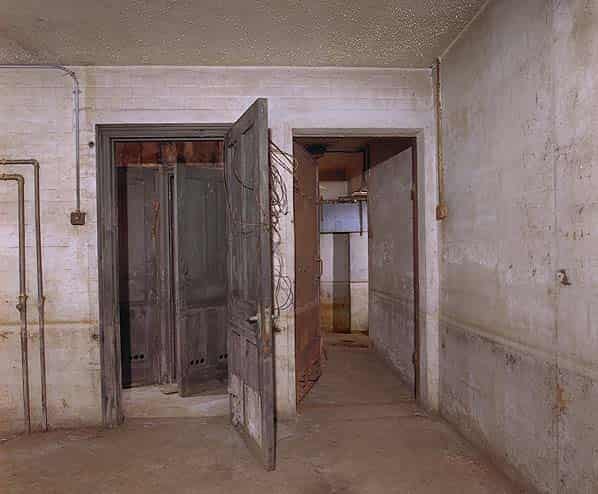
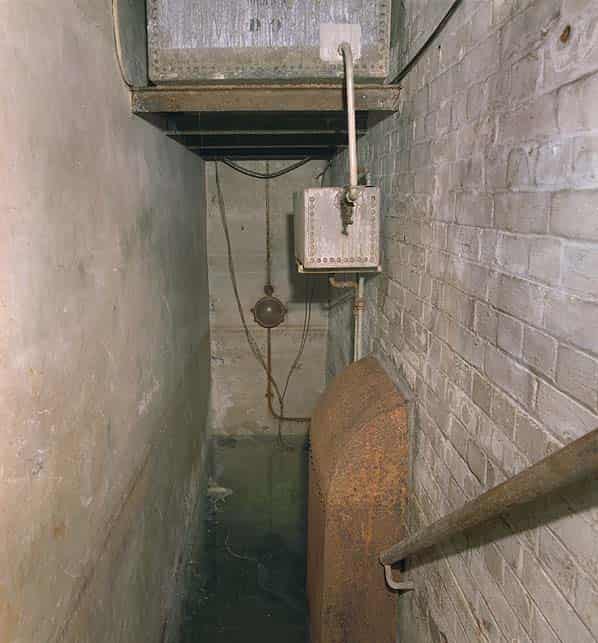
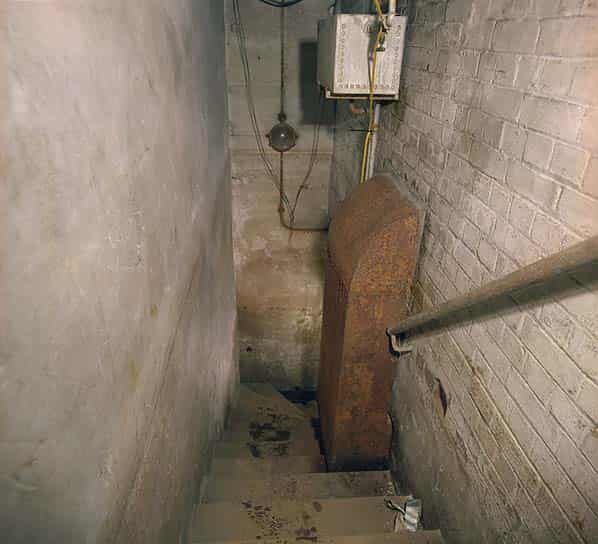
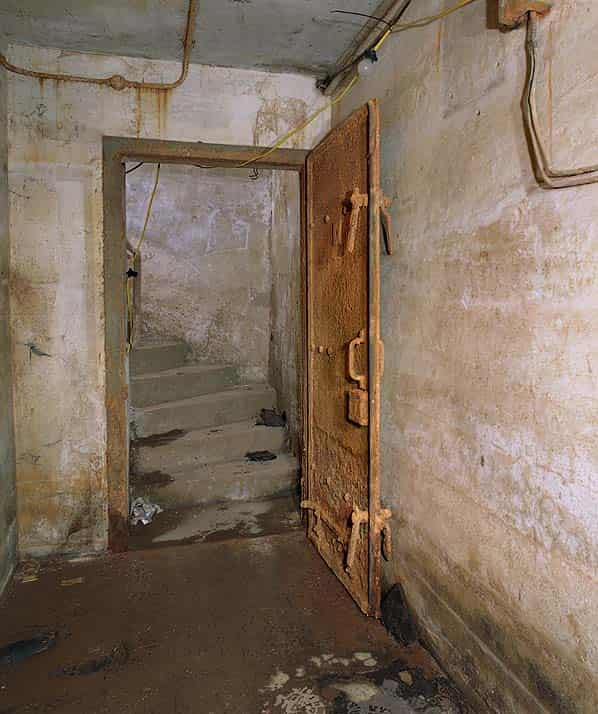
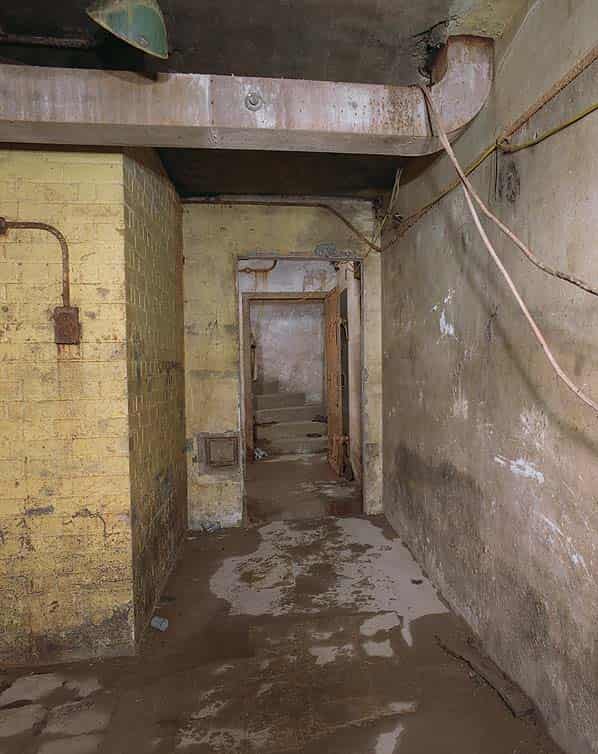
We entered at the northern end through a set of double wooden doors. In front of the doors there is a low concrete wall that has to be stepped over, presumably to stop flood water from entering the town hall basement. Ventilation trunking was originally fixed to the left hand wall but this has now been removed. Half way down the steps to the upper level is one of two emergency escape shafts. It consists of a square shaft with step irons in the wall up to a locked manhole cover. The top of the shaft was located in the pavement above in Garnault Place but the manhole cover was different to that seen below so it is assumed that there is a later cover over the original hatch. At the bottom of the steps is a steel plate gas tight door opening into a small lobby area from where a second stairway goes down to the lower level and to the right another gas door gives access to the upper floor which was originally designated as a shelter for town hall personnel during WW2 and was used as a civil defence training centre post war.
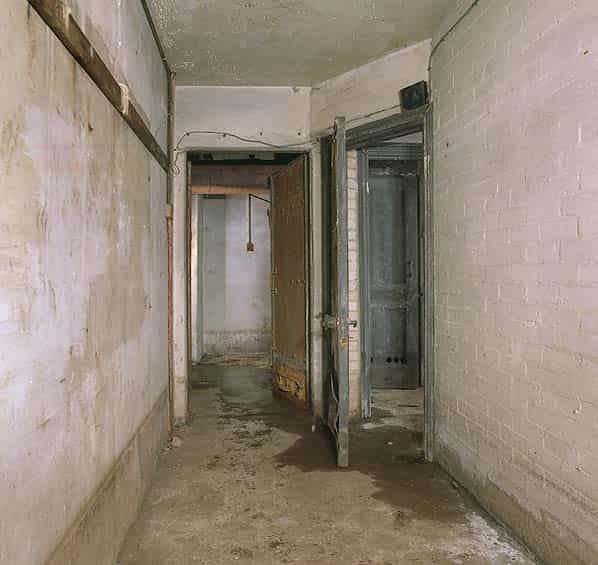
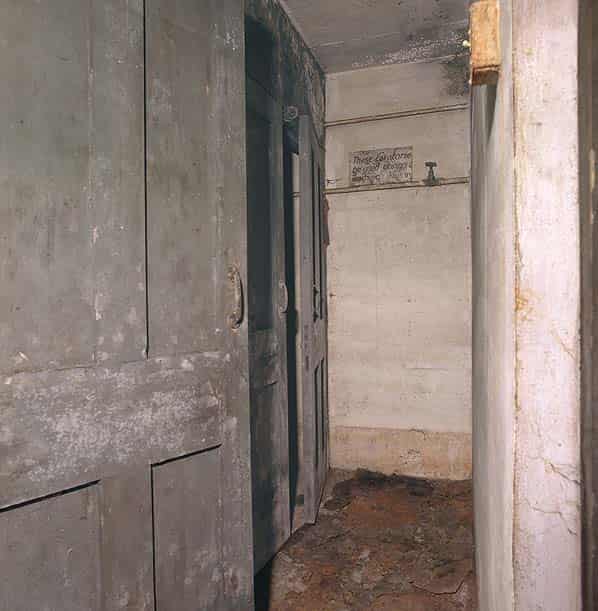
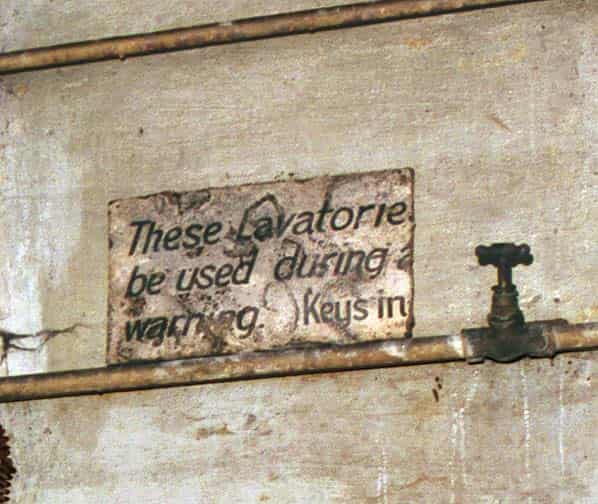
Passing through the gas door, there is a short corridor opening at the far end into a long wide room. On the left hand side of the corridor a wooden door gives access to the ladies toilets and another room. The four toilet cubicles have been stripped of any original fittings and one of the cubicles must have been taken out of use at some point as it now contains ventilation trunking which comes up through the floor from the plant room below. On the wall of the wash room there is a broken notice which reads ‘These lavatories …be used during…warning. Keys in… Unfortunately part of the sign is missing. Opposite the cubicles there is a small room which, on the original plan, is shown as a ventilation plant room although there is no evidence of this now.
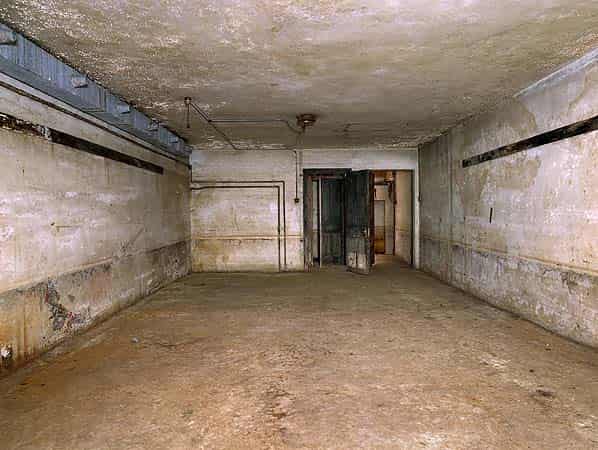
Moving back into the large room at the end of the short corridor. This is now completely empty apart from ventilation trunking running along one wall just below the ceiling. There is a wooden door at the far side leading into a similar room. There is a tide mark on the wall indicating that at some point this room has been partially flooded. It is interesting to note that the tide mark slopes from one end of the room to the other indicating that the bunker isn’t level. The second room is also stripped of any original fittings apart from ventilation trunking. On the far end wall there are two doors next to each other.
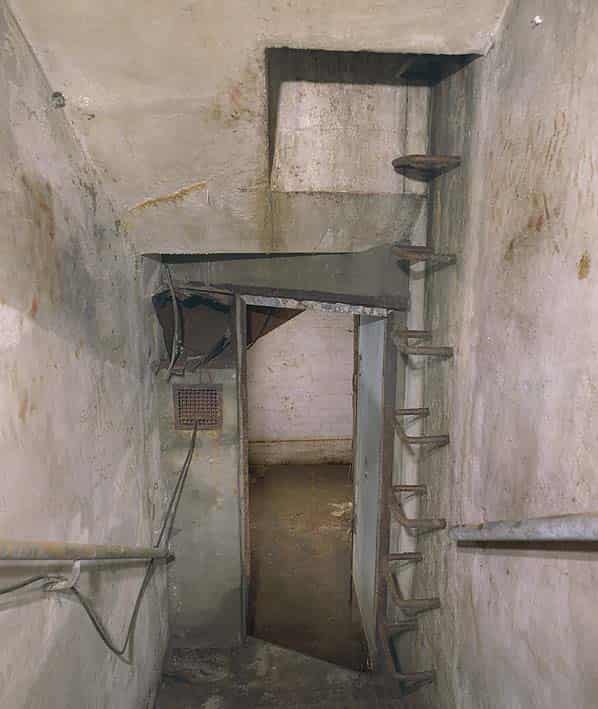
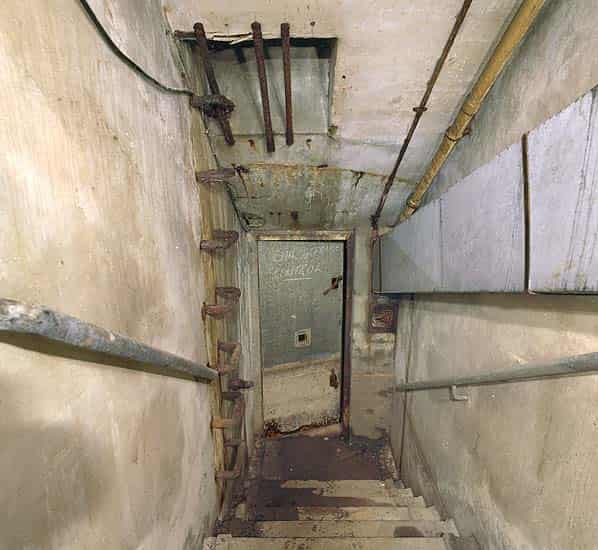
The left hand wooden door leads to the male toilets with two cubicles and the right hand steel gas door leads to another small lobby with stairs down to the lower level and through another gas door there stairs up to the town hall basement. On the outside of this door the words ‘Civil Defence Control’ are scrawled in chalk. Half way up the stairs is a second emergency escape shaft up to Garnault Place. The shaft has bars across the bottom of it and the top of the shaft has been capped with concrete.
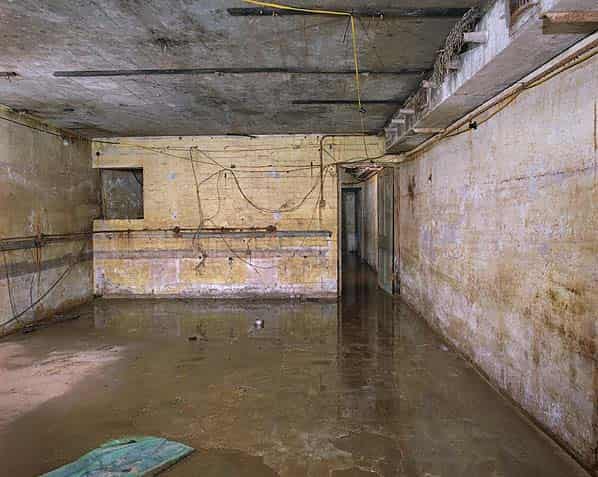
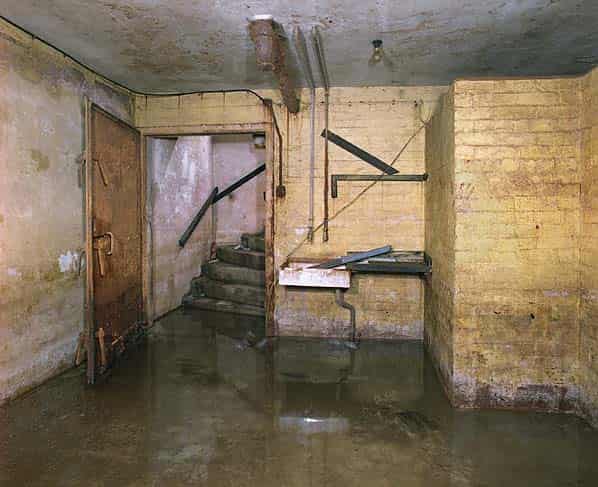
At the time of our first visit on 14th January the lower floor was completely flooded and inaccessible. The water level came to within two steps of the top of the northern stairway while it came to the very top of the southern stairway a difference of approximately 18" indicating a considerable tilt in the bunker. The water level fluctuates rapidly and a few days after our visit the water had started flowing into the upper rooms. The lower level was pumped dry seven weeks later to allow an inspection of the lower level on 5th March.
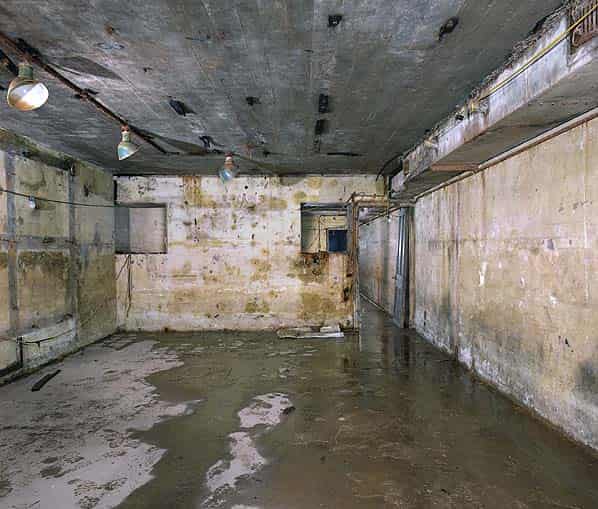
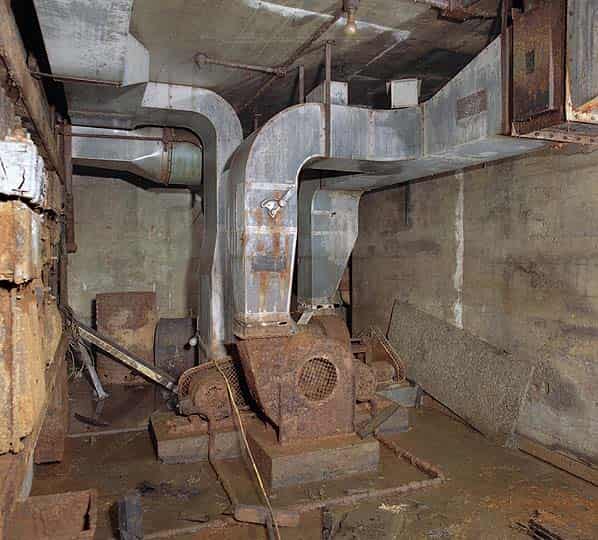
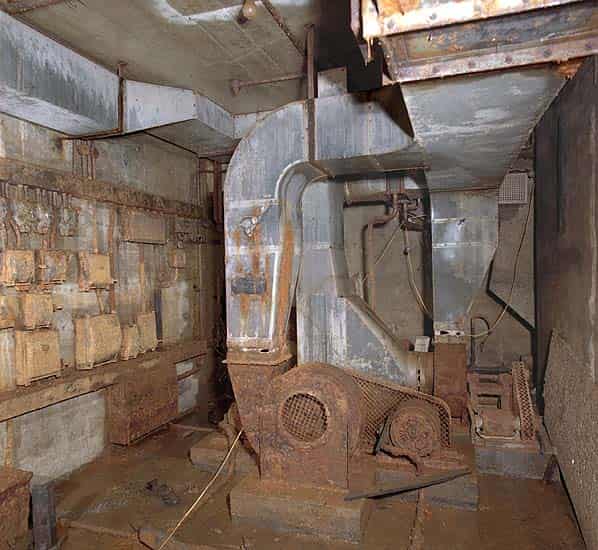
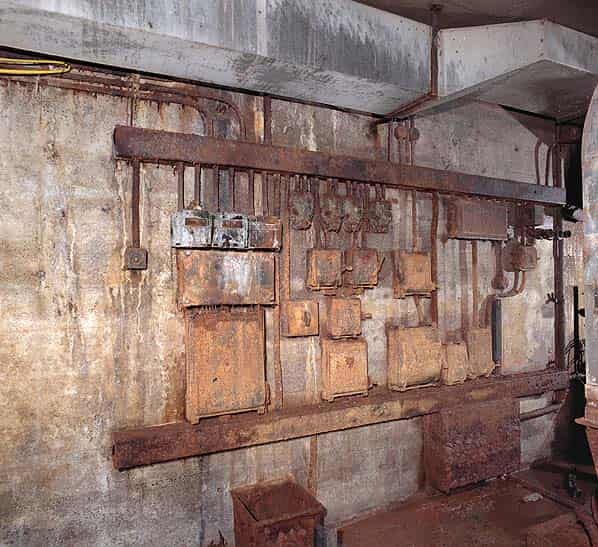
At the bottom of the northern stairway there is another gas tight door into the control room. As with the rooms above this has been stripped of any original fittings apart from ventilation trunking and a number of ceiling lights with angled shades which would have illuminated wall maps. At the northern end of the room a wooden door leads into the plant room. The door has acoustic padding on the inside to deaden the noise of the generator and ventilation plant. The generator has been removed but the ventilation fan and trunking is still in place in the middle of the room and there is electrical switchgear mounted on one wall.
At the far side of the control room a door leads into the signals room. There are also two large square openings in the wall between the two rooms. These could have been either windows or message hatches. There is no evidence of any wooden framework so it is unclear exactly what was here; they may just have been as they appear today.
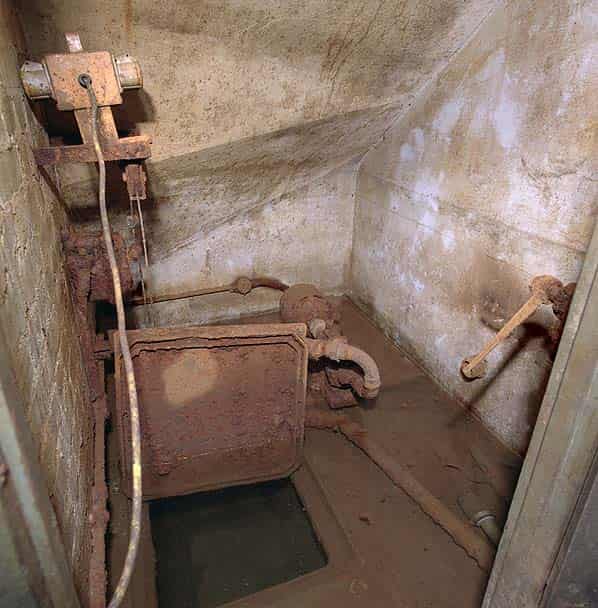
The signals room is slightly smaller than the control room and again is stripped of any original fittings apart from a wooden batten and table height fixed to two walls. This would have been the rear mounting for the acoustic booths. On the far side of the signals room there is a short corridor with a door on the left into a messengers’ room and doors into two small rooms. One was a toilet cubicle and the other has a flooded sump and a rusty pump mounted on the floor indicating that there has been a long term problem with water ingress. In the original plan this is shown as another toilet cubicle.
There is another message hatch between the signals room and the messengers' room. On the far side of the room there is a shallow butler sink and another steel plate gas door out to the southern stairway.
NOTE: A few London boroughs took an independent line on defence against air attack. Finsbury for instance was one of the most progressive, taking air raid precautions very seriously. It collaborated with the progressive architectural practice Tecton and produced a number of highly ambitious schemes that culminated in a textbook that attracted such interest and acclaim in 1939 that it was also published in the USA two years later.
The shelter design chosen was a circular underground affair designed as a spiral with a very shallow slope, approached from street level by ramps. Fully air-conditioned and provided with air locks, the idea was that these structures could be used as shelters for the duration of the war (for between 7,600 and 12,600 people according to size) and then as car parks when the hostilities were over. The street plan in Tecton’s book Planned A.R.P. shows that locations were chosen for 14 of these ambitious underground shelters but nothing concrete came of it.
Sources:
- Keith Ward
- Bob Jenner
- Andy Emmerson
- Roy Smith