Catterick was a 1st World War Royal Flying Corps airfield and was one of earliest military airfields in the world opening in 1914. Its role was to train pilots and assist in the defence of North East England. On formation of the Royal Air Force on 1st April 1918 it became RAF Catterick becoming 49 Training Depot Station.
In 1927 it came under Army Co-operation Command supplying any requirements the army had for air support, retaining this role until July 1939.
In 1935 it was largely rebuilt under the expansion programme with many of the 1920’s buildings being cleared away (the original watch office still stands). Most of the buildings standing today date from this period.
In September 39 Catterick became a Fighter Sector Station within 13 Group Fighter Command using the 1935 Sector Ops. Block. This was replaced in 1943 with a protected operations block identical to those built at other Fighter Sector Airfields.
Shortly after the new SOC was commissioned RAF Catterick was downgraded as it was no longer considered an important fighter base and during March 44 the last fighter unit to use the airfield departed and Catterick was relegated to a second line airfield. RAF Catterick had a decoy airfield at Low Moor located at grid ref SE393984 or Lat / Long N5422-W00123.
At end of war in 1945 the station became an air crew allocation centre and in 1946 the Band of the RAF Regiment and the RAF Regiment depot moved from Belton Park, Grantham to Catterick and from that time the station functioned as a training establishment where all ranks gained their professional skills.
The single runway at Catterick proved inadequate for the jet age as it couldn’t be extended because of a railway at one end and a river at the other so it was destined to house non-flying units such as The Band of the RAF Regiment, Fire and Rescue School etc. The runway was only used by light communications aircraft and gliders.
The RAF Regiment Depot moved to RAF Honington in May 1994 and the RAF Ensign lowered on 1st July 1994. After the departure of the RAF the base became part of the army’s Catterick Garrison and was renamed Marne Barracks. In 1994 the 8 Transport Regiment, Royal Logistics Corps moved to the site from Munster in Germany to take up its new role in support of the 3 Multi-Launch Rocket System (MLRS) equipped Royal Artillery regiments of 1 (UK) Artillery Brigade. Since 1999 the Regiment is now part of 102 Logistic Brigade providing a 3rd Line transport capability. The Strategic Defence Review will bring more changes with the formation of 2 new squadrons within the Regiment, 29 Transport Squadron and 64 Fuel Sp Squadron.
The runways are still used by the RAF at weekends when No 645 Volunteer Gliding School fly their Viking T1 gliders from there. This last RAF connection will however shortly be severed when the 645 VGS moves to Allanbrook Barracks which itself was formerly RAF Topcliffe. Numerous buildings are under threat of demolition with the proposed expansion of the Army base including the demolition of the 1935 watch office (control tower).
SITE VISIT
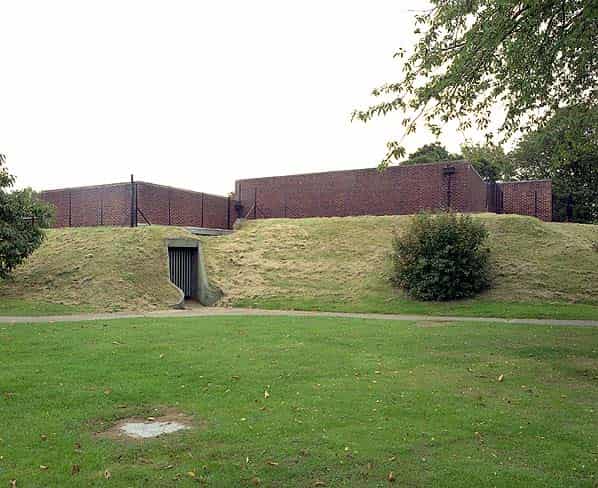
The Sector Operations Centre is centrally located close to the parade ground. It consists of a rectangular brick building surrounded by a grassed earth mound for blast protection. There is diagonal access through the mound into the bunker on two sides.
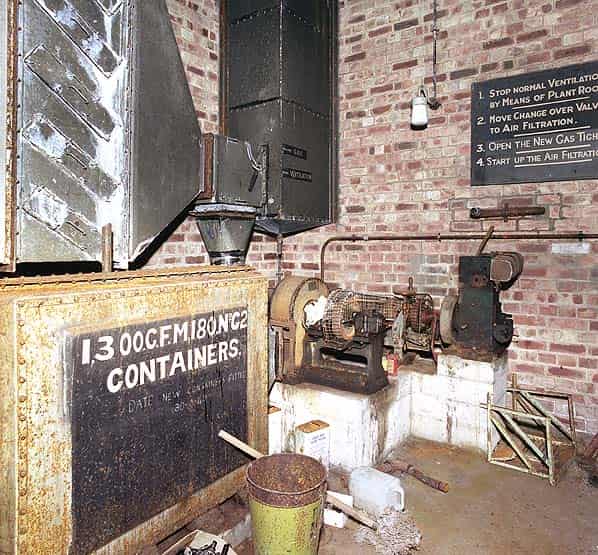
The bunker is roughly ‘L’ shaped with the back entrance consisting of an airlock formed from two gas tight doors. To the left, between the two air lock doors is the ventilation and filtration plant and switchgear room. The room is currently unlit and out of use. All the 1943 plant is still in place including the fan, filters and ventilation trunking which runs into all rooms in the bunker. There are several original notices on the walls one of which reads ‘1 Stop normal ventilation plant by means of plant room starter. 2 Move changeover valve lever to air filtration. 3 Open the gas tight damper. 4 Start up the air filtration plant.’
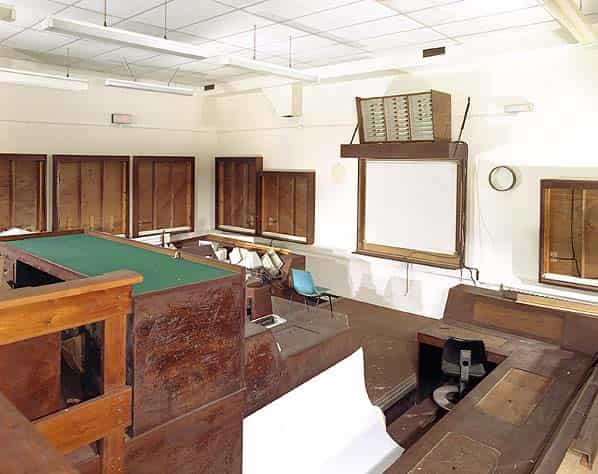
Beyond the second air lock door there is a short corridor with two rooms on the left, the first is a male toilet the second is the battery room. Beyond these two rooms the corridor enters the two-level operations room which has been altered for a new unknown roll, probably in the 1950’s. Originally there was a wide upper level ‘balcony’ looking down into the sunken well, accessed by wooden stairs at either end of the balcony. At the back of the balcony there were four offices.
The balcony has now been divided with a frosted glass panel wall leaving two narrow corridors. One still gives access to the four offices behind (one of these has teleprinter room on the door). In the middle of the new narrow balcony there is an extension outwards into the well with a long table.
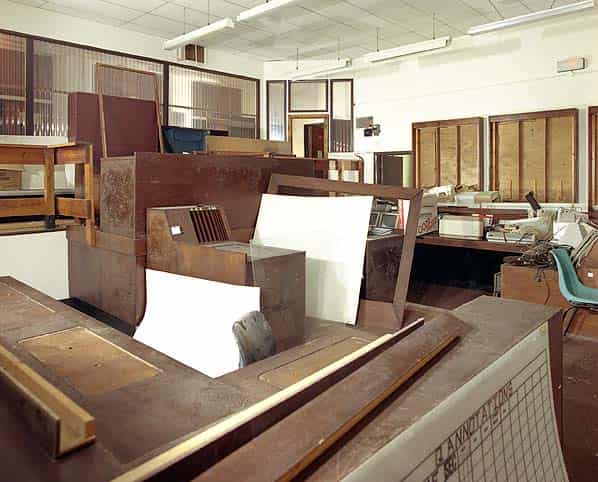
In the well there are two L shaped wooden console benches and around the walls ten back-lit Perspex situation board frames. Two of the Perspex panels are still in place. One has the headings ‘Dependants/Quarters’, ‘Barrack Blocks’ and ‘Messes’, the other is headed ‘Q Annotations’.
On the wall near the entrance to the Ops. Room there appears to have been a carrier control point. The WB1400 has been removed although its position is clearly defined. Alongside there is a box labeled ‘Siren Alarm System’ According to a paper notice the siren was controlled from Northallerton Police HQ.
On the far side of the balcony a corridor leads to the main entrance. There are 7 rooms on the right including the female toilet and kitchen. The old GPO room was locked and not accessible. This now houses a UNICOM, the army’s data system established in 1994.
It is unclear what role the SOC played post-war although judging by the alterations and furniture it acted as some kind of control centre. RSG1 was located at Catterick Gaza Barracks two miles away at Catterick Camp and RAF Catterick is believed to have acted as a support site for RSG1 from c1958 to c1963.
Apart from the UNICOM the SOC is now completely disused and strewn with rubbish. Most rooms are lit and apart from a little damp on one wall of the well the building is in good internal and external condition. It is unclear whether the expansion of the army base will affect the old SOC.
Those taking part in the visit were Nick Catford, Keith Ward, Jason Blackiston, Robin Ware and Robin Cherry.
Sources:
- Bob Jenner
- Keith Ward